


 |
|
 |
|





Filmed by Nicole Weed | Edited by Ardit Hushi
Today we're taking a bit of a side quest into the world of Canadian pipe shapes, diving into what defines this family.
The Billiard as a Starting Point
[Steve Mawby]: All of these are basically variations on the Billiard shape, just with different proportions. The Billiard famously has a bowl height equal to the length of the shank. There's a lot of intricate detail that goes into something as seemingly simple as categorizing a Billiard.
[Andy Wike]: It's a very canonical shape — in the pipe charts and elsewhere, it's a shape that's been around for as long as we've been making pipes out of briar, probably earlier than that.
[SM]: Arguably it's the canonical shape. When you think of classic shapes, it's about as classic as it gets. From there, you've got variations on that theme, and the first one we're talking about is the Canadian, where you extend the length of the shank and make it oval instead of round — you can see that flattened look in the profile. Extended, oval shank flowing into a tapered stem: that's what you have in a Canadian pipe.
The Canadian
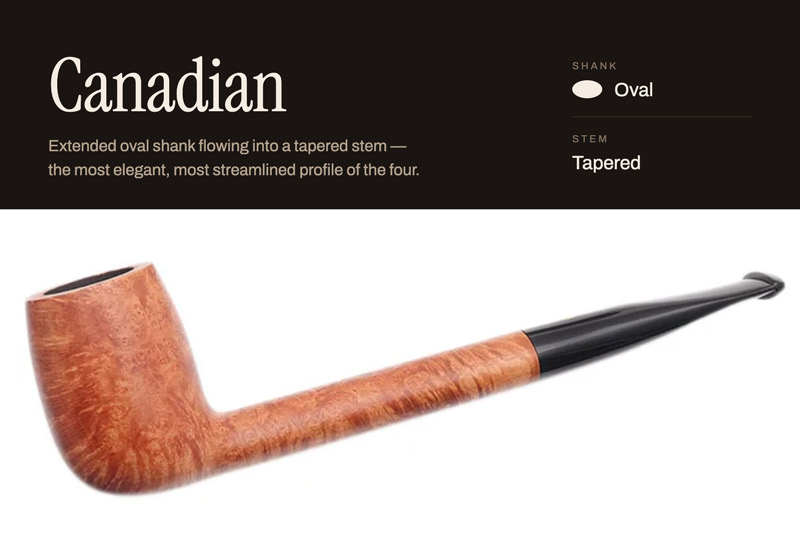
[AW]: That's right. If you've been on the forums or following the nerdier side of pipe collecting, there are a lot of rules around this. At one point, a pipe was only a Canadian if the shank was, say, twice the bowl height, with a very specific stem length as well. For us, we're really looking for a more elongated shank paired with a specific type of stem.
[SM]: And like you said, there were once very specific rules, but pipe making as a craft evolves. People want to play with those proportions and do variations on the basic theme.
[AW]: The rise of artisanal pipe making definitely turned those old rules on their head. But as a shape class, all four of today's shapes still exist, and I classify them with the Canadian as the family name, since I see the others as variations on it. The Canadian and the Lovat are probably the shapes you'll find most often in this family. I love Canadian shapes.
The Lumberman
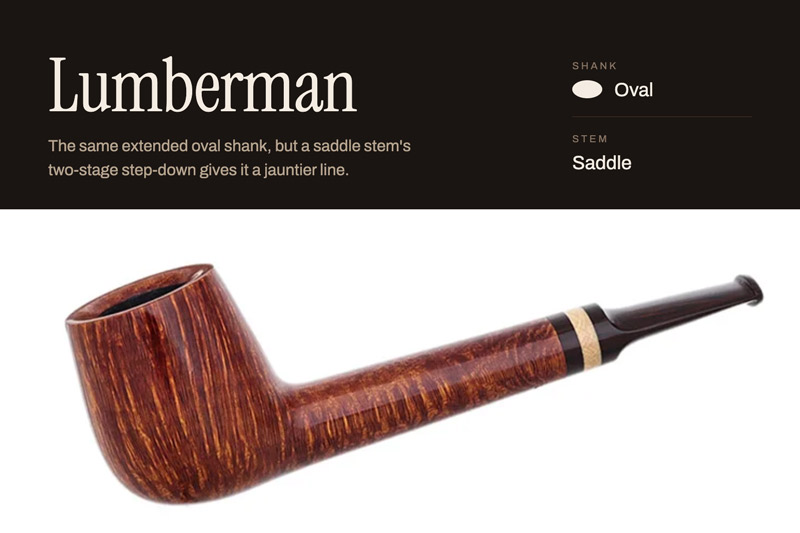
Next up on the list, we have the Lumberman.
[SM]: Yes. Like the Canadian, it has the extended, oval shank — that same flattened profile. But it has a saddle stem instead, with a flat section at the start and a steep drop into the rest of the stem toward the mouthpiece. It's another variation on the theme, and a good example of how you can take something as classic and seemingly simple as a Billiard — though any pipe maker will tell you it's nowhere near as simple as people think — and just adjust a few proportions or design elements to get a very different look and feel. Described on paper, it sounds almost identical to the Canadian, but the aesthetic ends up quite different, while still being classic and simple.
[AW]: I particularly like these two because, in profile, they're so slender and streamlined. The Canadian, with its tapered bit, has this very elegant look.
[SM]: Elegant is the perfect word for it. Whereas the Lumberman, because of that saddle stem's step-down, is a bit jauntier.
The Lovat
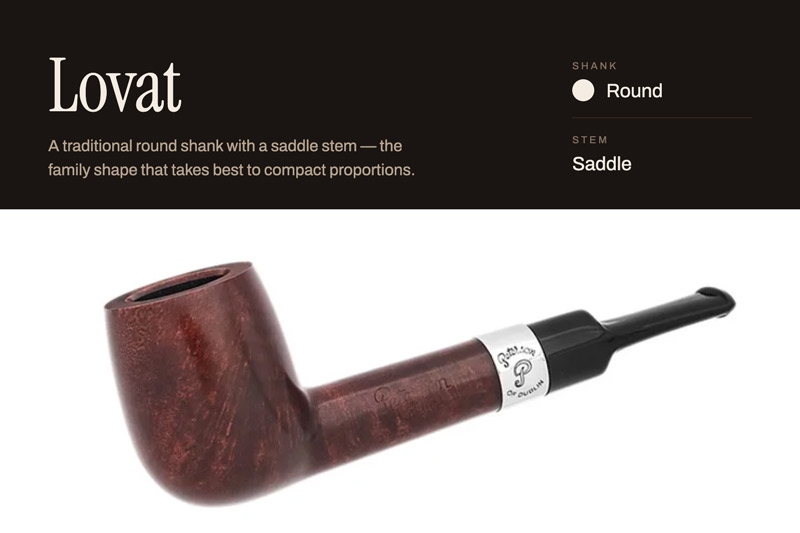
[AW]: Moving on — probably the other most popular Canadian family shape is the Lovat.
[SM]: My personal favorite shape, outside of the Bulldog, and definitely my favorite in the Canadian family. It's the same basic Billiard profile with a slight elongation, but with a more traditional round shank. Like the Lumberman, it has a saddle stem, with that same two-stage drop in the profile. Otherwise, it's still that same basic variation on the theme.
[AW]: I think the Lovat is the one I've seen the most people play with proportion-wise. It's hard to find a short Canadian, but Lovats work really well in more compact proportions. When I go looking for Lovats myself, I tend toward something more compact.
[SM]: Same here.
[AW]: But Chuck Stanion's favorite shape of all time is the Lovat, and he'd never go for a short throw. He likes the longer ones, with a taller bowl. It's interesting seeing how much that varies even among collectors who would all describe themselves as "Lovat people." Castello Lovats look completely different from Dunhill Lovats, and that's part of how the shape evolves.
[SM]: Same as with the Billiard — you've got the classic English and French Billiards, and then the Danish take, and the Italian school. They're all still Billiards, still following the same basic design cues, but you get very different pipes. Simple variations, consistent with the theme, but a different maker gives you a very different profile. That variety is part of what makes this family so versatile while staying classic and elegant.
[AW]: Exactly. You can find one that fits your own taste, whether you like tapered bits or saddle bits, short pipes or long ones. It's very versatile.
The Liverpool
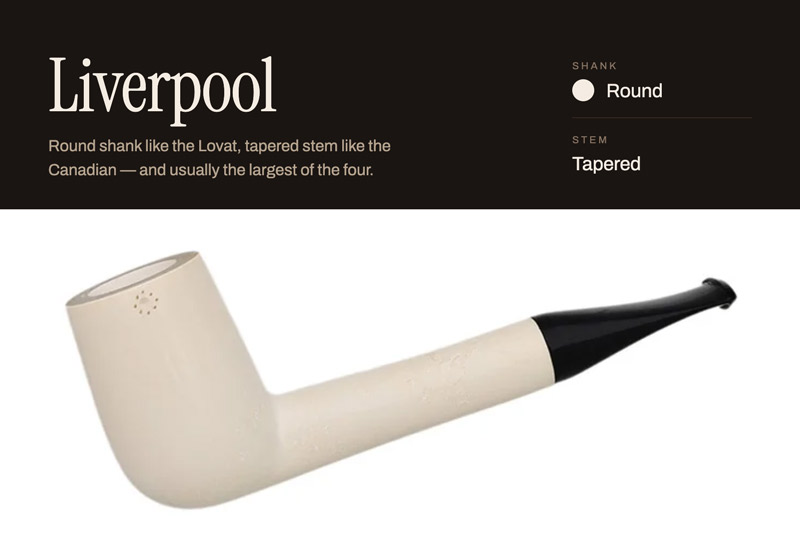
[AW]: The last pipe we have today is actually a meerschaum, and it's probably the lesser-known of these Canadian family shapes: the Liverpool. It's very similar to the Lovat, but often in larger proportions, and instead of a saddle stem, it has a tapered stem. I don't have many Liverpools in my own collection, but it's a cool shape, and I've seen a lot of variations on it. This meerschaum has more of a stack-like bowl.
[SM]: It is larger than any of the others, both proportionally and in real size. It's interesting. You've got the round shank like the Lovat, and the tapered stem like the Canadian, all mixed and matched into a new shape.
[AW]: Really, it just comes down to two variables: the treatment of the shank and the treatment of the stem, giving you four permutations across this family.
[SM]: Absolutely. These four are the basic templates for the Canadian family, which can really be described as varieties of the Billiard. There are other Billiard variations too, like the Chimney or the Stack, where the bowl proportions stretch out even further, breaking the "strict Billiard" rules by being a bit taller — just more elements you can always play with.
[AW]: Tweaking one thing can create an endless sea of possibilities.
[SM]: Absolutely. I'm smoking my Adam Davidson Lorraine, which is another variation — a basic Billiard, but with his signature accent and flair on the stem. Taking something classic and putting a personal twist on it, making it unique.
[AW]: And for those wondering, I'm smoking a really nice Canadian by Emiliano. I love this pipe.
[SM]: Very nice pipe.
Canadian Family Shapes
[AW]: We just wanted to cover these four Canadian family shapes today. Hopefully it gives you something to latch onto if you have a pipe in your collection you love but aren't quite sure what to call, and want to find something similar. That was really helpful for me when I was first getting into this hobby. Take a look at your own collection and see if you can spot some of these shapes in your rotation.
Let us know in the comments if you'd like us to explore more of these pipe-shape classifications.
You may also enjoy:



Comments
Nice job Andy and Steve.
A piece on bulldogs with bead grooves and Rhodesians
with bead grooves would be of interest.