


 |
|
 |
|


Briar vs. Meerschaum vs. Corn Cob Pipes: What Makes Them Different?


Today we are here to discuss a topic that a lot of people have asked about in the comments section: should I get a briar, Meerschaum, or a corn cob pipe? Let's dive into these pipe materials and what makes them subtly different. Keep in mind that all of them are great options and none are "better" than the others; it all depends on your personal preferences for aesthetics and functionality.
Note: The following transcription has been edited for clarity and brevity.
[Chris Herath]: I'm somebody who responds to a lot of the YouTube comments on our Smokingpipes channel, and one of the questions asked, whether people are just getting into the pipe-smoking hobby, or they've been at it for a little bit of time and they're starting to expand their pipe collection, is whether they should get into briar, Meerschaum, or corn-cob pipes. I wanted to bring Andy on today to just discuss these three different types of pipe materials and what role each fulfills in our personal collections.
Briar Pipes
One of the most common pipe materials people will see when they go to Smokingpipes' website is the briar pipe.
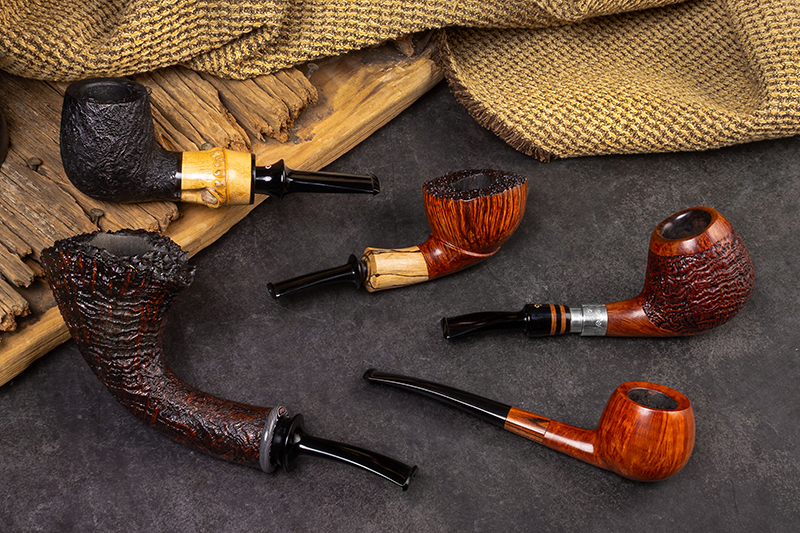
[Andy Wike]: When we think about pipe making in a modern context, primarily what we're talking about is briar. Briar comes from the heath tree. It is the root, or burl, that grows underneath the ground. Of course, there's a whole micro business around harvesting, curing, and cutting these burls of briar before they can ever make it into a pipe factory or workshop.
This material really became common in the 1800s, mainly due to briar as a wood being heat-resistant and hard, but not so hard that you can't ship it. It's fairly easy to work with. If you've watched any pipe-making videos, those guys make it look easy. Of course, it's not; you have to apply a great deal of pressure. It is work, but you have a lot more variability with what the shape could be. Then you also have things like the natural grain patterns. I'm smoking a sandblasted pipe from Abe Herbaugh and it's a really cool shape. Then you also have these micro textures all across the pipe. That's the ring grain coming through after sandblasting, getting rid of some of the softer material on the briar's face, so you get a really nice texture.
I like sandblasted finishes. I think that they have a tactile quality that's really nice. You also have rusticated, which is a carved technique, just depending on the maker. There's lots of different tools that people use to produce that finish and it can come in many different shapes and forms. And you have the smooth pipes, which are really nice because you get an expression of the natural wood's grain, sometimes with stunning birdseye on the fore there, with really nice cross grain just going down either side.
[CH]: I would say, not that the next two we're gonna get into don't have their own type of artistic expression, but the briar pipe can feel special. It can be an heirloom item that you could actually pass along to somebody. We have pipes on-site that are briar pipes that are over a hundred years old. Not only does it take an artistic standpoint, but it's also probably one that you're gonna keep in your collection forever.
[AW]: Oh, yeah. You and I have been in the Peterson factory and seen Charles Peterson's personal pipe. It's a little rough around the edges, but it's still functional and it's a really nice pipe. When it comes to briar pipes, they should be viewed as permanent installments in your smoking rotation.
[CH]: It's functional art. Especially with artisan carvers, everybody has their own take on it, whether that's the smooth finish showing off all the crazy grain, all the way to individual carvers having their own personal style of rustication or sandblasting.
What Makes Briar Unique
Can you talk to us a little bit about any advantages it might have when it comes to breaking it in? Is there anything we should be aware of if you're just getting your first briar pipe?
[AW]: Yeah. It is wood, so it will burn. It's important to just be mindful as you're lighting the pipe. You obviously don't want to use a torch flame or any hard flame lighter or anything like that when you're applying a charring light.
A lot of people tend to pack their bowls not all the way full when breaking in their pipes, and the thinking behind that is to start building that cake. You don't smoke all the way to the bottom and get that initial first couple bowls of carbonizing in the chamber.
I don't do that. I don't know of many people who I work with closely who do that. I think that there's something charming about the natural flavor from the briar as it builds that carbonization. I've never personally thought, oh man, I'm really trying to get through this break-in period because I think that you will get some of that characteristic of the wood as you're first enjoying a couple of smokes. Of course there's things like bowl coating that can help expedite the break-in process.
[CH]: We won't get into that, but I know when I first started getting into briar pipes, I wanted to know everything that I would possibly need to know about it. Of course I reached out to Shane and I was like, hey man, I got this new pipe. Is there anything I should know? And he's like nope, just smoke it. So I think that's a good thing for all of us to live by.
Another question we get a lot about briar pipes is on the issue of ghosting. What ghosting means is the residual flavor from a previous blend you smoked lingering in the pipe. English blends are often thought of regarding ghosting, so a lot of people have a briar pipe specifically for Englishes, and a separate one for Virginias.
Is this something briar smokers have to worry about?
[AW]: I think it really depends on your preference. The traditional guidance is that if you smoke a variety of different types of pipe tobaccos, you might want separate pipes for each of those tobacco families. If you smoke an Aromatic blend that's heavily topped or something in a briar pipe, your next couple of smokes will probably be affected by that smoke. You'll probably get some of the lingering aroma or flavor from the Aromatic, just due to the carbonization on the inside of the chamber.
I don't really worry about it. I might be unique in this, but I find it, again, charming when I can experience a little bit of the last bowl in the next one. It does change the experience. Now, if I want a true expression of this blend without any biases, I'm gonna reach for a pipe that I know doesn't have a ghost. I tend to not reach for those pipes when I want a true expression of the blend, but for everyday smoking, I just pick what pipe calls to me.
[CH]: The only reason I worry about ghosting is because it gives me another excuse to buy a new pipe.
[AW]: That's a good reason.
[CH]: My first three pipes I ever purchased were briar pipes. It wasn't out of needing more of a rotation. It wasn't anything with ghosting, it was just more that the pipes were attracting me from a visual standpoint. I was experimenting.
Choosing a Briar Pipe
That's the great thing about briar pipes — They come in so many different shapes and sizes, bowl depth, bowl width, colors, and stem materials. I just wanted these things in my collection because I liked them. I was learning so much about the stems that I preferred, and so forth.
If you're looking to choose a briar pipe, I always tell people to just seek out something that your eye gravitates toward rather than what you may read is the best for what kind of tobacco you may or may not like.
[AW]: Especially if you're just starting out, more than likely your tastes are gonna evolve.
[CH]: Of course. Mine have in just two years.
[AW]: I started with Aromatics, then quickly moved to Virginia blends, and then I found English blends and I just smoked those for four years straight. Then I got back into Virginias. If I would've built my collection around this stuff, it wouldn't have been as timeless.
My own pipe buying is very much what you described it as — I'm looking for what speaks to me. I'm looking for a pipe that takes on some of my style that I could see fitting in my rotation. I have some heuristics that I follow: I want a certain chamber size, or I want it to be under a certain weight, or I'm looking for this specific type of stem.
But those are preferences that you develop over time and that's the beautiful thing about pipe collecting. It can be dynamic, it's ever changing, it's ever evolving, and it's okay to fall out of love, for lack of a better word, with a pipe and trade it in and get something else. You're passing that on as an opportunity for someone else to find enjoyment.
[CH]: A lot of my briar pipe selection has to do with what I'll be doing while smoking. I'll smoke a Sitter when I know I have to do something where I'll be sitting my pipe down. I've got two young children, so if I'm grabbing a pipe at home, it's probably gonna be something that I'm gonna have a very short smoke in versus if I'm sitting at my desk editing a video, that could be something where I want something I can puff on for the next couple hours. A lot of my briar pipe choice is just based on the situation and the visual aesthetic.
[AW]: I think that's fair. If I'm analyzing my own collection, briar pipes are my daily drivers. That is what I reach for the most. Everything else is a little bit more situational.
Meerschaum Pipes
[CH]: The next type of pipe material we're gonna talk about is the Meerschaum pipe. This was a pipe that I probably got into after I had four or five briar pipes. I'm somebody who's very attracted to the idea of patina in an object. I like that in leather, denim, and all the different types of weird niche hobbies that I'm into. When I saw a very well-aged Meerschaum pipe, I was like, I have to get one of these fresh and I have to do this on my own.
Tell us a little bit about Meerschaum pipes. What's the history behind these? Do you have any in your collection?
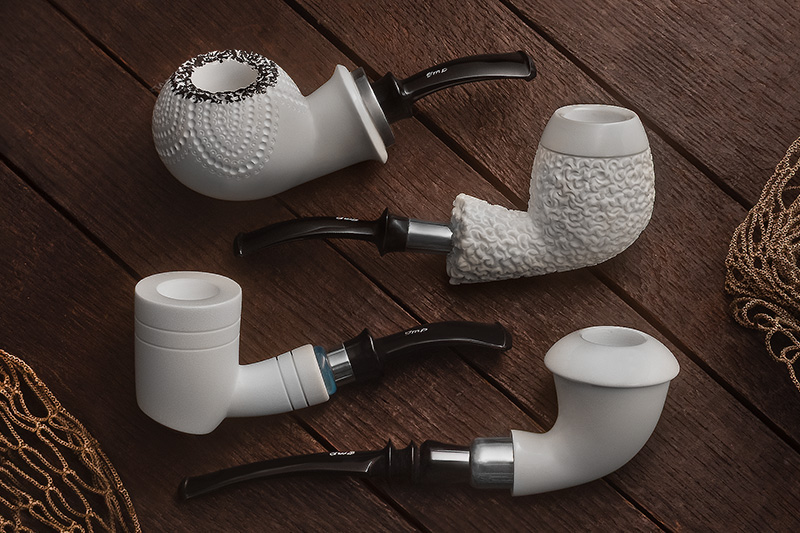
[AW]: Meerschaum is one of the older pipe-making materials. It does predate briar as a pipe-making material. If you go way back, there was actually a pretty big culture of pipe makers doing some really elaborate Meerschaum-carved pipes in Austria in the early 1800s. Eventually that wound down, and now Meerschaum pipes are produced exclusively in Turkey.
You still have a lot of really awesome artisans that are producing really interesting stuff, all the way from a classic English Billiard to the wild, freehand carvings. I've seen a lot of Meerschaums in my day and none of them have been the same, so that's really cool. The material itself is really interesting.
You have basically two different types of Meerschaum: compressed and solid-block. The compressed version isn't seen that often because it's on the more budget end, like some of the more starter pipes and things like that. A lot of Meerschaum pipes are carved by hand from solid-block meerschaum. As far as I can recall, I can't think of a Meerschaum pipe that we sell that isn't solid block.
When you mine this material and wet it, it becomes very malleable. It almost becomes like clay, so pipe makers can really add a lot of detail to it. They can shape it.
They are quite light, perhaps lighter than what you'd imagine from seeing images on-site. I think that there's a misconception because if this was clay, it would be much heavier. It does look like clay, but the material itself is actually a mineral called sepiolite. Once it's shaped and cured, everything is set. You can't really go back once it's dry.
What Makes Meerschaums Unique
It's a really interesting material for pipe making because it's extremely heat resistant. It's really difficult to burn out a Meerschaum. Don't try it at home. You typically don't have to have as much care in your lighting and cadence. It's also porous, which means that over time it will absorb some of the natural nicotine, oils, and moisture from the smoke, and that's where that coloration, or patination, comes from.
[CH]: Also, Shane, for example, uses Meerschaums a lot when tasting a new blend. A lot of that is that it produces a very cool smoke and there's not a lot of moisture buildup that you would have in a briar pipe.
[AW]: And it's flavor neutral. Unlike the break-in period for briar pipes, Meerschaum doesn't develop that layer of carbon on the inside of the bowl, so you typically do get a more flavor neutral, pure, true expression of whatever you're smoking.
[CH]: The Meerschaum pipe, for example, is one that I picked up before my first pipe show because I heard that people would have a lot of different types of tobaccos you would want to try at the show. You may be trying things back to back, with not a lot of rest periods in between smoking bowls of tobacco. You might be going from English to Virginia blends. And I was like, man, that Meerschaum just sounds like a great option for a situation like this.
Or if I'm going on a trip, I'll be taking an English blend, a Virginia blend, and maybe a Virginia/Perique blend as well. I just put the Meerschaum into the case it came with, throw it in my bag, and I know I have a very versatile pipe that's gonna handle pretty much every situation I throw at it.
[AW]: Earlier you mentioned the patina and how Meerschaum pipes can naturally color over time. One of the most interesting things is I could have that identical pipe and the coloration would be different because it doesn't just come from the smoke, it also comes from the natural oils in your hand and how you hold the pipe. Over time, you imprint on the pipe. Not only is it this heirloom that you can pass down, but it also has a unique coloring that you've helped develop.
[CH]: Yeah, absolutely. I think that's the first thing that drew me to this material. It's still probably the thing that keeps me coming back to it. I love the idea that every time I pull this outta the case, I can see what I've put into it and it really makes me excited for the future. If you really like the idea of aging along with your pipes and really putting your own stamp on something, briar pipes do this to a certain degree as well, as far as coloring and stuff, especially the lighter-stained ones, but Meerschaum is gonna be the one cool project pipe.
[AW]: If the patination and coloring is important, we do also offer coloring bowls, which are attachments to a Meerschaum pipe that can help you create a more even coloring across the pipe. We have an article about bowl coloring if you'd like to check it out. But that's something that you can add. Some of them are quite ornate and very elaborately carved because they're also from solid-block meerschaum, so you get a lot of variation there. It's a fun thing to experiment with. I reach for my Meerschaum pipes a lot of times for Aromatics, English blends, or something where I don't necessarily want to reach for one of my briar pipes or maybe they're resting or on rotation.
Corn Cob Pipes
[CH]: The last pipe material we're gonna talk about here today is one that I didn't grab initially. I started with briar, then got into Meerschaum second, but then when I was looking to go camping and I was looking for a few pipes that I wanted to take with me, I finally gave corn cob pipes a chance, and now they have stayed in my rotation. I was hesitant to try it at first, but now I don't know if my pipe-smoking rotation could exist without them.
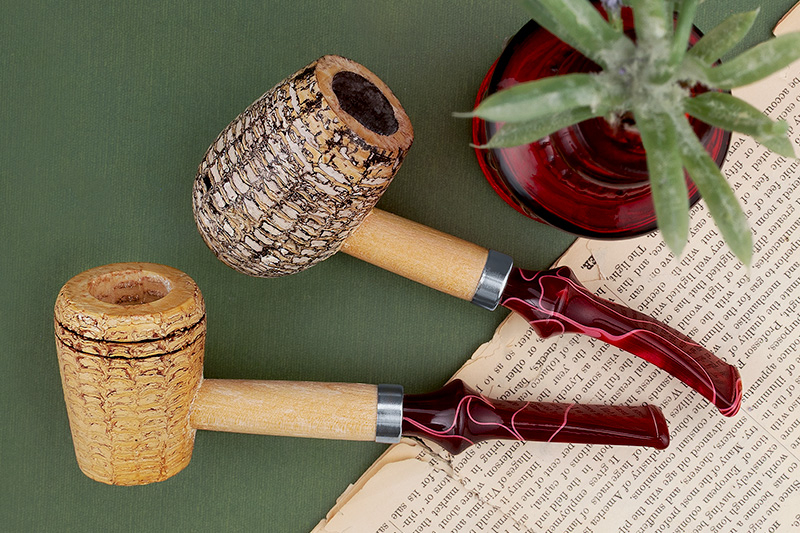
[AW]: Yeah, I think corn cobs are great, especially if you're new to the hobby and you want to start developing an actual pipe rotation and collection. This can help you get there without a serious upfront investment. These are more accessible than briar and Meerschaum pipes pricewise. They're made from actual corn cobs.
Missouri Meerschaum, long-time friends of Smokingpipes, are a solid, true American manufacturer. They have roots dating back to the 1800s. They continue to preserve the legacy of corn-cob pipes.
If we look at pipe smoking in popular culture or media, a lot of times it's the gourd Calabash that we see or it's a corn-cob pipe.
You think about people like MacArthur, and characters like Popeye and Frosty the Snowman, these are all icons that had a pipe in their mouth and that pipe was typically a corn cob.
[CH]: All characters and jokes aside — those were probably some of the reasons I didn't initially gravitate toward the corn cob — I was gifted one and took it camping with me, and immediately I really loved it.
What Makes Corn Cobs Unique
It was something that I could revisit throughout the day. It was something I wasn't afraid to try blends in for ghosting reasons. I wasn't afraid to break it and be out over $100 or $200 like I would be with a briar or a Meerschaum pipe. It's literally something I keep in my golf bag. It's something I can keep in my garage if the kids are around and I'm just doing yard work; I don't have to worry about breaking something that's expensive.
Those are some of the major advantages that I would see in having multiple corn cobs in your collection.
[AW]: Yeah, and there's so many different styles too. We have two limited-edition C&D Missouri Meerschaum collaboration pipes, Kingston Judge and Charles Towne Cobbler, and Old Dominion pipes on-site.
Old Dominions are cool because they're more rustic and they also have reed stems, which are interesting. I smoked these like crazy. There was a period in my life when the TV show Black Sails was still airing and I would have this ritual where I would smoke only Samuel Gawith Navy Flake whenever new episodes came out. I was super focused on that blend. I would smoke that in an Old Dominion corn cob pipe while I was watching the show. I don't know if I would've had the same experience from a briar or Meerschaum pipe. It felt like I was smoking something that they would've smoked but also just all the flavors from Navy Flake, particularly in a cob, I thought went really well.
[CH]: I actually have, I think, five corn cobs unsmoked at my house. Sometimes I'll have friends over and I'll be smoking a pipe while watching some sporting event or something like that, and they say, hey, I've never smoked a pipe before. And I say, it's great, let me give you something that you can try. It's $5 to $10, so they can take it with them. And from that, you might have created another pipe-smoking friend.
[AW]: They're super great for that. I try to have a couple in my bag for that exact reason. If I'm around folks who I often enjoy cigars with but they've never tried a pipe, I could share this experience with them without necessarily giving away a really nice artisan pipe with beautiful straight grain and silver to someone who's never smoked before. It has bad results. From personal experience, I will just say, it's tragic.
But corn-cob pipes are a great way of sharing this experience. Pipes aren't really like cigars in the sense that you can just hand them out to your friends, so having a couple corn cobs on your person is just a really good way of sharing the pipe-smoking experience.
Since the chamber sizes are often smaller than what you would get in a briar or Meerschaum pipe, I find them to be exceptional tasting pipes and I think Missouri Meerschaum even offers a line of very small tasting pipes. That's a really cool thing because if you're just developing your taste and you're not really sure which blends you like or what families you like, or you're just developing your palate, having a bunch of corn cob pipes on hand gives you a nice way of trying them. And then from there you can start building up your tobacco collection and cellar with what you like.
Also, if you drop it and it breaks, you're not out a crazy amount. I also think that they smoke exceptionally well. Missouri Meerschaum's engineering work that they do is great. I find that corn cobs, especially initially, have a sweeter smoke to them. I think there's something about the corn and maybe the sugars that are still in there.
If we're matching it with blends and stuff, a less-sweet Burley blend smokes well. If it's something like C&D's Redburn, it smokes exceptionally well in a cob. It might just be my perception, but I do get a little bit more sweetness out of that blend in a cob versus a briar or something.
Experiment With & Enjoy All Three
[CH]: That's the great thing about all these choices and this hobby, in general, is the ability to experiment. Try it in different chamber sizes, pipe styles, and different materials, and you may be surprised with the different results you're gonna get.
Hopefully this gives you a better understanding of these three different types of materials that are used in pipe making. We have all three available on-site. In my opinion, you should have one of each of these in your rotation and really it's not a versus situation, it's more that they all fulfill a different role.
[AW]: Yeah, 100%. My personal collection looks different than Chris's or even Shane's. We have pipes of all different shapes, sizes, and materials. We gravitate to what calls to us. It's not that briar pipes are better than Meerschaums or better than corn cobs, and it's not even that there's more variety. I think the stuff that Missouri Meerschaum's done recently with stem materials, accents, and finishes are very artisanal. It's really pushing the boundaries of what we think about as a corn-cob pipe. You can still get a lot of variety, and any of these are great additions to your collection.
Let us know in the comments if you have any other questions or your own opinions to add; we'd love to hear them!
You may also enjoy:




Comments