


 |
|
 |
|


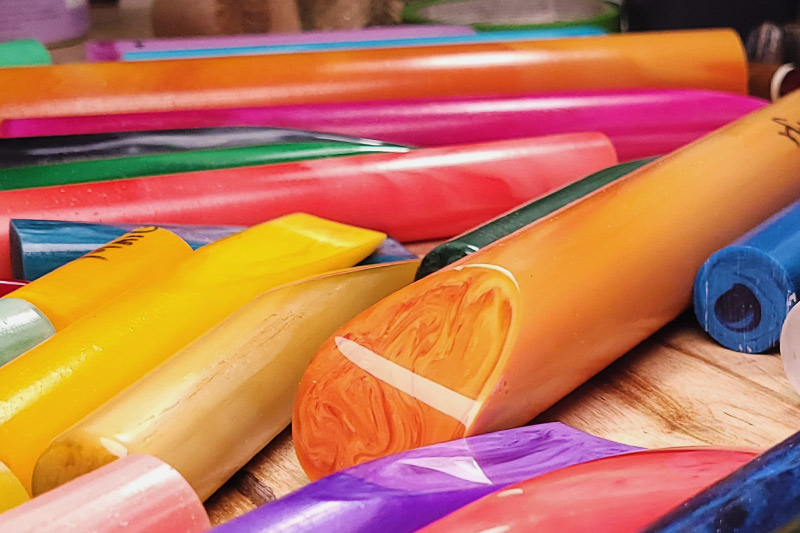
Photo by Micah Cryder
The pipe world has benefitted from several innovations in materials and techniques that have catapulted it to new heights. Perhaps the most notable example involves the discovery of briar as an ideal material in the mid- to late-1800s, revolutionizing the original paradigm of crafting pipes from cherrywood or other hardwoods and installing Saint-Claude, France, as the epicenter of industrial pipe production. Decades later, Sixten Ivarsson's "shape first, drill second" technique revolutionized the industry again and paved the way for handmade, artisan pipes.
Relatively speaking, though, revolutionizing innovations are few and far between both in the scope of human history writ large and more specifically in pipe making. Those pipe smokers who have invested in the hobby for decades will surely recount that not much has changed in the time since they bought their first pipe. Sure, new design languages have emerged; new colors and patterns in acrylic and vulcanite have created new trends; advances in finishing applications have led to aesthetic variety; and certain new materials have added diversity. But by and large, those advances have left little lasting indent on the pipe-making world, let alone led to a significant paradigm shift. Even the use of non-briar materials like morta or hardwoods with fire-resistant carbon chambers are fads at best: The vast majority of pipe smokers and pipe makers still prefer briar stummels fitted to stems of acrylic or vulcanite.
However, we're perhaps on the cusp of a new innovation and pipe-making revolution thanks to the efforts of Chris Kelly of Eldritch Pipes and Micah Cryder of Yeti Pipes. For years, the duo have endeavored to create an adequate substitute for Bakelite, and their experimentation has finally achieved success.
What is Bakelite?
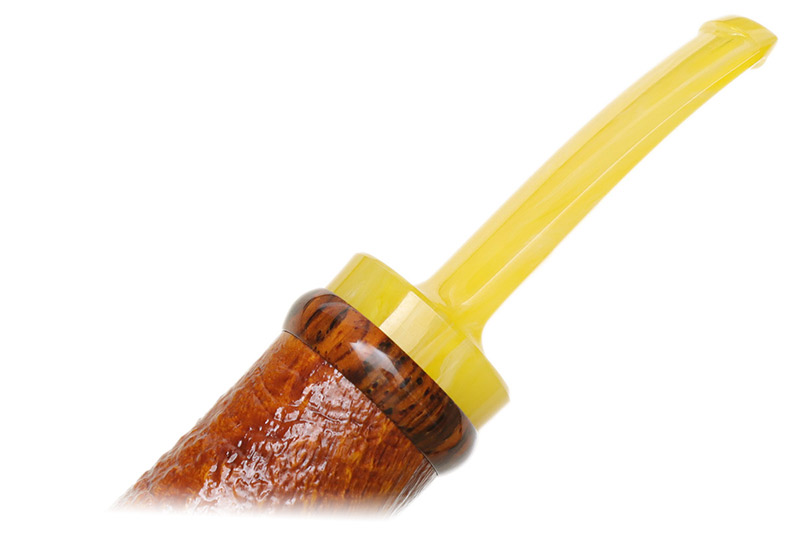
Bakelite Stem by Yeti
To understand Bakelite and its significance, we must first explore a brief history of plastics, specifically polymers. Not to get too in the weeds, but a polymer (poly = "many," -mer = "part") is a large-molecule substance composed of many repetitions of one or more monomers (mono = "one," -mer = "part"). These polymers are often initially resins — thick, viscous liquids — that cure into hard solids via a process called polymerization, resulting in materials that excel in durability and elasticity. Vulcanite is a polymer created from the resin of the rubber tree and combined with sulfur and heat to harden and "vulcanize." Bakelite falls under the same category of thermosetting polymers: those that are formed using heat, either through pressure or a catalyzing agent, to solidify the resin.
Through the second half of the 19th century, scientists had discovered the existence of polymers in nature, namely cellulose which comprises the natural structure of plants. John Wesley Hyatt expanded upon this discovery in the 1860s to create Celluloid — the world's first plastic — utilizing cellulose and other naturally occurring substances to create an astonishing material that remained hard and solid at normal temperatures but could be molded and reshaped under heat. It became the new standard for numerous materials in the late 1800s, including billiard balls, movie film, and hair combs.
For years after the invention of Celluloid, scientists attempted to create an entirely synthetic plastic, one made wholly of man-made materials. The most promising attempts involved resins that combined phenol, a common disinfectant of that day, with formaldehyde, but scientists consistently failed to produce a viable final product. However, not even a decade after the turn of the century, Leo Baekeland successfully polymerized phenol and formaldehyde through a specific combination of heat and pressure. He dubbed the resulting material "Bakelite," taking out numerous patents and publicly announcing his success in 1909.
Bakelite falls under the same category of thermosetting polymers
However, Baekeland's invention wasn't entirely stable on its own and needed filler materials to maintain its structural integrity. Most commonly, sawdust and asbestos were used as fillers, and they precluded manufacturers from dyeing Bakelite the bright, vivid, and complex colors we know it for today. Instead, early Bakelite was only available in a dark, muddy brown tone — not ugly, per se, but a deep, amber-brown at best and certainly more monochromatic. Thanks to its heat resistance, non-conductivity, and lack of strong aesthetic appeal, it was perfect for industrial applications: pipe fittings (the non-smoking kind), electrical outlets, coffee pot handles, etc.
This original Bakelite is different from what pipe makers today use to fashion stems. Its aesthetic is rather mediocre, and the use of fillers makes it unideal as a stem material. Pipe makers have an interest against utilizing materials that would harm their customers, so avoiding asbestos-infested materials is fairly commonplace. What we refer to as "Bakelite" in the world of pipe making is a colloquial catchall for a specific phenol-formaldehyde thermosetting polymer: Catalin.
Baekeland's original Bakelite patent expired in 1927, and the American Catalin Corporation modified his production process. Unlike Bakelite, Catalin didn't require any filler materials and could therefore be translucent and dyed myriad colors. For the sake of uniformity, though, I'll continue to refer to the material as "Bakelite," but understand that technically I'm talking about nice, clean, non-asbestos-containing Catalin.
Catalin expanded Bakelite's uses and elevated its reputation, catapulting it from an industrial, practical material to one of art and finery. From now-famous Catalin radios and exquisite cutlery handles to children's toys, buttons, and even jewelry, Bakelite became an endemic aesthetic to the Art Deco movement, delighting consumers with its durability and one-of-a-kind style.
Bakelite In Pipe Making
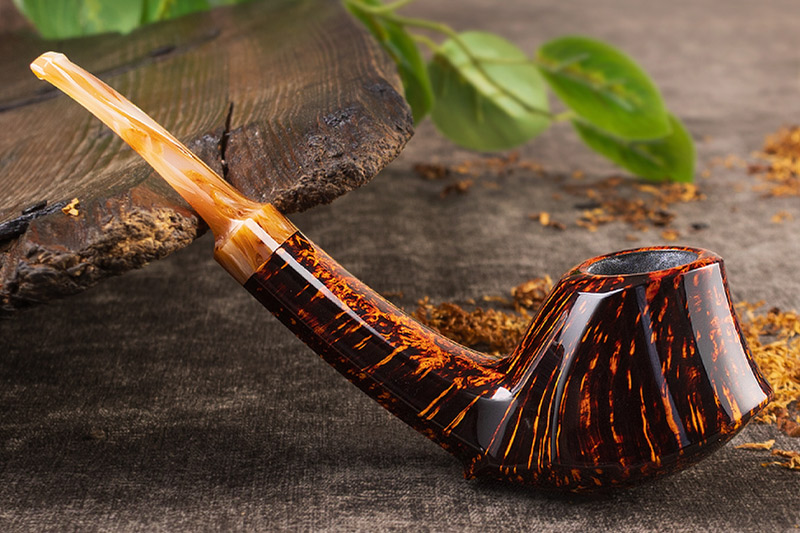
Yeti: Smooth Hiroyuki Tokutomi Tribute Volcano with Bakelite
Micah Cryder of Yeti Pipes didn't conceive of the idea to fashion pipe stems from Bakelite. Various marques used it as a more cooperative substitute for amber — but estate examples are considerably rare — and certain artisan pipe makers had begun to fashion Bakelite stems before Cryder even started making pipes. However, in today's pipe-making milieu, no name is more closely associated with Bakelite stems than Yeti.
Catalin expanded Bakelite's uses and elevated its reputation
"What initially drew me to Bakelite was seeing it on Todd Johnson's pipes. Very early on in my pipe-making career, I was looking at Todd's stuff, and I thought it was really cool," says Cryder. "I always loved that aspect: the colors he was able to use." If one had to choose Bakelite's most fascinating and attractive quality, it would be its color. Yes, acrylic and vulcanite — pipe stems' most oft-used materials — come in a vast array of colorways, but Bakelite has "a glow to it and a warmth," says Cryder. "It doesn't polish to a harsh shine. It's a really rich, deep, buttery gloss."
Moreover, while it's featured in solid colors, Bakelite's also available in deeply complex marbled patterns that simply can't be replicated in acrylic or vulcanite. Even in solid-color form, Bakelite retains a subtle translucence. "When you see marbling in acrylic, there's no subtlety; there's no softness to it," says Cryder. "It doesn't have a soft glow to it [like Bakelite]. I guess you'd say it tends to look more cold or harsh."
We owe this complexity of color to those early designers of the Catalin Company. "Bakelite came into existence right at the height of the Art Deco period," says Cryder. "There was an interest in new materials, and people in the world of arts and design were interested in it. They were essentially working as artists, and they were concerned with making it as beautiful as they could on a color by color basis." In those days, plastics — synthetic polymers — were the hot, new material, Space Age stuff, and didn't have the mass-production, cheap connotation we associate with them today. In its heyday, the use of Bakelite was a product's selling point and centerpiece, not merely a cheap means to save on production costs.
If one had to choose Bakelite's most fascinating and attractive quality, it would be its color.
As artists themselves, pipe makers decades later have approached Bakelite with the same reverence and excitement as those early designers, incorporating bold, vividly colored stems as the centerpieces of pipes. Pete Prevost and Micah Redmond are two American artisan pipe makers who have consistently featured Bakelite in their pipe making and are drawn to it for similar reasons as Cryder. "The way Bakelite sort of catches the light and almost has a little bit of a glow to it," says Redmond, "that's unique to it versus acrylic or other industrial plastics like that." For Prevost, "It's beautiful, and there are so many rad colors. I've done some stems that are straight up hot pink, and they really pop in Bakelite with its depth of color and contrast."
While acrylic and vulcanite achieve some aesthetic feats similar to Bakelite, neither one quite captures the depth, glow, and complexity of the vintage material. Moreover, pipe smokers are faced with a dilemma when opting for a stem of acrylic or vulcanite: Acrylic will retain its color without fear of oxidation, but it's significantly harder on the teeth than vulcanite; by contrast, vulcanite is softer but risks teeth marks, and it will oxidize significantly over time, requiring cleaning and maintenance. Bakelite is a near perfect middleground. From a hardness perspective, it falls in between acrylic and vulcanite, and while it will develop a patina over time, it doesn't come close to vulcanite's level of oxidation. Plus, antique objects intrigue most of us pipe smokers, so the opportunity to own a pipe that features a vintage material from the mid-20th century only enhances Bakelite's appeal.
At this point, it seems that Bakelite is a flawless pipe-stem material. Its colors are unrivaled; it's softer and more comfortable than acrylic; it doesn't oxidize like vulcanite and withstands teeth marks better; and it's anywhere between 60 and 90 years old, which we can all admit is super cool. However, it's not perfect by any means. Artisans navigate the difficulties and idiosyncrasies of Bakelite alone in their workshops, allowing us smokers and collectors to enjoy the finished products free of headache.
The Difficulties of Bakelite
First and foremost, no one manufactures Bakelite anymore. Its supply is inherently finite and only available on the secondary market, and such rarity and eventual extinction demand high prices. Those pipe makers who are even able to procure a source for antique Bakelite might be barred from acquisition by the price. "Bakelite is almost impossible to get these days," says Prevost. "It's so expensive if you can get it, and it's just hard to even justify putting it on a pipe because it's so expensive." Even though Micah Cryder was introduced to Bakelite early in his pipe-making career, he didn't begin using it in his work until much later: "It was very expensive, and I was just starting out," he says. "The idea of spending that much per stem was stupid. I needed to learn how to make pipes first."
Then there are the production and machining risks and the game of Russian roulette every pipe maker plays if they maintain a stock of Bakelite. As a thermosetting polymer, Bakelite was meant to be poured and molded into its final shape, not cut by a saw or drilled and machined on a lathe – which is among the steps in crafting a handmade stem. "When you're machining Bakelite, you have to be really careful," says Redmond. "If you cut it on a bandsaw, it can crack or chip." Prevost confirms: "It's so fragile to work with, and I'm always a little bit nervous as I'm working with Bakelite. If you drill it and it impacts the material too aggressively, it can split or almost explode a little bit in that area. And when you're shaping it on a heavy-grit wheel, it can split off whole chunks sometimes."
Even in storage, before ever being chucked up on a lathe or shaped on a sanding disc, Bakelite isn't safe from dysfunction. Temperature and humidity can negatively affect the decades-old material, as Redmond attests: "This stuff's really old at this point. You're talking about pieces of material that are potentially 80 years old, and it's a little bit sensitive to humidity and temperature changes. There have been times where I've had a block for years, and it was always fine. And then I open up my toolbox to go grab a piece and it's just cracked all over. I can't use that now."
"Bakelite is almost impossible to get these days,"
For all its benefits, charm, and uniqueness, Bakelite is a dying and unreliable material. A pipe with a Bakelite stem is special within any collection, and its rarity only increases daily. If only there were another material that boasted the aesthetic and material properties of Bakelite but was devoid of its deficiencies and scarcity...
The Resin Project
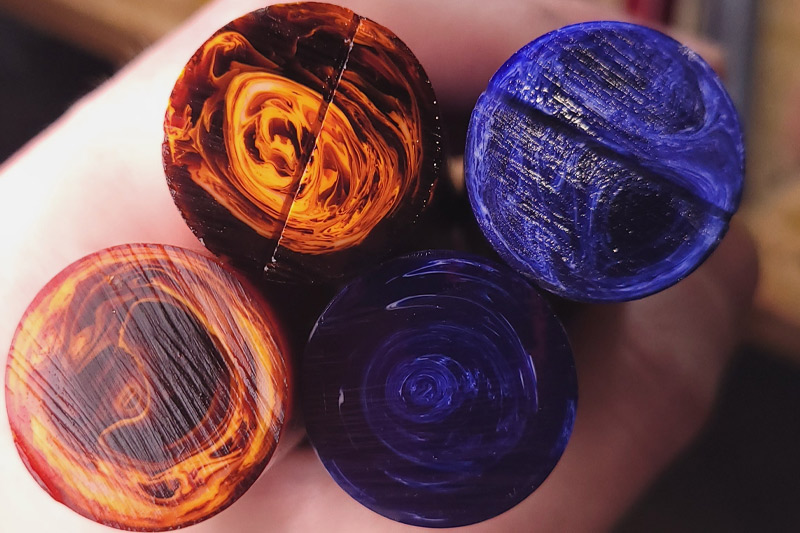
Early Attempt Resin Rods - Photo by Micah Cryder
Chris Kelly didn't initially endeavor to be a resin caster. He was first a pipe maker and still is. "I'm the kind of pipe maker who visualizes the pipe before I start making it," he says, and there were certain stem colors and patterns that he envisioned that simply weren't available. Feeling like he was always hunting for a particular color combination, Kelly came to a conclusion: "This is not the way to continue; I need to make what I need." He began casting resin blocks in the colorways he imagined for his pipes, selling his excess stock to the pen community. It was a good, simple setup: He could craft the pipes he envisioned, and he could sell what he didn't need anymore. "The version I started with in the beginning was polyester," he says. "It's cheap, which is important when you're just starting out, and it's self-degassing: A big problem is air bubbles in the resin, but a polyester polymer gets rid of all the bubbles on its own."
A pipe with a Bakelite stem is special within any collection
Kelly's experience and expertise grew after Kopp Pipes approached him to make stems for their Rattray's pipes. They wanted a different kind of resin, which required a different setup, so they funded his retooling. "It enabled me to get the process down for casting rods," he says. An invaluable skillset in his resin-production journey.
"Post-Rattray's, I had just been making rods for myself and for anyone else who was interested," he says. "And I was astonished by Yeti's work for its look and for his use of Bakelite, specifically." Kelly was interested in developing a resin substitute for Bakelite and knew that Cryder's feedback would be invaluable.
"I'd been working with Bakelite for years and building a collection of stock that I was using in my pipes," says Cryder. "And three or four years ago, Chris reached out and pitched the idea of working on replicating Bakelite with modern resins." Because of Cryder's extensive familiarity with Bakelite, he was the perfect collaborator for determining how similar to Bakelite a given resin rod was and what needed to be improved.
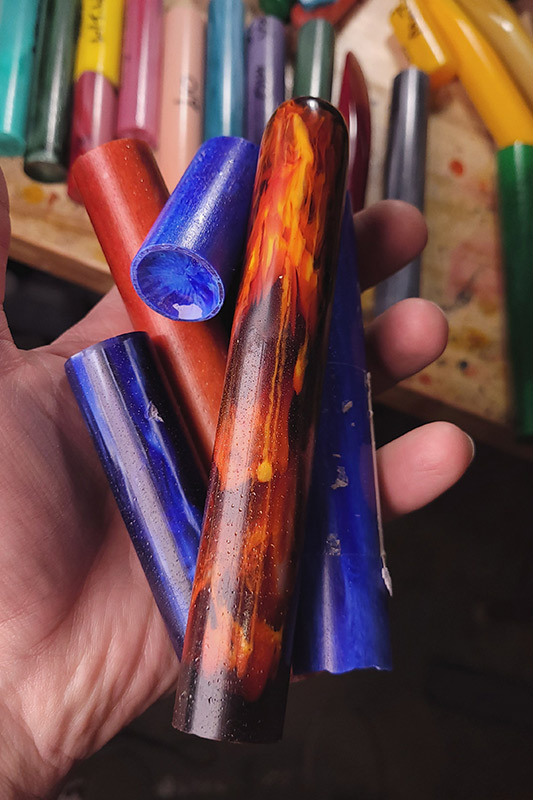
Early Attempt Resin Rods - Photo by Micah Cryder
The initial phase was almost entirely research and development. "You can't just combine any two pigments," says Kelly. "You need pigments with specific properties that will interact with each other in specific ways." So, Kelly would send Cryder a batch of resin rods. Cryder would assess them, reporting back to Kelly, and the two would brainstorm how to better capture the singular aspects of Bakelite. "We got some cool results, and it was certainly inspired by Bakelite," says Cryder. "But if you compared it next to Bakelite, it wasn't the same, so we were working on that off and on for a couple years."
A pivotal component to the project was the company Resin8, from whom Kelly sourced the pigments for the resin. Resin8 produced translucent pigments, which were essential in trying to capture Bakelite's semi-translucent properties. "Bakelite has this translucent quality to it," says Kelly. "Most colors for most resins are opaque, and transparent colors are few and far between." Resin8's production made the potential for a Bakelite substitute possible.
The pair encountered a massive obstacle, though, when Resin8 closed their doors. "They went bust during the COVID-19 pandemic," says Kelly. "I emailed them but got no response. I thought the project was over." Without a means of sourcing translucent pigment, there was no hope in replicating Bakelite's aesthetic qualities. "The project just sort of went on ice for a while," says Cryder. "For something like a year or so."
Kelly's experience and expertise grew
Thankfully, Kelly stumbled across another pigment supplier that also offered translucent colors. He reengaged Cryder, and the duo entered phase two of the project. "Chris got these pigments, and he adjusted his technique this time around," says Cryder. "And actually, it was a lot different. Bakelite's not a monolithic thing: There are grades of Bakelite from really cheap stuff that's super muddy and kind of ugly. And this test was kind of like mid-tier Bakelite. That was a big step forward."
Achieving a texture similar to Bakelite — or a density suited to pipe smoking — wasn't a hurdle: Kelly has been making pipe stems from resin for years (as have plenty of other pipe makers and manufacturers). The obstacle was the color, specifically Bakelite's semi-translucence, marbling, depth, and visual complexity. In phase two, "the rods had the translucence, but they still lacked the detail of Bakelite," says Kelly. "As detail increases in resin, translucence decreases." More trial and error, testing, and reiterating were required.
Kelly and Cryder's project has now entered its third and likely final phase. "We're at 90% of what we want," says Kelly, "but we're still reaching for that 99%." He's started developing his own pigments, which has been a real boon for their progress. It adds stability and security against another pigment supplier going defunct, but the science and relationship inherent to resin and color palettes is a tedious one. It's not like baking a cake and just adding different food dyes to achieve distinct colors; it's as if different food dyes also required different ratios of flour, sugar, eggs, and other base ingredients. "The recipes are all different," says Kelly. "What you do for dark blue, you can't do for yellow. It's a constant dialogue between Micah and me for each color and how we want them each to look."
Resin8's production made the potential for a Bakelite substitute possible.
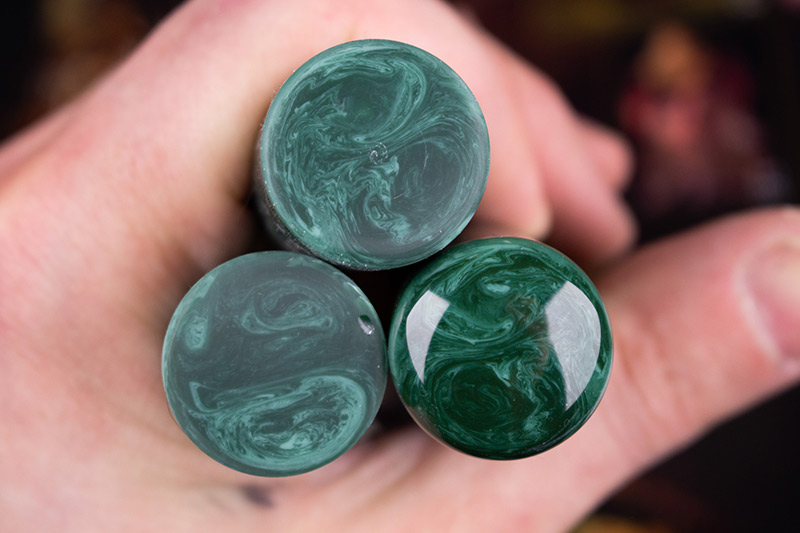
Resin Rods - Photo by Micah Cryder
Having achieved that 90th percentile, "we're finally at that point where we're transitioning from pure research and development to keeping a stock of inventory," says Cryder. "R and D is on the side now, and we're focusing on expanding our color range." The goal is to have a catalog of roughly 100 hues, allowing pipe makers to tailor their work to specific color palettes, as opposed to only offering one iteration of each major color. Unlike original Bakelite manufacturers who had to tailor their production to the colors that were most popular at the time, Kelly and Cryder can fine-tune and customize their production. "The way that we're making these with modern resin and modern technology, we can iterate and innovate on a microscale," says Cryder. "We don't have to make 10,000 units of every color a month to sell it all over the world. We can make small batches of it really quickly and efficiently, and once we get a color dialed in, we don't have to produce a ton of it at a time. We just flex it for demand. We can use the flexibility of a lean system, which is possible because of modern technology, to expand a wider color range."
Despite the resin matching Bakelite's color, its material properties differ slightly. The pair have improved upon Bakelite, eliminating its brittleness during machining while maintaining its unique color. "The resin we're using is more like vulcanite from a comfort and softness perspective," says Cryder. "And that slight flexibility means it's going to be less brittle and less prone to breaking. It's more durable, and it's more comfortable." In essence, this new resin combines the best aspects of every stem material with none of the drawbacks: The softness and comfort of vulcanite but without fear of oxidation, and the color, depth, and glow of Bakelite minus its rarity, expense, and stem-making tedium. With the foundation of the process laid and a number of colors having hit the market, Kelly and Cryder can spend the future refining and expanding their catalog of specific colors. Meanwhile, artisans have already started to utilize the new resin in their pipe making.
we're still reaching for that 99%
Reactions to the Resin
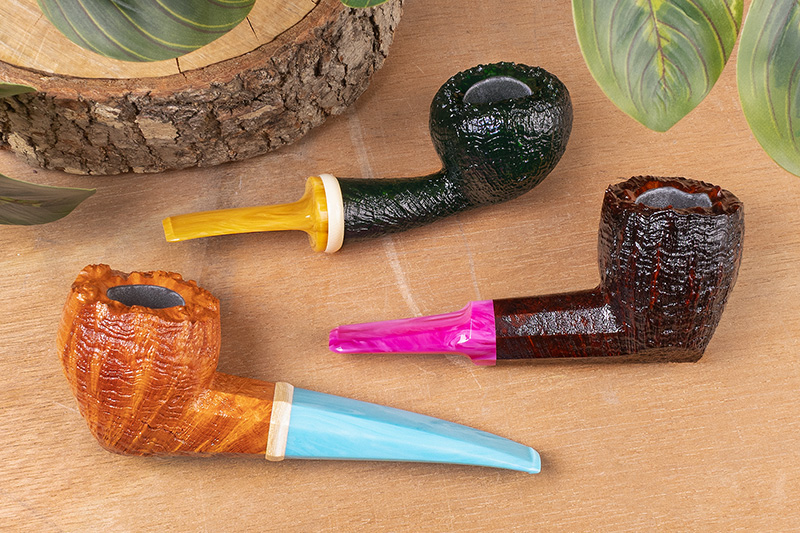
Yeti Pipes with Resin Stems
Cryder and Kelly shared a table at 2025's Las Vegas International Pipe Show, and they had a selection of resin rods for sale. Cryder had been selling them on his website for a little while beforehand, but this was the first opportunity that pipe makers had to examine the resin in person. They've since been crafting pipes that feature this special material, offering a distinctive aesthetic that for decades was only achievable through Bakelite, and their reactions have been overwhelmingly positive.
The pair have improved upon Bakelite
"If I didn't know better, I would think it was Bakelite, just from looking at a finished piece," says Redmond. "Aesthetically, it's the closest thing to really nice, cool, swirly Bakelite that I've seen."
"It was genuinely a total game changer for me the first time I used it," says Prevost. "I was blown away by how it hit on all of the best of both worlds for me."
When artisan pipe makers discuss their production processes, the vast majority loathe stem making. It's monotonous, tedious, time-consuming, and tiring. Acrylic and vulcanite wear files and sandpaper significantly, and vulcanite in particular makes workshops smell like sulfur. It's not a pleasant experience, but it's a necessary sacrifice for crafting a handmade stem that excels in comfort and optimal airflow. By contrast, Kelly and Cryder's resin rods are a breeze to work with from a pipe maker's perspective. Redmond and Prevost are as excited and impressed by how easily the resin machines as they are by its aesthetic qualities.
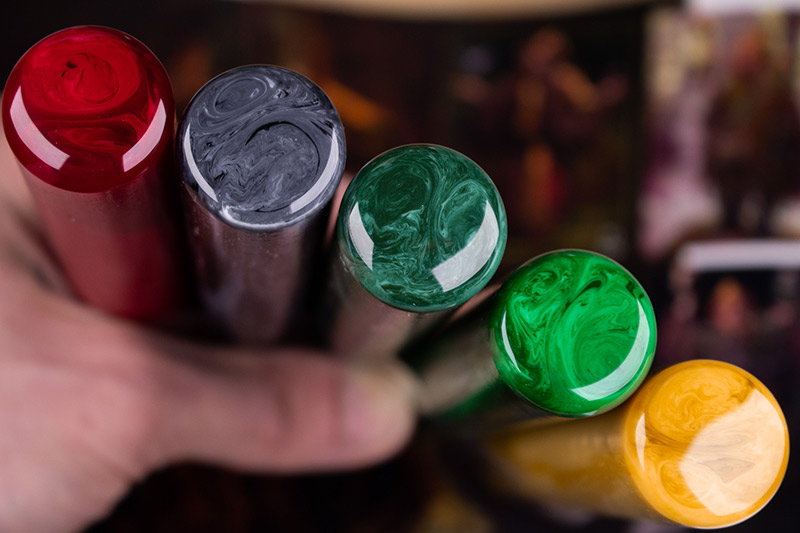
Resin Rods - Photo by Micah Cryder
"It doesn't have any of the drawbacks of Bakelite," says Redmond. "It's super easy to turn on the lathe; it cuts more cleanly; it doesn't chip at all. You can just drill it like normal without worrying about it cracking or chipping. Every part of the process, it's just nicer to work with. The way the resin responds to cutting, filing, sanding, polishing, bending, all that stuff, it's just easier than everything else I've ever worked with."
"Acrylic is almost a little gummy to work with when you're filing it. It'll clog up your files a little bit," says Prevost. "And when working with vulcanite, it smells like burnt rubber. This resin doesn't have an unpleasant smell to it when you're working with it, and it files to a straight powder. Shaping it, everything — it works so easily. It's wonderful. I'm stoked to get more of it and try out a bunch of different colors."
From their experience fashioning handmade pipes to their work crafting BriarWorks and Moonshine pieces, Redmond and Prevost have intimate and extensive knowledge of stem materials. Their praise isn't lip service or exaggerated enthusiasm over a new gimmick; it comes from a deep understanding of and familiarity with the travails and idiosyncrasies of working with vulcanite, acrylic, and Bakelite. Prevost doesn't say this lightly: "This really feels revolutionary to me for pipe making. If and when they have a solid, really good-looking black resin, I might just use it to make black stems."
Kelly and Cryder's resin rods are a breeze to work with from a pipe maker's perspective
Not only have Kelly and Cryder created a material whose color properties are indistinguishable from Bakelite, they've potentially developed a superior stem material period. If pipe-stem materials had a platonic ideal, it very well might be this resin.
The Future of the Resin Project
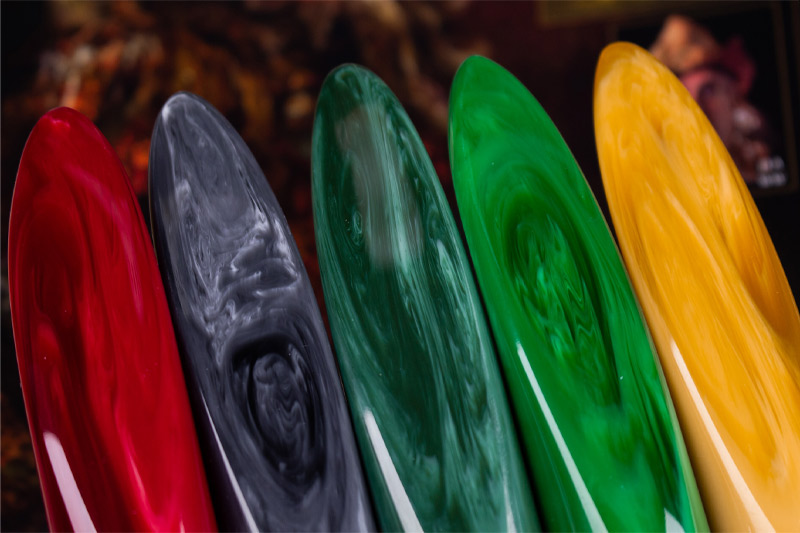
Photo by Micah Cryder
Conveniently for Prevost, developing a solid-black option is one of Kelly and Cryder's top priorities. "We're going to do some solid colors, and obviously jet black — basically a replacement for traditional vulcanite — is high on the list," says Cryder. They're also dedicated to improving their production methods for greater efficiency and capacity, while still maintaining a small-batch approach.
A name for the material is also on their to-do list. "Resin" doesn't quite do it justice. "Yeah, we have to figure out what to name it," says Cryder. "For what we market it as right now, just as our 'project,' we can get away with that for a while, but eventually we'll have to settle on something." I guess "The Resin Project" will just have to do until then.
The pipe-smoking hobby is an inherently and fittingly slow-moving one. The act of smoking a pipe is itself a meditation on slowness: preparing the tobacco, packing the chamber, the lighting ritual, monitoring the cadence, tamping, relighting, removing dottle, utilizing a pipe cleaner. Much of what has drawn us pipe smokers to the hobby and community is its intentionality and focus on deliberation – all of which require a sort of methodical slowing down. It's only natural that the history of pipe making would be similarly slow in progression.
Fads and trends have existed, do exist, and will continue to exist in pipe making, but they don't revolutionize. While modernizations have caused paradigm shifts, they're few and far between when considering the overall history of pipe making. The Resin Project, though, is no fad or trend. It's a revolutionary innovation that has the potential to dramatically affect the world of pipe making and collecting for the better. A beloved yet dying material has been reinvented and improved; the problematic elements of generic stem materials have been eliminated; and the horizon of what's possible with pipe stems and color palettes has expanded exponentially.
Bibliography
- American Chemical Society. "Bakelite: The World's First Synthetic Plastic." ACS, www.acs.org/education/whatischemistry/landmarks/bakelite.html.
- "Bakelite." Wikipedia, Wikimedia Foundation, en.wikipedia.org/wiki/Bakelite.
- "Catalin." Wikipedia, Wikimedia Foundation, en.wikipedia.org/wiki/Catalin.
- Cryder, Micah. Personal interview. 6 Feb. 2026.
- Cycleback, David. "Bakelite and Catalin Phenol Formaldehyde: Identifying the Popular Early Plastics." Cycleback.com, 31 Jan. 2013, davidcycleback.com/2013/01/31/bakelite-and-catalin-phenol-formaldehyde-identifying-the-popular-early-plastics/.
- Kelly, Chris. Personal interview. 4 Feb. 2026.
- "Polymer." Wikipedia, Wikimedia Foundation, en.wikipedia.org/wiki/Polymer.
- Prevost, Pete. Personal interview. 11 Feb. 2026.
- Redmond, Micah. Personal interview. 16 Feb. 2026.
- "Resin." Wikipedia, Wikimedia Foundation, en.wikipedia.org/wiki/Resin.
- "Resin Casting." Wikipedia, Wikimedia Foundation, en.wikipedia.org/wiki/Resin_casting.
- Robards, Julie Robinson. "Bakelight: A Symbol of Modern Culture." Press-Republican, 13 Sept. 2010, https://www.pressrepublican.com/news/lifestyles/bakelight-a-symbol-of-modern-culture/article_8b321e60-3b4f-53c2-8e09-f2b32006bfee.html.
- "Thermosetting Polymer." Wikipedia, Wikimedia Foundation, en.wikipedia.org/wiki/Thermosetting_polymer#Materials.
- "Vulcanization." Wikipedia, Wikimedia Foundation, en.wikipedia.org/wiki/Vulcanization.
You may also enjoy:






Comments
A well written, very good article. I thoroughly enjoyed it.
Because polymers are mentioned early in the article. Early additives, synthetic carcinogens, are scary unsafe mediums.
Turning attention to this new “revolutionary” stem. There is no mentioning of the “components/matrix” within the Resin Project. My thing is simple. I enjoy pipe smoking but want SAFETY from potential polymers/carcinogens from being inhaled?
Chris and Micah are understandably private about the specific materials and processes they use. However, I can assure you that there are no carcinogens in their resin, or any other dangerous materials. Remember: Vulcanite is a polymer, so that aspect isn’t new to pipe smoking or inherently unsafe. The only harmful additives discussed in the article regarded *early* Bakelite, which I was clear to disclaim is not used anymore. I understand your concerns for safety, but there’s no need to fear this resin :)
Interesting article. Although, they both need a name for the new material (and I would say a solid patent as well), something like "Kelder" or "Kelderite"!
Great article Truett. I've always wanted to know more about stem materials and their evolution. Now I do! Thanks!!
Potential names derived from Kelly and Cryder ...
CryKell
Crylly Resin
CryKel Resin
Truett, a fine article. It is informative and well written. It requires the reader to think and assess. Kudos!
Oh! The irony of a "rare" plastic. It just had to affect my pipe smoking eh?
Acrylic is a plastic as well! I don’t know of anyone complaining about it affecting the smoke :)
Hey Truett, really nice to see you back! Interesting article. Chris Kelly make some niche pipes but he also makes some really beautiful pipes as well, especially his sandblasted acorns. Would love to see SP carry some of his pipes.
He sure does! Not my call though :)
I'd like to thank Truett for this article. It was a fun interview to do, and lovely to read the feedback from Prevost and Redmond. I had no idea!
If anyone has any questions, I'd be happy to answer them.
Cheers 🙂
Very cool.
What is the website to purchase the resin rods ?
https://www.yetipipe.com/shop
Fascinating article. Throw some other uses out there for this Beyond pipe stems: guitar knobs, amplifier knobs, buttons, and various uses that Bakelite and Catalin were once used for... I have vintage cocktail items made from Catalin... I think most pipe smokers are the kind of people that enjoy quality items as opposed to mass produced junk... brings me pleasure every time I use my old boy lighter for instance... Something to think about for other usages!
Bring it on! I’ve been waiting for something like this. Can you use an alcohol like Everclear to clean it?
Absolutely.
Alcohol won't damage the stem.
i have a yeti pipe with one of these stems and honestly? it's fantastic. it's gorgeous and comfortable. i wish them success with this product because i want more of these stems out there.