


 |
|
 |
|


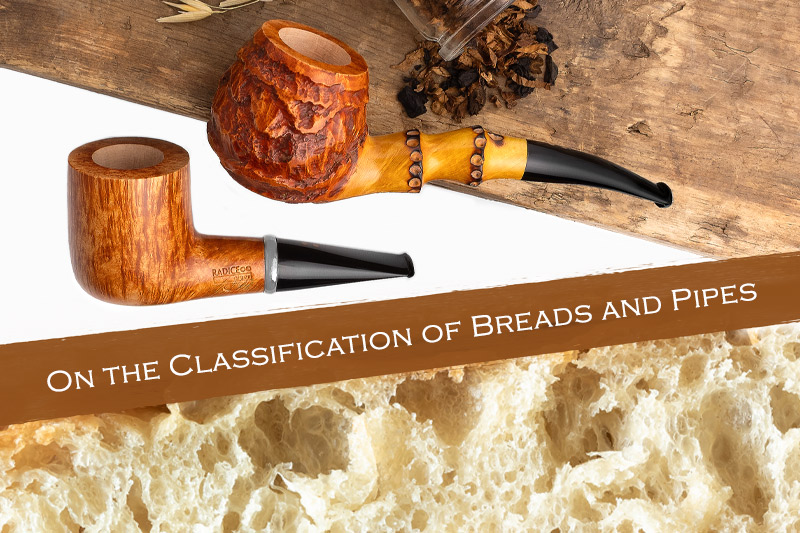
Early one cold afternoon this past January, I found myself walking to lunch with Marzio and Gianluca Radice and our friend — and translator — Francesco Laviano. We sat down at a table at an unpretentious restaurant — La Quadrifoglio in Cantù — that I'd been to a few times previously. I've been to Cantù and Cucciago perhaps thirty or more times over the years, so I'm pretty well acquainted with the lunch spots.
As always, out came this rather remarkable warm flatbread, sort of like Neapolitan pizza crust, sort of like Pane Carasau, sort of like Schiacciata (I understand full well that those things are sort of nothing like each other, but as will become clear presently, that's exactly my problem in trying to describe this thing). Anyway, it was delicious. It always has been. This time, I wanted to know more. Over the past few years, perhaps since my last visit to this restaurant, I've been baking bread more (yes, pandemic hobby). I ate a piece. And then another. And I asked "what is this sort of bread called?" To which Marzio and Francesco both immediately chimed, "Focaccia."
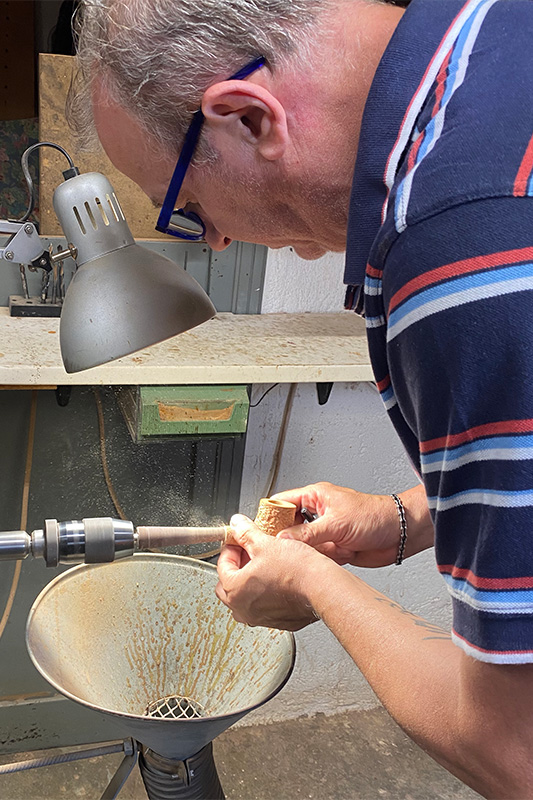
Marzio Radice
But focaccia is a catch-all for all sorts of flatbreads that vary widely from region to region and even locality to locality: this was distinctly not helpful, nor did it satisfy my very American need to classify, organize, structure and, ultimately, attempt to replicate at home. I pushed back gently: focaccia can mean a lot of different bread styles, I offered. Surely there's a name for this one. Marzio, Gianluca, and Francesco huddled and discussed for a few moments. "No," they said, "we just call it focaccia."
In some respects, for men who take their craft very seriously, who have devoted their lives to pipe making, creative minds who were molded by their almost eccentrically creative father, this is also how discussions about their pipes often seem to go.
Ask Marzio — and Marzio does almost all of the talking for the two brothers — what defines each of the various grades, or what the process is to arrive at a given finish, why a given bowl on the bench is marked for rustication or sandblasting, and he'll tell you why. But ask what he and Gianluca are after when they push the Billiard shape in a slightly more Radice direction — a little trimmer, the lines pulled tighter, perhaps with a slightly more tapered shank, but only the top is tapered — and you'll get an answer that eventually arrives at the same place as the bread: it is this way because it is good this way.
The frustrating thing is that it isn't evasion. It's complete.
Luigi "Gigi" Radice started making pipes at Castello in 1960, left in 1968 to co-found Caminetto with fellow Castello veteran Peppino Ascorti, then struck out on his own in 1980 to found Radice. His sons have been working alongside him in the narrow workshop in Cucciago — a short drive from Cantù that I have somehow managed to make confusing every single time — since long before most of their customers were in high school. They are, in the most literal sense, a pipe family.
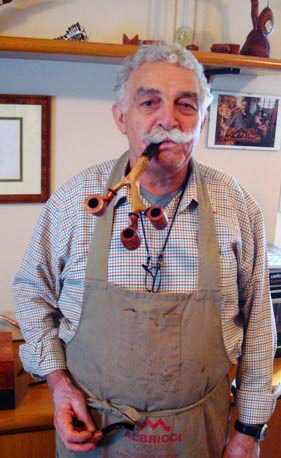
Luigi "Gigi" Radice with his three-bowled pipe
When I first visited, in 2010, I arrived — slightly late, as usual — to find Gigi at the band saw, removing the first big cuts from a block of briar. He looked up, smiled, and returned to work. Later he showed us a pipe with 360 degrees of birdseye, which briar's radial grain structure makes technically all but impossible, and a three-bowled pipe with little valves to turn each bowl on and off. Neither was an exemplary pipe in the sense that we typically think in the pipe-collecting community; both were sort of awkward, largely because both were made with an eccentric purpose: to actually yield a pipe with 360-degree grain in one case and, even weirder, make a pipe with three bowls and little twist valves.
I mean, as pipes they make no sense. As exercises in creative silliness on the part of an incredibly creative and talented man (who is, of course, perfectly capable of making nice pipes) that remain forever in the workshop as little frivolities, little expressions of pipe-making joy, with no intention of being anything more than that, they're delightful.
Gigi's English was about as good as my Italian — which is to say, entirely nonexistent — and our conversations in those days mostly involved pointing and smiling. Even with Marzio and Gianluca, with whom I have communicated for many years now through the kind help of Francesco, thirty-odd visits haven't yielded extended conversations of aesthetic or technical self-reflection. What it has yielded for me is something equally good: a deep familiarity with what the workshop makes, and a genuine fondness for the family's pipe-making style. Yes, at some level, it does lean on its aesthetic roots from Castello, and bears some affinity for the aesthetic that still predominates at Caminetto (now on its third generation, made by Tommi Ascorti), but it's distinctly different, eschewing both the monumentalism of the former and the structured formalism of the latter.
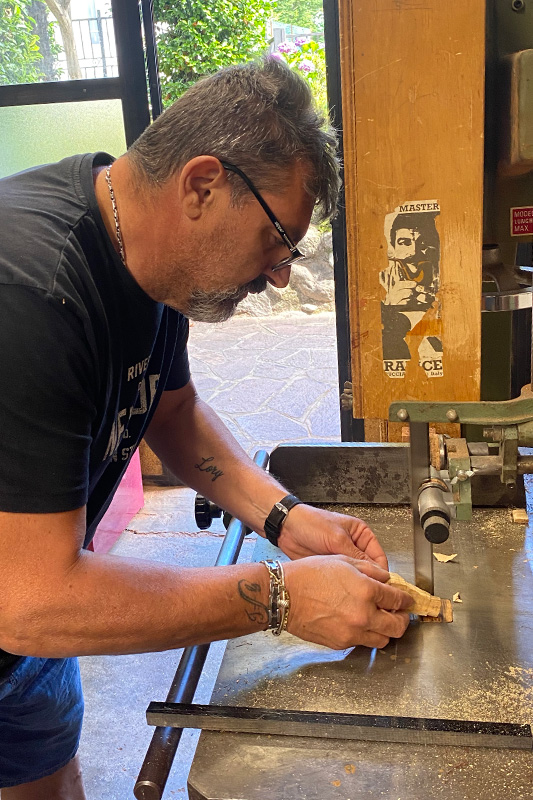
Gianluca Radice
Castello is unabashedly about making impressive pipes, sometimes huge, often stout, but always bold statements in pipe making. Caminetto's reliance on almost architectural forms —an aesthetic entirely distinct from the sort of Functionalism that the likes of Sixten Ivarsson and his students produced in Denmark in the 1960s and 1970s, but perhaps unconsciously leaning on some of the same intellectual currents — gives it a highly structured shaping lexicon. Radice is neither, though influenced by both.
Indeed, it's worth pausing for a minute and recognizing that Gigi Radice participated in and deeply influenced both of those styles also, so the aesthetic relationship among the three brands is certainly not linear. Still, the Radice style was the last of the three to emerge and it does so distinctively.
All three brands share distinct aesthetic markers: low visual weight of the bowl, with prominence given to the transition of the base of the bowl to the front, radically — by classical standards — tapered shanks, and a strong preference to tapering the top of the shank rather than doing so in a radially symmetrical way. While not as overtly and intentionally impressive as Castello, Radice has a warm, inviting character that Castello often lacks, a sophisticated playfulness, a seriousness that doesn't take itself too seriously. Radice shanks are typically narrower, more delicately conceived relative to the rest of the composition, privileging the bowl, playing with that ever-important interplay of visual weight given the bowl and the shank.
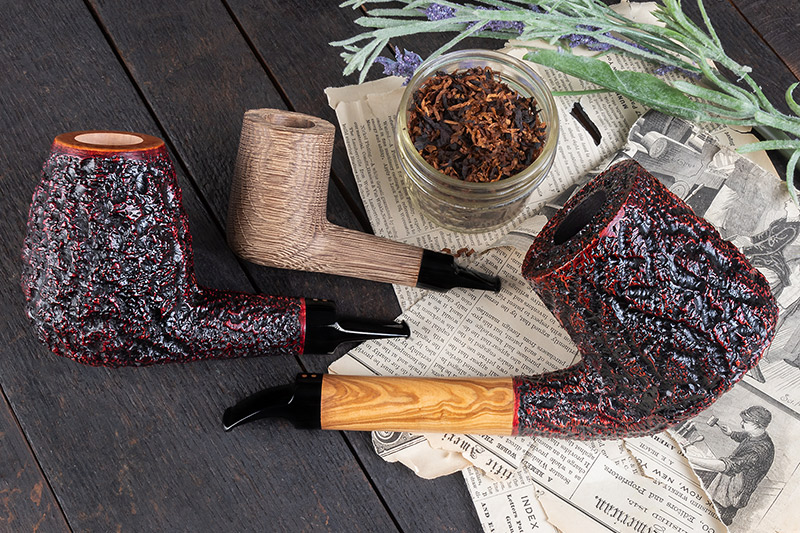
Similarly, the cheeking — where the shank enters the bowl — is more pronounced than either Castello's or Caminetto's. And yet, while the intentionally kinked transitions at the bottom of the shank of Radice's bent Billiard or bent Apple shapes are heavy nods toward the structured, architectural (in a very modernist sense) approach that defined Caminetto from its outset (and continued to be extended well into the 1980s), Radice's overall aesthetic is far more supple and inviting than the highly formalized shapes that define Caminetto.
This past January, after the bread and its concomitant taxonomic impasse, the antipasti plate, the pasta, and the coffee, we returned to the workshop, and Marzio and Gianluca got back to work. As they always do. The workshop at Cucciago feels the same as it always has — narrow, a little cramped, productive in that unhurried way that only makes sense if you've been at something for a very long time. It is what it is. And it is, as always, very good.
You may also enjoy:




Comments
It's fascination to learn about pioemakers- thank you!
Sykes, interesting piece. Thank you. Over the years I have owned many Radice and many Castello pipes. Radice stem work so far exceeds Castello that I have traded almost all of my Castello and retain almost all of my Radice pipes. Radice and Castello are otherwise quite similar, except for the hubris of Castello prices.
Sykes, an amazingly interesting article. I have two Castello pipes, billiards (SC 15’s) that I bought in 1969. One Searock, one Old Antiquari. Both carved. I have early Caminettoes with an almost identical carving pattern, including an Ascorti-Radice stamped Oom Paul. They were carved by the same carvers or carvers trained by them.