


 |
|
 |
|


Humans have enjoyed tobacco for literal millenia — just years ago researchers found evidence that prehistoric peoples chewed tobacco seeds. However, its trade is a comparatively much more recent venture. Native Americans were known to carry pouches of tobacco for personal consumption and bartering, but there isn't any evidence of widespread tobacco trade between indigenous communities. Humans have had a relationship with tobacco since the Ice Age; the Europeans commoditized that relationship into an industry that spanned the globe.
By the 1700s, most tobacco was transported in hogsheads: large barrels packed tightly with raw tobacco leaf. A common means of transporting tobacco, "hogshead rolling" consisted of literally rolling a hogshead down the road — roads that had developed specifically for tobacco trade. The round barrel functioned as a wheel, rolling behind the driver like a backwards, tobacco-laden steamroller. Hogsheads were regularly rolled for miles either directly to tobacco markets or to wharfs to be nautically transported to their destinations.
Not without a hint of poetic provenance, tobacco didn't merely travel the roads; it created them. And in the process, it altered not only the physical landscape but also the political, economic, and societal frameworks of the early Colonies.
Colonial Virginia's Tobacco
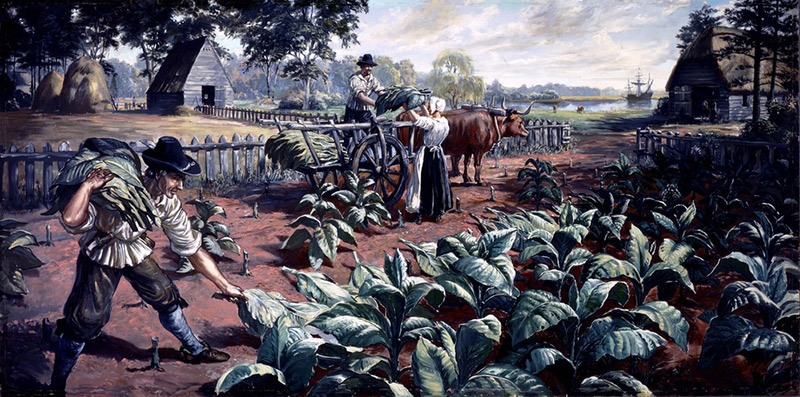
Sidney E. King: Tobacco growing at Jamestown, Va., 1600's
Not long after John Rolfe first planted Nicotiana tabacum seeds from the Spanish-colonized Caribbean and South America in Jamestown in the early 1600s, tobacco became Virginia's most profitable and valuable resource. The colony exported 20,000 pounds of tobacco in 1617. The following year, that amount doubled. For context, the Spanish had been exporting tobacco prior to the English, and in 1613, over 400,000 pounds reached the port of Sevilla. By 1619, tobacco from Virginia equaled the sale of Spanish tobacco in London; by 1620, those sales had doubled. Between 1686 and 1688, England imported 36,352,000 pounds. In the late 19th century, Virginia alone was producing around 40,000,000 pounds of tobacco, and by 1800, the production doubled to 80,000,000 pounds. For you bulk-tobacco connoisseurs, that's 1.28 billion ounces — 640,000,000 two-ounce tins of Cornell & Diehl's Autumn Evening — a simply staggering number.
This is the world of that time. English colonies in the New World were moving astronomical amounts of tobacco — before forklifts, semi trucks, and ocean freighters. Indeed, transporting tobacco was a considerable challenge. Early plantations in Virginia's coastal Tidewater water region had the advantage of choosing locales close to wharfs for easy access to ships, but as tobacco farming developed, fields and farms grew further and further inland across the Piedmont region. These distant plantations had to rely on small boats — "flats" or "shallops" — to transport tobacco via shallow creeks and rivers to larger ports; however, these methods proved unreliable. These vehicles posed inherent risks traveling long distances, not to mention their extra expense.
Hogsheads: Design and Construction
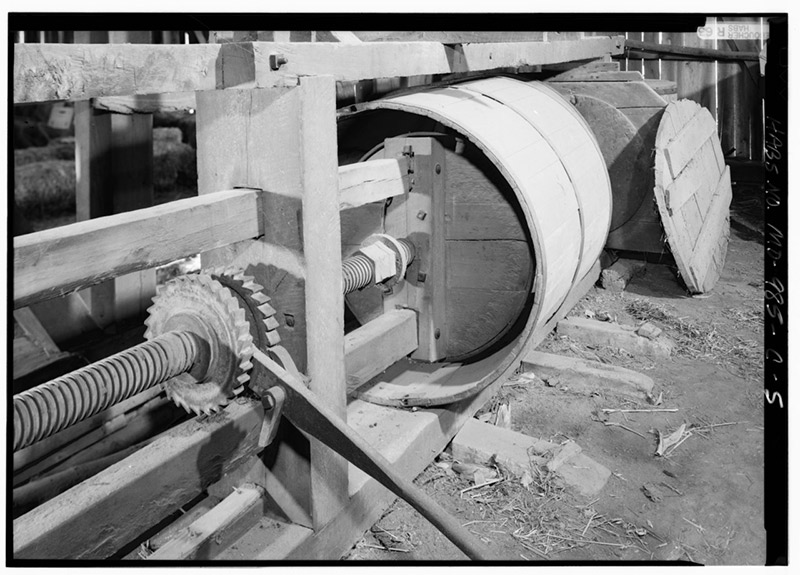
Detail view of tobacco press showing gears that turn press and compact the tobacco into the hogshead for shipment
As mentioned, tobacco was conventionally packed — or "prized" — into large barrels called hogsheads, which could weigh as much as 1,200 pounds. Originally, a hogshead was a measurement of liquid in England, but its specifications depended on the type of liquid: A hogshead of wine equaled 63 US gallons, while a hogshead of ale was only 51 US gallons. In the context of the American colonies, though, hogsheads were used exclusively for tobacco. Colonial legislatures progressively standardized hogsheads' dimensions over the course of the 17th and 18th centuries, with the barrels growing substantially larger as tobacco production expanded. By the end of the 18th century, the standard measurements were 54 inches tall by 34 inches wide.
Barrels are a diverse range of containers, varying in specific size and shape, but they share the same general construction: strapping wooden staves together to form a cylinder with flattened seals at each end. Those carrying liquids and heavier materials feature a bulging middle and are specifically called "casks." This particular, bulged construction increases the cask's strength and durability:
By [properly] jointing the edges of the staves, giving the barrel or cask the proper bilge (middle bulge) and convex shape, the joints become tight and circumference uniform. It provides added resistance to internal pressure and stress on the joints. This process, the most complex part of construction, is called raising the barrel. These well built casks or bilge barrels can withstand the increased internal pressures and distribute the stress evenly (Schenawolf).
Hogsheads, however, contained lighter, loose-leaf tobacco and could perform their function with less-advanced construction, not needing to be watertight and not needing a middle bulge. This allowed plantations to fashion their hogsheads on-site, utilizing unskilled slave labor instead of purchasing them from professional coopers. Moreover, transporting tobacco in hogsheads solved numerous logistical issues.
Loose-leaf tobacco wasted vital space on ships crossing the Atlantic. But, inside hogsheads, tobacco could be prized under great pressure to mitigate its surface area and house more pounds of tobacco across a smaller space. Farmers employed giant screw mechanisms within "prizing barns" that could be cranked to pack tobacco tightly inside the barrels — not dissimilar to how Perique is manufactured even to this day. Prizing allowed ships to carry as much as 50,000 pounds of tobacco without sacrificing area within their holds.
Rolling Roads
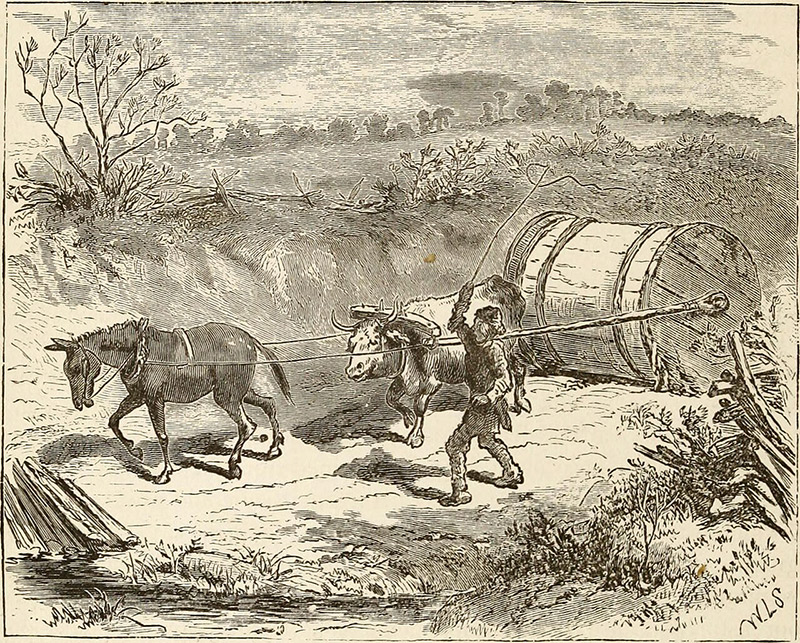
While also saving precious space, hogsheads also provided farmers with a means for transporting tobacco to market or to wharfs without the need of flats or shallops. By driving a pole through the middle, or at either end, of the hogshead as an axle, the barrel could be rolled on its side without the need for a wagon or cart. Attached to draft animals, hogsheads were rolled to the coast from distant plantations on what became known as "rolling roads." Moreover, contracted tobacco rolling became a viable business, with enterprises dedicated to tobacco delivery using their own animals and labor. As the tobacco industry's infrastructure developed, warehouses were built along the coast, storing hogsheads until they were ready for ocean transport. This need for long-term storage furthered hogsheads' advantages when compared to storing tobacco in the open air.
Planters close to the coast still shipped their hogsheads by cart or wagon, but inland farmers relied heavily on rolling roads; it wasn't uncommon to roll tobacco more than 100 miles. However, such distance and wear on hogsheads often damaged the tobacco. Further innovations were made by enterprising farmers: To solve the issue of rolling a hogshead directly on its side, these farmers fitted circular rims of hickory along the ends of the barrel to raise it off the ground. Called a "felly," this device required additional craftsmanship compared to the standard hogsheads that were carted or transported by boat, but it greatly increased the efficacy and longevity of rolling tobacco hogsheads.
While tobacco is no longer transported via rolling roads, these avenues still exist across the Southern states. For example, a number of modern roads in Alexandria, Virginia, began as rolling roads: "Roads like Oronoco were called rolling roads. For instance, today's Rolling Road takes you from Braddock Road near Burke to Pohick Church on U.S. Route One, but starting in 1753 Fairfax County planters used the path to move their hogsheads of tobacco from their plantations to the old port of Colechester" (Kimbell). Despite modernity's paved roads, stoplights, and motorized vehicles, hints of the Colonial tobacco industry live on in today's world and have left an indelible mark.
Nautical Transport
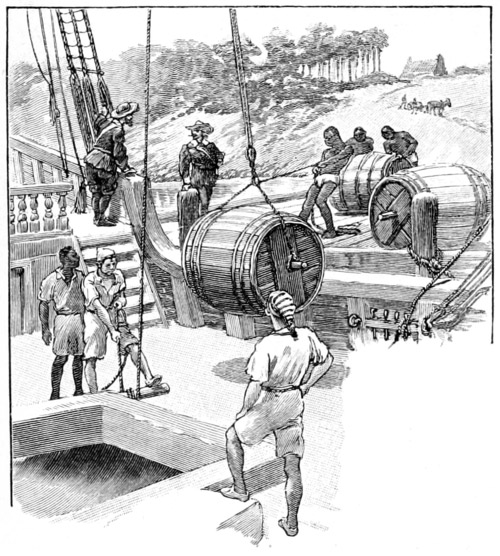
"Loading a Cargo of Tobacco" from the 1910 edition of The Leading Facts of American History
Similar ingenious advances were applied to nautically transported hogsheads. In the 1740s, Reverend Robert Rose discovered that by lashing two long canoes together, one could transport five to 10 hogsheads along the canoes' abutting gunwales without tipping over. This innovation became known as the "Rose Method" and was a commonplace means of tobacco transport throughout the last half of the 18th century.
By 1800, river transport had practically replaced tobacco rolling, and the James and Roanoke rivers became Virginia's main arteries for delivering tobacco to Richmond's warehouses. Furthermore, the Rose Method had been superseded by long, slender, flat-bottomed boats dubbed "bateaux." Patented by farmers N. C. Dawson and A. Rucker, these "James River Bateaux" were designed specifically with hogshead transport in mind. Very narrow in proportion to its length, a James River Bateau needed a crew of only three men and could float from Lynchburg to Richmond in only 10 days, with the crew utilizing poles to travel back upstream after delivery.
Virginia's infrastructure grew to accommodate this vital river-transportation system. Before 1800, farmers traveling down the James River via the Rose Method had to disembark at Westham, before a series of falls, and cart their hogsheads the rest of the way to Richmond.
There is the story of one planter who forgot to land his canoes at Westham. It seems that he left his plantation on the upper James with a load of tobacco and a jug full of whiskey. By the time he reached Westham the planter had consumed too much of the whiskey, and forgot to land at Westham. He rode his canoes, tobacco and all, over the Falls. Shortly thereafter he was fished from the waters downstream, wet and frightened, but sober (Herndon).
As the James River developed as an integral tobacco route, canals were built along the Westham falls, allowing bateaux to travel directly into Richmond. This improvement further cemented the waterway as a means of tobacco transportation and made the entire process more efficient and timely. It's estimated that by 1810, 25 percent of Virginia's entire tobacco production passed through the Westham canal along the James River on its way to Richmond.
The Impact of Hogsheads
The warehouses that stored hogsheads before their shipment to England led to the development of towns and cities nearby, and in many ways the urbanization of Virginia and other tobacco-rich states directly relates to the ecosystem comprising tobacco trade. It's arguable that the majority of a tobacco leaf's life was spent inside of a hogshead: Beginning with its prizing at the plantation, tobacco remained inside a hogshead until it was ultimately sold to those who would soon smoke it. From transport via rolling, wagon, or boat; to sitting in a warehouse awaiting inspection and sale; to being loaded onto seaworthy vessels and traveling across the Atlantic — all of that time was spent inside of a hogshead.
The relationship between tobacco and the hogshead is an intimate and substantial one that has lasted centuries and even continues today. Philip Morris still utilizes hogsheads, with much of the company's equipment and processes having been designed around the specific barrels. For something as quotidian as a wooden barrel, the hogshead has had a significant impact on the history of tobacco and society as a whole. To those living in tobacco country: Perhaps your daily commute was once along a Colonial rolling road, with felly-made ruts of yesterday running parallel to the painted white and yellow lines above.
Bibliography
- Ansley, John F. "Hogshead." NCpedia, State Library of North Carolina, https://www.ncpedia.org/hogshead.
- Cascone, Sarah. "New Archaeological Find in Utah Suggests Tobacco Has Been Used Since the Ice Age." Artnet News, 12 Oct. 2021, https://news.artnet.com/art-world/archaeologists-discover-12300-year-old-tobacco-use-2019581.
- Clement, Maud Carter. "Chapter Seven: Agriculture, Trade, and Industry." An Abbreviated History of Pittsylvania County, Virginia, ca. 1952, https://www.victorianvilla.com/sims-mitchell/local/clement/mc/abb/07.htm.
- Herndon, G. Melvin. Tobacco in Colonial Virginia: "The Sovereign Remedy." Virginia 350th Anniversary Celebration Corporation, 1957. Project Gutenberg, 1 Nov. 2008, https://www.gutenberg.org/cache/epub/27117/pg27117-images.html.
- "History of Tobacco." Wikipedia, Wikimedia Foundation, https://en.wikipedia.org/wiki/History_of_tobacco.
- Kimbell, Steve. "Carlyle and the Tobacco Trade." Carlyle House Docent Dispatch, NOVA Parks, Dec. 2008, https://www.novaparks.com/sites/default/files/pdf/Carlyle%20and%20the%20Tobacco%20Trade%20dec08.pdf.
- Lemire, Beverly. "Material Technologies of Empire: The Tobacco Pipe in Early Modern Landscapes of Exchange in the Atlantic World." MAVCOR Journal, vol. 5, no. 1, 2021, https://doi.org/10.22332/mav.ess.2021.4.
- "Making Our Cigarettes." Philip Morris USA, https://www.philipmorrisusa.com/products/making-our-cigarettes.
- Salmon, Emily, and John Salmon. "Tobacco in Colonial Virginia." Encyclopedia Virginia, Virginia Humanities, 7 Dec. 2020, https://encyclopediavirginia.org/entries/tobacco-in-colonial-virginia/.
- Schenawolf, Harry. "Coopers Had the Colonists Over a Barrel: 18th Century Barrel & Cask Production in America." Revolutionary War Journal, 21 Jan. 2019, https://revolutionarywarjournal.com/coopers-had-the-colonists-over-a-barrel-18th-century-barrel-cask-production-in-america/.
- Taxes and Tithes. Discover Stafford, https://discoverstafford.org/artifact/colonial-settlement/taxes-and-tithes/.
- Trout, William E., III. "Let's Roll a Hogshead!" Scottsville Museum, Virginia Canal Museum, 2018, https://scottsvillemuseum.com/transportation/homehogshead.html.
- The Yorktown Tobacco Press. Twisted Oaks, https://scottsvillemuseum.com/transportation/homehogshead.htmlhttps://www.twistedoaks.org/Tobacco/.
You may also enjoy:



Comments
Love history and love my tobacco, thank you for good read.
Fascinating, I love these historical articles, please keep them coming!
Indigenous here to say we very much still trade tobacco. We grow, and use it for ceremony. We sitll carry it for biindaakoojige. There are pipe carriers, which is how I ended up here on Smoking pipes for smoking tobacco.