


 |
|
 |
|


Sun Bear Bourbon Cask with Vic Seested and Jeremy Reeves


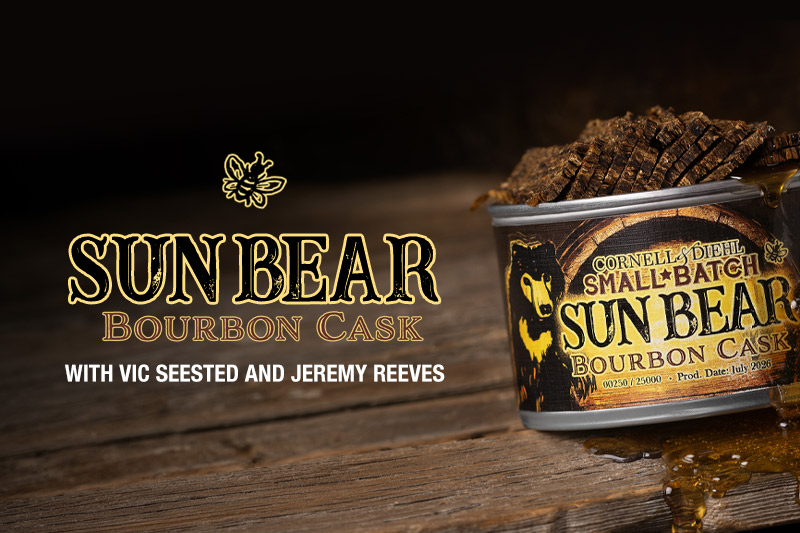
The most popular Small Batch by C&D, Sun Bear, is so beloved for a reason: it features a distinct honey in every edition, altering the experience of Sun Bear based on the varietal used, where it came from, and how the honey was prepared before it was incorporated into the blend. Let's take a look at this year's iteration, Sun Bear Bourbon Cask, with the help of Jeremy Reeves, Head Blender of C&D, and Victor Seested, beekeeper and provider of the black mangrove honey used in this year's Sun Bear.
Cornell & Diehl Small Batch Sun Bear Bourbon Cask will be available as of August 4 at 6:00 p.m. ET in limited quantities on-site.
Sun Bear Through The Years
Before we dive into the new Sun Bear Bourbon Cask, it's interesting to see the evolution of the blend from its original release in 2019 to today.
The OG Sun Bear in 2019 & The Second Batch in 2020
Sun Bear was originally designed to be an ideal summer smoke in warmer weather. "That's really at the heart of what the initial inspiration for Sun Bear was," says Jeremy, "trying to find something that not only performed well and smoked well in the heat of South Carolina, but that also spoke to the kinds of things that I experience in the environment during this period of time."

The original Small Batch Sun Bear was released in 2019 to great success, with 4,500 tins made that sold out incredibly fast. "For that initial batch, my partner Hillary and I used honey from our own hives." This honey had a really deep color from the goldenrod flowers they have. In honey, a darker tone translates into more strength in the flavor. Their honey also carried an interesting tartness that turned to spiciness on the back end. "We grow a bunch of hot peppers, so that actually translated into some of the flavor that our honey had and the way that honey translated onto that initial batch of Sun Bear."
Due to the success of Sun Bear, C&D knew they should do it again. There was a problem, though — no way Jeremy could handle a bigger production given his personal honey supply. "We didn't know who would be able to provide the honey, and wanted to do some digging there. Two or three days later, I got a phone call on the C&D line, and it was Victor Seested."
It turned out that Vic was a longtime fan of C&D, buying tobacco for about 30 years, placing orders over the phone with Craig and Patty Tarlor in Morganton, NC. He also happened to be a beekeeper up in Maryland. "He said, 'Hey, I really love Sun Bear. I bought a bunch of tins, and I love that you were talking about beekeeping and shining a light on something that's really important to me as a beekeeper.'"
Very shortly after this call, Vic supplied Jeremy with wildflower honey for 2020's edition of Sun Bear, and C&D produced 8,000 tins this time. Once again, it was a successful drop.
Sun Bear Black Locust in 2021
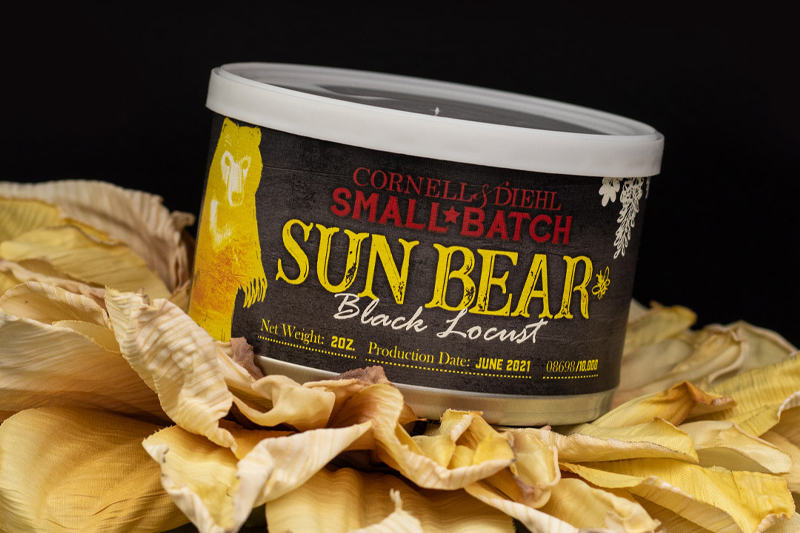
The follow-up batch, Sun Bear Black Locust, used honey from Vic's black locust bloom, and solidified how Jeremy looked at Sun Bear as a special release annually. "It became clear that the character of the honey made a difference in the way that the blend tasted, and that sort of surprised me."
Jeremy explains that using liquor as a casing on tobacco isn't like honey at all. "A fancy liquor on tobacco is a fool's errand. But the difference in honey varietal clearly carried through in the way that the tobacco smoked."
In general, honey is shaped by what surrounds the hive — bees gather pollen from a two-square-mile radius, therefore anything in that range — forest, flowers, farmland — impacts the honey itself.
The black locust plant's harvesting window was very narrow. "You basically have between six and 10 days where this flower is in bloom," says Jeremy, "and the bees that are going to gather from it need to be pretty much located right near where there will be black locust bloom. You can actually see the color change in the trays of honey going through a Langstroth box. It becomes pale at the point that the bloom starts. The bees are really prioritizing going to this flower. They innately understand that there's not long to work with it." The same can be said for various other honey varietals.
The honey from the black locust batch was very light in color and had a lemony note to it, and a very delicate flavor, which came through in the Sun Bear Black Locust blend. "From that time on, my focus has been finding interesting-tasting honey," says Jeremy. "Going to beekeepers and those operating an apiary who care about the bees, their health, and knowing what their colonies are doing, and tending to them ... that's who I want to work with."
In the mass production of honey, unfortunately the care for the profession isn't there in the way that it is for beekeepers who are passionate about it, like Vic. Jeremy strives to source honey that isn't heat treated or homogenized. "Honey that really carries the natural essence and ties it to the area where the colony of bees live and where it is produced is important to me."
Next Iterations of Sun Bear

After Sun Bear Black Locust in 2021, Sun Bear Mountain Flower came out in 2022, followed by Sun Bear Tupelo in 2023, before returning to Black Locust in 2024. That year, the production size of the release doubled from 10,000 tins to a whopping 20,000.

Sun Bear Navy Cask in 2025
Last year's iteration of Sun Bear Navy Cask saw the introduction of using retired barrels to age the honey in, imparting new flavor profiles to the overall blend as a result. "Two years ago I was reading Whiskey Advocate magazine and there was an article about bourbon barrel-aged honey," says Vic. He then recommended to Jeremy the idea of putting the honey into old barrels to be used on tobacco. "If you know me, I can really get into something. I Googled, made phone calls, and asked a lot of questions, which really didn't get much help. So to begin, I had to find barrels." Most of the whiskey barrels were much too large for him to handle, at a staggering 53 gallons. "I found a company, Northeast Barrels, that had some small-format, 11-to-15-gallon barrels. That would work. And so I began."
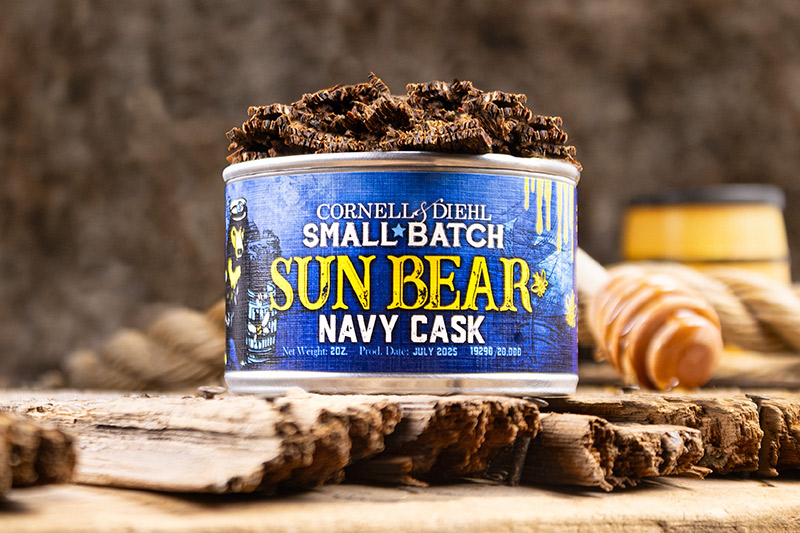
Those barrels also happened to be used for rum, resulting in the honey used in Navy Cask. "I have a greenhouse for growing orchids," says Vic. "I built a roller so I could rotate the barrel. If you aren't familiar with how whiskey and rum are aged, the barrels are put in big huge wooden buildings called Rick houses many floors high. The sun hits differently on the barrels and causes different flavors.
"Using my greenhouse, I would get temperatures near 100 degrees during the day and 60 to 70 degrees at night, just like the Rick house. I would sample the honey within the barrels with chopsticks, never double dipping. Over time, I could taste the change in flavor. I got it to where I thought the flavor had what I wanted and it wasn't too strong." The flavor combinations of the honey out of these barrels impact the blend of Sun Bear just as much as the tobacco varietals do. Last summer's Sun Bear success with barrel-aged honey could only mean one thing...
Sun Bear Bourbon Cask in 2026
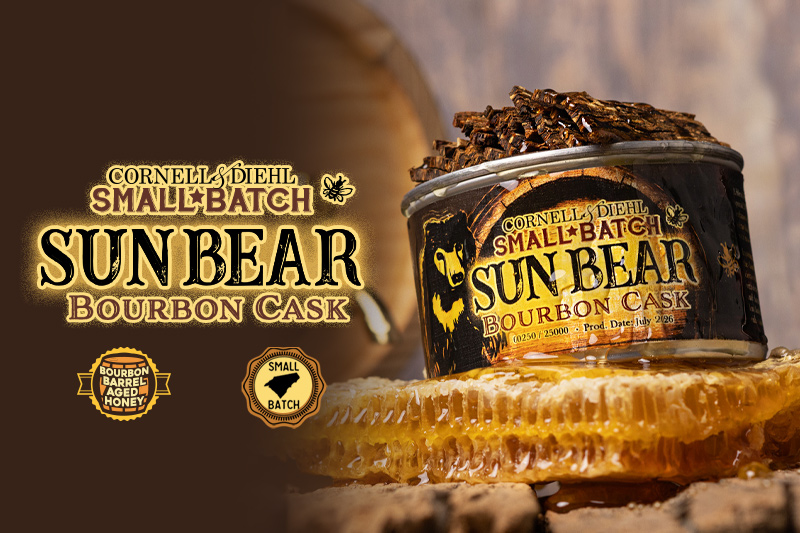
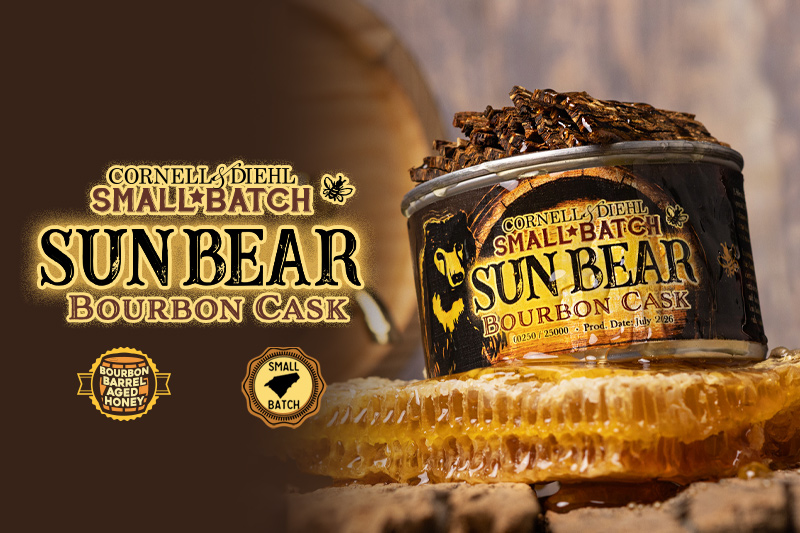
This year's Sun Bear release is the Bourbon Cask edition. Much like last summer, the honey was aged in a retired bourbon barrel before being added to the tobacco blend. This year's varietal of honey is black mangrove, sourced from S&S Apiaries in Florida. "My ex-neighbors moved to Naples, FL," says Vic, "and when my wife would visit, she brought me some black mangrove honey, which I loved. That apiary was chosen because the owner was so knowledgeable and responsive. I had him send me and Jeremy a jar. We loved it."
Vic notes that there are three or four different types of mangrove trees. One grows in the water, and another at the edge of it — black mangrove is the latter. On S&S Apiaries' website, they state: "Mangrove Honey is a light honey with a more watery texture that works great in recipes, smoothies and cocktails and has a slightly salty taste when it's fresh."
Jeremy and Vic both spoke to this salty taste, attributing it to the nectar of the mangrove trees that grow on the edges of wetlands and swamps. These trees are recognizable by their wicked root system. "The trees are directly tied to that saltwater," says Jeremy, "so you have this element of salt that comes through even in the honey that is produced from its nectar. With all the other flavors of that honey, the saltiness makes everything else taste a bit like sweet butter." This aspect calls to mind the salted butter on pancakes that are drizzled with honey.
"I find that creamy note and subtle salty note translate through in the smoke of this year's Sun Bear," says Jeremy. "You also get some of that woody depth from the bourbon barrel that the honey was aged in. There's a honeyed note, but also a touch of vanilla and a dark, charred wood character."
The use of black mangrove honey that has been aged definitely makes a difference in the overall experience of Sun Bear. "It's still Sun Bear," says Jeremy, "but it's always fun to see how just the small amount of honey that we're putting on this blend gives each year's version a new, unique twist."
Honey & The Industry

Chuck Stanion has covered much about bees and the honey industry in the past here on the Daily Reader, but it is quite intriguing to get to hear from Vic about his thoughts and his love for tending to bees as a beekeeper, as well as his love for pipe smoking.
Smoking since the age of 15, Vic was a financial advisor before he retired and became a beekeeper about 11 years ago. He came into the industry after hearing about it through one of his co-workers in his office. "I've had 15 to 20 hives here at my house," he shares. "My property backs up to a river and it's all wooded forest." He has kept bee hives for a local brewery as a favor for a number of years as well.
Being a beekeeper is a lot of work. He notes that good honey should never be pasteurized, and that unfortunately, honey is the most adulterated food in the world. "Honey is expensive and mass honey companies adulterate it with high-fructose corn syrup, rice syrup, and other kinds of sweeteners," says Vic. "When you go to the store, you do not know where the honey comes from a lot of times." As an example, if a label mentions local honey packaged and bottled in a specific place, that does not necessarily mean the honey was locally sourced at all.
Genuine local honey from the hive can have pollen in it, which helps with people's allergies when consumed. "My honey hasn't been refined, it hasn't been filtered, and nothing was done to it whatsoever. The bees make it, I take it out, extract it, and I bottle it. It's fantastic stuff."
Vic has tasted honey from all around the world during his travels. "I've had honey from Hawaii to Norway, Alaska to the desert. Cactus, fireweed, mesquite, and Greek honey." He shares that honey's color and taste ultimately come down to the source of the nectar — the sugar the bees gather from the flower. "Honey can be very dark, like the one I had from Hawaii, and then lighter yellow in color, such as honey from Greece and this particular black mangrove honey used in Sun Bear Bourbon Cask."
Jeremy and Vic's Friendship
Since Vic called up Jeremy seven or so years ago, offering up his honey for Sun Bear, the pair have become great friends. "Vic is very, very, very smart, very interesting, and he's just curious about the world around him in all sorts of ways," says Jeremy. "Every time I talk to him, he's digging into some new thing. I always learn a lot from him. He's great. He's the kind of person I wanna be when I grow up."
Vic is pleased to be involved in Sun Bear, which has become the leading Small Batch for Cornell & Diehl, selling out at lightning speed every year. "I've gotten great enjoyment from working with Jeremy," he shares.
Future Honey Projects
The pair continuously look for new ventures in honey, and Jeremy has a few projects in the works for the future. "Right now he is working on three different honey blends I've suggested," says Vic. "There's a Scotch whiskey — it's a phenomenal whiskey called Laphroaig that he is using with my Maryland honey. It's a peated one, and it's amazing. In Charleston, there's a distillery called High Wire. They make bourbon from Jimmy Red Corn that was thought to be extinct. They found a couple kernels and began to grow it." He's also working on a cotton hibiscus honey from South Carolina.
Discovering barrel aging with honey and seeing what flavors it affords to the beloved Sun Bear has opened new creative horizons for both Jeremy and Vic.
Sun Bear Components & Jeremy's Recommendations
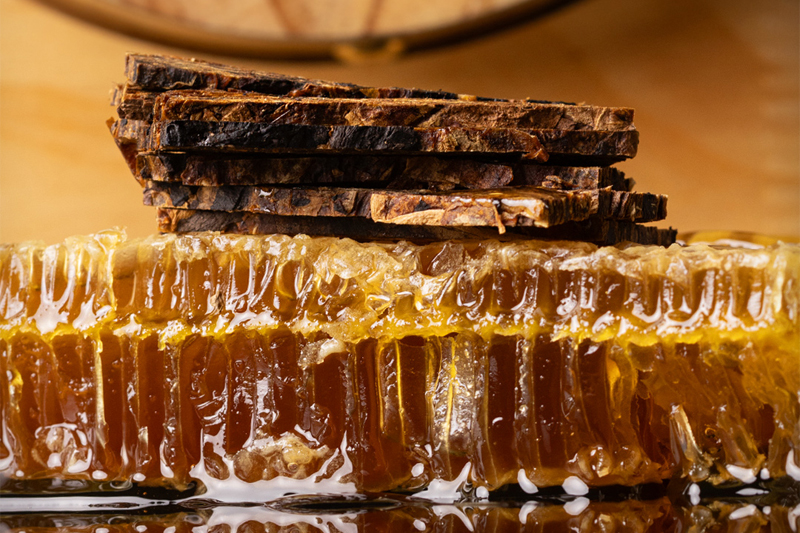
2026's Sun Bear Bourbon Cask is a flake-cut blend of 2023 Canadian Bright Virginias, 2023 North Carolina Red Virginias, 2019 Thai Izmir, and notes of raw black mangrove honey that has been aged and matured in a retired bourbon barrel. A subtly boozy, warm, and buttery character from this honey elevates the classic Sun Bear profile with natural sweetness, fruitiness, and deeper, barrel-aged notes of salted caramel, vanilla, and charred oak. Whispers of silver tequila and elderflower lend further complexity to the blend, resulting in a rich profile with a refreshing yet rounded finish.
Jeremy recommends Sun Bear to anyone looking for a warm-weather pipe tobacco — after all, it was designed to be a summer and spring blend. It's a floral, mellow honeyed sweet smoke that is not super heavy. Anyone just getting into Virginias or Virginia/Orientals will likely enjoy Sun Bear Bourbon Cask. "There's a lot to love here," says Jeremy. "The reason that honey works so well on those tobaccos is because it amplifies the natural citrus note and the aromatic qualities that Virginia and Oriental have together. It really plays on the flavor profile and takes it to another level." If you're just looking for a change of pace in your typical rotation, Sun Bear is a great option. "I think there's a lot of smokers that Sun Bear is really meant for."
Sun Bear Bourbon Cask is available as of August 4 at 6:00 p.m. ET. Production was limited to 25,000 tins. A special thank you to Vic Seested and Jeremy Reeves for their wisdom and passionate conversations about 2026's iteration of Sun Bear. We hope you enjoy it.
Bibliography
- Mangrove Honey. S&S Apiaries. (2024, June 20).
You may also enjoy:


Comments
When do pre-orders for the Sun Bear open this year
Does anyone know roughly what the price point of the 2026 sunbear is going to be?
Article says 20,000 tins but the picture of the tin shows 25,000 being produced? I think I’ve read elsewhere that it is 25,000. Very interesting article, thanks for taking the time to do the interview!
is there any way I can get the prior Sun Bear products. I am new to this pipe smoking thing but am very interested in the sun bear products, I also love bears lol .
The only way to obtain Sun Bear releases from previous years is the secondary market like tinbids or a pipe show. Alternatively, if you happen to befriend an enjoyer of C&D products, they might be able to fix you up also.
Looking forward to this one . If you guys ever want to get out to the high plains of the Llano Estacado there is some of the finest honey ive ever had out there . Tule Creek Honey needs to find its way into your tobacco blends . Keep up the good work and ill keep smokin it .