


 |
 |


Casdagli Brothers of the Sabre Custodian: A Conversation with Jeremy Casdagli


Filmed by Chris Herath and Nicole Weed | Edited by Nicole Weed
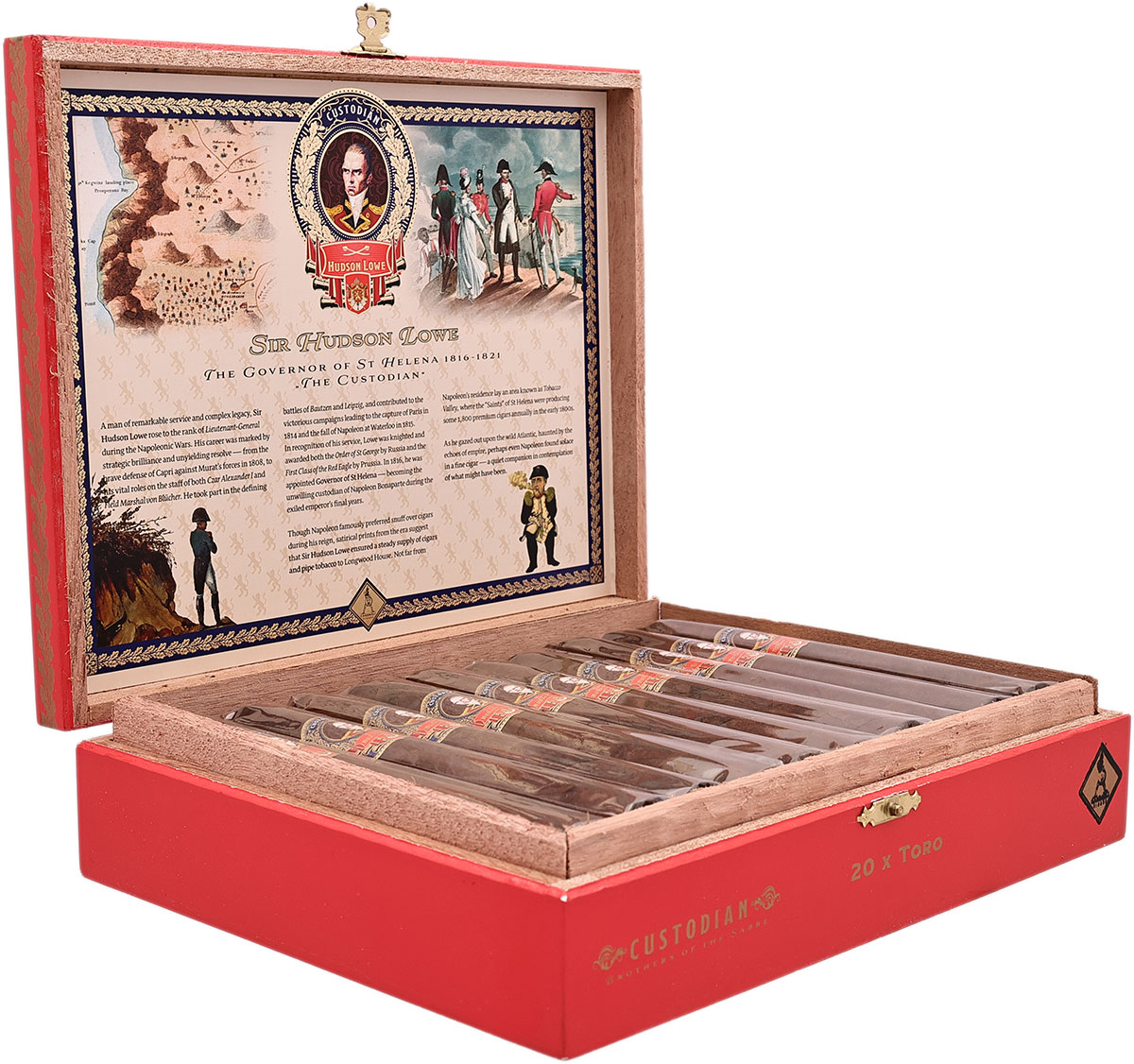
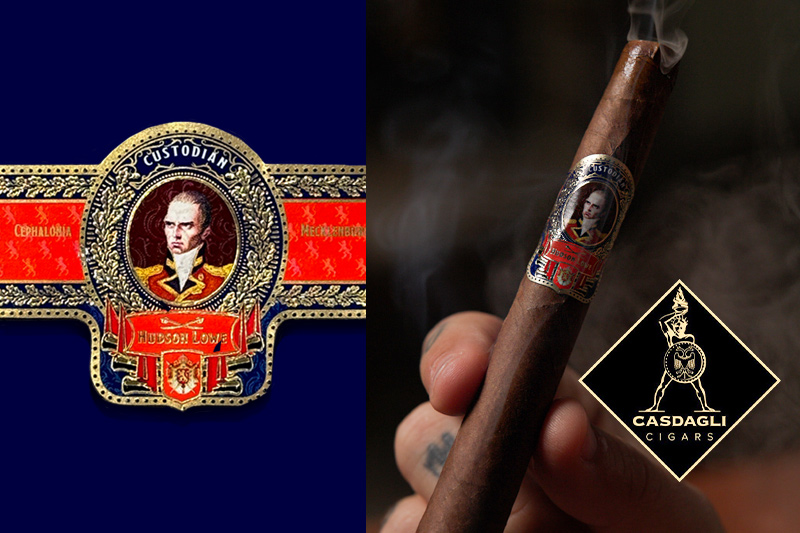
Alan Britt, Kane Coles, and I sat down with Jeremy Casdagli of Casdagli Cigars to smoke the Brothers of the Sabre Custodian, the newest addition to his series honoring the generals of the Napoleonic Wars. The Custodian pays tribute to Sir Hudson Lowe, the British governor of Saint Helena who guarded Napoleon in exile and, as it turns out, a member of Jeremy's own family.
Note: The following transcription has been edited for clarity and brevity.
Ambitious for a Morning Cigar
[Tyler Caldwell]: We're talking about a brand-new release from Casdagli Cigars, the Brothers of the Sabre Custodian, and what better way to learn about it than with the man himself, Jeremy Casdagli.
[Jeremy Casdagli]: Here we are having a nice morning cigar, which is quite ambitious, because this is one of the richer cigars in the series. As far as strength, I'd put it at about a three and a half out of five, so it's one of the slightly stronger ones. But it is smooth, so we're getting away with it.
Built Around Zimbabwean Tobacco
[JC]: Everyone was asking me when we were going to come out with a British general for this project. The British are one of the coalition armies, so they share a blend with the Prussian Blücher, the Forrader, and the Austrian Radetzky, the Vater. The French generals have a different blend.
This blend is built around a really unique filler from Zimbabwe. Many years ago, I had a business in Zambia, and we'd look over at Zimbabwe, the home of Virginia tobacco. About 10 years ago, someone made a hybrid of American Burley with a Corojo seed from Cuba, and it turned up in the Dominican Republic. The first time I heard of it was with the Kristoff Guardrail.
Hendrik Kelner Jr., our partner in the Dominican Republic, put this blend together for me. When that Zimbabwean tobacco turned up, he bought as much of it as he could for this project. About 10% of the filler is Zimbabwean, and he smoothed it out with some tobacco from the United States. He said it's not Pennsylvania Broadleaf, it's from Lancaster County, and that's all he'd tell me. It takes the edge off, much like Peruvian tobacco does for the Nicaraguan in some of our other cigars, giving you a full-bodied but medium-strength cigar.
Married in there are a couple of Dominican leaves, and the binder has a Kelner signature to it, because it's Yamasá. Then you have an Ecuadorian wrapper, a nice dark Colorado Maduro, and it marries beautifully with all of this.
A True Piramide

[JC]: For these projects, we always make two cigars for each general. So we have the Toro, and then a traditional Piramide that cones all the way down. That shape funnels a lot more flavor and richness to the palate. It's a very difficult cigar to make. It's all about getting to that El Dorado of rollers: something that cones down, is well-packed right to the top, and draws perfectly. We often call Belicosos and Torpedos Piramides, but a classic Piramide is this one, and there are very few true Piramides on the market.
[Alan Britt]: As soon as I saw the Piramide, I knew that's the one I wanted to smoke. I think you nailed it with this. It has that Kelner signature profile, and it's super rich and almost plummy, like sweet.
[JC]: Talk about molasses. We're dealing with tobacco here, so when people talk about sweetness, it's still got that inherent spice to it. But if you've had that black molasses syrup, that's what it reminds me of on the Piramide. People have been smoking the Toro on my tour through the States and going nuts about it as well, but I always like them smoking the Piramide.
Sir Hudson Lowe: The Custodian
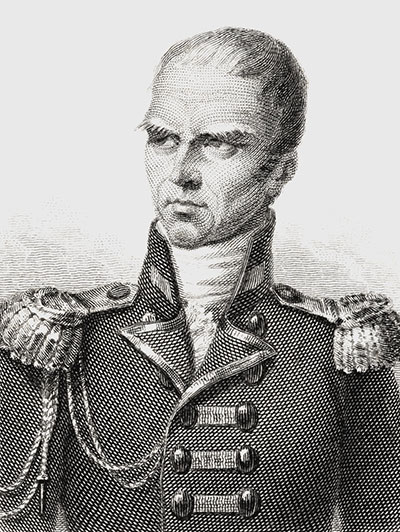
Sir Hudson Lowe
[AB]: Both times I've met you, Jeremy, I've really enjoyed talking history with you, and I'm particularly interested in the history of Sir Hudson Lowe.
[JC]: If you look at the life of Napoleon, Sir Hudson Lowe appears at the end of the story as the governor of Saint Helena. He was considered what we call a martinet: obeys orders, no sense of humor, no-nonsense. Napoleon died in 1821, and Hudson Lowe was sent off for a court-martial, which he passed. The family then went off to India and never really returned to England until the 1930s.
I know all of that because Hudson Lowe is part of our family. My grandmother on my father's side was Joyce Lowe. When I started the Brothers of the Sabre, the inspiration came from a school friend who's part of the Blücher family. Then at Christmas in London, my mother said, "I see you made a cigar for your friend. Why don't you do one for the family? Hudson Lowe. He's not the person you thought he was." I didn't know about this. And of course, every cigar in this project has to have a story, which I put in the lids.
The Case of Napoleon and Hudson Lowe
[JC]: I had to find a book that had been out of print since 1905, originally published by a British Army officer around 1870, called The Case of Napoleon and Hudson Lowe. Hudson Lowe was considered a disgrace. A couple of years ago in Togo, in French-speaking West Africa, I told people I was making a cigar for Hudson Lowe, and they said, "That murderer, the one that killed Napoleon."
When Napoleon died, they found arsenic in his hair, and there are many conspiracy theories about it. Hudson Lowe was sent back to London to answer for this, and for all the stories that he'd treated Napoleon disgracefully. He always referred to him as Bonaparte, never Emperor, and they only met a handful of times.
At his court-martial, Hudson said he called him Bonaparte under orders. As for the arsenic, he said, "Gentlemen of the court, Mr. Bonaparte was always very concerned about his hygiene, on campaign as well." Napoleon loved eau de cologne, and on Saint Helena they used to get it sent to him so he could bathe in it. Hudson went on, "I think you'll find that if you look at the recipe of eau de cologne, there's essence of arsenic in it. The Germans got him in the end, not I." And he was exonerated.
It was also discovered that Napoleon's Irish doctor had been sending letters back about how appalling Hudson was, because Napoleon wanted to be invited back. He never was, and his officers even apologized to Hudson Lowe two weeks before Napoleon died.
Napoleon's First Smoke

[JC]: It was on Saint Helena that Napoleon actually smoked tobacco for the first time. He was a great lover of snuff, and there's a little area called Tobacco Valley, very close to where he was held. About 1,800 cigars were made on Saint Helena during Hudson Lowe's governorship.
They didn't have photographs in those days, but they did caricatures, and there's one of Napoleon smoking that we put in the box. Underneath, it says, "Napoleon smokes and weeps with the fishes," and behind him is a little battalion of rats with muskets.
For this project, we name each cigar not after the general, but after what his soldiers called him. In this case, he was the Custodian. Hence the name.
Written Out of History
[JC]: So why was Hudson Lowe never brought back as the hero he should have been? In 1821, at a ball, an English lady asked Tsar Alexander, "So you knew that ruffian?" He said, "Ruffian? I call him friend, because I knew him during the most desperate times."
Hudson Lowe served in Egypt, and he raised a band of Corsican Rangers, from Napoleon's own island. He made his name in the desperate defense of Capri against Murat. When Murat eventually took the island, he refused to take him prisoner, saying, "You fought too well with your band of Corsicans and Maltese," and let them march out with honor. That's why we launched Murat alongside him this year, so they can meet again.
After the 1812 campaign, Tsar Alexander asked him to put together a division of Germans who had deserted Napoleon during that dreadful retreat. He then served on Blücher's staff at Bautzen and worked with Radetzky on planning the Battle of Leipzig. In the paintings, there's always a gentleman in a red uniform, and that's Hudson Lowe, but his name is never mentioned. Because he knew both armies, he planned their joint campaign into Paris, which sent Napoleon to Elba, and he was knighted for it.
In 1814, he foresaw that if France attacked again, the armies would meet at a crossroads called Mont-Saint-Jean, which we know as the battlefield of Waterloo. He built an embankment for defense there, and that's what saved Wellington's army, because the French artillery couldn't see most of the British, Dutch, and Belgian troops. But Wellington sent Hudson Lowe away before the battle, and when the embankment was dug up for the big mound with the lion on it, Hudson Lowe's legacy was wiped out with it.
Part of my mission is to exonerate my family member and put him back in a place of history where he belongs.
[TC]: And we're doing it one cigar at a time.
Blending to the History
[JC]: When I got in touch with Hendrik and said I wanted to honor the French and the coalition, the French were easy. I wanted something nice, light, and smooth, so we started from the Mareva Especial, a blend Marko Bilić chose for his Club Mareva, and tweaked it a bit.
For the coalition, I wanted something stronger that doesn't taste so strong initially, but creeps up, and suddenly at the end it kicks you a little bit in the ass. Kind of like the coalition did. So if you want the whole adventure, and we sometimes do events with the Brothers of the Sabre, you start with a French cigar, because they had the early victories, and finish with the coalition. It follows the historical narrative.
It's ridiculous, but that's me being a nerd. And after all, anybody listening to this, we're all nerds. We've got two more to come, a Russian and another Frenchman, and that will be the end of the project.
Why the Generals Smoked Cigars
[JC]: Cigars became de rigueur through the Napoleonic period for a very good reason. Pipes and snuff were more common, but the Kingdom of Spain was always a cigar-smoking place. When Napoleon took Spain in the Peninsular War, French generals like Ney served there and picked up cigars, and they took them all the way to Moscow and back. In the Navy, you can't just hurl your pipe overboard when something unexpected turns up, but you can lob your cigar.
Murat's cigar story is mixed up with one of the great bluffs of military history. He and Lannes, a pipe smoker, sat on Austrian cannons and quietly smoked as they strolled across the Tabor Bridge, convincing the Austrians on the other side that their emperors were at peace, so Napoleon could take Vienna.
[TC]: When it comes to cigars, almost everything has a story to connect to it. What I've always loved about you and your brand is that you go into intricate detail, with history and stories that aren't always synonymous with tobacco. On top of the artwork on your bands and boxes, and the uniqueness of the flavor profiles and tobaccos you use, that's why Casdagli is always unique in this industry.
[Kane Coles]: With the intentionality you put behind these stories and these profiles, that attention to detail adds a whole new level to the experience.
If you want a rich, deceptively strong cigar with a story worth telling, pick up the Brothers of the Sabre Custodian, available now at Smokingpipes.com.
You may also enjoy:



Comments