


 |
|
 |
|


A few months ago, back in maybe June or July, Tom Eltang called to chat. We talk pretty regularly, so this wasn't particularly unusual. After a few minutes of chit-chat, the conversation took an interesting turn. Tom dropped something of a bomb. He was done with the Golden Contrast stain after decades of using it as his primary—often his only—pipe stain. He'd developed an allergy to one of the components.

 But, after using it successfully for decades, Tom began to react poorly to it, both from the fumes while staining and from the dust resulting from the sanding process after the stain was applied. He started experiencing skin itchiness and tingling. Like nut allergies, apparently allergies to aniline can develop after decades of safe use. Of course, after it's dry and has been sanded, there's no risk of allergic reaction, so it isn't a matter of exposure to the pipes once complete, just a matter of working with the dye containing aniline.
So, the hunt for a new stain began. Tom started by buying stains, dyes and inks of various kinds from all over the world. By the time Dennis Mann and I arrived in his workshop a few days ago, he was running a test among three options, each with multiple different colors. The same two-part stain rules apply, of course. A black under-stain is followed by a lighter colored over-stain, which is then sanded off to create the contrast. He showed us three possibilities, all leather dyes, with each in two different colors, for the over-stain. All three (all six pipes) received the same black under-stain. For the purpose of the tests, the colors were less important than how the wood took the stain, so it was really a matter of making a decision based on factors other than color: adjusting the color is easy, finding the best stain for Tom's methods is the tough part.
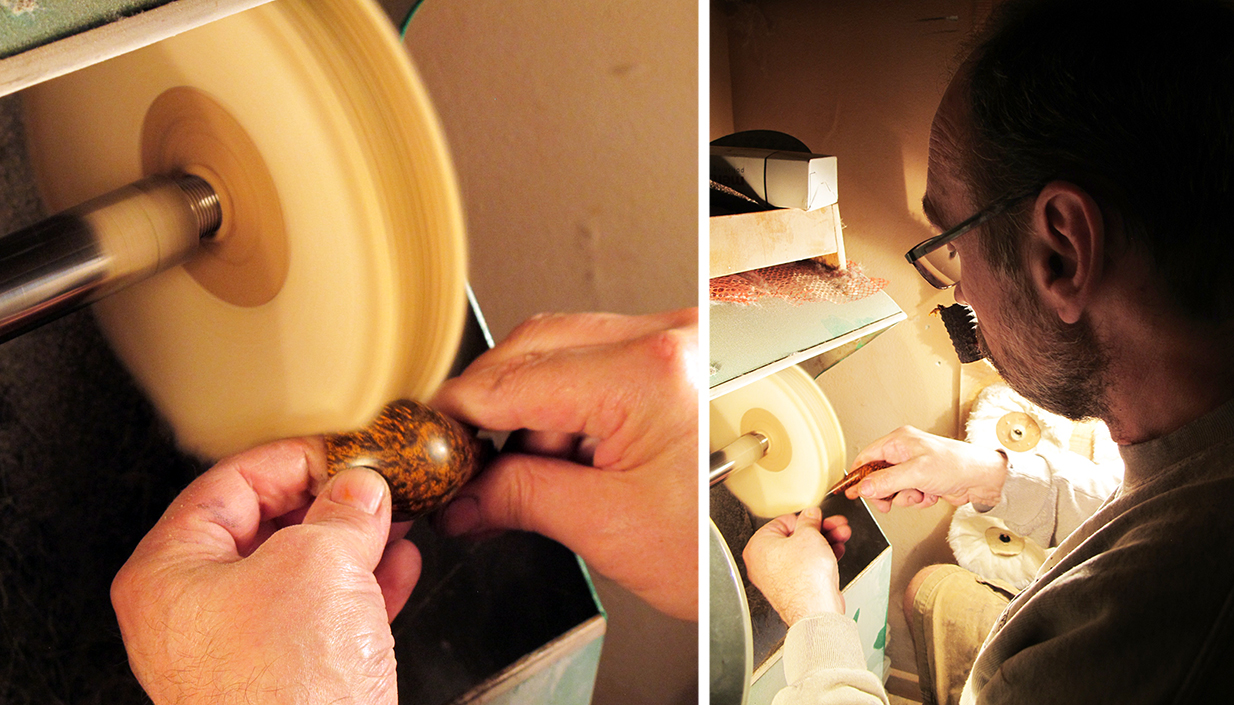
The three were leather dyes from companies in Italy, Denmark, and the United States. All came out looking good. The distinctions were fine; indeed, at a passing glance there was no difference before polishing. Tom finished the test pipes while I was writing the beginning of this blog post. The colors came out beautifully. All six were stunning, but these are fine grained distinctions. The American stain was the first to go; the colors just came out muddier than the other two. Ultimately, Tom opted for the Italian, which yielded slightly more vibrant results (but I couldn't tell any difference between the Italian and the Danish stain in terms of how the wood took it).
But the process doesn't end there. Tom has other experiments in the works, with different dyes with different properties. And he is still playing with colors. Even if he settles on the Italian leather dyes, he has to experiment with various shades of colors and levels of dilution to hit exactly the color he wants.
 Since nothing is yet decided, I can't say exactly what the final Eltang stain will look like. He thinks he'll probably end up using two or three different colors, selecting based on the shape, grain, or whatever he thinks is right for the pipe, rather than just one as he has for so long. I am quite sure that Tom Eltang's smooth pipes will be beautifully finished and his staining will continue to be some of the best in the world.
As Tom said, it's an interesting new challenge. He hasn't thought seriously about stains in decades; it's forcing him to explore aspects of pipe making that he simply hasn't had to contend with for most of his forty-year career. It was a privilege to witness part of that process.

Tagged in: Behind-The-Scenes Materials Pipe Makers Pipe Making Tom Eltang


Comments
The color on that test pipe looks like the eye of Sauron... I want it.
^ So True!
Can I understudy? x)
Absolutely amazing!! now I need to get an Eltang pipe :)
True Envy of pipe smokers including myself.