


 |
|
 |
|


Low Country Crescent Rising: Inspired by the Battle of Sullivan's Island


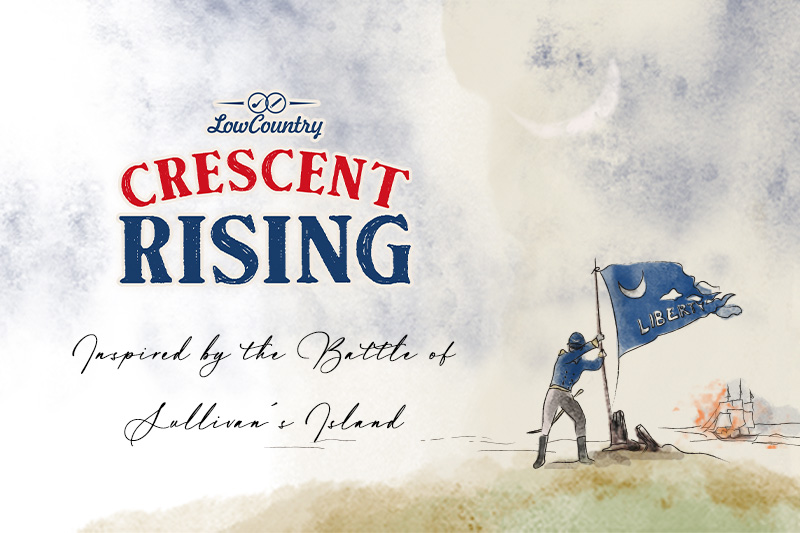
With the Moultrie flag valiantly raised after being struck down by British Naval bombardment, South Carolina's troops rose to the challenge at the Battle of Sullivan's Island in 1776, winning the Patriots' first major battle during the Revolutionary War. The latest Low Country blend, Crescent Rising, honors this historic achievement through a pure Red Virginia blend, and will be available in limited quantities on June 26 at 6:00 p.m. ET.
Moultrie and the Flag
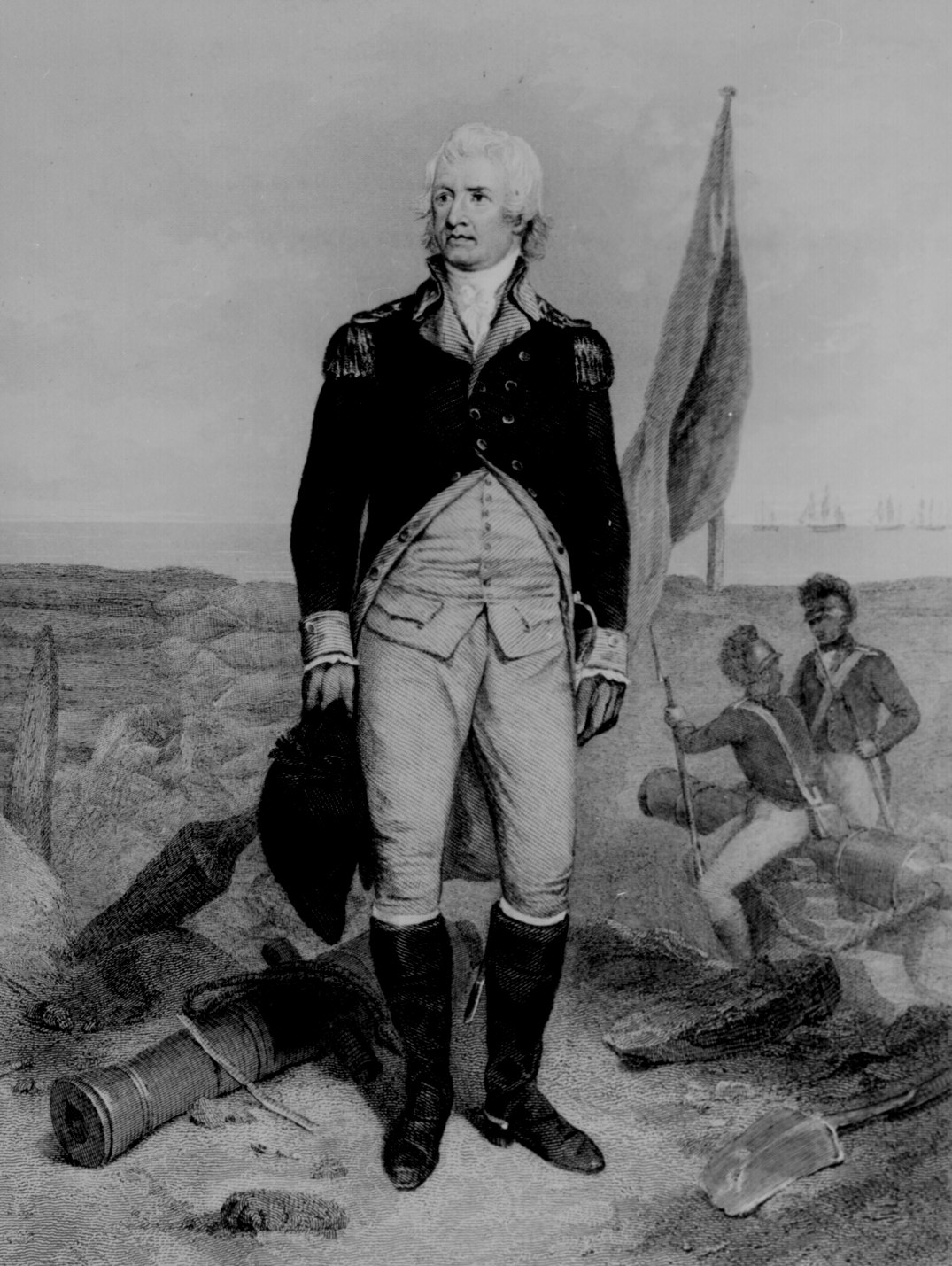
Colonel William Moultrie
To better understand what led to the Battle and this iconic victory, I asked Josh Burgess, Vice President of Manufacturing at Smokingpipes, and Sykes Wilford, CEO, for their input. Colonel William Moultrie, who designed the Moultrie flag in 1775 for the 2nd South Carolina Regiment, was a native-born South Carolinian. "He had seen military conflict in the Cherokee Uprising," says Josh, "but he was also active in colonial politics, serving in the South Carolina colonial assembly. As the colony began organizing its regiments for the Continental Army in 1775, he became a colonel, successfully defending the fort (still under construction during the battle) that would later bear his name." Post war, Moultrie made his return to politics and ultimately served as governor of South Carolina.
The blue-and-white design of this historic American-Revolutionary War banner matched the troops' uniforms — they wore polished silver crescent-shaped emblems on the front of their caps — featuring a blue background with a white crescent in the top left corner. "The flag Moultrie designed and its raising at the Battle of Sullivan's Island became a common and important symbol of the patriot cause in South Carolina history," says Josh, "and the South Carolina militia adopted it, keeping Moultrie's design (with the addition of a Palmetto Tree)."
Until 1861, South Carolina didn't have a state flag. The Moultrie flag inspired it, though their motivations were more negative than simply honoring the battle won. "When South Carolina seceded from the Union," says Josh, "keeping the design of the Moultrie was an attempt to appropriate the language of liberty and resistance to tyranny in the looming Civil War."
Battle of Sullivan's Island
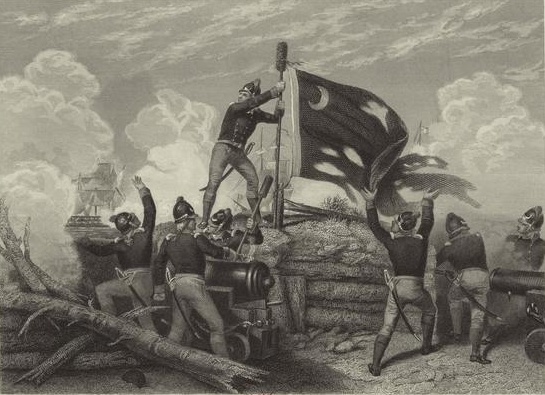
Sergeant William Jasper raising the flag over the fort, painted by Johannes Adam Simon Oertel, 1858
Prior to the Battle of Sullivan's Island, the British hoped to isolate the rebellion early in the conflict to the New England colonies. "As a part of that general strategy," says Josh, "General Henry Clinton led an attack on South Carolina early in the war — before the Declaration had even been signed — to establish a British foothold in the south." Their goal was to secure Charleston, a wealthy port city, and inflict economic pain on the colonies, "rallying loyalist support, which they vastly overestimated."
In late 1775, British expectations were that there was enough loyalist sentiment, especially among southerners, so that only a few regulars would need to be supported by loyalist militia. "Moore's Creek Bridge," says Sykes, "saw the destruction of the most promising (from the British perspective) loyalist militia — the Gaels of the North Carolina upstate — and Sullivan's Island utterly thwarted that campaign before it even started: the troops never landed and sailed back northwards."
The British organized an expedition in early 1776 to the southern colonies, arriving on the coast of North Carolina in May 1776. When they found conditions unsuitable for operations, General Clinton and Admiral Sir Peter Parker went to Charlestown (present day Charleston), landing on Long Island (present day Isle of Palms) near Sullivan's Island. Here, they encountered Colonel William Moultrie, who commanded troops of the 2nd South Carolina Regiment and a company of the 4th South Carolina Artillery, numbering 435 men.
During the Battle of Sullivan's Island on June 28, 1776, British naval ships approached and shot a signal gun around 9:00 a.m. that morning. Nine ships sailed into position, with Thunder and Friendship anchored around 1.5 miles from Fort Sullivan, while Active, Bristol, Experiment, and Solebay were led closer. They all began firing, and Moultrie's troops returned fire. Thunder's shots had little effect on the Patriots. According to David Wilson in The Southern Strategy: Britain's Conquest of South Carolina and Georgia, 1775-1780, Moultrie himself stated, "We had a morass in the middle, that swallowed them up instantly, and those that fell in the sand in and about the fort, were immediately buried." Thunder eventually broke out of its mounts due to overloading their mortars with extra powder in an attempt to increase their firing range.
About three hours later, Sphinx, Syren, and Actaeon were sent out on a roundabout route, yet were grounded on uncharted sandbars. None of them reached their intended position, which was fortunate for the Patriots. Moultrie stated: "Had these three ships effected their purpose, they would have enfiladed us in such a manner, as to have driven us from our own guns."
Moultrie's men concentrated fire on Bristol and Experiment, damaging Bristol in the process. In an attempt to destroy Fort Sullivan's walls, Admiral Parker attacked with broadside cannonades. However, this plan would also fail; due to the nature of the palmetto wood used to construct the fort, the structure would absorb the cannonballs. After a 10-hour long battle, the British withdrew to New York, not returning to South Carolina until 1780. British battle casualties exceeded 200, hurting their morale, and American losses totaled 12, with 26 wounded. The effectiveness of the palmetto trees utilized in the fort helped inspire the South Carolina state flag, which also features a palmetto tree.
Raising the Flag
.png)
Illustration of the flag from 1910
In a historic and iconic moment in U.S. and South Carolina history, Sergeant William Jasper raised the Moultrie Flag, or Liberty Flag, over the ramparts after it had been struck down by British Naval bombardment, rallying South Carolina's troops and reviving their spirits.
Sergeant William Jasper's genealogy and origins aren't known concretely, with several competing theories. What we do know is that he was a sergeant in the 2nd South Carolina Regiment at the Battle of Sullivan's Island. "He was in South Carolina by the 1770s," says Josh, "and served in a South Carolina regiment in the Continental Army, including at the Battle of Sullivan's Island."
They were victorious, and this win would help build momentum toward the signing of the Declaration of Independence, which we celebrate on this quarter-millennium anniversary.Significance of their Victory
"The Battle of Sullivan's Island was a really important chapter in the early Revolution," says Sykes. "It, and the Colonial victory at Moore's Creek Bridge near Wilmington a few months earlier, blunted British attempts to quickly reestablish control in the Carolinas and use them as a base for the campaigns in the north." The Southern Campaign later saw more success for the British. "But by then," says Sykes, "it wasn't about a quick reassertion of control in the face of minor rebellion: it was a protracted and bloody war. I think one of the most interesting things during the Revolutionary War is quite how unlikely its success was, particularly early in the conflict."
Josh shares how the most significant impact was psychological: "Patriot leaders in Philadelphia had a concrete victory over the world's most powerful empire to point to as they debated independence. The defeat was humiliating for the British. They, of course, lived to fight another day, but after Sullivan's Island, they largely withdrew from the South for the next three years."
In response to the first decisive Patriot victory over the British Royal Navy, General George Washington, who would go on to become the first President of the United States, wrote in his general orders of July 21, as quoted by the National Park Service:
This glorious Example of our Troops, under the like Circumstances with us, The General hopes will animate every officer, and soldier, to imitate, and even out do them, when the enemy shall make the same attempt on us: With such a bright example before us, of what can be done by brave and spirited men, fighting in defence of their Country; we shall be loaded with a double share of Shame, and Infamy, if we do not acquit ourselves with Courage, or a determined Resolution to conquer or die: With this hope and confidence, and that this Army will have its equal share of Honour, and Success....With such preparation, and a suitable Spirit, there can be no doubt, but by the blessing of Heaven, we shall repel our cruel Invaders; preserve our Country, and gain the greatest Honor.
Crescent Rising
Crescent Rising is a limited-edition blend with tin art inspired by the Moultrie flag, with the blue and white colors and the raising of the flag honored. The tobacco is comprised of three different grades of pure Red Virginias, ranging from Orange Red to Mahogany, all pressed before being sliced into delicate flakes. The experience is rich and round, with naturally toasty and citrusy notes, making it the ideal tobacco for summer celebrations, with an extra nod to history and a victory that helped pave the way to American independence in tandem with the 250th anniversary of the Declaration of Independence. Available June 26 at 6:00 p.m. ET in limited quantities.
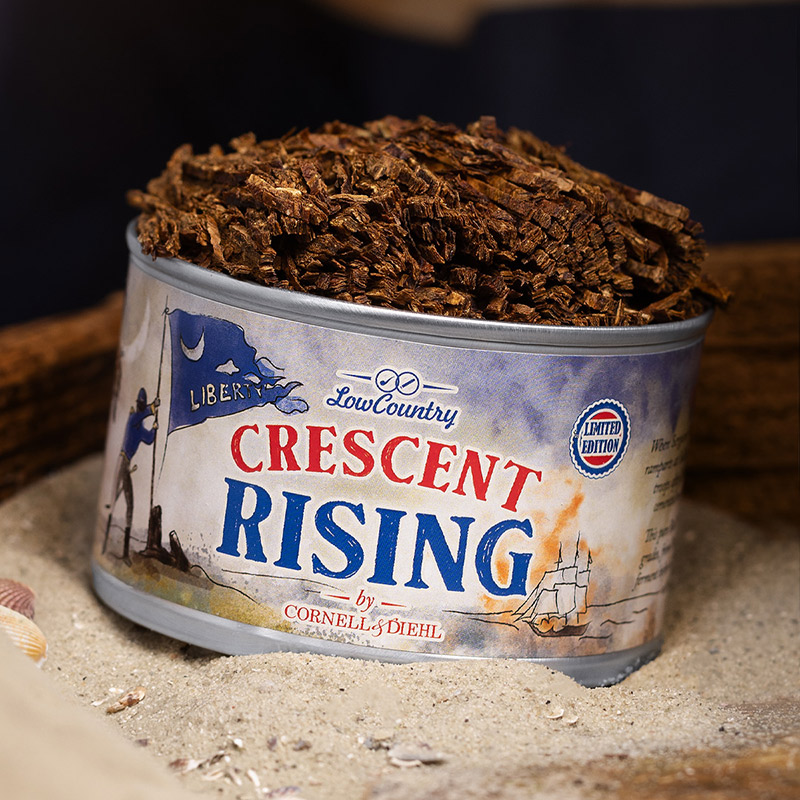
Available June 26 at 6:00 p.m. ET in limited quantities
Bibliography
- Battle of Sullivan's Island (U.S. National Park Service). National Park Service. (2021, April 23).
- Wilson, D. K. (2005). The Southern Strategy: Britain's conquest of South Carolina and Georgia, 1775-1780. University of South Carolina Press.
You may also enjoy:





Comments
Your presentation is wonderful! I love Cornell and Diehls history themed pipe tobacco. Im just finishing a can of Blockade Runner.
I’m a descendant of General William Woodford. He was captured and died on a P.O.W. ship. I’m always thankful for his and all that gave us a nation! I love the low country!
A very interesting and timely article. I now understand the design and history behind the unique South Carolina Flag. I noticed this battle ocurred before the Declaration of July 4th. The British should have learned from that conflict not to underestimate the resolve of tobacco farmers defending their homeland. Kudos to C&D for dedicating a pipe blend in honor of this battle.