


 |
|
 |
|


Small Batch: Carolina Red Flake 2026 — New World Meets Old World


Carolina Red Flake, Cornell & Diehl's annual Small Batch release, celebrates its 10th anniversary with an inspired tribute to flue-cured tobacco. Since its inception, CRF has represented C&D's perspective on the possibilities and flavors achievable in an all-Virginia blend. For 2026, C&D created a blend that reaches beyond domestic borders and traces the trade routes that made flue-cured tobacco a global crop.
Cornell & Diehl's Small Batch: Carolina Red Flake is available as of September 22 at 6:00 p.m. ET in limited quantities.
10 Years of Carolina Red Flake
In the course of a decade, Carolina Red Flake has taken many forms. Incapable of resting on their laurels, Cornell & Diehl has iterated again and again on a single theme — a blend made of all-Virginia tobaccos. Jeremy Reeves, Head Blender at Cornell & Diehl, explains: "A lot has changed. The first Carolina Red Flake happened because I was trying to find a new grade of Red Virginia to be our mainstay Red for regular production."

At the time, circa 2015, C&D's supply of a particularly choice vintage of Red Virginia was dwindling, so in an effort to find a replacement, Jeremy Reeves began exploring a variety of different options, tapping his sources for samples that would meet his requirements. "I didn't want to find something totally outside the norm and have everything change, but it set the bar pretty high for whatever we replaced it with."
During that process, Jeremy found a grade that was particularly unique. "It reminded me of rye bread, with a really pronounced caraway-like, spicy quality that was unusual. I liked it so much I turned most of that five-pound sample into flake, and I still have some of what we made from it. That leaf was the first Carolina Red Flake, and it was used again in the second iteration in 2017."
The process of discovery led Jeremy to play with the endless complexities of flue-cured tobaccos:
Which leads us to 2026's Carolina Red Flake — the first iteration to feature Virginia leaf from outside of the U.S. "Because of that wide breadth available even within pure Virginia, I started by showcasing what a very fresh harvest could be in a flake, then moved on to working with different vintages and blending two or three grades together — really just showing the range of flavor profiles achievable using flue-cured leaf alone. But this year is the first time we've gone outside the U.S. for some of the leaf."
The International Traveler
The history of Virginia tobacco, and tobacco in general — given that it originated in America — is as rich and fascinating as the leaf itself.
Unlike cotton, sugar, and rice, tobacco wasn't as restricted by its growing conditions — it didn't require as specific an environment as, say, sugar, which required a subtropical climate and considerable investment, in terms of both labor and capital.
Josh Burgess, Laudisi's Vice President of Manufacturing holding a PhD in colonial American history, explains: "Tobacco was different. It could be cultivated over a relatively broad area, it did not require an enormous processing infrastructure at the point of production, and the finished leaf was comparatively easy to transport. That combination made it an exceptionally attractive colonial cash crop."
Not only was tobacco a supremely profitable crop, the finished product was easily exportable to the old world — meaning the raw seed could be carried from region to region. "Tobacco is actually a fascinating example of an early global commodity because the plant itself was so portable. Once someone acquired viable seed, they could try growing it somewhere else. If the climate and soil cooperated, a new tobacco-growing region could develop without having to remain dependent on imports."
The Spanish and Portuguese were the first to encounter tobacco; the Spanish spread it across their territories; the English cultivated it as an industry in North America; and the Portuguese carried it along their trading routes, bringing it to India, Brazil, and parts of Africa. "Once Europeans had the plant," says Josh, "its spread became much more complicated than simply shipping finished tobacco around the world. Seeds were carried to places where Europeans thought the crop could be cultivated commercially."
The result was a crop that was fairly universal, and was desired by much of the world. The new world was its birthplace, but the old world, as we know it today, desired tobacco and wished to cultivate it in a way that made it their own. With that came a world of new, vibrant tobacco — one source, many iterations.
The Global Crop
"Tobacco, like tea," says Jeremy, "has gone all over the globe, and it's different in different places because of the weather, the soil, and the choices growers make about cultivation and curing. Fundamentally it's one plant — Nicotiana — but it responds to its environment and develops different traits depending on where and how it's grown."
Unlike other types of tobacco, Virginia tobacco is universally favored by growers; it's appreciated for its sweetness and is utilized in a variety of different tobacco mixtures. Virginias prefer sandy soil, which doesn't retain a high percentage of water, meaning the plant itself has to work hard for its energy and nutrients. In that process, it produces excess sugars, making it highly valued by cultivators.
Enter flue-curing: the process by which Virginia tobacco's sugars are preserved. Jeremy explains: "With flue-curing, you set the sugars first by spiking the heat — like caramelizing sugar on top of a crème brûlée — letting them bake in and hold, then slowly drawing the temperature down and back up over time. You still get the curing you want — losing the chlorophyll and ammonia you don't want — while preserving as much of that sugar as possible. That's flue-curing."
Carolina Red Flake 2026
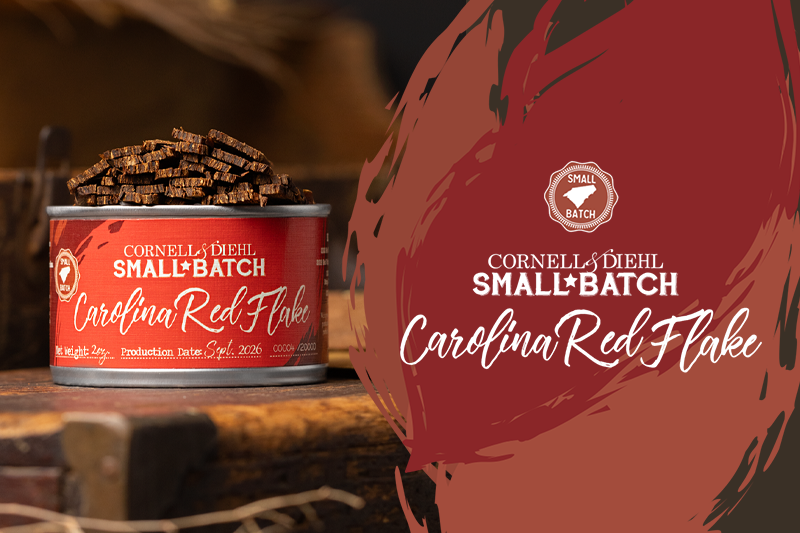
Jeremy, as Head Blender, is always looking for unique leaf, specifically leaf with some age on it — something that's off-the-beaten path. For 2026, he got his hands on two particularly interesting Virginias: fermented Brazilian leaf from 2023 and 2010 hand strips from India.
"The Brazilian leaf is especially dark, rich, and mellow — a soft flavor profile but with real depth. Think of the difference between a Zinfandel and a Cabernet Sauvignon: big, rich flavor, but rounded edges. Not much dry spice — more rich, lush sweetness." Similar to pilón-fermented cigar tobacco, this Brazilian leaf is fermented in large batches and constantly reorganized, with the temperature maintained throughout the lot for consistent fermentation.
Jeremy is particularly excited about the Indian hand strips in this year's blend: "Finding aged tobacco in raw form is increasingly difficult these days. The tobacco industry overall is shrinking, and COVID-19 had a real effect too. Before 2020, companies would often have a few cases on hand of tobacco that was three or four years old. I've been able to find a few things with real age here and there, but it's getting tougher. When something is good and comes in a small, specialized lot, we bring all of it in-house as soon as we get it."
The Indian hand strips counterbalance the starkness of the Brazilian leaf. "The Virginia hand strips are a little brighter by comparison — even with their age, they're a bit zesty, with that lemon-peel quality Virginias can have. Rather than fresh-grated lemon peel on a salad, think lemon curd — still lemon, but richer and darker."
These counterpoints are incorporated with two longtime CRF staples: 2019 Georgian leaf and 2022 North Carolina tips. The Georgian-grown Red Virginia tobacco boasts a deep sweetness that, on its own, could be one note, but as a component in the blend, it provides a complementary depth to the other tobaccos.
The tips — the smaller, newly grown leaves at the top of the stalk — are from a 2022 North Carolina crop. Since they're at the top of the plant, they receive the most sunlight and provide an intense brightness to the blend, lifting the other notes in the tobacco.
"Honestly, all the tobaccos here are special and unique — the whole is greater than the sum of its parts."
Even after 10 years, Cornell & Diehl has continued to find new ways to keep Carolina Red Flake fresh and interesting — a testament to the depth and nuance of flue-cured tobaccos. With the 2026 iteration, CRF reaches new heights, expanding to encompass the global history of Virginia tobacco itself, all while remaining true to its core: the finest flue-cured tobacco, blended to perfection, right here in South Carolina in the heart of old tobacco country. It's great right out of the tin, and it'll only continue to deepen with time and age. This year's edition of Small Batch: Carolina Red Flake will be available on September 22 at 6:00 p.m. ET in limited quantities.
You may also enjoy:





Comments
Hope I can get my hands on this . Do you think with all the proceeds from these hype blends, SmokingPipes could afford some additional servers to handle the traffic ? It’s pretty awful that regular consumers have to lose out in queue to the bots and scalpers
Hi Jared:
One of our brothers on the YTPC gave an update early last week that "apparently" ( we will see won't we) SP has made improvements to its server so we don't face the same shennanigans previously experienced where users were stuck trying to get to the website. Tobacco stained fingers are crossed! LOL
The problem is that I‘m no longer able to buy this wonderful CRF blends because of the hight customs duty. Thanks to Trump -:) -:).
The tariffs are imports into the US, not exports. The customs and duties you are paying are based on your country's laws and policies. This is why European tobaccos cost drastically less in America vicet US imports in other countries. Stop letting your government gaslight you.
I’d really like to see Smoking Pipes lower the tin limit so more customers can get this. Don’t see that happening though … smh.