


 |
|
 |
|



If you've ever smoked or handled an artisan pipe, you know something about Jess Chonowitsch. Maybe you've never met him; maybe you've not heard the name, but you know Jess because he contributed to design elements in the pipes you most admire. For almost 60 years, his skills and innovations have been acknowledged as among the best the world has seen. His influence and impact on pipe making have been profound, and he accomplished it with humility, quiet charm, and a dedication to precision that has left pipe enthusiasts breathless.
Jess passed away on November 28, 2025. His pipes remain to remind us of his dedication to craftsmanship, each a token of his unending quest for perfection.
Jess Chonowitsch's love for animals set him on a path to become a veterinarian in his youth, but the school closed down in the middle of his studies due to building integrity. He needed to make a living while waiting for the school to relocate, so he joined his father, pipe maker and tobacconist Emil Chonowitsch, who was learning additional pipe making skills with the famous Poul Rasmussen. Jess was learning from the best from the beginning, and Rasmussen's preference for traditional shapes would be a lifelong influence.
Emil left to pursue his own pipe making, but Jess stayed on with Rasmussen, who had become ill and would die a couple years later. Jess helped Anne Julie, Rasmussen's widow, figure out how to run the shop. She learned and became a famous pipe maker herself.
From there, Jess moved on to the W.Ø. Larsen pipe factory, which he didn't enjoy because it was a constant grind to produce mouthpieces and endlessly sand stummels to complete the designs of others. If Jess wasn't figuring out his own designs, he wasn't fulfilled. He found Sixten Ivarsson, arguably the most influential pipe maker who ever lived, and asked if he could work there. Sixten said, "Yes, but you don't get any money until you can make a pipe I can sell with my name on it." Jess agreed. It meant working at the Larsen factory in the mornings to earn and working at Sixten's in the afternoon to learn.
It took six months for Jess to make a pipe that Sixten approved. It was an honor to produce a pipe good enough for the "Ivarsson Product" stamp, and Jess continued with success after success. But then it was time for his mandatory military service, and he left the shop for 18 months. When he returned to civilian life, he returned to Sixten, but not to Larsen. He was done with quick-turnaround factory work. He liked investing whatever time necessary to get it right.
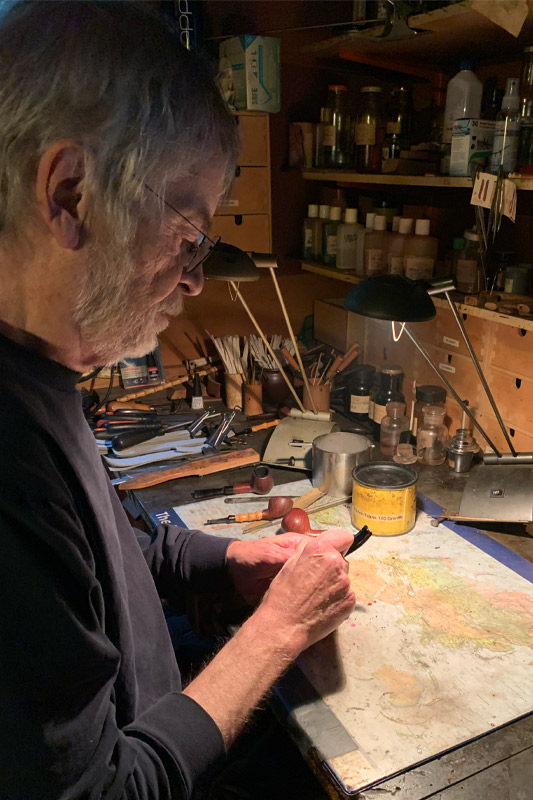
It was 1970 when Jess was walking down the sidewalk and glanced into a shop to see a young clerk who would change his life. He kept making excuses to walk by until finding an opportunity to meet Bonnie. They married soon afterward. They bought a beautiful story-book home with a thatch roof and opulent gardens, and Jess built a workshop. He kept working for Sixten for a while and began making his own pipes, and some of them began reaching the United States and other countries because the high quality was unmistakable. He became an independent pipe maker and contributed several shapes to the Stanwell catalog as his business and reputation grew.
Many collectors point to Jess's consistent use of simplicity and understatement as identifiers of his style, and that can be seen in his traditional shapes. His Billiards and Dublins and other shapes are recognizable from a distance as Chonowitsch interpretations. His lip buttons and their draft holes have become widely emulated, for example, but even so, a practiced eye can easily discern a Chonowitsch. One modification he often introduced to classic shapes is a rounded, smooth rim on sandblasted pipes. Billiards, for example, typically possess flat rims — but Jess needed to make the shapes his own, and many other pipe makers have echoed his design ideas. "It's funny," says pipe maker Jody Davis, who spent substantial time in Jess' shop to learn from the master. "I don't round my own rims specifically because Jess made it so popular. I wanted to maintain my own style so I avoided that." Pipe makers not only emulate Jess, but avoid doing so because Jess' designs have become so recognizable.
As for bamboo shanks, Jess improved on those as well, choosing exactly the right colors and proportions with nodes of just the right character to be attractively sealed, all sanded and perfectly fitted. Bamboo was often clunky and ugly and misproportioned before that; Jess brought the technique to a level of elegance. "Materials and shape could never be 'good enough' for Jess," says Sykes Wilford, CEO at Smokingpipes and Jess' longtime friend. "To take but one example, the bamboo he used had to be perfect; the thickness of the skin of the rhizome had to be just right, the culms of the knuckles had to be at exactly the right state of maturation — beginning to sprout, but not sprouted — and the shape of the bamboo had to be regular, with tightly spaced knuckles. Jess didn't settle for the next best available substitute; he would just stop using a material if he found the quality lacking."
Execution was among Jess' chief strengths, and it's perhaps the main reason his pipes have attained such lofty status. His designs never became outlandish; he relied on the perfect execution of simple elements, and he became expert at recognizing deficits.
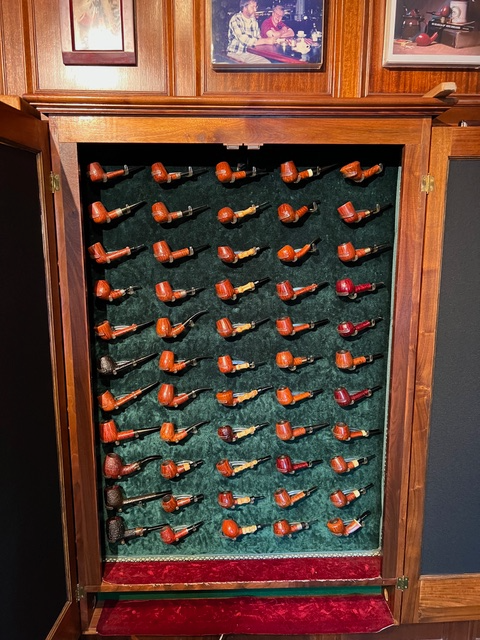
Rick Newcombe's Jess Chonowitsch Collection
Author Rick Newcombe is another friend of Jess', one who tirelessly promoted Jess' work when few in the U.S. had heard of him. He tells the story of displaying some of his collection of high-grade Danish pipes at a pipe show when Jess walked by and glanced at one of Rick's Billiards. "I won't say who made it," says Rick, "but it was a highly reputable brand." Jess asked if he could handle the pipe, and Rick encouraged him to do so. Jess pulled a matchbook from his pocket and picked up the Billiard. He slipped the edge of the match cover into a gap between the mouthpiece and shank on one side. "It was impossible to see," says Rick, "yet Jess saw it immediately."
Another aspect of Jess' craft is the amount of time he invested. "Nikos Levin told me a story," says Rick, "about visiting Jess and Bonnie. They were in the workshop and Jess was doing the finishing sand on a bowl, just the final details. Nikos and Bonnie went to the house and watched a Clint Eastwood movie. It was three hours long, and when it ended, Jess had still not joined them. They went back out to the shop to check on him, and Jess was in the same position, still meticulously fine sanding the same section of that bowl."
Jess' influence on other pipe makers is undeniable, and that is perhaps most noticeable in American pipe making. Both Jeff Gracik and Jody Davis famously studied with Jess and they have themselves influenced pipe makers not only in the U.S. but around the globe. Before that, American pipe making was less sophisticated. Mike Butera, J.T. Cooke, and a couple of others were doing great work, but only after Danish influence found its way to the U.S. did we start seeing American pipes that could compete on the world stage in terms of aesthetics and engineering, and Jess' pipes were at the forefront of that revolution because they were so admired by a new generation of American pipe makers.
"When I was learning pipe making," says Jody, "I used to hang out at UpTown's Smoke Shop in Nashville, and they had all those high-grade Danish pipes; they were exclusive distributors for many of them. They'd call when a new shipment came in and I'd go see them — Jess in particular. I remember thinking, This is how I want to make pipes. The perfection of what Jess did was amazing. Simplicity and perfection. Never garish or outrageous, just really great design and execution. His craftsmanship was among the biggest influences on me as a pipe maker."
Generosity was among Jess' defining characteristics. He always had time for younger pipe makers seeking advice. "When I started," says Jody, "it was hard to get materials. UpTown's got me on the phone with Jess, and Jess started selling me briar and German ebonite. That went on for a number of years. It was a gracious thing to do for somebody like me who was starting out. He allowed me to come to his shop and stay in his house. They were the sweetest people. A man of few words but an amazing artist and craftsman, and a huge influence on me and I know a huge influence on Jeff Gracik. I don't know that I would be a pipe maker today without Jess."
"I'm tremendously grateful to Jess," says Jeff Gracik. "Not only did he provide shaping advice and a better understanding of a shape-based approach, but he inspired me with his generosity and hospitality."
Jess arrived at the beginning of his career to a pipe making world in flux. "Beginning in the 1950s." says Sykes, "and continuing, arguably, today, Sixten Ivarsson's Functionalist reimagining of what pipes could be began a revolution in Danish pipe making, which later spread globally with the advent of the internet beginning in the early 2000s. Jess Chonowitsch was that movement's most conservative aesthetic voice. He was to a great degree more of a Functionalist even than Sixten, emphasizing minute, tiny details of shape and materials, bringing his meticulous attention to bear on details of pipes and pipe making that few even know exist. Jess Chonowitsch was a minimalist and a perfectionist, an artist who believed, per the Functionalist architect Mies van der Rohe, that 'God is in the details.'"
Rick Newcombe echoes Sykes. "Chopin said that masters know how to simplify things. That was Jess Chonowitsch. The simplicity that comes from totally mastering your craft."
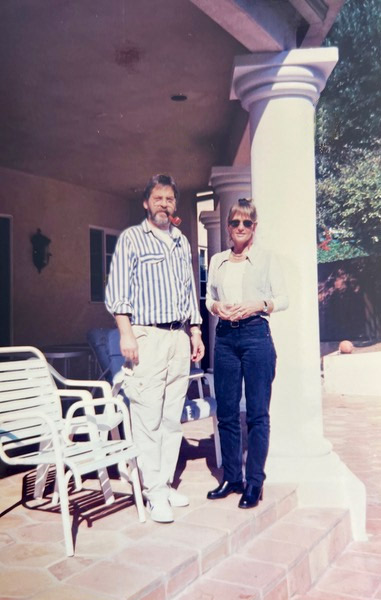
Jess and Bonnie
Jess and Bonnie traveled together to pipe shows, and they visited the U.S. 18 times. They were always together and theirs was a touching love story. Sadly, in 2006, Bonnie became ill with ALS (Lou Gehrig's Disease). It halted Jess' pipe making while he was at the height of his powers. He was dedicated to his wife, and spent the next six years caring for her. When she passed, he spent another two years recovering and made only a few pipes. He never returned to his previous output.
"Jess said that after Bonnie died," says Rick, "his life was effectively over. She was the love of his life."
"For Jess," says Sykes, "there was little separation from the joy he took in life and the joy he took in his pipe making; if he could not find that joy, he could not make pipes. And that joy left him with Bonnie's decline and it was never fully recovered. Jess and Bonnie enjoyed a marriage that brought them joy and brought joy to those around them; with her illness, they were both ill, and with her passing, he was left with only half of himself."
If the universe is just, Jess and Bonnie are together again, but those of us left behind find ourselves in a world where there's a little less magic, a little less devotion to craft, and a little less commitment to the pipe community. Jess Chonowitsch embodied those qualities. In a world where the word "master" is too casually awarded (everyone seems to be a blending or carving master these days), there is no other way of describing Jess' contributions to pipe making. He was a genuine master.
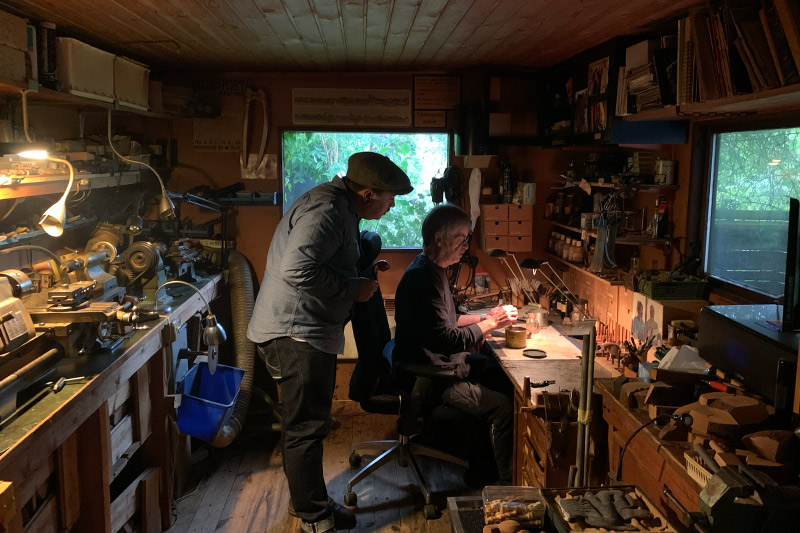
Shane Ireland and Jess Chonowitsch in his workshop
You may also enjoy:






Comments
This is a wonderful tribute to Jess by Chuck Stanion. When I told Chuck that Jess felt despair after Bonnie's death, I wish I had added what he said next: "My children and grandchildren are keeping me alive."
They are such a close family and an inspiration to those of us who were lucky enough to meet them.
My display cabinet shows acquisitions made one at a time over a period of many years. The key is one at a time, which is how Jess made them. You have to study his pipes one at a time, slowly, to appreciate the complex details that he made look so effortless. He took his time and never rushed the process.
Leonardo da Vinci must have anticipated Jess Chonowitsch when he said, "Simplicity is the ultimate sophistication."
Learned about Jess years ago because of your book. The Pipe community lost an actual legend
The first true master I learned about when I started pipe smoking.
Thank you for such a beautiful article about a wonderful man. I’m so grateful I knew him, and Bonnie.
What a wonderful tribute memorial. He will be remembered as the warmth of his pipes and those he influenced fills our hands
.
Good day!
I really want to buy your pipe
Very-very want!)
One of Jess's pipes just sold for $2,994.83 on eBay.
I am interested in pipes and tobacco