EN
EN
 JA
JA ZH
ZH





 All New Pipes

















Ask a question about this product.
Measurements & Other Details
- Length: 10.00 in./254.00 mm.
- Weight: 3.20 oz./90.72 g.
- Bowl Height: 4.00 in./101.60 mm.
- Chamber Depth: 1.65 in./41.91 mm.
- Chamber Diameter: 0.75 in./19.05 mm.
- Outside Diameter: 1.75 in./44.45 mm.
- Stem Material: n/a
- Filter: None
- Shape: Freehand
- Finish: z_N/A
- Material: Briar
- Country: United States
About This Pipe
Of course, that period of silent reverence was followed by banshee-like whoops of admiration, but for a brief few seconds, the pipe causes us to actually act like the professional, astute experts we pretend to be.
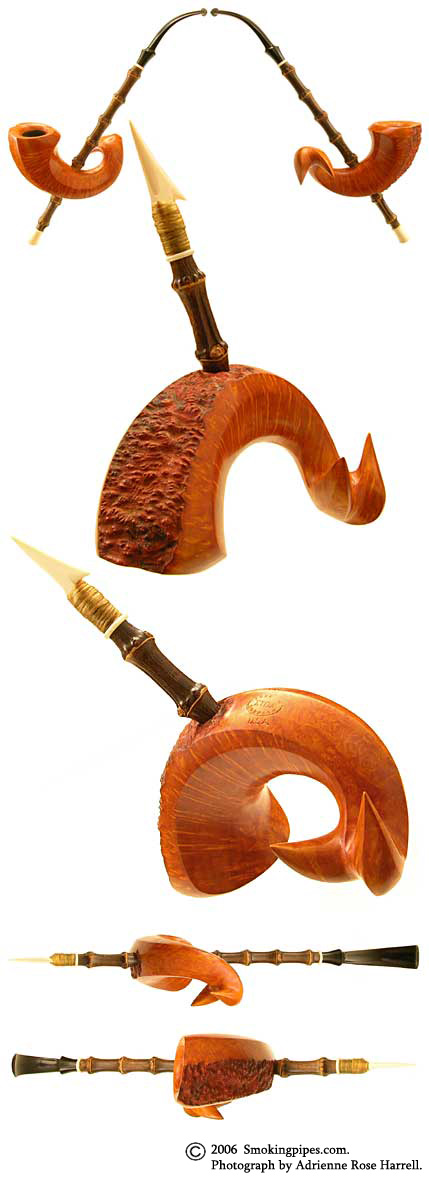
Pipes are inherently simple objects and, in their simplicity, they tend to cohere aesthetically. As the complexity of a pipe increases slightly, the danger of visual incoherence (or visual imbalance) increases substantially. Further, as the piece ceases to be simply a pipe and becomes an object of abstract art, the complexities, and dangers for the pipe maker multiply, since the overarching aesthetic theme must be met along with the underlying necessity for visual balance. And it is with all of these things in mind that we must assess this pipe. Not only is Todd's composition visually striking and well considered, it holds true to both the theme of Speared Fish in abstraction and resonates with the Arctic themes stated in the name of the piece and intonated in the choice of materials-- from fossilized ivory to sinew.
Todd isn't the first pipe maker to explore the ideas presented by mimicking the forms of aquatic creatures. Kei'ichi Gotoh did so with his Sio-Yaki (bamboo or other material piercing both body and tail of the pipe) series of pipes and Teddy, contemporaneously, did so with his Whale and Seal theme (focusing more on the animal). Indeed, Lars' fish shape of decades ago, now a standard Danish-Japanese-American high grade theme, was aquatically inspired. So, where does this piece, which by any measure is extraordinary, fit into this pantheon of pipes inspired by Poseidon's creatures?
If we consider this composition both synthesizing and, in other respects, departing from the respective styles of Teddy and Gotoh, then we're getting close to understanding it. While possessing some of the organic predilections of his mentor Tokutomi, Gotoh is a structuralist, architectural designer of pipes. His pipes, while exhibiting some organic elements, are formal compositions-- the will of the maker is visible in the creation. And yet, because of his Japanese artistic roots, he maintains an inherently Eastern sense of visual balance. So, we have Gotoh's Sio-Yaki, which combines a structured approach to design with a Japanese approach to symmetry and asymmetry, plus, at the same time, right around the world in Denmark, Teddy was playing with an entire series of shapes based on aquatic forms. True to his Western-Modernist aesthetic roots, these pieces were more formal and more abstract than Gotoh's.
So in looking at the above pieces, we can clearly see the artistic antecedents for the Inuit. Todd combines the pliability of the Teddy with the overarching structure of the Gotoh. We can see this in little ways. Todd seems to employ negative space (around the tail, especially) in much the same way Gotoh, or, for that matter, Tokutomi would. Yet, he still has a distinctly Western approach to the combination of various textures-- the way the plateau base is handled in combination with the smooth portions of the bowl exemplifies this.
His use of black bamboo, a material almost unique to Todd, furthers the juxtaposition of colors and materials in a way that neither Teddy, nor Gotoh, would. The rough-hewn appearance of the black bamboo, especially in concert with the inherently rough sinew, contrasts sharply with the incredibly fine, careful shaping and finishing of the bowl-- literally giving the impression of a sleek fish juxtaposed against a rudimentary, crude spear. Further, Todd does seem to be pondering the interplay between the organic and natural and the crudely man made, which, of course, suggests an ironic, if understated, conception of the piece on Todd's part. And irony is achieved at a yet deeper level in that the modernist components of the composition are the most organic.
So, we find ourselves back to our question of aesthetic synthesis. The composition is undeniably complex, both in terms of its physical structure and its underlying artistic significance. There's no question that the composition coheres visually, but in trying to synthesize these various aesthetic strands, while making a larger metaphorical point, Todd Johnson has attempted something far more challenging than simply attempting to make a pipe 'work'. We'll leave you to decide whether he's accomplished all of these ambitious goals, but we certainly think he has.
-- Bear Graves & Sykes Wilford