EN
EN
 JA
JA ZH
ZH





 All New Pipes



















Ask a question about this product.
Measurements & Other Details
- Length: 5.60 in./142.24 mm.
- Weight: 1.40 oz./39.69 g.
- Bowl Height: 2.07 in./52.58 mm.
- Chamber Depth: 1.80 in./45.72 mm.
- Chamber Diameter: 0.75 in./19.05 mm.
- Outside Diameter: 1.49 in./37.85 mm.
- Stem Material: Vulcanite
- Filter: None
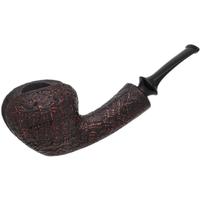
- Shape: Horn
- Finish: Sandblast
- Material: Briar
- Country: Japan
About This Pipe
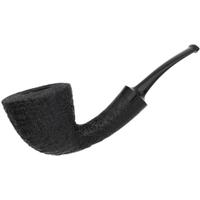
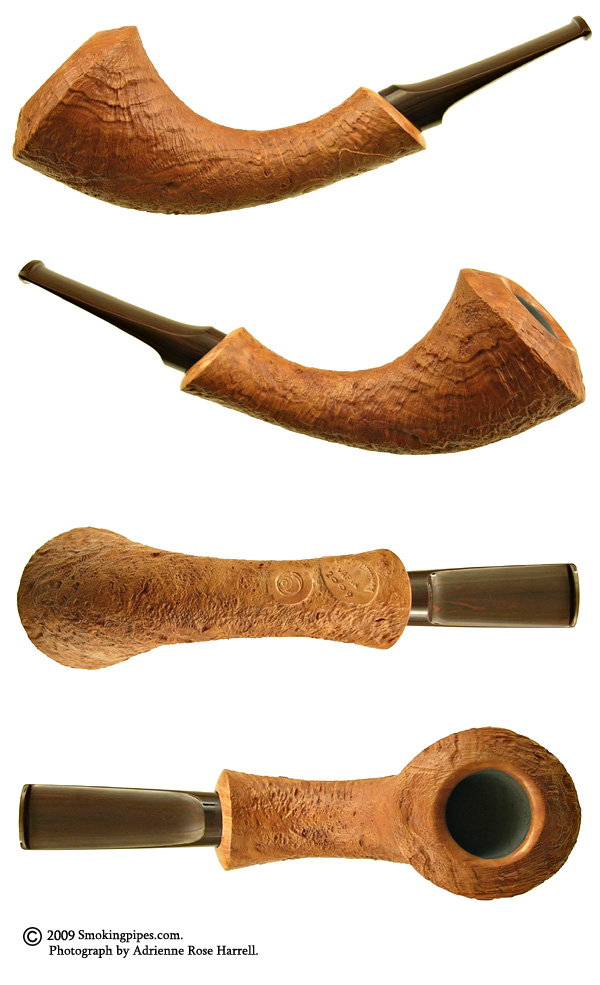
This particular piece does not seem to specifically reference a Danish pipe maker, but the overarching ideas at work here are certainly within the Danish oeuvre. It references a specific design or maker only inasmuch as all horns that have happened since refer implicitly to Sixten's first paneled horn shape that, one could quite reasonably argue, was the first modern 'freehand' pipe (freehand in that it couldn't be shaped on a lathe, not freehand in the 1970s fancy freehand style).
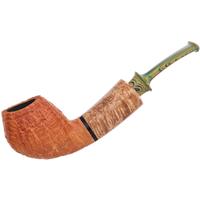
The angle of the back of the shank on this piece, referencing the cant to the top of the bowl, the dome of the bowl, the line at the back of the shank, makes the pipe. All of the various angles and components reference each other. Nothing is distinct. Nothing could be changed without radically altering the composition. All of the components work together, harmoniously in an array of interlocking aesthetic references. Even the saddle of the cumberland stem echoes that angle at the end of the shank.
Tokutomi's pipes frequently seem haphazard or wild to the uninitiated. It's important to remember, and pipes such as this certainly reinforce that, that while Tokutomi works within a very different artistic framework from that of the Danes, he is extremely deliberate. His aesthetic ideas are not random; nothing is left to chance.
This extends into the color and texture considerations, of course. Tokutomi doesn't use cumberland as a stem material very frequently, but it's the perfect choice here, softening the composition as it is paired with a light brown stained sandblasted bowl. The sandblast itself offers a striking texture contrast to the smooth, shiny cumberland.
It frequently takes a little effort to 'unpack' Tokutomi's compositions (as painfully post-modern literature professor sounding as that is), but it's worth the effort. Especially as a westerner, this is not an aesthetic that is immediately accessible or understandable. But, having taken the time and effort to shift perspective just slightly, it becomes immediately apparent how truly brilliant Tokutomi is as a pipe maker.
-- Sykes Wilford