


 |
 |


Now in its second year, Small Batch: Fires on the Levee is a blend built around tradition, honoring the culture and tobacco of St. James Parish, Louisiana. Divided by the Mississippi River, the parish has been the historical seat of Perique tobacco, and that tobacco-growing heritage is still alive in the local cultural memory. Derek Roussel, owner of 31 Farms and a third-generation Perique farmer, tells me, "When you go through this town, there are rarely any older guys who didn't have their hands on tobacco — who don't remember coming home from school and working in the tobacco field, or spending their summers there."
Growing Perique has always been a family affair, the tradition and expertise handed down from one generation to the next: "It used to be that large families were the only people who could grow tobacco, because you needed that labor... It was a job, and they did it for income, but it also carries a huge piece of tradition and family."
Nowadays, only two farms carry on the Perique tradition, and one of them is stewarded by Derek Roussel and his family. The Roussels are Cornell & Diehl's only Perique supplier, and Cornell & Diehl is their sole buyer. Over the years, the two organizations have developed a close working relationship, learning from each other and cultivating a symbiotic bond.
Fires on the Levee, in many ways, honors not only the traditions of St. James Parish and its Perique legacy, but also the collaboration between grower and blender, the partnership that made the blend possible to begin with. Family, tradition, heritage — these words appeared again and again when speaking to people about this blend. And it turns out, they're as crucial to the blend as any of its components.
A celebration of St. James Parish, Perique, family, and tradition, 2026's Small Batch: Fires on the Levee is available on December 8 at 6 p.m. ET, with only 18,000 tins produced.
A Tradition of Bonfires
Every year, families gather along the Mississippi River and set its levees ablaze. For over 20 miles, you can see a daisy-chain of bonfires, the bright glow of burning pyres reflecting in the river's dark mirror. This is how the people of St. James Parish have celebrated Christmas Eve for well over a century, and it serves as inspiration for Small Batch: Fires on the Levee.
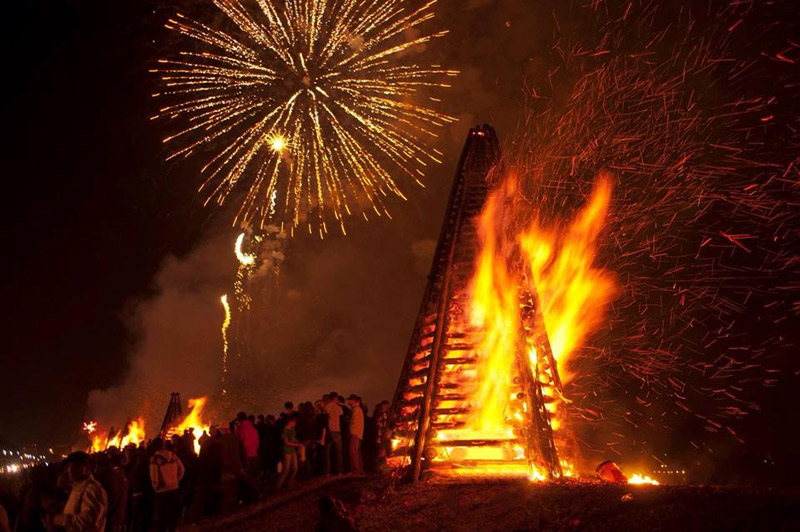 Christmas Eve on the levee, St. James Parish
Historically, these fires have served two purposes. The first is to light the way for Papa Noël, a Christmas gift-bringer in Louisiana Cajun culture who's distinct from, but closely related to, Santa Claus. The second was to provide light for those crossing the river to attend midnight Mass on Christmas Eve.
Today, it's a tradition that thousands of people flock to see every year. For Derek and the people of St. James, the fires are a familial touchstone: "The tradition right now is really what keeps families together. In a world of chaos and busyness, it still pulls these big, giant families that are scattered. It gives them something to experience together, and everyone does some part in it. You're either building the bonfire and lighting it, or you're opening your house to all the visitors who come to see."
Moreover, this tradition served as inspiration for Jeremy Reeves, Head Blender of Cornell & Diehl, when he started developing Fires on the Levee: "I thought it was a really cool bit of not just history, but a way the community of St. James Parish had continued on with this tradition long after it was necessary or relevant for practical reasons. It just became what you do — you build your fire on the levee."
It just became what you do — you build your fire on the levee.
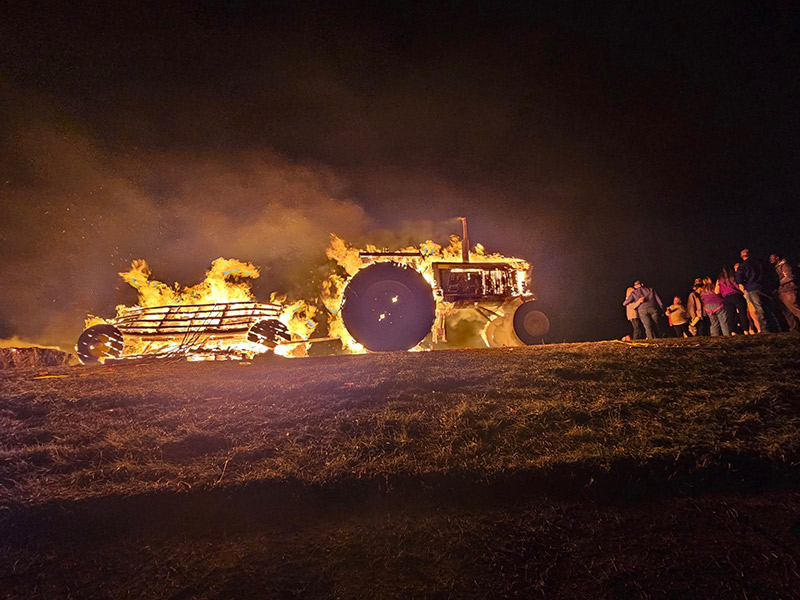
These fires are a stone's throw from Perique's historical planting ground, right along the same river banks. "When I go to work at 31 Farms, I'm driving parallel along the levee on Louisiana 44 — River Road," says Jeremy. "River Road literally follows the banks of the Mississippi, and immediately to your left is the levee. You're right next to it." In Fires on the Levee, tobacco and local tradition meld together.
Partnership Between Cornell & Diehl and 31 Farms
In 2020, as C&D was expanding, so was its need for a reliable Perique source. Enter 31 Farms. "Perique is such a unique process, a unique region where the tobacco is grown, and there are not many people doing it," Jeremy says. "It was important to us to be able to get the quantity and the quality of Perique that we need for our production, and we found the best way to do that was to partner directly with 31 Farms."
More than a business arrangement, the relationship between C&D and 31 Farms is a mutually beneficial joint effort, combining the know-how of two esteemed organizations in the tobacco industry. "He's dealing with the final product, we're dealing with the leaf, but they work together," says Derek.
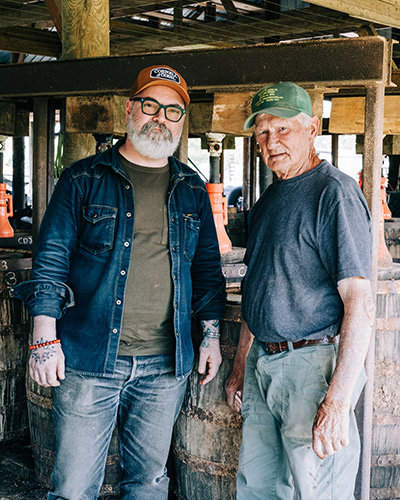 Jeremy Reeves at 31 Farms
Jeremy, for his part, has taken a hands-on approach with the 31 Farms team since the partnership began. "Jeremy has come to every step of what we do," Derek says. "We put an axe in Jeremy's hand. He cuts tobacco. He came and broke suckers." ("Suckers" are small shoots that grow and draw nutrients away from big leaves, usually appearing after the tobacco plant is topped.) That curiosity about the nuts and bolts of the farming operation fostered an ongoing conversation between Jeremy and the Roussels: "That open dialogue helps him know what to expect from the leaf, and it helps us understand how to get the product to what he's trying to produce," Derek says.
A shared admiration for Perique and a shared passion for producing the best product possible led to a tight-knit relationship: "That's what created the great working relationship, and now it's become like family," Derek says.
Special Leaf: Perique Dark-Fired
For Jeremy, the idea of Fires on the Levee has always been about crafting a blend that evokes the smokiness of a bonfire. Knowing that he'd want to return to the blend and continue iterating on that flavor profile, Jeremy began planning this year's release while he was still preparing last year's. He had an idea and wanted to take things a step further, so he decided to leverage 31 Farms' Perique expertise for a highly specialized leaf, tasking the Roussels to process a batch of Dark-Fired Kentucky the same way they do Perique.
Perique is processed in an old-fashioned and time-consuming manner, its analog nature requiring in-depth knowledge of the tobacco and a specific understanding of how the leaf matures over time. "There's no written recipe that you follow perfectly to the book," Derek says. "There's a lot of adjustment that goes in."
There's no written recipe that you follow perfectly to the book.
The process looks something like this: After the tobacco has been harvested and stripped of its midrib stem, it's gathered and packed into old whiskey barrels and put under intense pressure — 25 tons worth. The idea is to push all the air out of the tobacco to prevent spoilage. Then, every three months or so, the pressure is removed and the tobacco is tossed, with the bottom leaf moving to the top. The pressure is then reapplied. During this time, the tobacco begins fermenting in its own moisture content. "As it ferments, you go from this thin water to — it's almost sappy," Derek says. "It'll get thicker and sappy, and the leaves will absorb as much of that sappy moisture as they can withstand." The entire process takes about 18 to 24 months, and it's done almost entirely by hand.
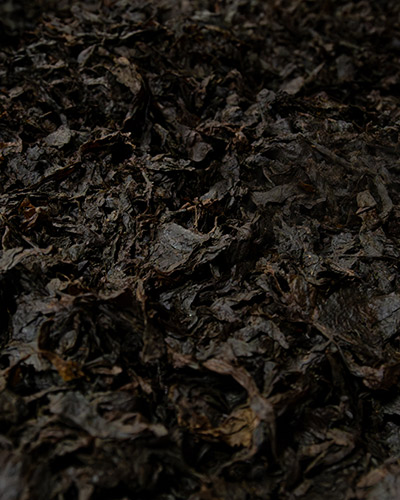
The Dark-Fired leaf used in Fires on the Levee 2026 is the first non-Perique tobacco that the Roussels have processed. From the outset, the difference between Dark Fired and Perique was stark: "It's definitely a drier, thinner leaf, and a smaller leaf... a thinner, more fragile leaf than Perique," says Derek. Perique, by comparison, is quite hefty: "A Perique leaf is about a millimeter thick, not counting the midrib." Likewise, the sugar content was also different: "It's a darker leaf, an upper stalk position," Jeremy says. "I didn't want the fermentation of the Dark Fired to lean so heavily into the Perique profile that you sort of lost it. The sugar content of the Dark Fired is a touch lower than what Perique has."
The whole process was an experiment for both C&D and 31 Farms. "There was no expectation on the fire cured," Derek says. "It was a trial. And so we didn't know how it would turn out. We just communicated with Jeremy on what we were seeing and what we were smelling." Jeremy shared a similar curiosity. "This was the first time we had worked with Dark Fired processed in that way," he says, "so we had to take extra care and pay attention to each step."
The results, however, turned out to be something special. "You can see the fermentation, you can see some sappiness growing when you take it out," Derek says. "There's a little stickiness... It's got all the characteristics. It's just not as bold."
Small Batch: Fires on the Levee 2026
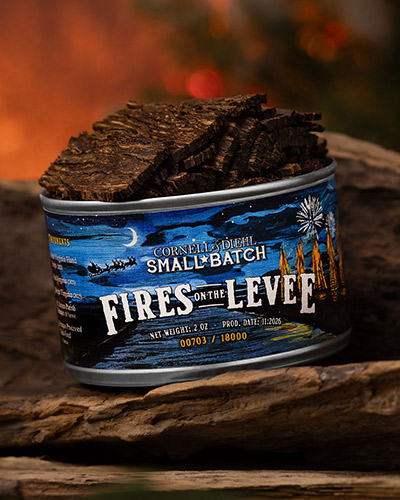
"The barrel fermentation definitely does change the game there," Jeremy says about the Perique-processed Dark Fired. "You do have a more pronounced sweet element to that smokiness, and it's toned down the smoke a touch — just made it even more incorporated into the whole flavor profile of the blend."
The special Dark Fired is joined by a selection of other tobaccos. "In this case the Perique is obviously important to the story of the blend," Jeremy says. "But we're also using Dark Virginia hand strips from Brazil, from crop year 2023, and some Izmir from 2005. And then we're using not only the Dark Fired that we were able to get, which I thought was beautiful, but using it in a further processed way, having gone through that Perique fermentation."
Those tobaccos work in concert to deliver a bonfire smokiness that's deep with savory and sweet notes. "Think along the lines of barbecue, or of braised short ribs," Jeremy says. "It's dense and deep and meaty and rich, but also has some sweet elements to it. It's a perfect sweet and savory blend, to my way of thinking. That smoky character, and notes of maple, or vanilla — oaked vanilla. It's rich, but it's velvety at the same time."
Those tobaccos work in concert to deliver a bonfire smokiness that's deep with savory and sweet notes.
Small Batch: Fires on the Levee 2026 celebrates the bond between 31 Farms and Cornell & Diehl, the rich history of Perique, and St. James Parish's yearly holiday bonfires. It's a unique tobacco experience, combining special Perique-processed Dark Fired, Dark Virginia hand strips, 31 Farms Perique, and Izmir leaf. Ring in the holiday season with Fires on the Levee, available December 8 at 6 p.m. ET.
You may also enjoy:


Comments
Great article, will definitely try and get some when it comes out. Love last year's. Worked on tobacco farm as a teenager growing up in South Georgia, Topping and suckering was probably what I disliked the most. Would love to smell the tobacco when they remove it from the barrels. Our tobacco was flue cured and I loved the smell of it curing. Keep up all the good work.