


 |
|
 |
|


Filmed by Chris Herath and Nicole Weed | Edited by Ardit Hushi
We asked the team a loaded question: what beats a Cuban cigar? Tyler Caldwell sat down with Kane Coles, Chris Herath, and Alan Britt to make the case for four New World blends that go toe-to-toe with Cuban classics — and to talk candidly about why the Cuban market isn't what it used to be.
Note: The following transcription has been edited for clarity and brevity.
[Tyler Caldwell]: We want to talk about something that could be controversial — Cuban cigars, and maybe what we feel is better than Cuban cigars.
[Alan Britt]: Most of us have worked in a retail environment, and honestly, it's probably my least favorite question. Someone walks in and the first thing they ask is, "Do you have any Cubans?" That's typically someone new to the hobby who doesn't quite understand the embargo. But there is a Cuban-specific profile you can find in a lot of New World cigars. Terroir's a thing, it'll never be exact, but a lot of New World blenders are very good at capturing that style at a much more attainable price point these days.
[Kane Coles]: 100%.
[AB]: Cuban cigars are nuts with price. These are much more obtainable to the American consumer.
[TC]: Yeah, I think when it comes to Cuban cigars, there's more of an aesthetic to it that people are looking for.
[AB]: Status.
[TC]: Status. And in the United States, in that domestic market, the lure of Cubans is because we can't go to our local brick-and-mortar or online website and buy them. So there are so many Americans who don't understand the profile of Cuban tobacco. And, like you said, there are so many more New World-style brands that capture that essence, that aesthetic, and that profile, utilizing tobacco that's not Cuban.
The Cuban Cigar Rabbit Hole
[Chris Herath]: My background on Cuban cigars — and Tyler, one of the reasons I think you asked me to be in this video — is that I'm somebody who really went down the Cuban cigar rabbit hole when I got into smoking cigars. Back in 2008 or 2009, when I wanted to try some Cuban cigars, there were different ways to get them into the States domestically, and a lot of those have shut down in recent years. Pricing has become way inflated past the actual value of the cigars, at this point.
I kept going down that rabbit hole, working my way through nearly every Cuban brand I could find. I liked what I found — unique, not totally different, with some of those distinct hay-like qualities — but the shine wore off over time, especially as the price increased.
Back then, I was getting Ramon Allones or Partagas Serie Ds, D4s, for $200-$250 a box. Now that's like $900. And you might have five or six of those that are just tent pegs — unsmokable — just because of the quality control issues they have in Cuba.
My wife would say I hoard them; her closet has become a sanctuary for aging Cuban cigars. But over time, I've learned there are New World cigars that deliver not just similar taste experiences, but in many ways better ones.
[KC]: I think that's one of the big things. When you think of Cuban tobacco, most people think of luxury. And, to me, one of the biggest aspects of luxury is consistency — and right now, you just don't see that on the Cuban market.
Buyer Beware
[CH]: And are you even getting a real one? I talk to people who have tried Cuban cigars, and it was off a cruise ship in Jamaica, from a guy with a table set up with glass-lid boxes.
[AB]: We've all seen the glass-top beach Cuban cigars.
[CH]: If you're trying to get Cuban cigars, only shop at a Habanos dealer. The glass tops are not real. Save your money.
[AB]: Don't buy it from a guy on the beach — rule number one.
[KC]: Yeah. I believe they say that about 90% of Cuban cigars on the market are fake.
[CH]: There's good fakes, too. Once the prices went up so high, you get people entering the market just to make a buck, and they're getting — like counterfeit Rolexes — really good dupes. But in cigars, if it's not the real deal, then what's the point?
Four Picks, Four Countries
[AB]: So what we've done today is we've all grabbed one of our personal favorites that mirrors a Cuban-esque profile. Tyler, what did you choose?
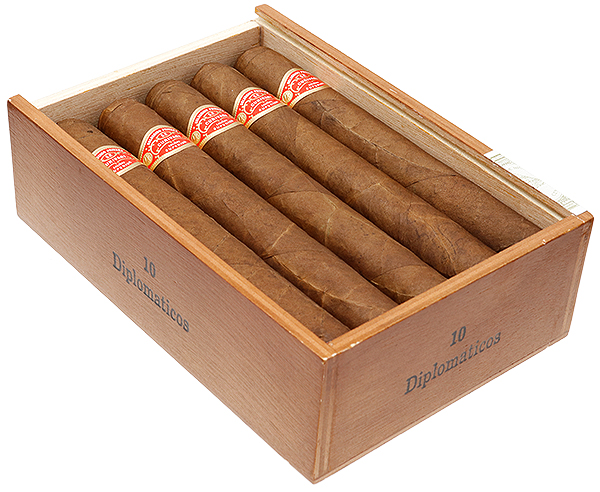
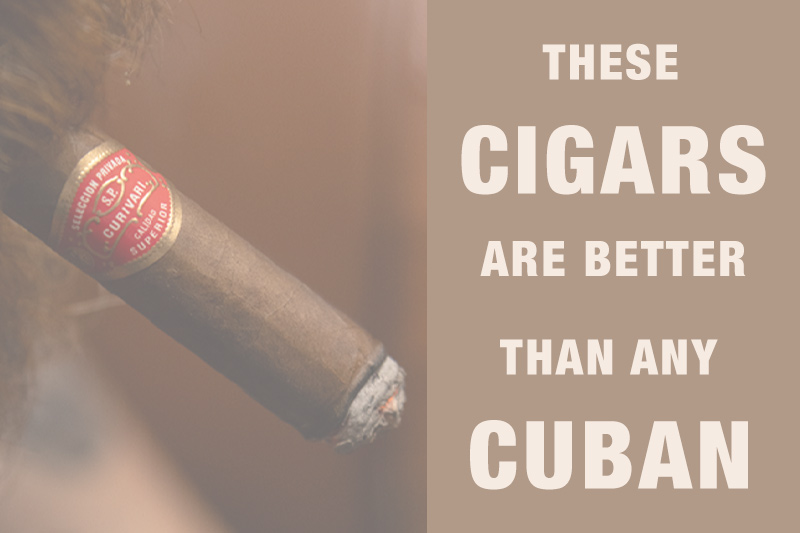
[TC]: I chose the Selección Privada by Curivari. I've always been a big fan of Curivari — in the domestic world, I always say it's the best-kept secret in the cigar industry.
[AB]: Tyler, you sold them to me seven years ago.
[TC]: Yeah, it's a brand that's everywhere, but no one's ever heard of it. They're primarily Nicaraguan-based, made in Nicaragua, using mostly Nicaraguan tobacco across their blends. And if you deep dive into their history and marketing, a lot of it is made to mimic or pay homage to a famous Cuban line. What I find most interesting is that Nicaraguan tobacco is probably the least Cuban-esque tobacco there is — but they do something magical to make it taste Cuban.
[AB]: Now that we've opened that Pandora's box — you guys feel free to disagree — I personally think Honduran tobacco is maybe the closest to a Cuban profile.
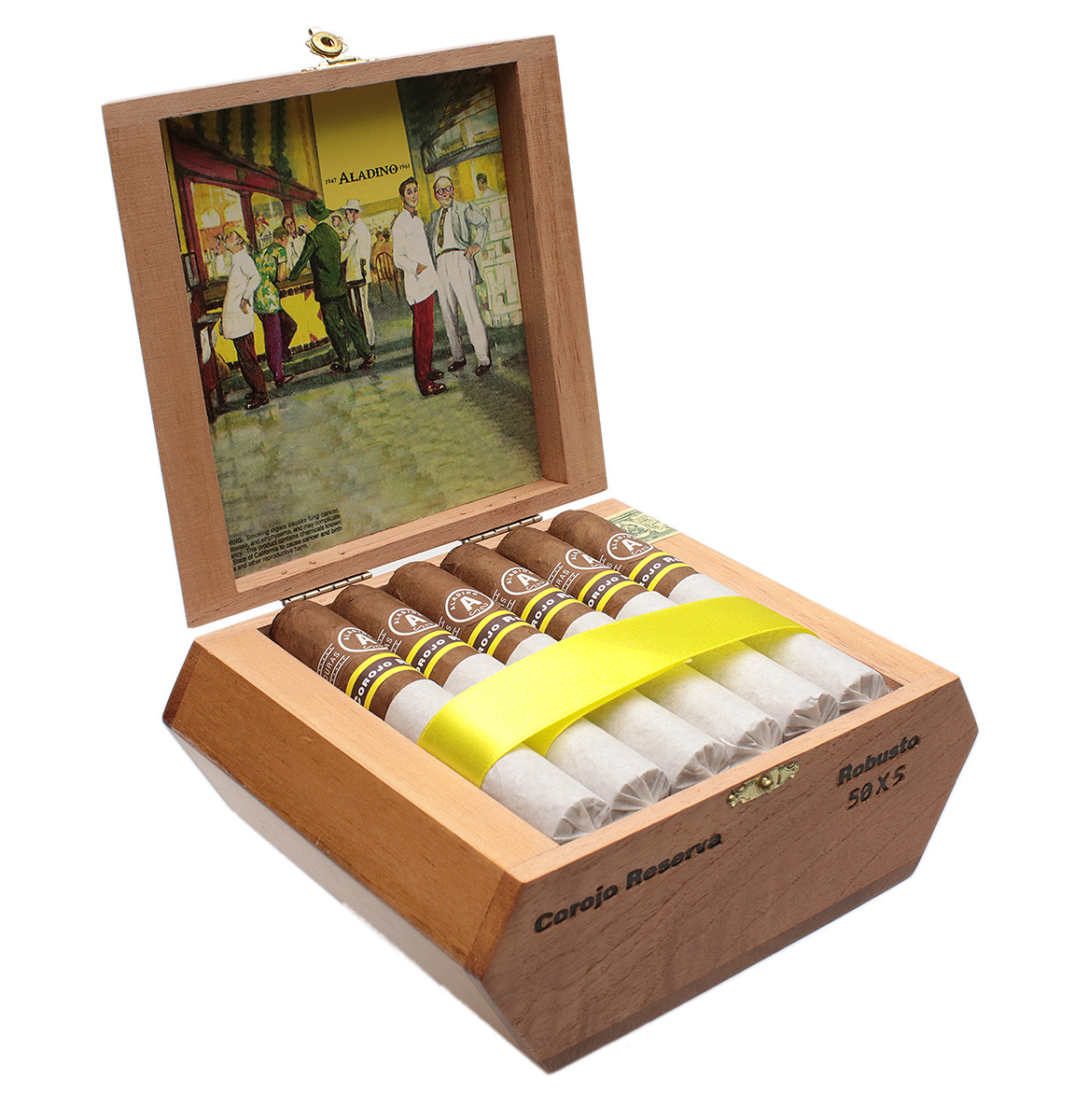
[KC]: I would agree. That's why I chose Aladino. To me, Honduras just has the soil most akin to Cuba — the same flavors you'd expect, from the Jamastrán Valley, where Jerry is making these great cigars, especially given that they use authentic Cuban seed. I think they're one of the only producers who can authentically say that.
I chose the Corojo Reserva — 100% Honduran Corojo. Aladino's something I fell in love with quickly, whether it's the Corojo Reserva or the Vintage Selection. This gets that pre-embargo flavor a lot of people are seeking, even if none of us are old enough to actually remember what that tastes like.
[AB]: On most Aladino bands, except the Corojo Reserva, you'll see a time period — I think it's 1947 through 1961. Justo Eiroa, the patriarch of the Aladino family, states those as, in his opinion, the golden years of Cuban cigar production. I love when makers whose families immigrated from Cuba bring that Cuban expertise and blending style to New World cigars. Aladino's a brand I personally really respect.
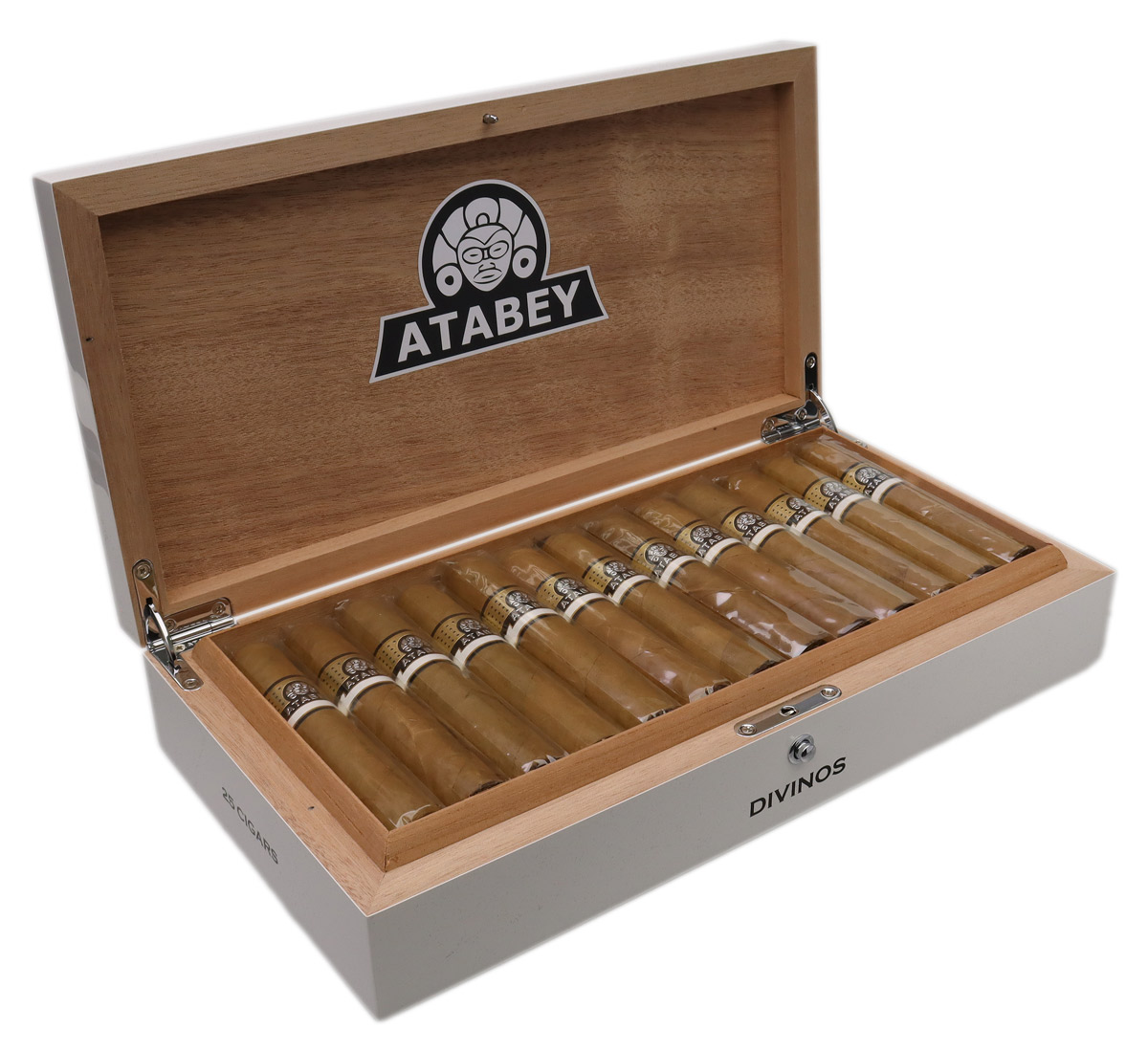
[CH]: I've got the Atabey Divinos. This is one I didn't seek out because of the country it was made in, although that is a little different — these are produced in Costa Rica, which represents less than 1% of US cigar imports. It also has a Peruvian ligero in it, which you don't see in a lot of blends.
When I realized I wasn't going to be buying Cubans anymore, I started diving into Google, and a brand that kept coming up was Atabey. Back then, they weren't disclosing a lot of their components, and to this day a lot of it is still a closely guarded secret. There was a lot of forum chatter that Atabey had to be using Cuban tobacco, it's so close — and there was mystique tied to Alfonso Nelson, who was also connected to a lot of the branding behind Cohiba.
[TC]: There's a lot of connection with Behike, too, behind Atabey and Alfonso himself.
[CH]: And I'll say, it's not trying to be that. It's trying to be its own brand — not a dupe. It's a high-level premium cigar with a gorgeous wrapper, it photographs beautifully, and has flawless construction. I told Tyler, I can smoke this cigar forever and just be happy. Even at the price they're at now, it's still cheaper than a Cuban cigar, and it's an experience that's repeatable and consistent, which just isn't part of the Cuban experience anymore.
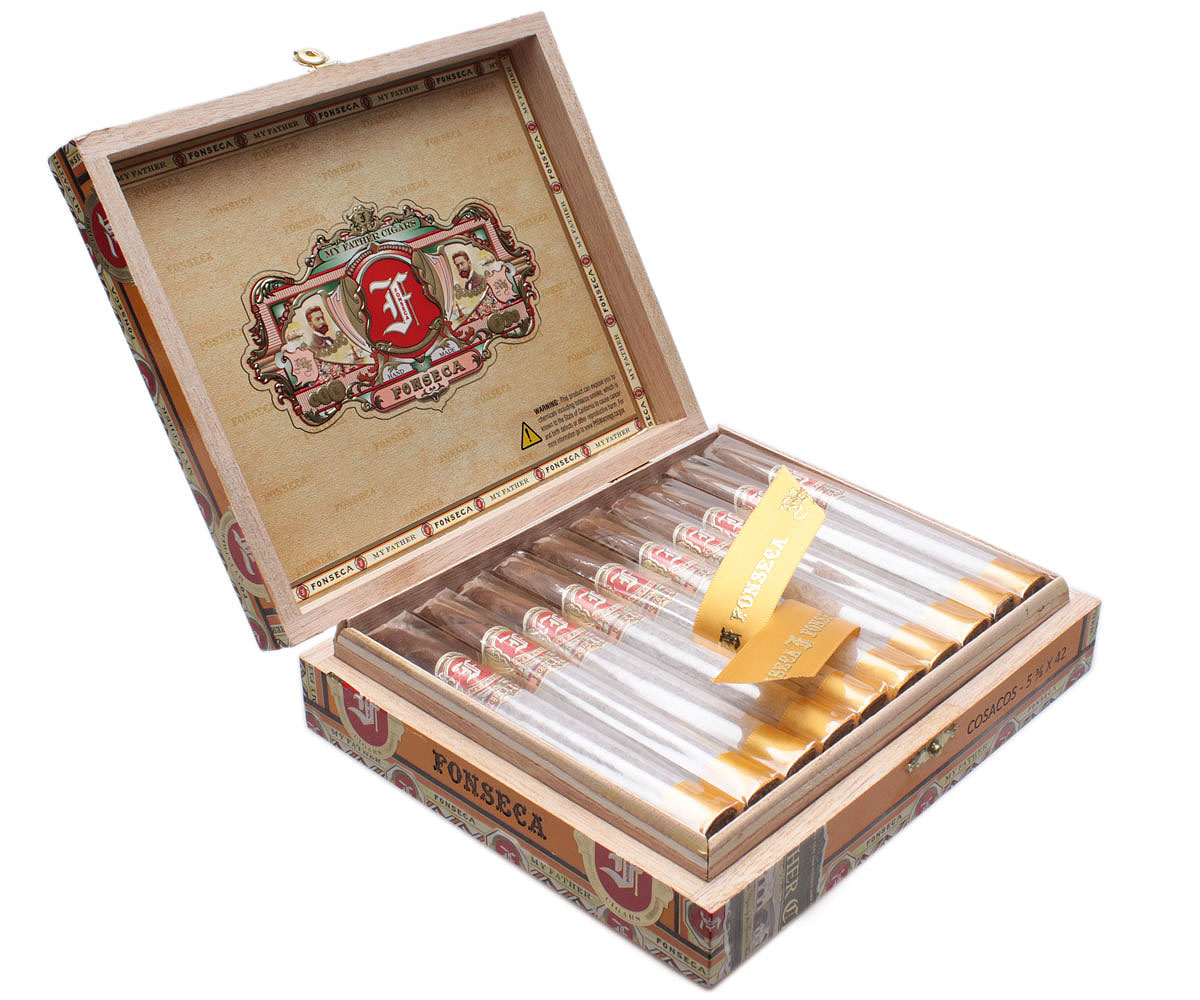
[AB]: Last but certainly not least, I went with Fonseca — the American counterpart to the Cuban brand Fonseca. If you're familiar with the US market, due to the embargo, most Cuban heritage brands do have American counterparts: Cohiba, Montecristo, and so on.
[CH]: Which is very confusing for people. Working retail, you'd have people buying Cohiba who think it's Cuban.
[AB]: Inexperienced consumers just don't know the nuance of that. But most of those are owned by General Cigar and Altadis. Fonseca's an interesting one because it's currently owned and manufactured at My Father, by the Garcia family. Like Tyler pointed out about Curivari, My Father uses almost exclusively Nicaraguan tobacco — the Fonseca line is a Nicaraguan puro, with a shade-grown Corojo '99 Rosado wrapper, which is a Cuban-hybridized seed. It's such a Cuban-esque profile: medium-bodied, hay-like, some baking spice, and well-rounded. Not the most complex cigar, but it's so good, and at sub-$10, it's a great price point.
[KC]: I feel like that might be a common misconception for people with Cuban cigars — they assume it has to be this grand, complex, wildly different experience, and might be disappointed to find out it isn't. It might just be like that Fonseca: consistently great. Nothing that blows you away, but a good profile.
[TC]: I can agree with that. I think the allure of Cubans really peaked in the '90s cigar boom, when domestic cigars were traditionally much lighter, smoother, and milder. When people got their hands on Cuban tobacco, they were wowed by the added complexity and intensity. Bring it to today, and it's the complete opposite — domestic brands now are more about what people thought Cubans were in the '90s.
[AB]: It's crazy how things have flip-flopped since the '90s. Back then, US market and New World producers put out a ton of Claro, Double Claro, and Candela wrappers, because they required less fermentation and producers were trying to pump cigars out. It inevitably leads to an inferior product, where Cuba at the time was far better at properly curing, fermenting, and aging tobacco. Nowadays, it's quite the opposite.
Why New World Wins on Consistency
[KC]: I think that's the luxury the US market has — we have all these countries we're buying from: Nicaragua, Honduras, Ecuador, up in Connecticut in the US, you name it. Cuba's still just Cuba.
[CH]: It's a puro, grown in one location. There are altitudes, soil types, which field faces a river; all of that goes into the taste — but it's still one place. A lot of what we carry in our humidor could have a Nicaraguan wrapper and a binder from Indonesia — taking that hodgepodge of ingredients to make the best experience possible.
[AB]: In recent years, Cuba has faced real challenges — economically, politically, and from natural disasters, hurricanes, and mold plagues in the fields. There's a lot of difficulty crafting a puro on an island, with all your eggs in one basket. There are also rumors that some Cuban cigars don't contain solely Cuban tobacco. We're not in Cuba, so it'd be near impossible to confirm or deny that, but the rumors persist.
[CH]: If I grab a cigar and it's totally plugged, or it starts cracking down the middle, I have a customer service system to go to. Issues can happen no matter how good the factory is, but if you reach out through Instagram or customer service, odds are it's going to be made right. You're not getting that with Cuban cigars. You might spend $1,000 on a box of 25 Cuban Robustos, and if 10 of them are unsmokable, you're out.
[AB]: Or even worse, mold. Even from a manufacturer perspective, how often do you see someone complaining in a forum about a plugged cigar, and the actual owner steps up and says, "Shoot me a message, I'll take care of you?" The retailer, the middle man, doesn't even have to be involved. The perks, at least in the American market, are fully toward supporting New World cigars. I think it's a better product currently, in this day and age.
[KC]: Think about what excuses you'd make for a cigar that cost you $80 to over $100 in our market. If the smallest thing went wrong, you'd say that ruined your experience. But for Cubans, you're spending that same $80 to $100, and five of them might be plugged.
The Verdict
[TC]: For an ending note here: anyone who is a domestic customer without the ability to obtain Cubans, who wants to understand the profile and the specialty of it — these are great options for you. They're going to meet that profile as closely as possible. There's also a ton of other brands we don't have time to get into today — Warped, Tatuaje, and others, all focused in their own way. They're not reinventing the wheel. They're just trying to make it a little better.
[CH]: Yeah, their blenders like the Cuban profile, and they're riffing with the ingredients available to get something that, in many cases, is better.
[TC]: And if you're an international consumer with access to any Cuban you want, but you're looking to add something different to your rotation...
[AB]: More financially attainable.
[TC]: ...that too, these are brands that are perfect for your smoking rotation — the best of both worlds.
[CH]: Even if I lived somewhere Cubans were readily available, it'd be a pretty boring smoking world for me if that's all I could get. It'd probably be a 70/30 mix skewed toward New Worlds, just because there's so much more happening on that side of things.
[TC]: That's right. Check out our selection of cigars at Smokingpipes, and let us know what you think is the most Cuban-esque brand out there.
You may also enjoy:



Comments
Great article on the Cubans. My son was actually telling me the same thing. Especially the quality control coming out of Cuba