


 |
|
 |
|





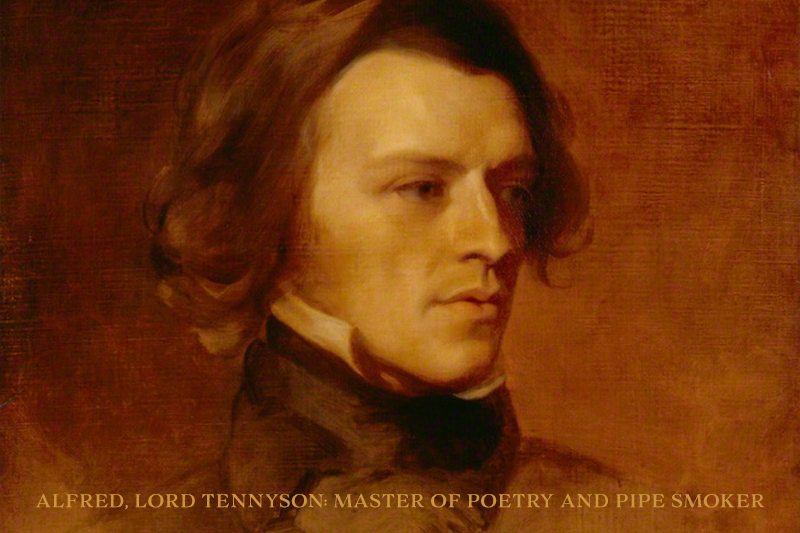
Alfred, Lord Tennyson, 1840
Alfred, Lord Tennyson is one of the most influential poets of all time. At the minimum, you've heard the words "Tis better to have loved and lost than never to have loved at all" from his poem, In Memoriam. Tennyson's life was so much more than a few quotes. He was a thoughtful and compassionate man, if a bit erratic, and saw a sort of whimsy in this world. He also was a heavy pipe smoker, and like so many of us, a flawed character. Tennyson's life is one that many of us can relate to, and today I'd like to look at how this man produced some of the best poetry of all time.
Tennyson's Early Life
Alfred Tennyson was born on August 6, 1809, in Somersby, England, into a large middle-class family, becoming the fourth of 12 children — eight sons and four daughters. His mother was Elizabeth Fytche, a niece of the Bishop of Lincoln, and his father was George Tennyson, rector of Somersby and Bag Enderby, and the eldest son of George Clayton Tennyson, a man with great created and inherited wealth who lived in a 2,000 acre estate in Tealby. Alfred's father was something of a black sheep, losing his own father's confidence, and he felt disinherited in favor of his younger brother Charles, who became a member of Parliament and eventually became the resident of their father's manor in Tealby.
In Alfred's younger years, his father began to suffer from fits of epilepsy, leading to rage and drinking. In 1820, this rage led to George writing a scathing letter to his father, as outlined in John Batchelor's Tennyson: To Strive, To Seek, To Find.
'God judge between you & me,' he railed. 'You make and have always made a false estimate of me in every respect.' Once embarked, he could not stop. He had been 'thrown into a situation unworthy of my abilities & unbecoming either your fortune or my just pretensions'. As for his many children, he was 'kept in the dark with respect to their future prospects, with broken health & spirits'. He closed his letter as though he did not expect any further communication with his father in his lifetime: 'there is a tribunal before which you and I may speedily appear, more speedily perhaps than either of us desire or expect — there it will be seen whether you through life have treated me with that consideration & kindness which a son has a right to expect from a father.'
Despite the animosity between his father and grandfather, Tennyson and his fellow siblings held mostly favorable memories of their childhood. Their imaginations ran free at their estate, and a young Tennyson fell in love with the rolling landscapes around him. In their earliest years, Tennyson's father's self-imposed task of educating his children gave him much stress. While George was a talented and smart man; he had his limits, eventually leading him to send the three eldest boys — Frederick, Charles, and Alfred — to a school in Louth, mostly due to its proximity to their grandmother and aunt.
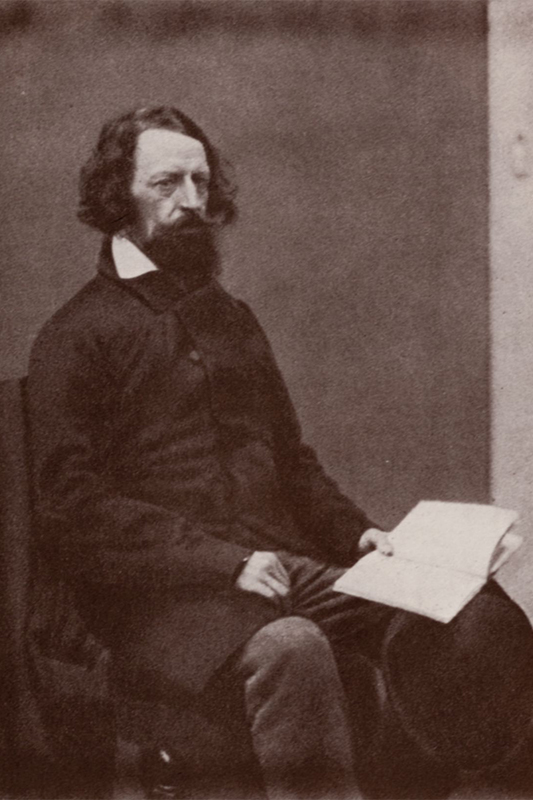
The Louth Grammar School was a nightmare for the young Tennysons. At the time, it suffered from the wrath of reverend Dr. John Waite, a brutal man who beat the children into submission. Alfred recalled that Waite "thrashed a boy more unmercifully for a false quantity than a headmaster today would thrash a boy for the worst offence of which a schoolboy could be guilty." The headmaster's anger infected the school, and a great deal of bullying occurred among the students. Alfred suffered there for four years, leaving in 1820 at age eleven, feeling he had learned nothing.
Upon returning home, imagination soon fluttered back into Tennyson's life. Tennyson's father instilled a love for the arts into his children at a young age, whether it was painting or poetry. Tennyson and his siblings were fond of a game where they'd take turns writing stories in the format of a letter, which they placed under the vegetable dishes at dinner and read aloud at supper's end. These letters spanned a landscape of Arthurian legends, tales of heroic knights, and accounts of slaying dragons, among other unimaginable evils, before rescuing damsels to save the realm. Alfred's imagination was fueled by the works of Shakespeare and Lord Byron, who served as such a hero to the young man that when word of his death reached Somersby in 1824, Alfred carved the words "Byron is dead" on a rock near the church.
One of Tennyson's earliest works was an attempt to write his own play, The Devil and the Lady. The title page held the Latin quote spes alit juventutem et poesin, vituperatio premit et laedit, which translates to "hope nourishes youth and poesy, abuse represses and injures it." As his father's spirits darkened, Alfred and his father's relationship became increasingly troubled. Tennyson began to write poetry that carried a sensitivity to suffering and some manner of passive suicidal ideation. His son wrote in his father's memoir,
"The sense of his father's [i.e. Old George's] unkindness and injustice preyed on his nerves and his health, and caused him at times to be terribly despondent. More than once, Alfred, scared by his father's fits of despondency, 'went out through the black night, and threw himself on a grave in the churchyard, praying to be beneath the sod himself.'"
Tennyson always carried with him a softness and vulnerability. His childhood friend, Sophy Rawnsley, recalled how observant he was of the world around him, even at a young age. "We liked to talk better than to dance together at Horncastle, or Spilsby, or Halton; he always had something worth saying, and said it so quaintly."
Tennyson's College Years and First Published Works
In 1827, Tennyson took leave of Somersby, feeling relief at getting away from his father and pains of loss at leaving behind his childhood and his home. Tennyson entered Trinity College in Cambridge in the fall that year while at the same time Tennyson and his brother Charles published their first collection of poetry, Poems by Two Brothers. The collection didn't sell well but the publication afforded them some social reputation in their early careers.
While Tennyson remained close to his brothers during his time at Trinity, he still felt great pangs of homesickness, and penned several poems exploring his grief. Despite these emotions, Tennyson built a notable presence at the college. His fellow undergraduate W.H. Thompson, upon seeing Tennyson for the first time, remarked, "That man must be a poet."
Tennyson was well regarded for his looks and soft spoken nature. Scottish historian and philosopher Thomas Carlyle described him as such:
Alfred is one of the few British and foreign figures (a not increasing number I think) who are and remain beautiful to me, a true human soul, or some authentic approximation thereto, to whom your own soul can say Brother! One of the finest looking men in the world. A great shock of rough, dusky dark hair ; bright, laughing, hazel eyes ; massive, aquiline face, most massive, yet most delicate ; of sallow brown complexion, almost. Indian looking, clothes cynically loose, free-and-easy, smokes infinite tobacco. His voice is musical, metallic, fit for loud laughter and piercing wail, and all that may lie between ; speech and speculation free and plenteous ; I do not meet in these late decades such company over a pipe. We shall see what he will grow to.
In January 1828, a young Tennyson met one of his closest friends, Arthur Hallam. To Tennyson, Hallam was everything he felt he never could be, but they both bonded over their inherent loneliness at the college and troubled relationships with their fathers. The two men would join the secret Cambridge society the Apostles. The Apostles grew close over their time together, and Tennyson was held in high regard. However, he was prone to fits of depression but his friends were always there to support him.
In the summer of 1829, Alfred's father urged him to enter in the competition for the Chancellor's Gold Medal for poetry. Tennyson wasn't keen, but he reworked his poem "The Battle of Armageddon" and won first place. He downplayed this achievement, not being particularly pleased and admitting he only did it because of parental pleading. By June 1830, Tennyson published Poems: Chiefly Lyrical. He was only 20 and still an undergraduate, yet some of his most famous poems come from this collection, including "Mariana" and "The Kraken." Hallam, passing the summer with Tennyson at Somersby, sent his mother a copy of Tennyson's book along with a letter that said, "He is a true and thorough Poet, if ever there was one; and though I fear his book is far too good to be popular, yet I have full faith that he has thrown out sparks that will kindle."
Tennyson's father died in 1831, forcing him to leave Cambridge before he earned his degree. He returned to his childhood home to help care for his widowed mother and family. Once again, Hallam spent that summer with the Tennysons, this time becoming engaged to Tennyson's sister, Emilia. It would take Tennyson two years after his father's death to publish his second collection, simply titled Poems. The collection was notable for the first version of "The Lady of Shalott"; however, the collection was met with heavy criticism, and Tennyson did not publish his work again for 10 years.
This criticism was compounded with the death of Hallam, who suffered a cerebral hemorrhage while on holiday. The loss of his dear friend took a heavy toll on Tennyson, and inspired poems like "In the Valley of Cauteretz" and "In Memoriam A.H.H.".
Eventually, the Tennyson family's time at the rectory came to end and they relocated to Beech Hill Park, High Beach, around 1837. Tennyson enjoyed the proximity to London where he could visit friends, but never lingered overnight because he couldn't bear to leave his mother alone. Throughout this time, Tennyson was experiencing a crisis of sorts. While Hallam's death gave Tennyson creative inspiration, he also became manic and erratic: He declared his love for his future wife Emily Sellwood, then broke off their engagement. He descended upon his friends unannounced for hand outs, his appearance became shaggy, and he turned to drinking.
In this manic state, Tennyson would befriend Dr. Matthew Allen, who ran the nearby asylum. Their friendship and erratic state inspired Tennyson to invest in Dr. Allen's wood-carving enterprise, which led to the unfortunate loss of much of the family fortune, further worsening his depression. The highlight during this time was Tennyson meeting Thomas Carlyle in 1939, and the two became lifelong friends and smoking companions. With what little money he had, Tennyson moved to London permanently in 1840.
Tennyson the Poet Laureate
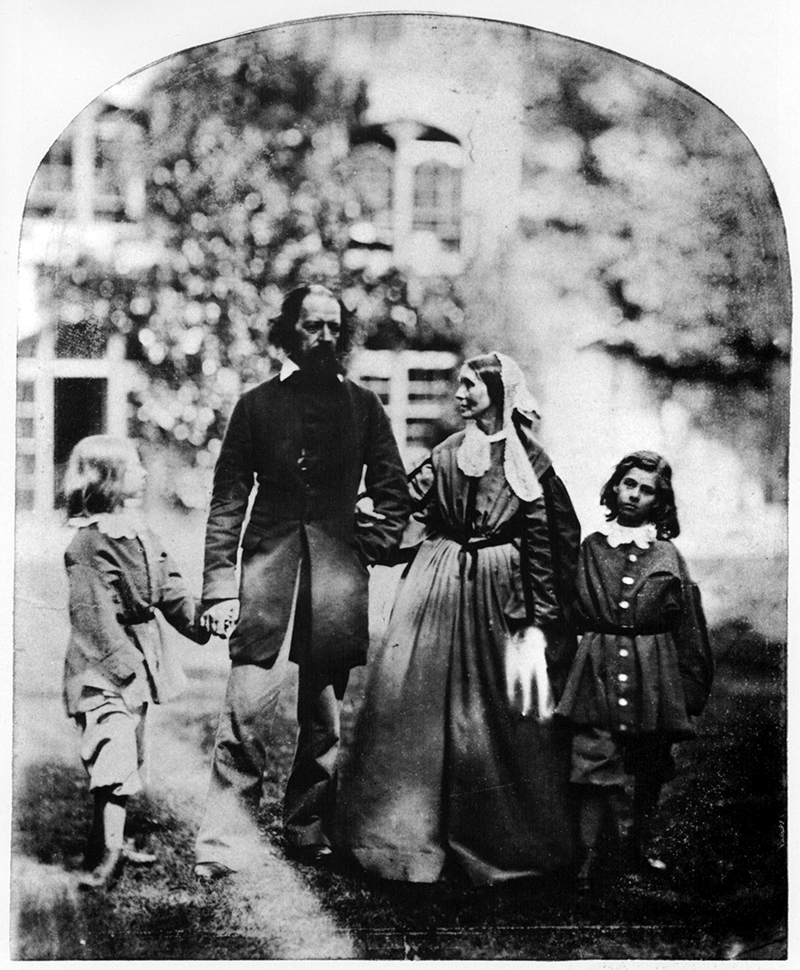
Alfred, Lord Tennyson and Family
It wasn't until 1842 that Tennyson would publish another set of his work, the two-volume collection Poems. The first volume was composed of previously released works and the second was entirely new material. Poems was met with near instantaneous praise. Despite his success, however, his friend, Aubrey de Vere, grew tired of Tennyson's erratic behavior and snapped at him that he needed "occupation, a wife, and orthodox principles."
Aubrey's comment encouraged Tennyson to take control of his life in a more responsible manner, and by the summer of 1850, he and Emily married. This marriage was one of many achievements that he earned that year. Earlier that May, Tennyson had published In Memoriam, which many consider to be his masterpiece, and that autumn, he was elected to succeed William Wordsworth as Poet Laureate.
Tennyson's domestic years served him well. He took great joy in gardening and construction. He was an affectionate father to his two boys — Hallam was born in 1852 and Lionel in 1854 — and a devoted husband to his wife. Tennyson released Maud, and Other Poems in 1855, his first published collection as Poet Laureate, which included a poem about mental derangement as well as the classic "Charge of the Light Brigade".
When Tennyson and Emily sent the boys away to school, there was a shift in their life. Emily's bursts of energy diminished, and she struggled with servants, often berating or firing them, while Tennyson took frequent trips to London, changing his publisher. He suffered from palpitations and tried to give up tobacco but failed regularly, and he drank heavily at night. Around 1874, Tennyson had his mind on drama, penning historical plays — Queen Mary, Harold and Becket — but they failed to make a lasting impression.
Despite Tennyson and Emily's distance, he loved her dearly as Hallam outlines in this anecdote from his memoir:
"One evening Mr. Venables and Mr. de Vere called. They talked for about an hour with my father — my mother having already retired to rest. At last, after puffing at his pipe for some moments in silence, my father spoke like one thinking aloud "I have known many women who were excellent, one in one way, another in another way, but this woman is the noblest woman I have ever known." As Aubrey de Vere writes to me, "No friend who had then heard him could have felt any further anxiety as to his domestic happiness."
The gulf between Tennyson and Emily grew further when Lionel died at sea, and Tennyson lost his brother Charles. Emily's condition worsened and she collapsed that year, passing her secretarial duties to Hallam, and spending much of her remaining life on the sofa. Tennyson carried a sadness in his heart. Historian Michael Thorn remarks that "Sadness and nostalgia are to be found in many of the last poems contained in Tiresias and Other Poems (1885), Locksley Hall Sixty Years, After (1886), Demeter and Other Poems (1889) and The Death of Oenone, Akbar's Dream and Other Poems (1892). But there is also a vigorously fighting spirit at play in those poems, which pour scorn on his contemporary world." The Death of Oenone, Akbar's Dream and Other Poems would be Tennyson's last published work, as that fall he fell ill and passed away gently into the night.
Tennyson and the Queen
When Prince Albert died on December 14, 1861, Queen Victoria entered a deep depression. Tennyson had been Poet Laureate for 10 years when he received a private message from Princess Alice asking him to write something on the matter. Tennyson was filled with doubt and anxiety, but he created a dedication in his Arthurian project Idylls of the King, along with a recognition of the Queen's grief.
These to His Memory — Since he held them dear,
Perchance as finding there unconsciously
Some image of himself — I dedicate,
I dedicate, I consecrate with tears —
These Idylls.
Break not, O woman's-heart, but still endure;
Break not, for thou art Royal, but endure,
Remembering all the beauty of that star
Which shone so close beside Thee that ye made
One light together, but has past and leaves
The Crown a lonely splendour.
May all love,
His love, unseen but felt, o'ershadow Thee,
The love of all Thy sons encompass Thee,
The love of all Thy daughters cherish Thee,
The love of all Thy people comfort Thee,
Till God's love set Thee at his side again!
In addition to this dedication, the Queen read Tennyson's In Memoriam, which deeply resonated with her. She had the Duke of Argyll present her personal copy to Tennyson to show him the book's worn nature and various annotations. The Queen had even changed the masculine pronouns to feminine, adapting the poet's words to frame her own experience.
Tears of the widower, when he sees
A late-lost form that sleep reveals,
And moves his doubtful arms, and feels
Her place is empty, fall like these.
This connection to his poetry afforded Tennyson a personal audience with the Queen. The Duke of Argyll informed Tennyson that the Queen had commanded him to visit her at Osborne House, which alarmed the poet. Tennyson wrote to the Duke, "I am a shy beast and like to keep in my burrow. Two questions, what sort of salutation to make on entering her private room? And whether to retreat backward? Or sidle out as I may?"
Argyll calmed Tennyson's anxieties, telling him, "Don't let yourself be a "shy beast" — and "come out of your burrow." As well as, "I think She likes all natural signs of devotion and sympathy. In this be guided entirely by your own feelings — All formality and mere ceremony breaks down in the presence of real sorrow."
The private audience took place in April 1862, and despite his nerves, they shared a connection, as told in Tennyson: To Strive, To Seek, To Find:
The Queen was a young widow longing for fellow feeling, but she was at the same time a public institution. There could never be anything informal or spontaneous about an audience with her, but she loved to link Tennyson's writings with her own emotions; In Memoriam reflected her grief. 'Next to the Bible, In Memoriam is my comfort,' she told Tennyson; she also said, 'I am like your Mariana now.'Wholly inappropriately — given that her husband could never have been other than Consort — Tennyson said of Prince Albert: 'He would have made a great King.' The Queen tactfully ignored this, and replied at a tangent: 'He always said it did not signify whether he did the right thing or not, so long as the right thing was done.' Tennyson reported this to an old Cambridge friend: 'As soon as it was out of my mouth I felt what a blunder I had made. But, happily, it proved to be the very right thing to have said.'
The following year, Tennyson and his family were summoned to Osborne House once more. Records from the Queen's personal writings are referenced in Tennyson: To strive, to seek, to find, in the text she remarks that she "had some interesting conversation with him and was struck with the greatness and largeness of his mind, under a certainly rough exterior." While the Queen and Tennyson had no other notable meetings, it was clear that Tennyson had left a lasting impression with both his poetry and genuine nature.
Tennyson and Pipe Smoking
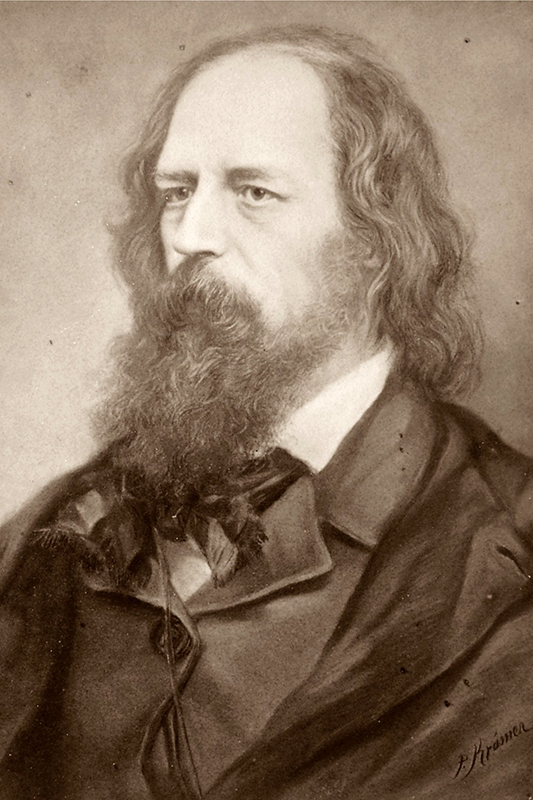
From an early age, Tennyson had a penchant for pipe and leaf. In Greenwich Exchange Student Guide to Alfred, Lord Tennyson, Thorn shares records of Tennyson's early friends at Cambridge recalling Tennyson as "already addicted to strong tobacco, which he smoked in clay pipes." It was a habit that he carried with him until his death; even when he attempted to quit, he couldn't go more than a few days before returning to the habit. Pipe smoking was critical to his writing process, however: "Hundreds of lines were, as he expressed it, 'blown up the chimney with his pipesmoke, or were written down and thrown into the fire, as not being then perfect enough.'"
In the evenings, his children recall, "He used to sometimes read aloud in the evening, in a deep sustained sonorous voice. I remember little Hallam warning me not to trouble him when he was smoking his first morning pipe, when he used to think that his best inspirations came." Outside of inspiration, Tennsyon used smoking as a form of connection. Thomas Carlyle wrote to Tennyson on December 7, 1842, "But do you, when you return to London, come down to me and let us smoke a pipe together. With few words, with many, or with none, it need not be an ineloquent Pipe!"
Tennyson was a master of his craft, carrying with him a deep compassion for the world and his fellow man with an imagination that has painted emotions across readers' hearts for generations. While his life was troubled at times, he was surrounded by loved ones and is beloved to this day. His love for the pipe is well documented and was a critical part of his work, something I feel we can all relate to. If I am to leave you with one Tennyson quote, one sentence from this man's life to reflect on, it would be a simple, disarming line that continues to resonate deeply with me: "I am a part of all that I have met."
Bibliography
- Tennyson, A. (1914). Life and writings of Alfred Lord Tennyson. Government College Lahore.
- Tennyson, H. T. (1898). Alfred Lord Tennyson: A memoir. Macmillan and Co.
- Thorn, M. (1951). Greenwich Exchange Student Guide to Alfred, Lord Tennyson.
- Batchelor, J. (2014). Tennyson: To strive, to seek, to find. Vintage Books.
You may also enjoy:




Comments
An excellent and well written article. A truly interesting read, thank you for sharing.
I have always been a fan of English literature, except for the Romantics whom I considered to be cloying and hysterical. Tennyson, however, was the exception and I devoured his writings. This essay is excellent; I didn't know a lot of his history, and you've captured the spirit of the man. Thank you.
This was well done, most interesting. It reminds me slightly of Samuel Taylor Coleridge, though he had different things which haunted him.
Outstanding!!!!
Well done, Rose! Thanks for this great article!
Here's an anecdote about Tennyson that contains a double pun based on a line in one of his poems, turning it into a reference to his pipe smoking. It also suggests how socially and politically well-connected Tennyson was in his day: "On 8 September 1883, he [meaning Tennyson] and [Arthur] Hallam [son of Henry Hallam, Dean of the University of Bristol] joined [future Prime Minister William] Gladstone at Chester, and went with him and a large party for a cruise in the [ship named the HMS] Pembroke Castle, which Sir Donald Currie had put at their disposal for the purpose. . . . Sir William Harcourt joined the ship at Ardnamurchan Point and sailed with them to Tobermory, and it was then that he made the classic pun which has been so often quoted. Tennyson was, as he frequently did, talking about tobacco and saying that the first pipe after breakfast was the best of the day. 'Ah,' said Harcourt, 'the earliest pipe of half-awakened bards.' It was observed that the poet did not at all appreciate this burlesquing of one of his most treasured poems ["Tears, Idle Tears"]."
BTW, the original HMS Pembroke Castle was built in 1883, served as a passenger/mailship, was grounded in 1887, was sold to Turkey in 1906, and was sunk in 1915 (WWI).
Later, a different ship with the same name served in WWII.
References: https://www.ourcivilisation.com/smartboard/shop/anecdtes/c19/tennyson.htm
Sorry - I neglected to include the second reference: https://www.bandcstaffregister.com/page4348.html
(This page from the British and Commonwealth Shipping Register online gives the history of the HMS Pembroke Castle, including sketches and photos.)
Thank you for great article. I very much enjoyed and learned something new.
Fantastic article. I’ve never read Tennyson and don’t particularly care for poetry but I may try to find some of his poetry now. Thank you for the article.
Thoroughly enjoyed this article. Thank you!
This article was extremely well written and very enjoyable to read
Thank you
These little essays are valuable. Thank you. May they continue, and supplant the space taken up by useless cartoons.