


 |
|
 |
|


We often reference Functionalism in regard to pipe making here at Smokingpipes, particularly when discussing Danish pipe designs, and we occasionally mention the name, Arne Jacobsen. If you're an enthusiast of the work of Tom Eltang, then the name should be familiar. One of Tom's most iconic designs is named after the Danish architect, whose work in the field contributed to the continued development of the Modernist architecture movement and the burgeoning discipline of Functionalism, especially in Denmark.
Functionalism itself is an extension of Modernist architecture, staying true to the use of clean lines and novel forms, though with an additional element of humanism which saw it focus on the function of the structure itself as it related to form. This dynamic resulted in a school of architecture and design that created structures bereft of any excess or ornamentation, left free from any construct which did not directly improve its ability to function. The origins of the movement can trace to 1896, when architect Louis Sullivan wrote, "It is the pervading law of all things organic and inorganic, of all things physical and metaphysical ... that form ever follows function. This is the law." While Sullivan may have established the basic tenets of functionalism, influenced by Roman architect Vitruvius, he certainly did not practice it as it later existed in the 1920s and 30s, his buildings maintaining a rather opulent sense of ornamentation throughout his career.
"It is the pervading law of all things organic and inorganic, of all things physical and metaphysical ... that form ever follows function."
Functionalism, as we know it today, was developed throughout the early 1900s mostly by European architects, mainly centered around France and Germany with the works of Le Corbusier, Walter Gropius, and Ludwig Mies van der Rohe. Arne Jacobsen is significant within the movement thanks to his distillation of the style into a recognizable, international design language and his meticulous use of "total design" which extended the reach of Functionalism into the realm of both product design and interior design. In addition, Jacobsen was a prominent pipe smoker, being photographed more often than not while accompanied by one of a number of pipes, though his most iconic is a slim, sleek straight Dublin with a generous forward cant which went on to become the basis for one of Tom Eltang's signature designs which bears his name.

Tom Eltang: Smooth Arne Jacobsen
Life and Work
Born the son of Johan and Pouline Jacobsen in Copenhagen, Denmark in 1902, Arne Jacobsen was intrigued by art from an early age, inspired by his mother's hobby of painting floral motifs. His passion for the arts ran so deep that he initially dreamed of being a painter, though these dreams were tempered by his parents who dissuaded him from that career path and instead encouraged him to become an architect, as the field was more secure and had better prospects for his future.
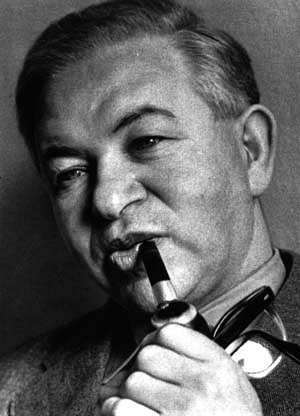
After attending boarding school, Jacobsen took up work and was apprenticed as a stonemason before attending the architecture school at the Royal Danish Academy of Fine Arts, where he studied under a number of contemporary architects, though most notably Kay Fisker and Kaj Gottlob, both of whom went on to design a number of iconic Modernist structures. He studied there from 1924 to 1927, and in 1925 attended the Exposition Internationale des Arts Décoratifs et Industriels Modernes in Paris, France, a world's fair that would spawn the Art Deco movement in the years immediately following its end, the name being a reference to that of the fair which begat the style's roots. There he won a silver medal for one of his early chair designs and explored the vast grounds, though rather than being struck by the decorative opulence that pervaded many of the exposition's exhibitions, he instead focused his attention on Le Corbusier's L'Esprit Nouveau pavillon, a starkly modern, box-like structure that contained living spaces furnished entirely with mass-produced, commercially-available products that reflected a practical, utilitarian-leaning focus on high-quality design that could be feasibly acquired by the majority.
Before leaving the academy, Jacobsen visited Germany, where he was exposed to the works of Walter Gropius and Ludwig Mies van der Rohe, the first and last directors of the Bauhaus school, respectively, which Gropius founded in 1919. After winning a gold medal for his graduation project in 1927, Arne went on to work in the architectural firm of Poul Holsøe in Copenhagen.
... Jacobsen visited Germany, where he was exposed to the works of Walter Gropius and Ludwig Mies van der Rohe, the first and last directors of the Bauhaus school
In 1929, Jacobsen collaborated with Flemming Lassen and won a Danish Architects Association competition for designing what came to be known as the "House of the Future," a revolutionary design that was later built full-scale at an exhibition in Copenhagen's Forum. This house was a truly remarkable feat of design: a spiral shaped structure made from glass and concrete that included a private garage, a boathouse and a helicopter pad, and which possessed features such as windows that rolled down like a car's, a conveyor tube for mail, and a kitchen that was stocked entirely by ready-made meals. The design of the house and its interior furnishings reflected a keen understanding of the goals of Le Corbusier and the style of the Bauhaus school, immediately establishing him as an architect on the precipice of Modernism.
After the acclaimed success of the "House of the Future," Jacobsen was able to open his own architectural firm in the city, completing the Rothenborg House as one of his first commissions. The stages of planning for this project reflected a process that became typical for many of Jacobsen's future designs, as he personally outlined each facet of its construction down to the furniture and the fittings, making it a complete and total expression of his vision.
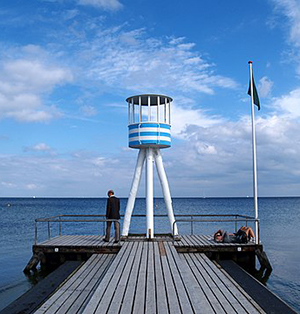
Lifegaurd Towers
He was later commissioned to build the Bellevue seaside resort at Klampenborg in 1932, for which he designed the beachfront areas and their now iconic lifeguard towers, the accompanying residential block, and a theater, which has since become considered one of the most important works of Jacobsen's career and a triumph of Functionalist design. This theater was completed in 1936 and included design features that were revolutionary in their day, most notably a retractable roof that could be pulled back to allow for open-air performances of shows, all while maintaining a look that was elegant and modern, yet simple and free from excess ornamentation. Though his style is celebrated today thanks to its dignified fusion of functionalist structure with Scandinavian sensibilities, it originally attracted a good deal of controversy for its Avant-Garde style; however Jacobsen still went on to design several highly public pieces, such as Stelling House on Gammeltorv Street, one of Copenhagen's most historic areas, and the Aarhus city hall, both of which received protests from the general public but are now considered seminal works.
... his style is celebrated today thanks to its dignified fusion of functionalist structure with Scandinavian sensibilities
The onset of World War II made building supplies scarce, and the the placing of Denmark under full Nazi military occupation in 1943 gave Jacobsen reason to flee the country due to his Jewish heritage, which he did with the support and assistance of the Danish resistance, rowing over the Oresund sound and into Sweden. There he completed a few architectural works but mainly focused his efforts on creating wallpaper and fabric designs. He returned to Denmark in 1945 after the end of the war, finding the country wanting for affordable, efficient housing that could be quickly built, something which he had experience and insight in creating, and after his career began to flourish once more, he went on to build two housing complexes, one of which he lived in until the end of his life, and the Rødovre town hall. After completing these, Jacobsen would begin work on some of the largest projects of his career and fully come into his own through his use of total design.
The first of these projects was the Munkegaard school, which was conceived in 1949 and finished construction in 1957. Built to house 1,000 students, the school featured an uncomplicated design that split the arrangement of classrooms into two halves connected by glass corridors that were surrounded by courtyard areas. Its success in both design and concept saw Jacobsen win the commission for Saint Catherine's College at Oxford University. These two projects were both under the complete control of Jacobsen, and he used control not simply to furnish these buildings with mass-produced products, but to design entirely new and original furniture sets and fittings for each one, as well as designing the grounds, going so far as to designate the fish which would populate the St. Catherine's College ponds. The overwhelming success of these projects and the high-concept design language that went into their construction saw them both listed on national registers of historic buildings in their respective countries.
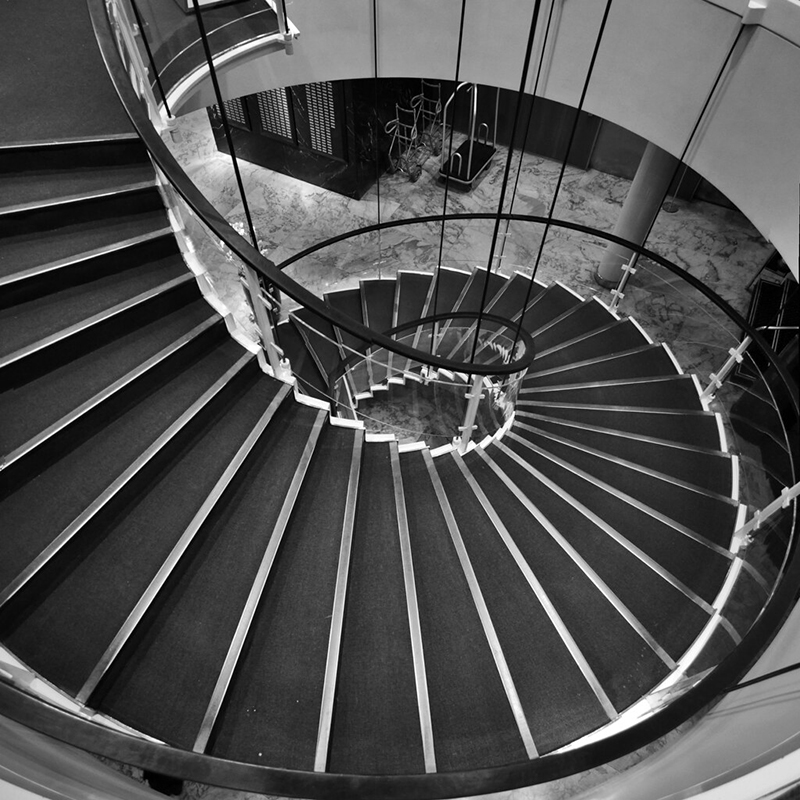
SAS Royal Hotel, Central Staircase
Another of his largest commissions was the SAS Royal Hotel in Copenhagen, made for Scandinavian Airline Systems and now known as the Radisson Collection Hotel, Royal Copenhagen due to a brand partnership between the two companies that later resulted in the full ownership of the hotel by Radisson. Here Jacobsen controlled the entirety of the construction, like the previous two ventures, designing the fittings, furnishings, landscaping, furniture, airport shuttles, wallpaper, and cutlery, realizing his vision in totality and later being known as an example of a Gesamtkunstwerk. This is a German loanword that broadly describes a work of art which incorporates many styles or art forms to achieve its full realization, and in architecture refers to those instances when an architect has complete control over a building's totality. It's arguable that the majority of Jacobsen's later work falls into this category, but the SAS Royal Hotel is notable for both its iconic furniture designs and that it's become considered a lost Gesamtkunstwerk, as the Radisson's corporate standards later removed and replaced nearly every bit of Jacobsen's interior design.
Two of the chairs that he made specifically for this hotel went on to become classics of Modernist design, the Egg and the Swan, and were rife with supple, organic curves that reinforced the humane aspect of Jacobsen's Functionalist work, softening the structured, angular interior of the hotel and later being put into full-scale production. The cutlery set he designed for this hotel is especially notable for being used by Stanley Kubrick in 2001: A Space Odyssey as the utensils used by the astronauts thanks to their futuristic look and daring approach to form.
Jacobsen passed away in Copenhagen in 1971, and has since been remembered more for his furniture designs than for his striking architectural exploits. Like the Egg and the Swan, many of his chairs have enjoyed reputations as classic designs, such as the Ant chair and the Seven series of chairs, and many of them are still in production today, the majority of them originating as specialty pieces for specific projects. These chairs had a great impact on the Modernist style of furniture design thanks to their novel forms and easy elegance, staying true to Jacobsen's style of clean lines and little-to-no excess ornamentation, placing the focus entirely on the structure and its functional purpose.

Arne Jacobsen Chairs
Throughout his work, Jacobsen established a style of Functionalism which held in high regard the artistic value of proportion and of function itself, putting forth that a well-designed piece which performed its function as well as possible was itself beautiful solely because of its usefulness. His eye for proportion enhanced the function of his work as well, and in this he found a connection to architectural styles of eras past, citing proportion as one of the key factors making ancient architecture so compelling and enchanting.
Impact
Arne Jacobsen's style of architecture was instrumental in bringing the idea of Functionalist aesthetics over to Denmark, and he is widely considered the father of Danish Functionalism, creating an aesthetic language which can be seen in the works of future Danish architects. His furniture designs were incredibly impactful in their future influence on not just the Modern style, but the Danish Modern style in particular, introducing it into the wider world and infusing it with his signature sense of graceful line work, contributing to Denmark's burgeoning furniture industry which would then go on to become one of the nation's most profitable exports.
In the pipe world, ripples of his architectural style was felt as Sixten Ivarsson began the artisan pipe making revolution, Jacobsen's elegant cleanliness of form and comfortable flow of line translating into soft curves and slight alterations of shapes that emphasized a quintessentially Danish approach to aesthetics. As Sixten continued to lay the groundwork for the coming wave of Danish classicism, the designs which he made for Stanwell started selling and the Danish aesthetic reached further shores.
The similarities between Jacobsen's work and the artisan pipe-making movement are most palpable in regard to the ideal of total design. Just as he was afforded complete control over every aspect of a building's construction, so too is the artisan in total command of the aesthetics of their work, the selection of the briar, the cutting of the stem, and all of the shaping, not to mention any fittings, being their responsibility alone. In much the same way which the later buildings by Jacobsen became known as Gesamtkunstwerk, it could be argued that each artisan pipe represents something of a Gesamtkunstwerk as well, being the total artistic expression of that individual's vision for the particular pipe. As briar is shaped to favor grain and smoke well, Functionalist buildings are shaped to please the eye and serve their specific purpose as well as possible. In this full realization of purpose, Jacobsen found great beauty, and in this way pipes, too, achieve beauty, for some of the most stunning examples of the form are those that simply smoke with excellence.
You may also enjoy:





Comments
A serious but very readable overview of 'modernism', perhaps the most important--but often neglected--theme of life for the past hundred years. And it was a thoroughly unexpected treat to find this informative and thought-provoking piece tucked away in the pipe-smoking archives!
Superb article. Kudos!
The Arne Jacobsen article is yes, superb. As a fan of Bauhaus and even more, Danish design, I loved reading this. Our home is dominated by Danish furniture, B&O sound, but so far merely three Danish pipes. That may have to be rectified. Mange tak, mahalo and aloha from Hawaii.
Wonderful quick overview of Arne's life and works. While so much more could be said, like his own art form, the concise nature of your article contained the necessary information to serve it's purpose without the burden of flourishes. One of the pipe shapes I enjoy collecting is the Bulldog. It is a shape people generally love or hate, for it's faceted lines. When asked why I like them so much, I usually explain myself by talking about motorcycles, specifically bobbers which were the precursors to choppers. Bobbers were a movement in the 1940s based on a similar idea of functionalism where anything unnecessary was removed from the bikes. In theory, this would make the bike weigh less and thus go faster. I my view, bulldogs are sort of the bobber/choppers of the pipe shape world. Imagine a stout pot pipe. Now, cut the top half of the bowl down to where the only thick walls left are where you need them most during the smoke, then take that round shank and trim it down leaving only a diamond shank from within. Next, cut those chubby cheeks off the bowl and you'll have a bulldog, a shape steeped in functionalism. Yes, functionalism as a design idea paved the way for so many features of our world we take for granted now. What were once avant-garde choices, are seen today as classics because they were always so much more than simple designs.