


 |
|
 |
|


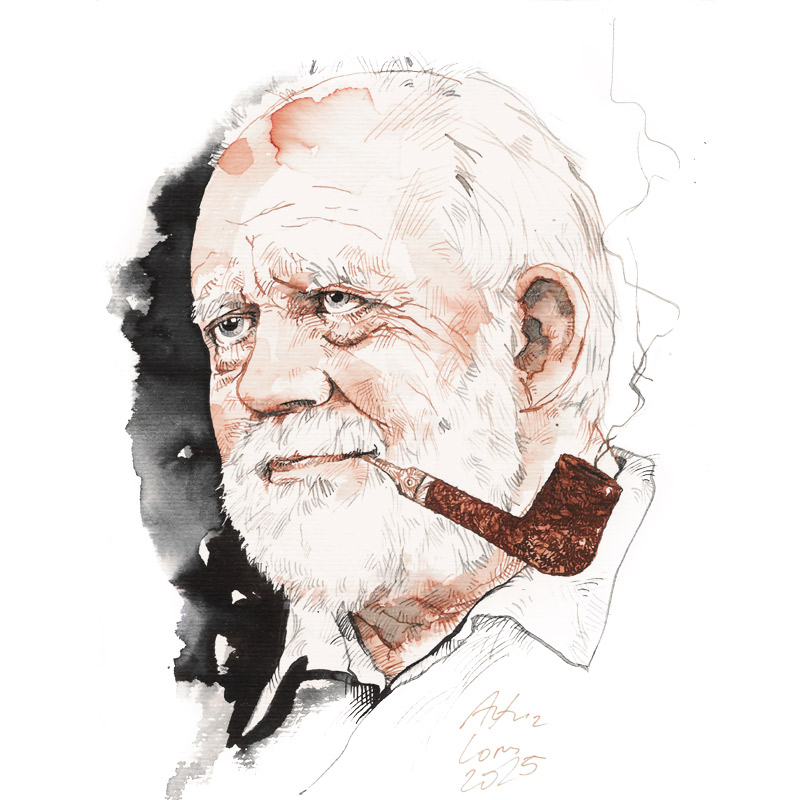
Portrait of Chuck Stanion by Artur Lopes
"I don't want you to write about me, Truett."
"I know, Chuck, but Sykes and Andy really want an article commemorating you in light of your retirement. They've commissioned a portrait by Artur and everything."
"Yeah, but it's only retirement! Save it for when I'm truly gone and can't read it. I hate reading about myself almost as much as I hate hearing myself speak."
"Okay, I understand. What about a compromise? What if I write about you but keep it strictly to pipe stuff, leaving out your Arctic excursions, the hundreds of orphanages you've built by hand, and the galaxy NASA named after you?"
"All right, I'll allow it. Just keep it low-key."
Chuck Stanion needs no introduction on the Daily Reader. He's penned over 250 articles since his tenure at Smokingpipes began in October 2017, and every article not featuring his byline has benefited from his editorial hand. In many ways, the Daily Reader is synonymous with Chuck's voice, vision, and vigor, yet it would be naive to reduce his pipe-community contribution to only the Daily Reader — no matter how influential it may be.
A pillar within the community, Chuck garnered an impeccable reputation as the Editor of Pipes and tobaccos magazine (P&T). He's also an experienced pipe smoker, pipe collector, tobacco connoisseur, and Doctor of Pipes. First and foremost, though, Chuck is a writer, a craftsman of prose whose writing has informed the pipe community for the better part of three decades, and July 31, 2025, marked his last day at Smokingpipes and the beginning of his retirement. It's only fitting that a man who honored, educated, and entertained so many through his Daily Reader editorials and essays be likewise elevated on the platform he helped construct.
Chuck the Pipe Smoker
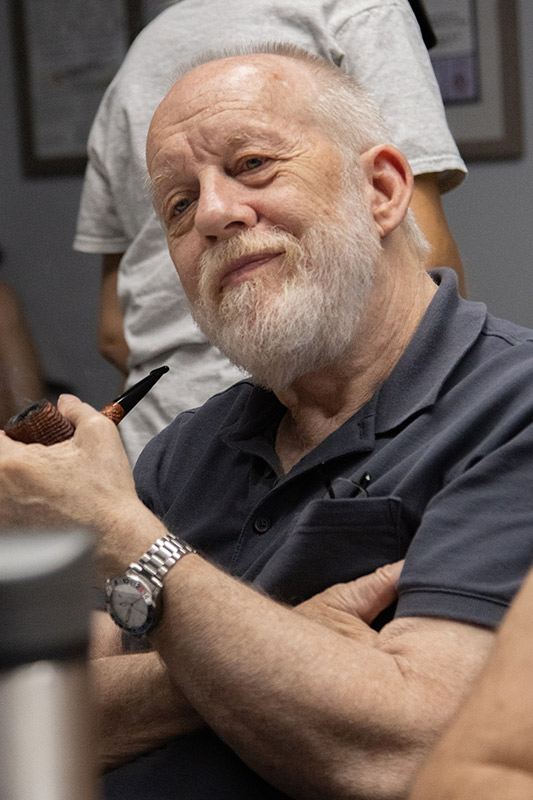
Chuck's father passively introduced him to pipe smoking. "My dad smoked a pipe on and off when I was a kid, and I was always fascinated by them," says Chuck. "When my parents slept in on Saturday mornings, I'd get up before them and check out his pipes. I just liked the shapes, and I liked the smell, though they tasted awful." Though his father quit smoking when Chuck was in high school, the influence planted a seed that Chuck would later water when he started smoking a pipe himself at the age of 24.
His pipe-smoking origin story may lack the Hollywood appeal of a radioactive spider or the destruction of a home planet, but it does carry the tell-tale signs of fate or some inexplicable cosmic intervention. "I just woke up one day and said, 'I'm going to go to the smoke shop and buy a pipe,'" he says. "I've reexamined that day in my mind many times, and I can't find the motivation anywhere." Though devoid of any meaningful or relevant rationale, that first pipe — a Savinelli Billiard — set Chuck's life on a trajectory that's benefited all of us; a butterfly effect, if you will.
As with most of us, Chuck's pipe-smoking preferences have evolved over the years. "I used to only smoke bent pipes," he says. "I didn't see the point of straight pipes, so I was smoking bent pipes and bizarre Freehands." It wasn't until 1999 that Chuck began to appreciate the beauty and practicality of straight, classic pipes. "At P&T, I hijacked J.T. Cooke into carving the first P&T Pipe of the Year, and we wanted to do a Billiard because it's the most popular shape — we wanted to make sure they sold," he says. "These pipes arrived, and, my God, Cooke's proportions were phenomenal. He made a Billiard that made me happy just to look at. I bought one and smoked it. It smoked better than any pipe I had at the time, so I bought a second one, which also smoked better than any pipe I had. It got me thinking, 'All right, these traditional shapes are traditional for a reason.'"
Such an experience began refining Chuck's pipe-shape inclinations, but it took time to further narrow his preferences to what they are now. For those who don't know: Chuck's collection primarily comprises Lovats and other saddle-stem Billiard variants. If Rich Esserman is known as "The Big Pipe Guy," then Chuck is the "Lord of Lovats." "It took me a year or so to realize that saddle stems were more comfortable in my teeth," he says. "From the early 2000s and on, the Lovat has been my favorite shape."
I'd get up before them and check out his pipes. I just liked the shapes, and I liked the smell, though they tasted awful.
Similarly, Chuck's tobacco preferences have matured from when he first started smoking a pipe. As a bartender, he was smoking cigarettes and decided that he would rather smoke a pipe. "I was smoking both cigarettes and pipes and was having a hard time giving up the cigarettes, so I quit them both," he says. "For four or five years, I didn't smoke at all, but then I picked the pipe back up without the cigarettes." While smoking a pipe behind the bar, he experimented with Aromatics. "People liked the smell of what I was trying at the time, but I felt like a poser," he says. "I didn't seem old enough to most people to smoke a pipe, but I've fixed that. Now, I'm old enough."
From Aromatics to English mixtures, Chuck's tobacco exploration followed a familiar journey, but his English phase was short-lived. "I really fell for English blends, but my wife lost her tolerance for them," he says. "I switched to Virginias, and I liked them even better." He also enjoyed smoking cigars at the time, but it didn't take long for him to leave those behind as he did with cigarettes. "If I'm going to spend some time smoking, I'd rather smoke a pipe," he says. For Chuck, "The pipe is it. Once you get past all that tongue bite crap and you know how to maintain your pipe and you start smoking really good tobaccos, there's nothing that can compete with the pipe."
Just as Lovats have become an identity marker of Chuck as a pipe collector, his love of McClelland tobaccos has remained a stalwart aspect of his smoking preferences. "After a CORPS show in the early 2000s, I went to Bob Hamlin's house with Bill Ashton-Taylor, David Field, Mario Lubinski, maybe Marty Pulvers, I'm not sure, and other such luminaries in the pipe world," he says. "I was star-struck by these people, but they just treated me like part of their group. Bob had this 20-year-old tin of McClelland No. 27. It had to be opened with a can opener; it wasn't a pull-top lid. I'd never had aged Virginias before, and it blew my socks off. So I became a McClelland fanatic."
McClelland's Beacon became a particular favorite of Chuck's, but it didn't appeal to his palate at first. "My first tin of Beacon that I ordered, I smoked a couple of bowls and threw it away," he says. "I didn't like it at all, but I returned to it several years later. My palate had developed enough that I was able to appreciate VA/Pers and straight Virginias." Even though McClelland closed its doors in 2018, Chuck still has Beacon in his cellar along with other McClelland staples. "I've been mainly smoking McClelland 5100," he says. "I have a couple of cases that I add Perique to, and I've got a bunch of tins of No. 27 — that original Virginia that turned me on to McClelland. I add 5% of Cornell & Diehl's 31 Farms Perique to that, and it's just dynamite."
Ever since I met Chuck in early 2018, he's been synonymous with Lovats and McClelland. Every meeting, every company event, he's never without a pipe; it's as much an appendage as his nose or left arm. "I never go anywhere without a pipe," he says. "It's just a part of who I am."
Chuck the Writer
Perhaps the only characteristic more intrinsic to Chuck than pipe smoking is his quality as a writer; he's been a writer much longer than he's been a pipe smoker, after all, having written his first short story while in the fifth grade. "It wasn't assigned or anything. I just decided I wanted to write it," he says. "Then in the seventh grade, I started writing for the middle school student newsletter. From seventh grade on, I knew I wanted to be a writer." Even from a young age, Chuck's literary voice was distinctive and steeped in humor. His first article explored, in his words, "the nefarious agenda of the evil beings known as orthodontists," and by his senior year of high school, he had a weekly column in the Ithaca Journal called "Literary Corner." "It was terrible," Chuck says, but "it had my photo and everything; I was a minor celebrity."
After deciding to continue his education, there was no question what Chuck would study in university. Unfortunately, a bachelor's degree in Creative Writing in the 1970s proved as immediately useful to Chuck as a driver's license to a nine-year-old. Finding employment in the field was difficult, so in the meantime, he managed a restaurant and a nightclub while his wife, Bev, completed her studies to become an occupational therapist. It wasn't the stepping stone he intended, but Chuck's patience and flexibility were rewarded.
"I never go anywhere without a pipe," he says. "It's just a part of who I am."
Bev finished her degree and turned the attention to Chuck: What did he want to do next? "I was thinking I could stay in restaurant management. That was a career, but I didn't particularly enjoy it," he says. "And to her credit — and I'll always be grateful to her — she said, 'No, I didn't ask what's practical. I asked, What do you want to do?'" The couple moved to Tampa, where Chuck enrolled in a master's program at the University of South Florida. "My interest was in satire and Mark Twain," he says. "And two of the biggest minds in satire criticism, Pat Rogers and John Clark, were at USF."
Chuck the Satirist
A pipe-smoking satirist who idolizes Mark Twain seems a bit on-the-nose or even manufactured — like the kid I knew in high school whose band, Zed Leppelin, with "original" songs called, "Escalator to Eden," "So Much Affection," and "Ebony Canine," were all "purely coincidental" — but in Chuck's case, it was entirely authentic.
"I've been a fan of Mark Twain since, I don't know, I was 12 or 13 years old," he says. "I had just read Tom Sawyer and Huck Finn, and around seventh grade — when I was getting into writing myself — a theater troupe came in and did a play on Twain and his work. I can't remember much about it, but I remember enjoying the hell out of it." The interest snowballed as Chuck read more and more of Twain's writing: novels, sketches, short stories, anything with his byline. "He just really resonated with me," says Chuck. "I loved his short sketches. They were just funny, and I loved the way he manipulated language to get a laugh." Anything Twain-related spoke to Chuck, and he devoured everything he could on the topic, including Hal Holbrook's Mark Twain Tonight! one-man stage show. "He did a fantastic job. I saw his live show several times," says Chuck. "It was so hilarious."
However, Chuck didn't merely passively consume Twain's work; he sought to experience it firsthand. Inspired by the humorist's tales of the Mississippi River, Chuck and a friend drove to New Orleans, sight unseen, and found work on the Mississippi Queen: the second-largest paddle-wheel driven river steamboat ever built. A seven-deck recreation of a classic Mississippi riverboat, it ran service from its maiden voyage in 1976 to its decommission in 2008. Chuck's experience working on the boat would be a Daily Reader article unto itself, so this brief synopsis will have to suffice for now:
My buddy and I got in my car, and we drove to New Orleans — didn't have anything set up, but we went and found jobs on the Mississippi Queen, which was a life-altering thing in itself. The whole reason I wanted to go was to see the river the way Mark Twain saw the river. And I did. It was an awful job: I hauled garbage; I did dishes; I mopped; just whatever. But I had my nights where I could sit on the deck and watch the river go by, and it was like coming home again. I'd never seen the Mississippi River before, but it just felt, wow, this is where I should always be, I think. That said, we had two murders and one stabbing among the crew while I was onboard, maybe more, since so many disappeared over the side. Lots of drugs and violence on that boat. It was crazy.
Young Chuck found a kindred spirit in Twain. Even in his earliest writings about the "evil beings known as orthodontists," Chuck's style clearly tended toward humor, and Twain would give Chuck aspirational fuel for his own writing future. In his words: "Seeing someone like Twain perform the craft at such a high level motivated me."
After earning his master's at USF, Chuck continued into a PhD program, focusing his doctoral dissertation on Twain. Not without a twist of dark irony, though, Chuck's development into a satirist and expert on Twain came at the expense of two literary minds: "John Clark ended up being my major professor for my dissertation, and he did more for my writing than any other teacher I've ever had," says Chuck. "I remember when I asked him to head up my dissertation on Mark Twain, he delivered one of the best compliments I ever got, saying I finally seemed to be getting the hang of it. Unfortunately, he passed away when I was working on it."
Jack Moore saw Chuck through the end of his doctorate and planned to recommend his dissertation for Best Dissertation of the Year. However, he too passed away, only two weeks after Chuck's oral defense, and subsequently, Chuck missed the chance at recommendation and lost another mentor who greatly influenced him. "So, yeah, I killed two major professors with that dissertation," jokes Chuck. Though macabre, such darkly humorous circumstances do befit Chuck's entry as a satirist into the upper echelons of academia. Thankfully, Chuck's mentorship of other writers, such as myself, hasn't resigned him to the same fate as his doctoral advisors.
Despite leaving academia, Chuck's expertise as a Twain scholar and facility with satire have not collected dust. His writings for P&T and the Daily Reader were regularly punctuated by humor that extended beyond the narrative circumstances to affect the language itself — much like Twain's usage. Moreover, Chuck is never shy or unwilling to educate about Twain when the situation requires it. Brian Levine, host of the Pipes Magazine Radio Show podcast, co-organizer of the Las Vegas Pipe Show, and former colleague of Chuck's at P&T, recounts how his daughter benefited from Chuck's academic expertise after she was assigned to write a school paper about Mark Twain. "I called Chuck while we were in the car," says Brian, "and next thing I know, he and my daughter are talking back and forth about all kinds of Mark Twain stuff and where to focus her paper. He ends up emailing me 12 or 14 pages of his doctoral thesis, so now my daughter's got a section of a doctoral thesis to use for her middle-school project."
If Chuck has the ability to help someone, he will never shy away. Now, 14 pages of a doctoral thesis for a middle-school essay might be like buying a bazooka to solve a cockroach problem, but it certainly gets the job done. I highly doubt any classmate of Brian's daughter had a more reputable or knowledgeable bibliography.
Chuck the Editor

While completing his postgraduate studies, Chuck became a patron of the Tobacconist of Temple Terrace and close friends with its owner, John Sabia. In 1996, John invited Chuck to join him at the RTDA trade show (the predecessor of what is now the PCA trade show). "That's when I met Dayton Matlick," says Chuck. "He had just come out with Pipes and tobaccos magazine."
This chance encounter catalyzed Chuck's entry into the pipe industry, with a little vote of confidence from John. "John told Dayton what a great writer I was," says Chuck, clarifying that "John didn't know if I could write a grocery list. He never read anything I'd written, he just told Dayton that." John prompted Dayton to let Chuck write something for a fledgling P&T, and Chuck offered to interview Randy Wiley, who lived nearby, and to write a story about him. "So, I wrote it while I was still in school, and sent it off to Dayton," Chuck says. "He liked it well enough that he started asking me for my résumé. I was flattered but didn't give it serious consideration until after a couple more of Dayton's phone calls."
Dayton needed an Editor for the magazine or, rather, a new Editor. He had an Editor already, but he wasn't a pipe smoker. Worse: he was an anti-smoker. Chuck, meanwhile, was a paragon of pipe smoking, a brilliant writer, and just an overall mensch — the perfect candidate. "I ended up taking the job, and we moved to Raleigh," says Chuck. "That started my journey with Pipes and tobaccos magazine. They hired me as an Assistant Editor, and I pretty quickly became Managing Editor and then Editor-in-Chief. I did that for 20 years."
Over the course of those two decades, P&T gilded the pipe community with an indelible influence that cannot be understated. It was no secret that pipe smoking was fading from public consciousness, yet here was a publication devoted to producing polished and professional articles about the art and lifestyle of pipes and tobaccos. Pipe smokers relied on the magazine for past and present pipe history and current events; pipe makers relied on it for promotion and industry reach; and retailers relied on its ad space. P&T was the pipes and tobaccos magazine, and for years it was the best avenue for seeing some of the best pipes ever made with the best quality photos possible, especially for those unable to attend in-person pipe shows. Dayton and particularly Chuck were beyond instrumental in developing P&T's renown throughout the industry.
As Brian recounts, "Chuck made sure as the Editor that there was always a good balance of current events, historical stuff, good information, and the photography for the time was simply the best that we had." As a pipe smoker, Chuck knew what other pipe smokers wanted to see when printing pipe pictures, and he was actively involved in P&T's photo shoots, ensuring that they captured each pipe as accurately as possible. In fact, he also served as staff photographer. "When pipe makers didn't have photos, which was often," says Chuck, "they sent pipes to the office for me to shoot. I remember when we got a digital camera and what a boon that was. It was such an improvement not having to go to the photo shop to process 18 rolls of film."
Moreover, P&T helped the careers of numerous pipe carvers, most notably J.T. Cooke. When Chuck commissioned Cooke to make the magazine's Pipe of the Year collection in '99, "it was really the first time that Cooke's name was anywhere outside of some pipe shows and a couple of retailers," says Brian. "Because of the P&T project, Cooke ended up getting all of this notoriety and started getting a direct list of customers. Chuck Stanion is probably single-handedly responsible for helping J.T. Cooke get out from behind the curtain and into the forefront."
Chuck gives more context to the story, explaining what happened behind the scenes when Cooke was suffering from severe carpal tunnel. "One thing I'm most proud of is the way the pipe community banded together to save J.T. Cooke's pipe-making career," he says. "He had no insurance and needed surgery. I started contacting people and sent correspondence about the problem, keeping it secret from Jim because he never would have allowed it. Folks all over the world sent me stuff to sell on eBay, and Dayton gave me leave to do it all on company time. We raised $32,000, and Jim got his surgery, giving him another 25 years of pipe making. Hundreds of people participated. It was a heart-warming token of the community's kindness."
"Saving pipe-making careers" wasn't a part of Chuck's job description as Editor, yet that's the kind of person he is. He not only cares deeply about the pipe community, but he cares deeply about people, and he's immensely humble in his service. It's one of the things those who have encountered Chuck admire most about him. "One thing that I've really always admired about Chuck is that he is so humble," says Brian. "He doesn't take praise for anything; he doesn't take praise well, but he greatly deserves a lot of it. Because he's so humble, he doesn't understand exactly how good his writing is and how important it has been, and he doesn't want any accolades for it."
To that point, Chuck would probably rather sleep in a bed of wild sumac than have this article exist, but that's exactly why it should.
Another way through which Chuck transformed P&T and the pipe community at large was through his column in every issue, "The Editor's Desk." "Dayton wrote that when I first started, but after a couple of years, he turned it over to me and I wrote it," says Chuck. "It was almost always humorous — or supposed to be —, and people responded to that. Some said it was their favorite part of the magazine." He also regularly traveled to write his stories. "We didn't do phone interviews," he says. "If I wanted to do a story on somebody, I'd get on a plane and go see them and take pictures myself there and see it all in person, which added to the texture of an article. I would go to Denmark for three weeks, pick up as many stories as I could in one trip, and then space them out over the next year."
Before Chuck arrived at the magazine, P&T was fairly straight in its reporting, not stuffy, but certainly more measured and classically journalistic in its tone. Chuck naturally brought a fresh, comedic bent, and it was well received by readers. "My natural inclination is to drift into humor in almost anything I'm writing, and I applied that early on," he says. "One of my first pieces was on J.T. Cooke, and I got a little sarcastic with it — not anti-Jim Cooke at all, just talking about how ridiculously up in the mountains and the snow he lived, just the dangers of the road to get there. I gave it to Dayton, wondering if this was going to fly or if I'd have to revert to straight reporting. I just didn't know. I didn't know his vision for the magazine at that early stage. He liked it, though, and the readers liked it, so I continued to pursue that tone."
Fans of the Daily Reader are familiar with and regularly entertained by Chuck's humorous style, especially his references to Grandpa and the 10 Tobys. He developed that trope at P&T, continuing it at Smokingpipes, and it's been a welcome aspect of Chuck's writing to readers worldwide, punctuating learned pipe knowledge, history, and opinion with a satirical bent.
Most of all, though, Chuck and Dayton used P&T to serve its readers and the pipe community. "Dayton and I really thought the same about the magazine in that its primary purpose was not to make money," says Chuck. "Its primary purpose was to serve the hobby and the industry, and the money would come as a natural side effect of that. Turns out that didn't work, but we meant well." The magazine promoted pipe clubs, specific products, new pipe makers, new accessory makers, new tobaccos. "We ran basically free ads for people a lot," says Chuck, "and many have said that they got their start and wouldn't have gone any farther if P&T hadn't supported them in that way. We never did much more than break even, but we were well regarded in the hobby."
My natural inclination is to drift into humor in almost anything I'm writing
One such person benefited by the magazine was Sykes Wilford, founder of Smokingpipes and Laudisi Enterprises. Smokingpipes was a regular advertiser in P&T, and Sykes was also a fan of Chuck's writing in general — an appreciation that would later result in Chuck transitioning to Smokingpipes.
Chuck the Laudisian
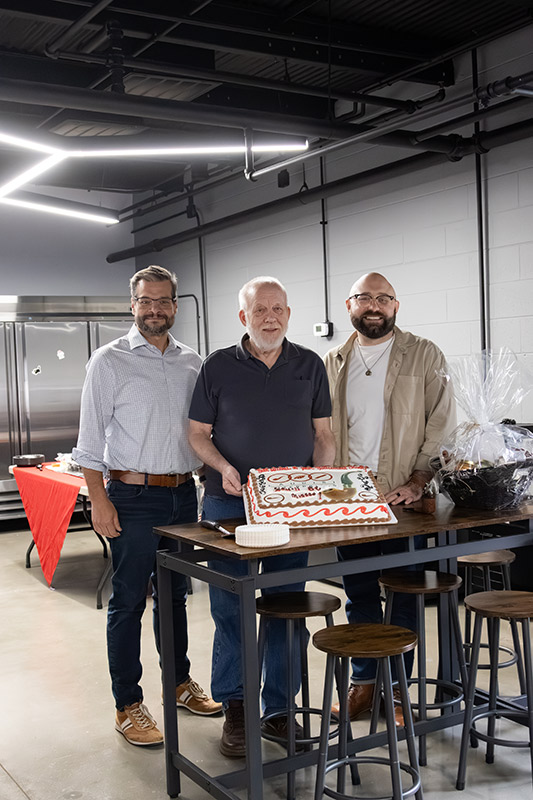
Unfortunately, after over 20 years of service to the hobby, Pipes and tobaccos became untenable, though it lasted far longer than any previous pipe magazine. The magazine's parent company, SpecComm International, was being sold, and Chuck knew that it was time for him to move on. "I knew P&T was going to be sold," he says, "and I had no assurances that the new owners would keep the magazine and keep the staff, which they didn't." He had to get out before that happened. "P&T was my baby," he says. "I couldn't stand the idea of watching it be reduced in size, or seeing travel for interviews curtailed, and I especially didn't want to be there when it closed. I knew it was coming, and I left. I was sad for a long while."
Thankfully, Sykes and Smokingpipes were interested in a writer of Chuck's caliber, and he joined the team at Laudisi in October 2017. "When I first came to the hobby, Chuck was very much one of the people that I really looked up to," says Sykes. "He cared about pipes, he thought about them, and he wrote extremely well. It's something I prize in myself and others, and he was really smart and funny and kind to me as this young guy."
Sykes and Chuck met long before they were colleagues. "Our first meeting at a pipe show was kind of a fan-boy meeting on my part," says Sykes. "'Chuck Stanion, I love P&T, and I love your column.' I was all of 21 or 22 years old when this happened." In many ways, it was a dream realized to have Chuck eventually at Smokingpipes.
Smokingpipes had a blog before Chuck was hired, but its publications were intermittent and unprioritized institutionally. "In the early days of the blog, I basically wrote 90% of the articles," says Sykes. "We wanted to start publishing on a regular cadence and make it feel more like a publication and less like a blog associated with a retail website." Chuck was necessary and essential in that endeavor, and his hiring elevated Smokingpipes' written voice exponentially. "I hired Chuck because I thought he could help with our writing, but I also hired him because I did not want the hobby to lose Chuck's voice. What Chuck was doing was important," says Sykes. "Hiring Chuck in 2017 was an interesting moment for me personally because Chuck went from being this person who I admired sort of distantly to someone who I had a work relationship with. Chuck was a big deal, and I was just some young dude with a pipe website. There was a moment in 2017 when I thought, 'Okay, wait a second, Smokingpipes is a big deal because we just hired Chuck Stanion."
In those days, though the Smokingpipes Blog existed, much of the writing workload focused on email newsletter introductions, which were, in essence, small articles. Andy Wike, Vice President of Marketing for Laudisi, was instrumental in revamping the blog and rebranding it as the Daily Reader. "We had kind of reworked the Daily Reader by this point, but it was in its infancy," says Andy. "Once Chuck started working on that, that's when I think the magic really started. I sort of had an idea for what the Daily Reader could be, but I couldn't do it on my own."
Chuck's experience as a writer of pipes and tobaccos was invaluable to the project, but he'd also curated a readership unlike anyone else in the industry. He also brought an authentic perspective, having focused P&T on its content and service of the hobby as opposed to a vapid marketing tool. "What Chuck did for me with the Daily Reader was to temper my instincts and really make sure that it became a separate publication that was divorced from any sort of sales incentive," says Andy. "I can't tell you how many times I've given Chuck an assignment, and he's able to talk about a product that we want to let people know about, but in such a natural and organic way that it never really seems like a sales pitch."
For Andy, good marketing is simply telling the truth and letting a product speak for itself, and Chuck's authenticity meshed perfectly with that philosophy. "What Chuck does is find unique and interesting ways to tell a true story," says Andy. "We're very fortunate to work for an organization that believes in that paradigm. The Daily Reader isn't about selling products. We tell stories. We educate, share, and speculate. We invite our readers in, where they're welcome as part of our tribe."
Chuck appreciated the Daily Reader's new vision, and he seamlessly incorporated his distinctive voice and expertise. "I felt like I was reconnecting with my audience, with pipe enthusiasts," he says. "As I said before, with P&T, you served the community first and yourself second. I always had that attitude with the Daily Reader. I was in the Marketing department, but I still approached it as 'do what's interesting and cool for the community first,' and they'll come to you because of that, instead of hammering the marketing stuff."
"Once Chuck started working on [the Daily Reader], that's when I think the magic really started.
In his role as Editor, Chuck not only defined the Daily Reader's voice through his numerous articles, but he also imprinted his editing expertise on all other pieces, mentoring Smokingpipes' other writers through the process. "Chuck was the final editor on kind of everything," says Sykes. "He refined and sharpened a whole generation of writers at Laudisi and helped me to refine and sharpen my writing in many cases, too." As an editor, Chuck is devoted to extremely high standards, not for his sake but for writing's sake. "Chuck refuses to accept bad writing," says Andy. "We have standards for what is good enough to post on our website, and those standards largely are Chuck's own. How we approach the Daily Reader from now on will definitely be framed by 'What would Chuck do?'"
Chuck's work at Smokingpipes on the Daily Reader combines with his experience at P&T to inform a legacy that will last decades across the hobby. His dedication to truth and his surgical approach to writing helped create two of the most influential pipe-related journals in history.
Chuck the Craftsman

Whether for Pipes and tobaccos magazine or the Daily Reader, Chuck approaches everything he's done with the precision and execution of an artisan craftsman. "He's really dedicated about the diction that he uses and his word choice and sentence structure," says Andy. "He's thinking about it on a micro level, the exact words he's using — like a poet — but then on a macro level, he's also thinking about flow and organization and how ideas are presented to the reader in a logical and natural way. He's just such an incredible storyteller and has the ability to interweave humor into a more serious piece without coming off as trite."
Chuck is like an artisan pipe maker but with words instead of briar: He has the technical chops to craft a piece of writing like he's at a lathe or a sanding disc, and that acumen is married to an artistic je ne sais quoi that can't be taught, like a pipe maker interpreting briar's grain to inform the shape and maximize the grain's beauty. Chuck maximizes information and entertainment like a master craftsman, shaping prose according to his artistry — all burgeoned by expert engineering that makes for a cohesive composition that's easily digested and thoroughly enjoyed.
"I think of Chuck as a consummate craftsman," says Sykes. "Really great writers manage to synthesize their influences and have their own style, and Chuck is an exceptional storyteller, an exceptional craftsman." Like an artisan pipe maker today drawing on the design languages of past makers, such as Lars Ivarsson and Hiroyuki Tokutomi, Chuck seamlessly incorporates his love of Twain and satire with his own voice into something entirely its own, free of facsimile and mere duplication.
Moreover, Chuck has never sought glory from his work; he writes because he's a writer. Lars and Toku and other such masters made pipes because they were pipe makers, not because they sought notoriety. Chuck's success and influence are byproducts of his skill and work ethic, not because they were the ultimate goal. When he first joined Laudisi, he told Sykes that he only cared about one title: writer. "To this day, his title is Senior Writer, Editor," says Sykes. "This is a man who cares about his craft. For most of the real world, title, status, position, that's what's important. But for Chuck, he cares about being a craftsman, and I really admire that."
Chuck the Icon
Whether knowing Chuck's voice from his days at P&T or unfamiliar with him until the Daily Reader, pipe smokers everywhere have benefited from Chuck's ability to weave narrative with wit. His retirement marks the end of a sterling career, and the hobby owes him a debt. Thankfully, his writing will inform, inspire, and tickle generations of pipe smokers to come through copies of P&T and articles on the Daily Reader.
Chuck maximizes information and entertainment like a master craftsman, shaping prose according to his artistry
Join me in celebrating Chuck's legacy and his invaluable contributions to the hobby. We wish him a long and happy, well-deserved retirement and hope to catch him at future pipe shows. There may be other exceptional writers in our hobby, but few — if any — will leave a mark as significant as Chuck. Those of us who had the opportunity to witness his writing when it was new are truly privileged, and I'm thankful that future readers will still be able to enjoy Chuck's definitive voice, helpful wisdom, and infectious charm.
"I've never had a good stock of wisdom, but I'm loaded with appreciation," says Chuck. "The readers are most important to me. Without an audience, a writer is nothing. The pipe community has meant an awful lot to me, and it's been a privilege to serve it in what capacity I could for these years."
You may also enjoy:





Comments
When I first started reading Daily Reader articles, I only clicked on headlines and read articles whose topics interested me. I didn’t pay much attention to the author, but it didn’t take long before I started clicking on every article that had Chuck in the byline, no matter the headline or the subject. I knew I would enjoy the article, the content, and the prose and learn something (or many things) along the way. Sorry to see him go, but grateful to have been able to read his writing. Happy retirement!
Well done, Truett. And way to keep it low-key🤣 In the last photo I imagine "Chuck the Bartender" with a cigarette dangling in his mouth, a smouldering pipe in one hand, and the other hand sliding me a Wild Turkey double on the rocks in a dark smoke filled bar as we shoot the shit about pipes and tobacco. Maybe in a parallel reality...
Fantastic read. What a gem he is
Chuck is a truly gifted writer and I will miss him. All the best in retirement!
God is the same, yesterday, today, and tomorrow! So are Mark Twain and Chuck Stanion remembered in the yesterdays, read today, and sought-after in the tomorrows of time. Happy Retirement Chuck! 👍
My first reaction to the news of Chuck's retirement, even though I'm 14 years behind him and counting (looking forward to it): https://youtu.be/RQJK_gWi7-8?feature=shared
Sad to see Chuck retire, but it's well deserved. Time for him to collect a pack of Toby's and enjoy life!
Mr Chuck
Thank you for yours expertise in Pipes World - I enjoyed article years ago
about ….. Worst pipe of my Life.
Thank you Chuck and…… I always remember that.
Smile , Humor and friendship .
Thank you Sir
Allow me to join the parade of thankful readers and well-wishers. Chuck has been a source of education and entertainment, and his voice will be missed. I'd wager that there's a market for the collected writings, if y'all were so inclined...
Chuck did make an appearance on the Pipes Magazine Radio show where he mentioned getting the rights to his contributions to the P&T Magazine and compiling them into a book. Brian, if I remember correctly, told him not to take too long and worry about making it perfect... but I think Chuck would want it to really please his readers, take pride, and make it as perfect as possible. I think a collection of all his writings here, at Smoking Pipes, along with the artwork would be a welcomed and appreciated addition as well. It would probably be going to far to have him read and record his writings for an audible series, I know how much he enjoyed reading the Christmas story that Shane put him up to. Lol
What a beautiful tribute to Chuck! Knowing that quality writers never really “retire,” I can only hope that Chuck will continue to produce his magical writings and that Pipe Line will publish them. Otherwise, doggone it, how do we keep up with the Tobys?!
Chuck,
I will never forget the opportunity you gave me to write a piece for Pipes&Tobacco. It was about William Faulkner, the legendary author and pipe smoker.
Being published in P&T gave a struggling writer, and pipe smoker, the opportunity to enlarge his horizons. I’ll never be able to thank you enough.
This a beautiful tribute, and more than well-deserved.
Here’s to a happy retirement.
Fred Brown
If you tell the truth, Chuck, you don't have to remember anything.
Fair winds, sir.
M.
We'll miss you! Best wishes for an excellent retirement!
I am sad and happy. Sad because I will so sorely miss your interesting, insightful, and amusing writing. Happy because, as a retiree myself, I know that “When it’s time, it’s time”. So, enjoy time with family and doing whatever it is you enjoy doing. And BTW I may have a larger collection of pipe tampers. A box of 2 1/2” aluminum roofing nails has provided me a tamper or three in every coat, jacket, vehicle, pouch, lounge chair, pair of overalls, and fishing vest I own. Thank you for the many, MANY years of enjoyable stories.
I’ve always enjoyed Chuck’s pieces and I wish him a peaceful and enjoyable retirement.
And what a lovely piece by Truett to honor Chuck… I can see the mantle being passed…
I’ve always enjoyed Chuck’s pieces and I wish him a peaceful and enjoyable retirement.
And what a lovely piece by Truett to honor Chuck… I can see the mantle being passed…
Chuck is too youthful to retire! I hope he continues to write -- just for fun -- as he is a unique voice in our hobby. He is a legend with a fan club that spans generations, and I hope to see him at pipe shows in the future.
I have always enjoyed your writing Chuck. Enjoy your retirement. Hopefully there is a lot of front porch sitting with a good pipe.
Truett, thanks a ton for your astounding article on Chuck. I had no idea just what he had accomplished – and we’ve all benefitted. I am an avid follower of the Daily Reader and have complete confidence that Chuck’s mentoring will guide you and your team in the years ahead.
Best wishes.
Truett, your beautifully crafted article did full justice to a quiet giant of our hobby.
Very well written. I’m sure Chuck is proud. I have a large collection of P&T magazines so I’ll just continue to image he’s still writing.
Years ago, on the Pipesmokers2 Yahoo Group, I had a brief but memorable exchange with Chuck, in re: a thread of comments in a post I wrote about my first year of being a pipe smoker. This would have been 2004, at the latest.
I wrote about the experience of my first purchase of pipe and tobacco from somewhere other than a drugstore, about getting the hang of a smoking cadence that wouldn't burn my tongue, about how friendly pipe smokers on the 'Net would offer to send me pipes and tobaccos (RIP, Bear Graves) and how my initial tastes in tobacco were developing.
Chuck wrote a friendly and encouraging comment, thanking me for my beginner's perspective (he said sometimes it's hard for guys who've been smoking for decades to remember the beginner experience) and encouraging me not only to keep at it (pipe smoking) but also to write more about it.
The Yahoo Group is long, long since relegated to memory, and as far I know there's no way to recover any of the "content" (not the word we used in those days), but here's my memory of the exchange:
(Chuck was the editor of Pipes and Tobaccos magazine at the time, of course.)
Me: "Wow! Thank you! I certainly didn't expect a compliment from the esteemed Mr. Stanion."
Chuck: "Well, now... I don't know about "esteemed Mr. Stanion". Most people just call me 'that dirtbag' ".
Me: "Okay! Well then... how about a free lifetime subscription, DIRTBAG?????"
Chuck: "Well now, if I went around just handing out free lifetime subscriptions, I wouldn't truly be living up to the 'dirtbag' moniker, so, as much as I would like to..."
Everybody LOL'ed and LMAO'ed at it. I felt like it was part of my welcome into this wonderful world of briar and leaf. Thank you, Chuck (or Mr. Stanion, or Dirtbag) for making pipe smoking more fun and more interesting for this newbie way back when. Been at it over 20 years now, and you're part of the reason.
Rafe Hyatt
Nashville TN USA
Happy semi-retirement Chuck. I remember teasing smokingpipes.com if you pass the probation back in 17':) Sweet smoke from Jakarta!