


 |
|
 |
|





In this unique video, I was able to connect with Per G. Jensen, Jeremy Reeves, and Shane Ireland to discuss an exciting new collaboration we are proud to present to you: the Per Jensen Legacy Collection, now available on-site with four incredible blends we can't wait for you to dig into.
Note: The following transcription has been edited for clarity and brevity.
[Andy Wike]: We have a different video than we would normally do, but we have some being in different continent problems that Zoom is very nice and helps us solve, which we are super grateful for.
[Shane Ireland]: Per, I think it's past my bedtime where you are.
[Per G. Jensen]: It is, yes.
[AW]: Yeah, Per, thank you so much for joining us. Same to you, Jeremy. We really appreciate you guys taking some time to talk with us here at Smokingpipes about a super exciting collaboration between Per and Jeremy: the Per Jensen Legacy Collection.
Per's Inspiration
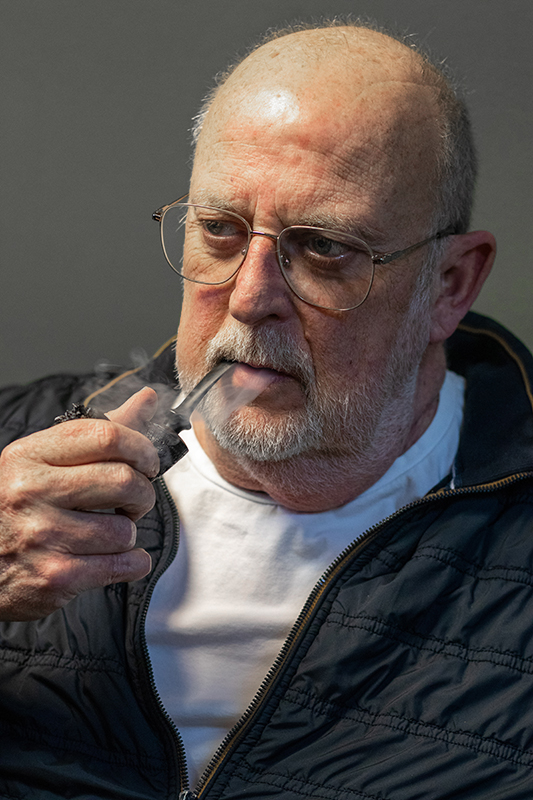
[AW]: I know this project has been in development for quite a while now, and there's a lot of R&D that went into it. Per, can you tell us a little bit about what the Legacy Collection means as a series, what the origins of this idea are, and what you want this new series to represent for you as a master blender?
[PGJ]: Yeah, the background is my father, Georg Jensen, who established a pipe factory in 1954. Before that, he had a very exciting life, I would say. Unfortunately, he died when I was very young. I was 20 and he left me with the pipe factory. You have to remember, this was 1980, so the community was looking at the only male: me. There was my mother in the company, there was my sister, and I was the only male, so they automatically said, he is in charge. I was very angry at my father, at that time. I had the feeling he left me with this strange company that I didn't know and without the proper education. And then, over the years, it's always good when you grow older, you get milder, and all these feelings I thought from time to time, and I got a little bit further every time.
When I moved to Berlin three years ago, I had packed everything I had in Denmark into Kaizen boxes. When I unpacked them here, I found a lot of photographs from his early life, and came to the realization that he had an extremely interesting life. He was doing stuff that others only dreamed of doing. There came a day where I forgave my father, and that helped a lot.
Then the desire started to grow to make a line of tobaccos to honor him, from his very early military career, over his 33 years in the Harbour Police in Copenhagen, the first fall, inspired by water, and then the next one was inspired by the pipe factory and all the stories from that period.
These ideas never went anywhere until I got in contact with you guys. I think there was a reason why it didn't happen before, and that was because I was waiting for the right tobacco.
[SI]: It's meant to be.
[PGJ]: Yeah. And sometimes you cannot explain why it is like that, but it just turns out that way.
Working with Jeremy Reeves at C&D
[PGJ]: And then, the week in March with you was tremendous. It was a learning process for me as well, because I came from Mac Baren, a big company. If you cannot produce 500 kilos from one blend, forget it, then you cannot produce it.
[SI]: Per, if I may, I'm curious. As a blender, your experience going from a really large organization like Mac Baren, to working with Jeremy at Cornell & Diehl, was it like a relearning process? Were you back to your roots? Did it feel liberating and creatively more free for you?
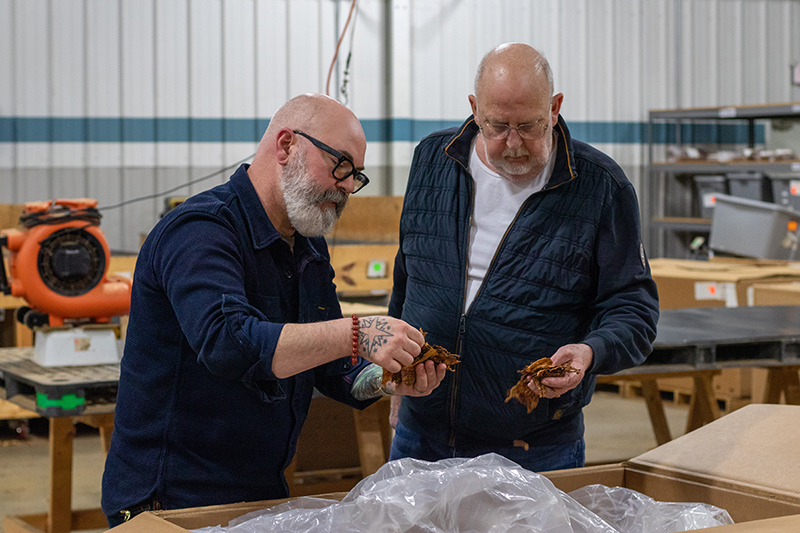
[PGJ]: Yes to all of the above. It's impossible to be in a bad mood with you guys. There's always something happening and everybody's smiling. Jeremy took me by surprise because I was used to tasting the raw tobacco, the casing, and then the topping. Yet here, suddenly, I'm in a factory where we have the raw tobacco, we hardly have any casings, and hardly any toppings, if any at all. So that was a completely new learning process.
Comparisons to Capstan Tobacco
[PGJ]: I would say the tobacco is more pure than what we had at the company. Just to give an example, the two Virginia flakes, the Bright one and the Red one, is actually a take on making a Yellow Capstan and a Blue Capstan, how they would look in the '60s.
[SI]: That's actually the first one I chose to smoke.
[PGJ]: Perfect. And the English had the purity laws. They had a very small list on what was allowed to be put in tobacco. It went back to the 16th century because the bakers were putting sawdust in the bread and the wine seller was adding lead to make the color more red, so they introduced the purity law and that also applied in tobacco. That ended in 1986 when England joined the European Union. But Capstan made under the purity laws is, I think, very close to what we have made with the two Virginia flakes.
What do you think, Jeremy?
[Jeremy Reeves]: Yeah, I think so. Of course, I've not smoked any of those tobaccos without a bunch of age on them, I've had the opportunities to smoke some very old tins of tobacco and some very old tins of Capstan. But it is difficult for me to parse how much of what I'm experiencing has to do with age and how much of it has to do with processing.
I will say that the older tins of Capstan that I have tried seemed different to me in terms of what I guessed ingredients might have been in the tobacco from more modern examples of Capstan, if that makes sense. There's a certain amount of guesswork involved, but I have a little bit of an idea of what things used to be done and what things are being done in more modernity. You can taste those things, even if the tobacco is very aged.
[SI]: Yeah, it does have a remarkable emotional similarity to those blends. There is that youthful, zestier quality to it, considering that it's fresh, but even the aroma right now is ringing some bells from some aged examples that I've smoked, and of course on the palate I can feel the difference in age. But, like I said, the best you can do when a bunch of us weren't even born yet when those tobacco were last made, and even if we've been fortunate enough to try them, is see if it rings some of those same bells.
There's a tanginess here that's different from all of the vinegary types of tanginess that we've experienced in modern tobacco production that does remind me very much of some of the old Ogden's and Bell's produced tobaccos.
[PGJ]: Yeah, it's a very good question because nobody can prove it. If you can find a tin from the '60s, it has many years of storage. It's not freshly made like all tobaccos are now.
Legacy Collection Blends
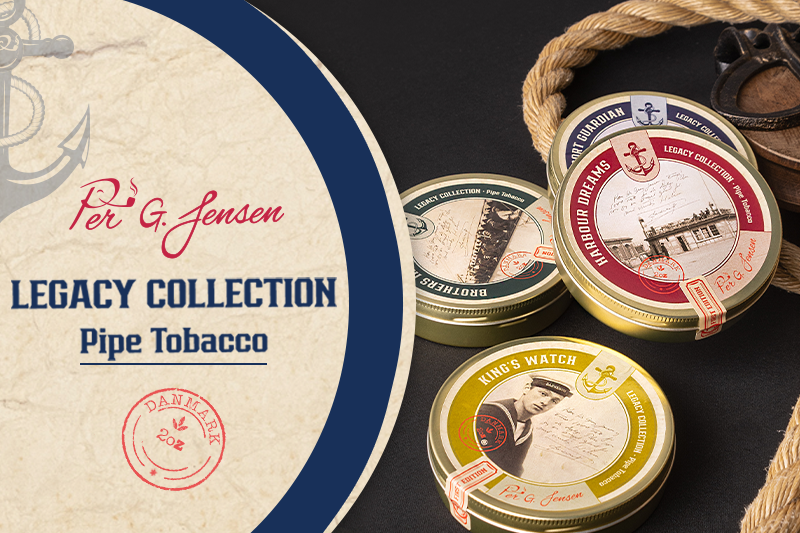
[AW]: We've got Port Guardian, which, from your perspective, Per, captures that same experience of old Capstan Blue, and then King's Watch, capturing that experience of old Capstan Yellow. There's also Harbour Dreams, which is a sophisticated ready-rubbed Burley, with a slight Aro quality, and then Brothers in Arms, which is a little bit more Dark-Fired forward. Can you speak to the blends, Per?
[PGJ]: Sure. The Burley has a chocolate note. I remember, back in the '60s when I went visiting with my father and mother to Langelinie, that part of the harbor in Copenhagen, also where the Little Mermaid is placed, which was the spear of the harbor where he had his duty. Beside that, there was a place where they were selling ice. I always remember looking forward to it because I always got an ice and that is where I learned to love chocolate ice. That might have a little bit to do with the choice as well. Of course, my father was checking ships when they were coming in doing security, loading, and all those sorts of things. He also had American ships and Americans were Burley smokers. My father, at that time, said, we don't throw anything away. We smoke it. So he smoked Burleys from time to time.
[SI]: Good man.
[PGJ]: And then the Dark-Fired Kentucky with a little bit of Perique, that was actually his favorite way to smoke, where he took the Capstan — he preferred Three Nuns, but if not, then Dark Twist would do — and then John Player's Red, which doesn't exist anymore, but it was an old, very thinly cut flake. Then he would mix it all and put it into a jar. That was also my first tobacco I smoked when I sneaked it into a pipe and I almost died. It was strong.
[AW]: That's a strong introduction, for sure.
[PGJ]: Yeah. Think of that for a newbie. It burned and there was a couple of years where I said no, never again. But, yeah, I got over it. And then the old Three Nuns had the Perique in the center.
[SI]: I love the tin note on this one.
[AW]: Yeah, I think they're all quite good. And I think what's really special about them is that not only did the blends themselves capture this moment in time, like this ephemeral nostalgia, recreating an experience that you remember, but the tin art reflects that too. These really awesome photographs of your father or the various places that you've mentioned make the package more cohesive and help bring you into that time and re-experience that in a new way.
It's really interesting all around. All of these blends give me a Danish-American crossover kind of vibe. Danish ways of approaching tobacco, but manufactured the way that we do it at C&D.
Intriguing Aspects of Blending the Legacy Collection
[AW]: Jeremy, can you speak to some of that and how, on the production end of things, or like how to scale this, that might have been challenging or some of the things that you found interesting about the project?
[JR]: Working with Per so closely in the factory was really important to me. It was a great collaboration bouncing ideas off one another and getting these blends to be what we envisioned. Creating a flavor profile is different here. Where perhaps in a Mac Baren manufacturing situation, there would've been a need for a particular flavor so here, let's turn to this type of processing or this type of additive. For us at C&D, it's more we need this type of flavor here and there's a tobacco that can do that, nine times out of 10. It's differences in approach.
I think it was fun to be able to see our manufacturing techniques fresh through his eyes, and at the same time, I was also learning about what their manufacturing techniques and approaches were. Gaining insights both ways.
But yeah, ultimately that was what I realized; we're just turning to different ingredients to accomplish the same thing.
[SI]: I think a lot of us as smokers think that a lot of this is very black and white. Like you gotta put this much Black Cavendish in the blend if you're trying to achieve this thing, and if you want it to taste like chocolate, you use chocolate number two or whatever. So really, that's the kind of stuff that I find interesting here, and a lot of the work that Jeremy does that I've tried to observe and learn from is the way that, not just substituting ingredients, but balancing them against other things is a factor as well.
I'm curious, when you guys were here in the factory and looking at all the tobaccos, you've seen a crazy amount of tobacco in your time, Per, was there any particular component that we had that Jeremy sourced that you found particularly interesting or that you really loved?
[PGJ]: Not a specific tobacco, but I have something else I found fantastic. First of all, and I'm sorry to do this, Jeremy, but I have to send some nice words in your direction. You're really a fantastic tobacco blender. You know your raw tobaccos and you know your grades. We tried different mixtures and at last we succeeded. What struck me in the whole factory was the enthusiasm from everybody. I'm not a poetic man, but I would say you are in love with your raw materials, and that is a big step of the way. So that's why I'm extremely glad that this project didn't happen before we met, to be quite honest.
[JR]: Same. Thank you very much, Per. It was really cool to get to show you around and to share our approach. I've been doing this for 11 years and this is just day to day but it was really cool to realize like all over again, oh yeah, we're handling it at every stage and people know what it's supposed to smell like and people know what it's supposed to feel like, look like, etc.
Jeremy's Experience Collaborating With Per
[SI]: I have a similar question. Jeremy, Andy, and I have been hobbyists and smokers and then we came into the business at a very similar time, so I know your history as pipe smokers and, I have to say, Per, that there was a period in time, and I think all of us remember this fondly, when you were doing some of the coolest product development that Mac Baren had seen in decades.
I'm wondering, Jeremy, what was it like for you to come into this project looking back on yourself before you were blending tobacco? Back to the days of smoking Modern Virginia, Mature Virginia, HH Acadian Perique, and all the HH blends, to when Pure Virginia came out. I remember how much all those products meant to us as smokers, and being able to work with Per on something new, I'm just curious what that was like for you?
[JR]: I mean, quite frankly, it was intimidating. I love what we put together at C&D, and I believe in our manufacturing practices and how we approach tobacco, but at the same time, I was like what is Per going to think? What is his perspective going to be? And it was intimidating. It was nerve wracking to think about. It's like handing over your baby for inspection, and in order for this to all work, you have to really give feedback. You can't just say, oh, it's cute.
[PGJ]: Jeremy, I understand you completely. I had the same feeling at Mac Baren when tobacco guys were visiting. As I said, I came with open eyes and no prejudices so that everything I could see and learn would just be fantastic. It was something new because I know I'm not at Mac Baren anymore.
[JR]: It was really cool going through that process and working with you. I got to work with Per Jensen who was a master blender before I really was doing anything in tobacco except maybe selling it. It was cool to think that I was working on a Virginia flake with the mind behind the HH line. That was fantastic.
Per Jensen's Own Legacy
[SI]: I remember the first time I visited Mac Baren, Per, you and I had lunch together. We ate Stegt flæsk and I had an Ale 16, which was the first one I ever had. I've had way too many since then. But that was before the Pure Virginia release, and you gave me some to sample and I remember smoking it, and just being like, oh my God.
I think especially back to the early days of Cornell & Diehl being part of Laudisi, like we had such a close relationship with you and with Mac Baren in general, and we all really looked up to the products that you were putting out. It was a benchmark in modern tobacco production in this renaissance that we've seen in the last 20 years of interest in quality pipe tobacco. You were leading the charge in many ways and all of us were super excited about all of those products. It's just really cool to be sitting here talking about something new that's a collaboration between the both of you.
[PGJ]: I get the question very often, which of the blends you have made are the best? And there can only be one answer: the next one. As long as we think like that, we are going to have some good times.
Where to Begin & Current Favorites
[SI]: I have one more consumer kind of question for the both of you guys. We've gone through the blends, we've talked about the inspiration behind them, and I think there's a return to an approach to blending that is more about the raw materials and the purity of them than it is about fancy dressings and top notes and stuff like that.
Where would you recommend consumers start? How does this lineup fit into a rotation? What if you're this kind of a smoker? Which one of these is for you?[PGJ]: I would suggest one of the Virginia flakes, perhaps King's Watch, which is the Bright Virginia flake. And then, go on to the next one, the Burley, because it's a very pleasant tobacco to smoke, and the last one would be the Dark-Fired Kentucky because I think you need a certain palate to be able to enjoy it. I don't know if you agree or not, Jeremy.
[JR]: I think that's an accurate approach, in terms of how I would stack them in strength. And that's usually how I think of going through tasting flavors. You wanna start with the thing that's least overt, strong, full, and rich and move richer, but certainly the Brothers in Arms is really well suited to an end-of-day smoke. I think of it as being rich enough that I would enjoy it after dinner, but if somebody really likes robust tobaccos, it certainly could be an all-day smoke. I wouldn't put it there. But I do think that Harbour Dreams could easily be an all-day smoke, for me.
[SI]: Port Guardian, for me, is an all-day smoke because my preferences in Virginias lean a little towards the darker side anyway. Are there any of the four blends that the two of you find yourselves reaching for more, at the moment?
[PGJ]: I think I'll let Jeremy answer that question because I have no more samples left to reach for.
[SI]: We can fix that.
[PGJ]: The one I was reaching for the most was one of the two Virginia flakes. I'm a Virginia smoker.
[JR]: I was smoking a lot of Port Guardian, and now I've really been getting into enjoying Harbour Dreams. Those have been the two that I've gone most back and forth between. But especially for an earlier in the day kind of smoke, King's Watch is right up my alley. And, like I said, I think that Brothers in Arms is one that I have enjoyed a few times after dinner. We don't have a Latakia blend in the mix, so for folks who might be interested in English mixtures, I would suggest checking out Brothers in Arms. There is a smoky character and a depth of flavor there that might appeal to and fit a similar niche.
[PGJ]: Perfect. And we're just starting now with this collaboration, so give it time.
[SI]: I was actually really pleased. I haven't had a chance to smoke it yet. I'm gonna make my way through all these, of course, and I'm sure people can probably hear me and see me talk about what I think about them, when I do those Tasting Notes.
I was really impressed with Harbour Dreams, not only with the idea on paper but also the tin note. I feel like the traditional American Burley-style tobaccos are not a format that we see a lot of in the market in the last decade or so. A lot of times, when you think about Burley tobaccos, you also think about the addition of various Cavendishes, different flavorings, and they're good. And there's a reason that there's still a lot of people that are interested in those types of blends. But this immediately elicits the emotional response that the old-school style American Burleys did.
The tin note is insane. It's so captivating. I'm really excited about that one, in particular, because I feel like, yes, I can wrap my head around King's Watch and Port Guardian and what they're meant to be and they're right up my alley, but I actually think that on paper, Harbour Dreams would've been something that I would've been like, okay, yeah, I'm interested in it, but I'm much more interested in it now, and it's because it has that feeling of an old-school American Burley blend, without a lot of extra frills and extra flavors. I think it was an interesting choice for you guys to start with a blend like that in the line and that's very exciting.
[AW]: I just wanna take a moment and thank you both for sitting in with us and for doing this interview. I'm really excited about this launch and I hope that all of you enjoy these tobaccos as much as we've enjoyed being part of their development. Thank you everybody for watching. Thank you, Per and Jeremy, for joining us.
[JR]: Thank you to you. I really enjoyed it.
[PGJ]: Glad to be here.
[SI]: Thanks, everybody.
You may also enjoy:


Comments
Still waiting for a replacement for Bold kentucky from Per Jensen. Please and thank you !!
Try Brothers in Arms, not a replacement but a sensational burley blend!
Brothers In Arms is definitely an all day smoke for me. One of my favorite new blends in quite some time!