


 |
|
 |
|


Produced by Chris Herath and Nicole Weed | Edited by Ardit Hushi
I sat down with Joshua Burgess, Vice President of Manufacturing at Laudisi, to talk about Peterson's collection of pipe finishes — from the smooth pipes of the Patent era to the textured, multi-tone finishes of today. We had a range of samples on the table, and while it wasn't a comprehensive list, it was enough to walk through Peterson's approach categorically.
Note: The following transcription has been edited for clarity and brevity.
Peterson in the Patent Era
[Andrew Wike]: When we think about Peterson pipes, particularly in the Patent era, we're really talking about smooth pipes.
[Joshua Burgess]: We're mostly talking about smooth pipes. We didn't see textured pipes from Peterson until the 1940s, and that would've been with the introduction of Donegal Rocky. Mostly when we're thinking about pipes from that era, we're looking at pictures, drawings, and old catalogs. Those are not colorized, of course, so we don't get a perfect representation of what the finishes would've looked like. And then, of course, we have some antique pipes, but those have been around for a very long time, and time has taken its course, and those have darkened. But I think what you would've seen from Peterson in that era, as you say, is more smooth pipes, and not as wide a variety of colors.
I think this is a feature of more modern pipe making that we've come to expect: that factories will offer a diversity of colors and finishes. I think things would've been simpler then. You would've had a very dark brown, a sort of standard medium brown, and then a light brown on some of the more premium offerings. So compared to the company's origins, I think Charles Peterson, if he were to walk into the factory, one of the things that would strike him is, gosh, look at all these colors.
[Andrew Wike]: Yeah, for sure. Particularly when we move into some of the more modern finishes — several years ago, Peterson re-engineered their whole sandblasting setup. I think even the colors of the sandblasts and the sandblasts themselves, obviously that wasn't a thing in the Patent era. It's really interesting to see how those have evolved, particularly the stains that we use and different rustications, and how those complement the overall aesthetic of the line, but also showcase some of the different briar in different ways.
Smooth Finishes
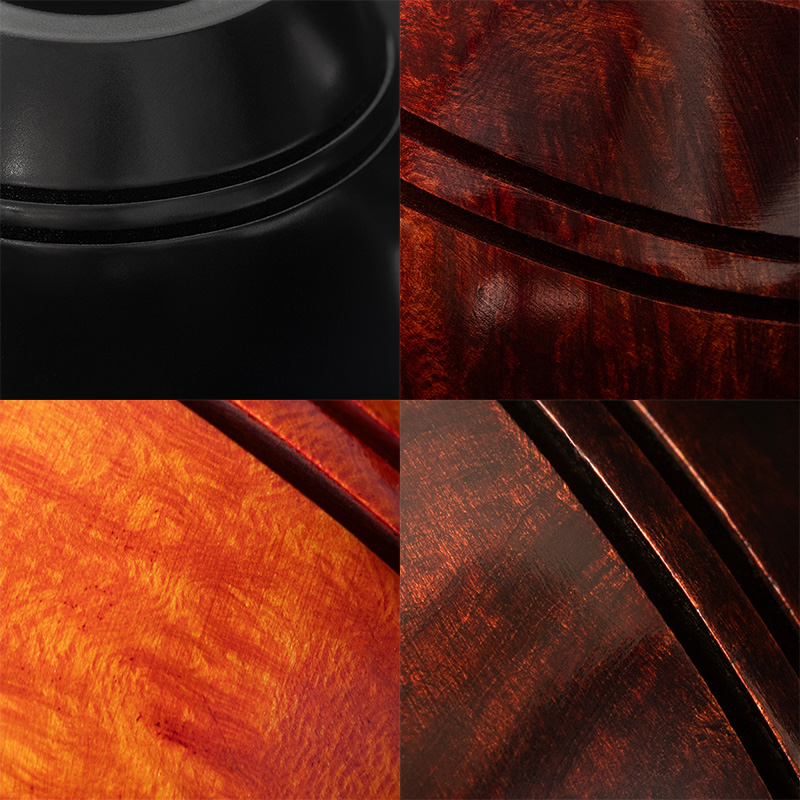
[Andrew Wike]: Josh, you have a lot of our smooth pipes in front of you. Can you talk to us a little bit about how Peterson approaches smooth finishes in the factory — what our options are on the factory level, for those consumers out there who haven't been to the factory?
[Joshua Burgess]: Of course. So much of this is wrapped up in a process at the factory that we refer to as grading. William Murray, our primary bowl grader, inspects each bowl, and Willy's looking for cleanness, quality of grain, or richness of the grain. And on that sort of decision matrix, it's like picking out a dress or picking out a suit for someone. You wanna dress them in the thing that best suits their character and personality. That's in a nutshell what grading is. And so out of that process comes this decision about what stain is gonna work best on that particular pipe.
So that gives us something like a Heritage finish. Heritage would have grain. It wouldn't have particularly rich grain, so it would be a darker finish that doesn't highlight the grain as much as a lighter finish, which you would see on the natural. That said, I love the Heritage finish. I think it's a very classic, old-school look. I think it is reminiscent of the pipes that you would've seen in the Patent era. I suspect that the factory made a whole lot of pipes in those days that look like Heritage. The range is really encapsulated by those first two pipes on the rack here.
The natural in the 406 are very richly grained pipes. Those pipes don't have flaws, so that is the place that we really wanna show off the natural quality of the wood. And so you choose a light stain in a case like that because it does accentuate what is there. In a case like that with a natural, your job becomes highlighting what nature has given you.
That's the way we think about the natural bowls. Then you have a finish here that's more in the middle. This is something that's richly grained, but not as rich as what you see on the natural. The goal becomes something similar, highlighting what nature has provided, and that's really what we do on a pipe like this, which would be middling grain.
[Andrew Wike]: Okay. That's super interesting.
[Joshua Burgess]: And then we get an Ebony. Ebony's a really interesting case. Certain bowls and certain blocks of briar — if you think about that grading matrix, they don't have a lot in common with these bowls. They're quite bold, so they don't have grain. But what they are is remarkably clean. Those are perfectly well-suited for an ebony pipe, and you actually see some artisan makers who embrace this as well. But that becomes an important finish for the factory.
And then we have a nice contrast finish. We refer to this in the factory as dark smooth. It's lighter than the Heritage, but it's darker than the natural. I like this finish because it's the contrast between the harder grain and the softer grain, so you do get that sort of golden contrast that I think is particularly nice.
Textured Finishes
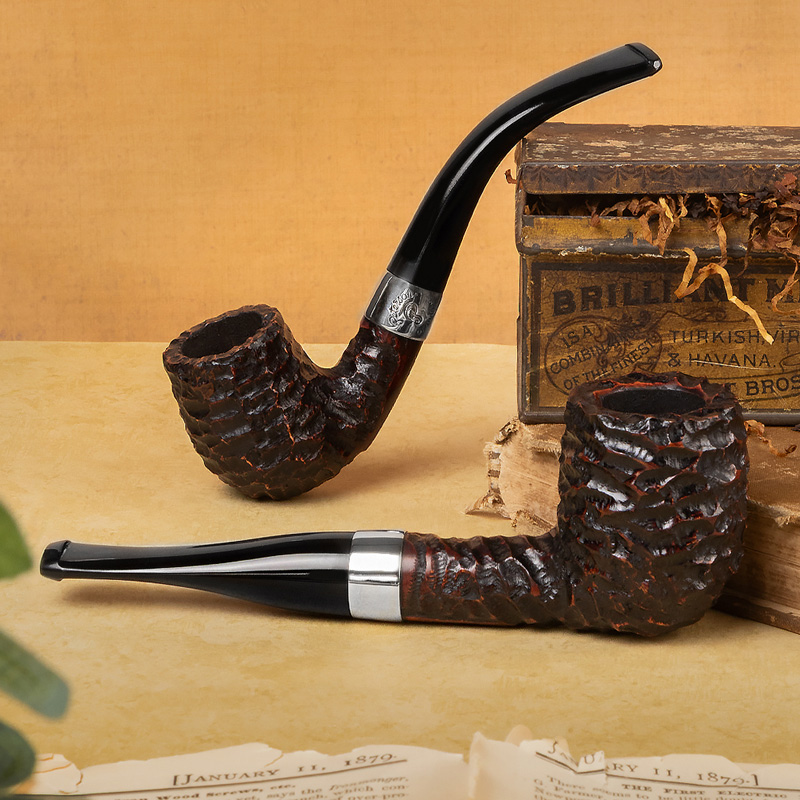
[Andrew Wike]: Moving over to our textured finishes, which again, if we're talking about Peterson's history, are more modern additions. The first textured pipe was in 1945 with the Donegal Rocky. Of course, then we've added a lot of different other finishes, including some novelty ones like the Jekyll and Hyde, which is a really interesting combination of the best of the smooth and the best of the rusticated. But then also really tightly grained PSBs, our contrast sandblasted Ruas, and then even just the actual rustication itself, which is an art form that has been passed down from artisan to artisan.
[Joshua Burgess]: We also have two-tone pipes. That is, we apply one color of stain, and then over the top of that, we apply another color of stain, and then we buff them to get the final result that you see here. On the first pipe there, the Aran rusticated, you get a natural accent on the high points, and then you get a darker stain in the recessed areas, and so it does give you that nice contrast.
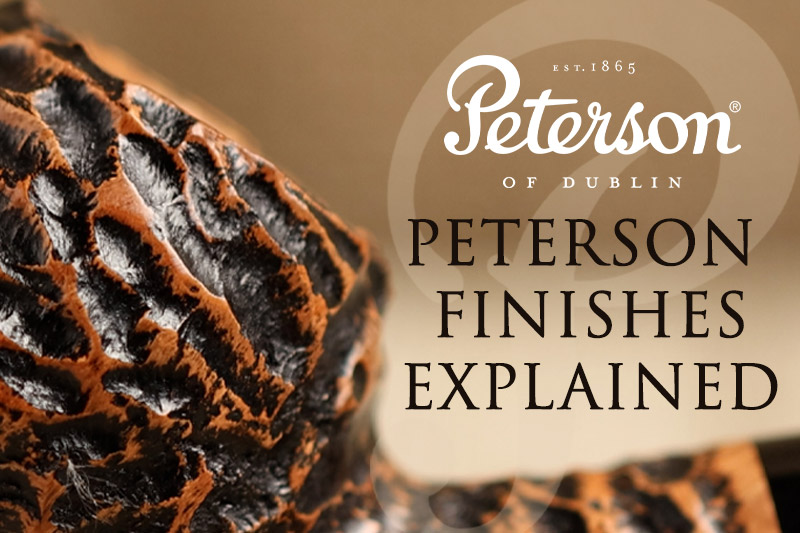
Donegal Rocky — we mentioned earlier that was the first textured and first rusticated finish that Peterson introduced — I suspect that Donegal Rocky looks an awful lot today like it looked in those early days, so this is my favorite of the textured finishes. We use this on rusticated pipes, but we also use it on sandblasts. So you would see this, for example, on Sherlock Holmes' sandblast, where I think it's particularly nice, but this also comes out of that two-tone process. So we apply one color, and then we put another color on top, and then we buff, and so the recessed areas end up staying darker, and the higher areas are lighter. I think this one is particularly nice because you get that rich oxblood color that I really like.
[Andrew Wike]: Yeah. It's so cool to see the grain through the texture as well, in multiple different ways.
[Joshua Burgess]: I think it's particularly nice. And then you have the black sandblasts. Black is one of my favorite colors to use on a sandblast, especially after we upgraded the sandblasting setup at Peterson. When we first did that, we were getting great results, and we were just looking at that point at the raw briar, and we had lots of different ideas. We were very excited to go stain those pipes because they looked so great without stain. We were really excited to see what it would do. The black stain surprised me. I think it highlights the grain so well. It looks classic. I love the pop of the black pipe against the silver band. It's one of my absolute favorite combinations, and every year I buy a Pipe of the Year and I get a black sandblast, because to me, that combination lands every time. I always add one of those to my collection.
[Andrew Wike]: It's particularly nice paired with silver, too.
Jekyll and Hyde
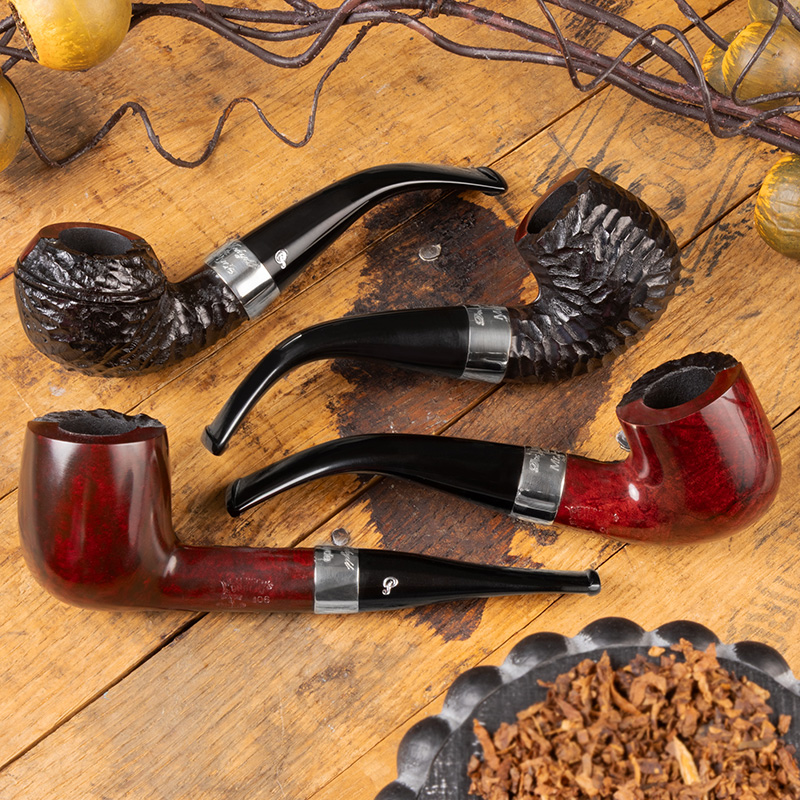
[Andrew Wike]: Okay, so Jekyll and Hyde has to be a really hard finish to do.
[Joshua Burgess]: It's a fun one. Yeah, it's a little challenging. So let me say that I think this is very clever. This is one of the newer additions to Peterson — it was around before we were involved at Peterson, but it's still pretty new. The Jekyll and Hyde smooth and rusticated, that's great, and really clever. They're tough to make.
[Andrew Wike]: Yeah, like getting the symmetry right, I would imagine.
[Joshua Burgess]: Yeah, getting the symmetry and lines right. So you actually make the entire pipe smooth, and we've designated one side to be rustic. We'll sand the entire pipe, get it smooth, and then you send it over to the rusticators, and they texture the side that's designated to be rusticated. Then, in staining, they're really tricky too, because you have to be careful to preserve that line. You don't want the black stain on the rusticated side spilling over onto the red side, so you have to be very careful there.
It's a tricky thing for the factory to do. It's a really interesting texture. We've seen combined finishes — there were American factories who were doing this and American artisans who were doing that. You see a lot of spot-rusticated pipes from the 1970s. And so it takes that idea and pushes it one step further. I think it's very clever and a lot of fun.
The Rua
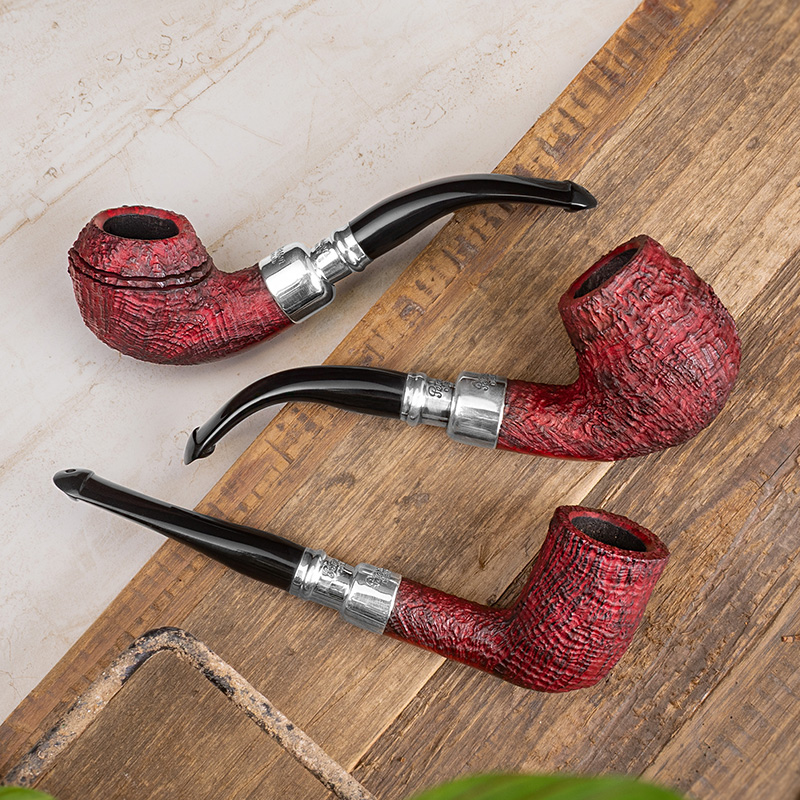
[Andrew Wike]: All right, and then to close us out here, we have probably what's my favorite sandblasted finish from Peterson — that's the Rua.
[Joshua Burgess]: The Rua's special. The Rua was Peterson taking an artisanal process that sort of defines a certain type of artisanal sandblast and a contrast stain. It's not totally dissimilar to the two-tone texture that we use on rustic, but the process is much different, and it's more intensive. You stain the pipe one color, and you blast away that color, but it remains in the darker areas — the more recessed areas. So that second blast is very light. It is a great finish. It is the newest finish that we do in terms of color. I've been awfully happy with that one. I think it works perfectly on those craggy sandblasts. It has a lot of character. It somehow feels classic Peterson and very modern at the same time.
[Andrew Wike]: 100%. I think that the deep red sort of calls to mind your really early deep red Bruyères, but then you're also getting tons of texture, and then the sort of darker, smokier black tones coming out, too. So it's just a really great finish, and I think that it showcases the grain in a really interesting way, but also in a way that's different from any of the other sandblasted finishes. You get that duality of what it would've looked like smooth because of the contrast finish. But then also all of the ring grain or blasted birdseye or whatever it might be.
[Joshua Burgess]: It is labor-intensive, but the results just can't be argued with. It's a great pipe.
[Andrew Wike]: It's awesome. Josh, thank you so much for sitting down with us and talking about Peterson's collection of finishes. I know we didn't get to all of them today, but I think if you guys are out there shopping for a new Peterson pipe, we wanted to give you a little bit of an insider's look into how these finishes are developed, how they're executed, and what decisions for certain finishes are made for certain pipes. Be sure to leave us a comment and tell us what your favorite Peterson finish is.
You may also enjoy:

Comments
Great video, thank yall for sharing it.
The detail on the Jekyll and Hyde pipe is amazing. Love the Heritage finish as classic but the Rua has my interest also