


 |
|
 |
|


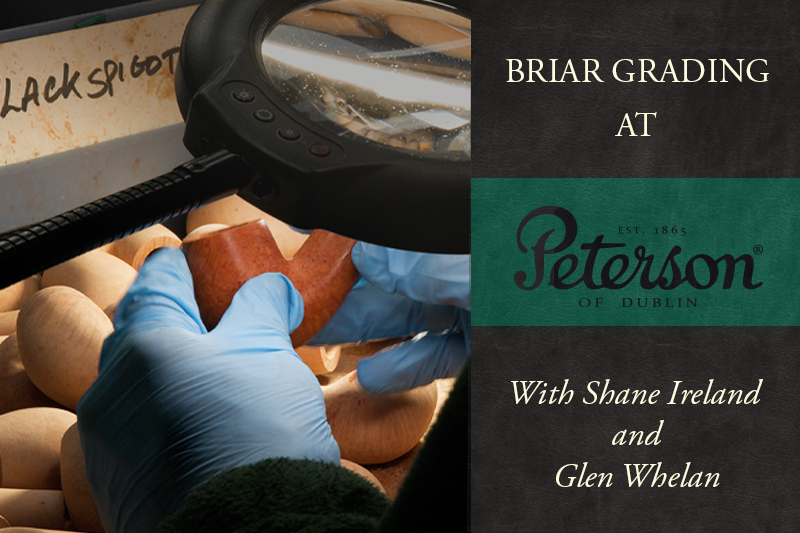
Briar Grading At Peterson with Shane Ireland & Glen Whelan


I recently visited Peterson of Dublin in Ireland and had a chance to chat with Glen Whelan, Managing Director, about what I think is arguably the most fascinating and certainly my favorite department in the entire production area: briar grading.
Note: The following transcription has been edited for clarity and brevity.
[Shane Ireland]: Tell us a little bit about briar grading.
[Glen Whelan]: Well, grading is the start process for all pipe manufacturing here at Peterson. Once we finish in the pre-production area, the bowls come up to William "Willie" Murray and he looks through 'em, gives them a cursory look, and then they go into 11 buckets. Each bowl is graded individually. He's looking for various aspects of the bowl, like grain structure and consistency of grain. Willie is the keeper of the grades. He basically decides what series we can make.
[SI]: And that's the kind of thing where such an extensive amount of experience is necessary to be able to make those decisions on a daily basis across dozens of models. Within those 11 grades, there's also sub grades.
The First Step of Grading
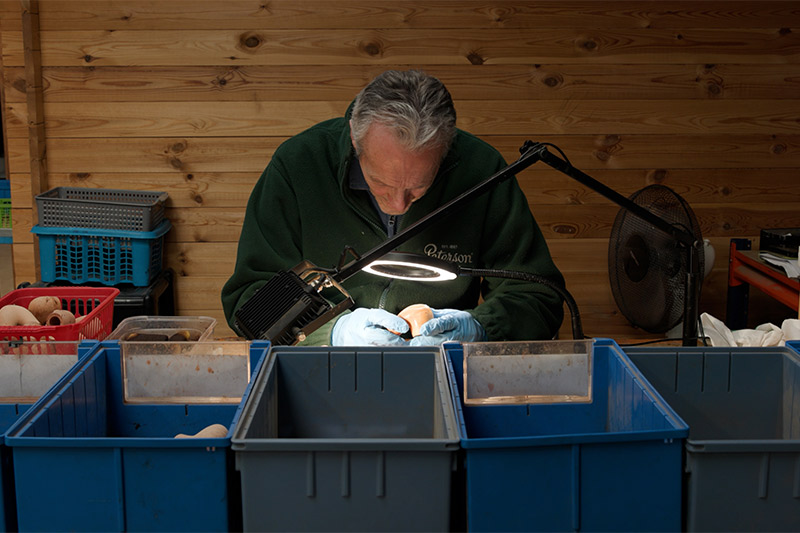
[GW]: Yeah, this is the first step of grading, especially when it comes to textured bowls. We'll have bowls that he'll designate that are to be sandblasted. From those bowls that are sandblasted, then we get five grades out of that.
Even as he's grading those sandblasted bowls, in most cases, he's gonna send them back for more blasting because we can chase the grain a bit more and go a little deeper. Most of the time we end up getting upgrades on those bowls as a result. It's very rare that we'll have to downgrade if we send it back in for chasing.
[SI]: You can tell the grain structure pretty immediately.
[GW]: Yeah, the rings are what he's looking for. He's gotten so good that he's just able to see the rings that a naked eye untrained wouldn't be able to see.
[SI]: A lot of artisan pipe makers talk about reading the briar, and that's essentially what grading is.
[GW]: It's only through experience that you can obtain that kind of knowledge to be able to deal with that. He's very quick at doing it because of the experience.
[SI]: There's also gonna be certain finishes where you know that a certain density of the wood is gonna take the finish a little differently, so you may not want to send certain bowls to certain finishes.
Midpoint in Grading: Supreme vs. Other Grades
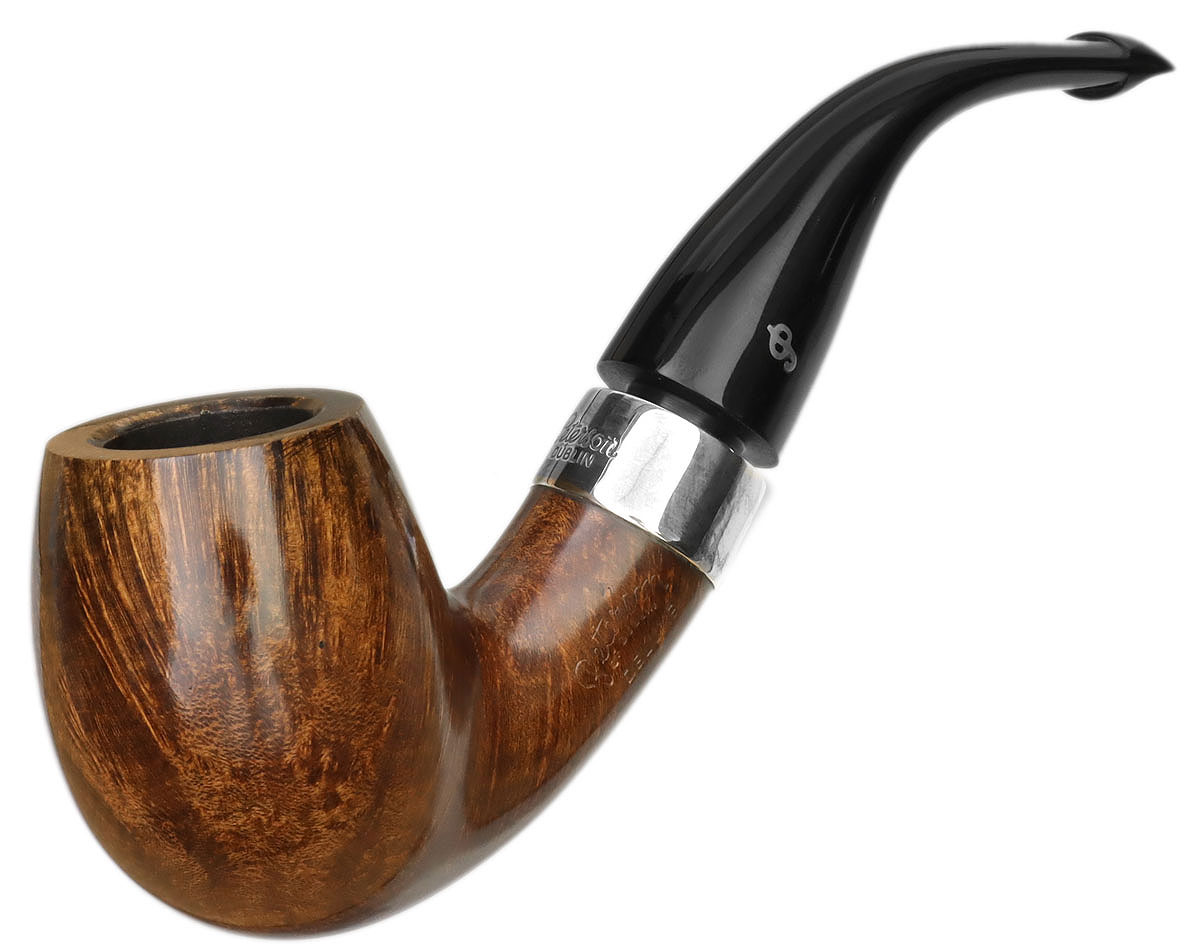
Peterson Deluxe System Dark Smooth
[GW]: Exactly. There's a midpoint in the grading on smooths where we know they're gonna be used for Contrast. It's like a Deluxe System dark smooth; we call it a black-and-white stain. It's getting a darker undercoat first, and there's a very specific grain needed for that series. It's important in his thinking when he is grading that he knows it's gonna be Contrast and we want the grain highlighting, then you get that lovely, consistent structure on the bowl. It just lends itself to a really nice finish.
[SI]: So just like you're looking for horizontal rings when you want to grade a sandblasted pipe, the vertical grain structure varies a lot between something that could be a Supreme or something that could be a Contrast.
[GW]: Exactly. Willie has very high standards when it comes to grades for Supreme.
[SI]: As one does.
[GW]: Exactly, and as he should, which is why we don't get a tremendous amount of Supremes. Those have to be perfect grain structure, totally flawless, but consistent in grain structure as well. That's the key.
[SI]: What's the average run size of one shape when he's grading?
[GW]: It really depends on how it comes up from the bowl-turning area. He is usually doing about 300-400 at a time, but that can vary. Our team is able to sandblast 80 to 100 bowls a day. That's keeping 'em moving in between the smooth grading. So usually Willie's day looks like grading a couple of buckets of bowls as they are coming up from bowl turning and then he ends up with a sub grading at the end of the day where he has to do the sandblasted pieces.
[SI]: I remember coming here a couple years ago. This area is usually my first stop in the factory, and I remember all of us being so excited because at that point there was a particular run of a Sitter shape, and there were three Supremes.
[GW]: Oh, yeah. And that's worthy of an announcement.
[SI]: It's a 1% yield.
[GW]: You have to see it, and then you're almost in disbelief thinking we need to check it again to make sure that they really are Supremes. Sometimes you just get lucky, and then he could go 3000 bowls across 10 shapes and get nothing. Not a single one. This is just briar. Briar is a lottery, which is what we tell people. So often we get asked, why would you make a rusticated pipe when you could've made a smooth? We can't always do that.
[SI]: Nobody does it on purpose.
[GW]: Exactly. We'd all love to make smooth pipes all day long, but rustication is just part of the factory pipe production.
[SI]: It's also that 1% or less of the top, top, top briar that makes the whole thing fun as a pipe maker, as a collector, and even as an enthusiast. Supreme bowls are rare and as close to perfection as it gets.
[GW]: All the pipes are shepherded with the same amount of care and attention in the factory, but when a Supreme is going around the factory, it's special. It's on a better road. At the end of the process, in the stamping area, I will give it one last check. If it's still all the way through, it's a Supreme, and either myself or Jonathan Fields will sign off on it with the stamping, and then it goes to Conor Gahon in Quality Control.
It's really getting checked three separate times outside of Willie doing the initial check. Even when he grades it as a Supreme, there's very often times that it goes through the factory and it won't be a Supreme after papering, and unfortunately we get a sand spot or something. It's just par for the course. It's just the way it is.
[SI]: I'm curious if there's any shapes that Willie either loathes grading or loves grading?
[GW]: Yeah, I'm sure. It's like anything, we all have parts of our job that we don't love, but typically with the smaller bowls is where we get better yields because it's much less surface area. It'll be a day where we'll take a full page ad out in the national newspaper if we get a House Pipe Supreme. It's just not gonna happen.
Again, it's a lottery; it's a natural resource. We predominantly use Ebauchon. You're not getting the kind of hit that you get if you're using plateau but that's just factory pipe manufacturing.
Grading: An Important Responsibility
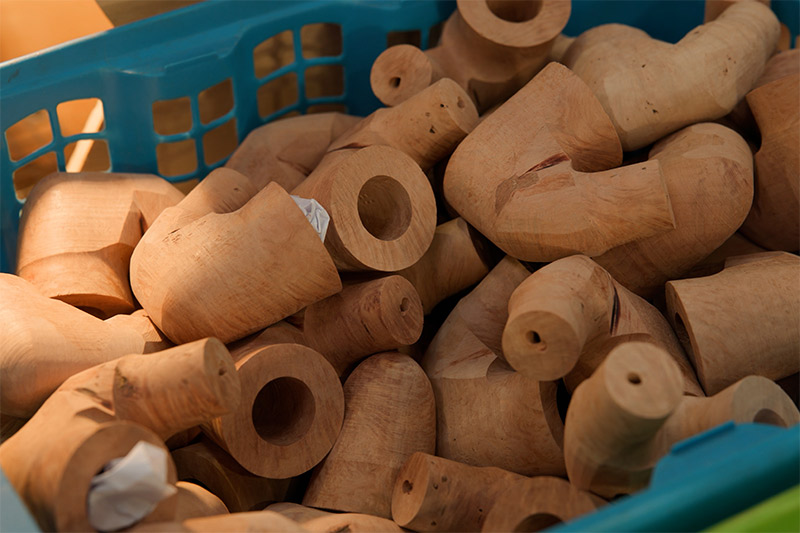
[SI]: How many people over the years have been responsible for grading here?
[GW]: Willie's currently responsible for grading and Kevin Brennan, at the moment, is in training for grading. My father, Tony Whelan, has done it in the past. Before that, probably just a handful.
[GW]: It's all about the experience. You can't just take someone off the streets. They can't be green behind the ears.
[SI]: They've gotta go through other parts of the factory.
[GW]: They need to have been exposed to production. In pipe making, you need to know what the end product is gonna look like to be able to grade successfully for that end product. If you don't, you're just guessing and it's gonna come back to you straight away.
[SI]: For as long of a history as Peterson has had, you can basically count on one hand the number of people that have had enough experience to do this part of the job.
[GW]: And those highly specialized roles are all over the factory in other parts of production. We see direct links from Willie to Liam Larrigan, from Jason Hinch and David Blake in silverwork. It's people who have had 20-40 years experience.
[SI]: And long apprenticeships.
[GW]: Long apprenticeships. Simon Ellard is almost finished and he's been here for 11 years.
[SI]: Yeah. That's crazy.
[GW]: Kevin's a trainer and Kevin's been at Peterson for nearly 18 years.
[SI]: 18 years to start training in grading.
[GW]: Yeah, but Kevin has so much experience because he's the first step in the process in the factory. He's held the bowls that Willie has graded. He's seen firsthand all the examples of what they should look like, what the grade structure should look like, why they have to be rusticated, and why they fit in sandblasted. He's a perfect fit.
[SI]: It's a lot of responsibility.
[GW]: Huge. You're basically the keeper of the heritage in grading. You're protecting the brand from making mistakes. There's a routine in the factory. The bowls come down and they're trusting that Willie has done his job, which invariably he has, and it just passes all the way through then. It's a lot of trust but I think everybody is a specialist in their area. They're basically artisans within their own area. And in grading, it is the same. You have to be able to read the briar, as you say, and that's a skill and an art form in itself.
[SI]: And not something you can put a fast track on while handling thousands of bowls.
[GW]: No. If you try to fast track any training in pipe manufacturing, it's just a fast track to failure. In bowl coating, you're a bit safer from that happening, but you still need training to know not to be sloppy.
[SI]: Giacomo had me turning bowls pretty quickly down there.
[GW]: Yeah, we'll see how they grade out. I'm curious to see the shaping on them.
[SI]: That's right.
A Factory Within A Factory
During each stage, from sorting the briar before they even get turned, for size, and then this part of the process, before we're talking about stains, stems, mounts, and any of that, the bowls have to pass through such experienced hands.
[GW]: This is a factory within a factory. We're basically our own supply chain for manufacturing.
[SI]: And it's a painstaking and slow process. Even if you're good at it — Willie makes it look easy after all these years — you're making countless decisions over and over again with every single block that goes through their hands and we haven't even gotten started yet, basically.
[GW]: He can be grading up to 2000 bowls a week, which is insane, but that's what gives us the choice when we want to come to manufacturing to help set the factory up for the weeks ahead. It's integral to the streamlining of processes and making sure the factory rolls efficiently and smoothly.
Next Steps In Production Post-Grading
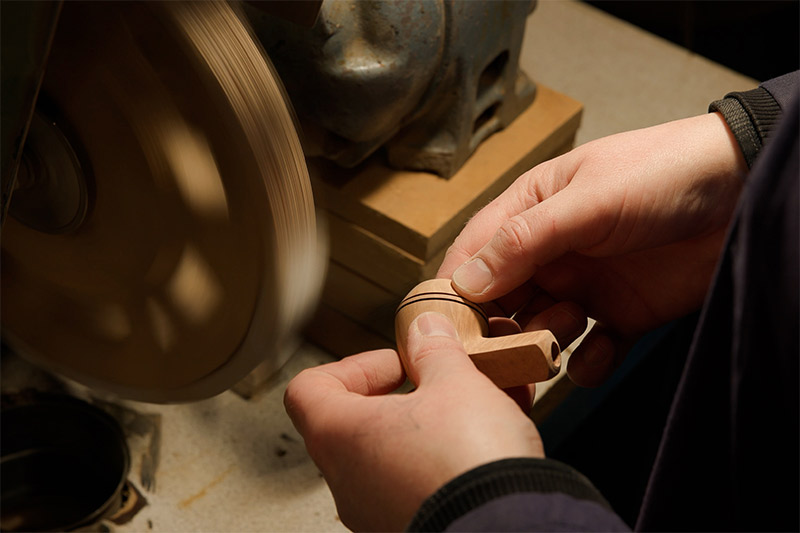
[SI]: Once you have a supply of bowls and shapes that are graded, at that point, what is the next step in planning production?
[GW]: Then it's just weekly meetings where we look at where we have orders, and what's already in production, because having a good mix is very important for the factory. We can't put 2000 smooths into one area all at once because it's just not efficient. We'd break the factory. And usually the yield is what dictates the mix. They usually line up really similarly, so we just follow what Willie grades and then that gives us choices.
If Willie grades into a sandblast, we have three, four different series that we can make in sandblast. Likewise, smooth grades, we have many different series, depending on the grade it's using. Willie's usually dictating what we're making, just by virtue of how he's grading. We're driven on a week-to-week basis. Even though we have plans for six months out, we know what we wanna produce within a period, it's the grading that dictates when we do that.
[SI]: Incredible. Thanks so much, man.
[GW]: Thanks, Shane. Always a pleasure to have you here.
[SI]: Always a pleasure to be here in my favorite department.
You may also enjoy:





Comments
This comment has been deleted.
For me, almost any Peterson is a good pipe. I very much prefer the smooth bowls, though, and am for the traditional straight stem pipes. I have Petersons, not as a collector, but as a smoker, and I enjoy them. This gentleman is opiniated, and from my perspective, just wrong!
Would love a Sherlock Holmes Supreme Silver Mounted Professor P-lip.
Why wasn't Willie interviewed? He has the expertise and is doing all the work. Hello!
When my wife and I visited the factory, we were able to watch Willie and talk with him while he was grading bowls. A gentleman and quite humble. We were both impressed how Willie could read the grain with just a little water and a strong light.