


 |
|
 |
|


The Kiseru: An Overview of the Traditional Japanese Smoking Pipe


While Japanese artisan pipes are world-famous for their innovative design and smoking quality, there is a long tradition of pipe culture in the island nation that stretches back over four centuries. Tobacco was introduced to Japan by Portuguese traders in the 1570s and Dutch metal pipes around 1585, when the Dutch first visited via a Portuguese ship from India with the pipes that merchants and sailors preferred because they were not fragile, especially in comparison to clay pipes. Tobacco became popular among the wealthy merchant and feudal classes, and to enjoy the newfound delicacy, the Japanese fashioned distinctive pipes called kiseru.
The word's origin has been debated, with two sources being the Khmer word khsier in Cambodia and the Portuguese que sorver, "to be drawn." However, Dr. Barnabas T. Suzuki, who is widely accepted as the world's leading authority on early Japanese tobacco use, says that, "there is only one source for the word Kiseru: the Portuguese que sorver, meaning 'a thing for drinking.' The Portuguese did not use pipes for smoking before the end of the 19th century, adopting the word cachinbo, which is most probably derived from the Arabic."
Dr. Suzuki additionally says that, "the Cambodian word khsier is a corruption of the Japanese word kiseru. There were two Japanese towns in Cambodia that were supplied with tobacco by Dutch and Japanese ships during the 17th century."
The kiseru was adopted as the primary means for consuming tobacco in Japan, making its way into nearly every aspect of Japanese mass culture, particularly during the Edo period.
What is a Kiseru?

In short, the kiseru is a traditional Japanese tobacco pipe. The basic design of the kiseru is quite similar to that of other pipes from the Early Modern period, consisting of a small bowl, a shank, and a mouthpiece, though there is significant variation in style and function, as we'll see later.
The most common style of kiseru is the rau-kiseru, featuring a bowl of brass or iron fixed to a shank, usually made from bamboo or hardwood, with a second metal section forming the mouthpiece. The absorbent qualities of the stem material helps the mid-sections of these pipes act as a natural filter system, as the porous reed and wooden pieces wick tar out of the smoke, not dissimilar to the bamboo-shanked pipes that are popular with western artisans. Unlike bamboo-shanked pipes in the west, the rau, or reed, is designed to be removable, and many smokers replace them regularly to maintain the flavor and coolness of the smoke.
Unlike bamboo-shanked pipes in the west, the rau, or reed, is designed to be removable
The second primary style is made entirely of metal, called nobe-kiseru. The most distinctive trait of kiseru lies in the minute bowls of these pipes, often no larger than the tip of one's pinky finger. Like pipes today, there was considerable historical variation in size and style that denoted the owner's social status and even their occupation. While bowl size is relatively consistent, the length of kiseru can vary significantly, with shorter pipes being common, historically, among working people, and lengthy, more delicate pieces favored by the upper class, similar to the Korean pipes discussed in a previous Daily Reader post.
Kizami

Preparing Tobacco Leaves
As with early European pipes, the bowls of kiseru were smaller than those used today because of tobacco's scarcity and cost, but even as tobacco became more readily available, kiseru retained their diminutive bowls. There are several reasons for this, one of which is the particular form of tobacco smoked in Japan, called kizami. Kizami refers primarily to the extremely fine-cut tobacco smoked in kiseru, as opposed to any particular varietal, though kizami is made from varietals developed in Japan that are virtually unknown outside the country. If one has any experience with shag cut tobaccos like Le Petite Robin by Tabac Manil, one can approach an understanding of just how fine kizami is, though even the Belgian blend resembles a ribbon cut in comparison to the hair-like fineness of kiseru tobacco.
Smaller bowls are more suited to the packing technique required to fully enjoy Japan's unique tobacco, as well as a matter of taste, since smokers in feudal Japan also preferred to smoke several small bowls in a session, as opposed to a single larger one. There are two main brands of kizami produced today, Takarabune (meaning treasure-ship) and Koiki. The former is made in Belgium by Flandria Tobaccos, with a slightly rougher cut, more similar to shag, while the latter is produced in Japan using only native leaf processed entirely by hand, painstakingly cutting bundles of tobacco into the finest cut with specialized chopping boxes, closely resembling the techniques of past centuries.
There are two main brands of kizami produced today, Takarabune (meaning treasure-ship) and Koiki
How to Smoke a Kiseru
The unique design of the kiseru, coupled with the singular form of tobacco it's intended for, requires a particular packing and smoking process that differs from the methods used for western pipes. The bowl is most often filled in a two-step process, first taking a small pinch of tobacco and packing it tightly in the bottom of the chamber. Next, a larger pinch of tobacco is placed atop the base layer in a gravity-filling fashion, piled above the rim of the chamber. This allows the tobacco at the top of the chamber to light easily, not unlike kindling, before creating a slower burn as the smoke progresses.
While filling the chamber above the rim allows more tobacco for each smoke, the petite chamber is still quickly consumed. Smokers will often refill the bowl several times in a single session; since the metal chamber is immune to burnouts, one needn't fret about overheating the pipe. Since kizami is so difficult to obtain, I can't provide much in the way of description for the tobacco's flavor, though the small size of the light-colored raw leaf leads me to believe it's not unlike certain grades of Virginia and Oriental tobacco.
Kenka-Kiseru: The Japanese Fighting Pipe
Perhaps the most interesting aspect of the kiseru is its adaptability as both a smoking implement and a weapon of self defense. At the time when smoking was first introduced, Japan was experiencing the waning years of the Sengoku Jidai, or Warring States period, when the nation was in a near-constant state of war among the powerful samurai clans that sought to assume the office of Shogun.
The possibility of violence was an omnipresent reality at all levels of society, and many systems of martial arts were developed using a wide array of items, from bamboo flutes to, in this case, tobacco pipes. Even after the Tokugawa Shogunate brought relative stability to Japan, crime syndicates abounded in the cities of the Edo period, leading pipe makers to devise specialized kiseru that could function as truncheons in situations where diplomacy was insufficient.
... many systems of martial arts were developed using a wide array of items, from bamboo flutes to, in this case, tobacco pipes
These kiseru were considerably larger than their counterparts, with many exaggerating the size of the bowl and mouthpiece to mace-like proportions while retaining a relatively short overall length. Other fighting pipes were exceptionally long and made of iron, some including studs on the mid-section to afford a surer grip and wielded like shortswords. Such pipes were especially popular among the bakuto, forerunners of the famous Yakuza clans who were notorious for operating illegal gambling dens, doubling as loan-sharks for shady clients. Kenka-kiseru afforded them weapons that could be carried openly on their belts without arousing much suspicion from the authorities.
Over time, a dedicated form of martial arts was developed around using these pipes and was called kiseru-jutsu, modeled after earlier forms that employed the tessen, or war-fan. I can imagine that after a long day of fighting rival gangsters and extorting the peasantry, kenka-kiseru could provide a particularly satisfying smoke.
Kiseru and the Japanese Tea Ceremony

(Girls at home) 1880
On the other end of the social spectrum, smoking kiseru, like many aspects of Japanese high culture, became increasingly formalized during the Edo period, between 1603 and 1868. Offering a guest tobacco in one's home became an opportunity for a host, particularly one of a higher status than the guest, to show off their wealth and good taste.
A typical tobacco ceremony, or tabako-do, would often begin before a guest entered the home, with the host preparing an elaborate tray of tobacco, pipes, and other accessories, called a tabako-bon, in advance. It was considered in poor taste, when sitting down to smoke, for a guest to begin before the host. Upon the guest's arrival, the host would ask them to smoke some tobacco, which the guest would politely refuse, since the master of the house ought to smoke first. This exchange would be repeated several times until the host carefully cleaned the kiseru before handing it to the guest. Finally, the guest could begin smoking, making sure to complement the taste and quality of the tobacco, of course. The tabako-do eventually became such an integral part of Japan's culture of hospitality that it was often incorporated into the traditional tea ceremony. In some schools of tea, the tabako-bon remains an important item to display during the ceremony, though smoking the kiseru has become less common.
The tabako-do eventually became such an integral part of Japan's culture of hospitality that it was often incorporated into the traditional tea ceremony
The Kiseru Today
For over three centuries, the kiseru was virtually the only way to consume tobacco in Japan. However, after the Meiji Restoration opened the country to more foreign trade in 1868, the traditional pipe was quickly outpaced by the introduction of cigarettes. Today, only one shop dedicated to the kiseru remains in Japan. The Tanigawa Sejiro Shoten in Kyoto offers kiseru made entirely by hand with beaten and polished brass and employing only traditional techniques.
While such a situation may seem dire for the kiseru, the pipe has experienced something of a renaissance in recent years, with many young people becoming increasingly interested in traditional tobacco and smoking methods. The Tanigawa Sejiro Shoten even hosts an ikijin or "smart peoples'" club, where smokers gather to enjoy the unique experience afforded by the kiseru. Additionally, there is an annual kiseru festival near the town of Ishioka, Ibaraki prefecture that's been held every September since 1954. That year, the local tobacco crop was spared from the effects of intense hail in what the local farmers considered a miracle. As a gesture of thanks, they constructed a massive 3.5m or about 11.5ft kiseru and hauled it up Mount Kaba to a Shinto shrine, and offered it to the local deities.
It has since become an annual tradition, now with an even larger kiseru, which was made by the Murata Manufacturing Company in 1964. Most impressively, the pipe is quite functional, and is lit and smoked using a special pump attached to the mouthpiece. On the off chance one needed another reason to visit Japan, the kiseru festival should certainly make the list.
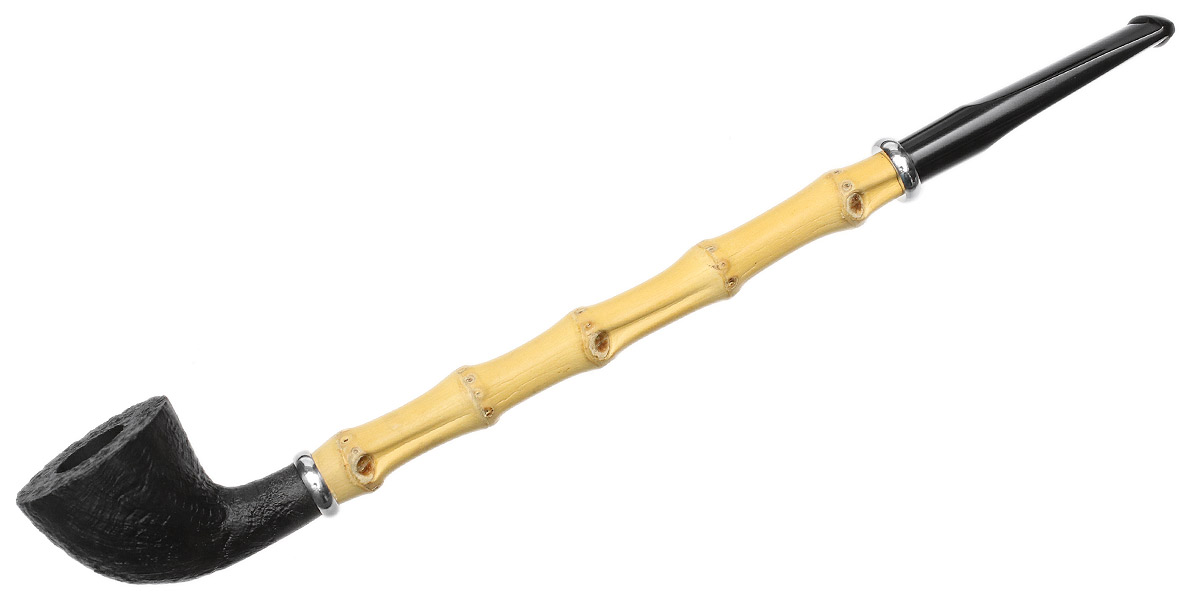
Tsuge: Ichirin Sandblasted Bamboo Dublin
For those interested in the kiseru, Tsuge offers an accessible way to experiment with the smoking qualities of traditional Japanese pipes. The Ichirin line is a series of Dublin designs modeled after the kiseru, with a long bamboo shank and diminutive bowl that allows smokers to experience as close to a proper kiseru as briar will allow. While one may not have access to kizami, these pipes are also excellent for smoking shag cut blends.
The kiseru and its accompanying tobacco are among the oldest continuous tobacco traditions outside of the Americas, special not only for their unique aesthetic qualities but in the singular smoking experience they provide. Despite the ubiquity of other forms of smoking, the practice of smoking kiseru continues to persevere and grow, with no signs of disappearing. With some luck, intrepid smokers from all countries may be able to enjoy a bowl of fine kizami, and I certainly intend to sample it if I ever make my way to Japan.
References:
- "Kiseru Pipe", The Kyoto Museum of Traditional Crafts, Google Arts & Culture
- "History of kiseru", Kiseru-Pipe.com
- "What is a Kiseru", Kiseru-Pipe.com
- "For Mountain Bikers and spiritual climbers, Kaba-san — Ibaraki.", Tokyo Travelog
- "Praying for Good Tobacco Harvests at Mt. Kabasan's Kiseru Matsuri", Tsukublog
- "Kiseru", Wikipedia
- Loring, John, C. "The Japanese Pipe (kiseru)", 2002, Contributed by Yang Forcióri, Pipedia.org
- Suzuki, Barnabas, T. "Introduction of pipe (Kiseru) smoking into Japan", The Pipe Year Book 2001, Academie Internationale de la Pipe, 2001.
- Suzuki, Barnabas, T. A Historical Study of the Global Propagation of Smoking, 2015, English Summary
Editor's Note (10/26/2022): This article has been updated to correct minor inaccuracies and to provide additional information from Dr. Barnabas T. Suzuki — author of A Historical Study of the Global Propagation of Smoking, 2015, and Kitsu'en Denraishi no Kenkyu (A Historical Study of Smoking Introduction into Japan), among many other respected texts.
You may also enjoy:




Comments
Nice article. The Japanese tea ceremony is also a part of Zen Buddhist thought and practice, combines art and appreciation of nature, and social interaction. This past summer, here in Texas, has been unbearably hot and miserable. Since I work outdoors, my pipe smoking activity has become a nocturnal event if I'm not too exhausted from the heat and have a desire to smoke. As a person who took Judo back in the early 90s and combatives later while serving in the Army, I often think about my Pipe Fu and how I would react to an attack at night while smoking outside in my shady neighborhood. A poker would work nicely. I imagine gripping it like you would an old fashioned cork screw and jamming the stem and shank into an assailant's eye socket or trachea should buy you some time to get away or hang out and continue to break them down. Don't get me started on how creative I can get with a Czech tool. And who would like a pipe cleaner up the nose? A cob would be easier on the wallet, if you break it in a fight... cheaper to replace. Maybe I'll open a school for Pipe Fu some day. The pipe is a comforter, a counselor, and a protector. Namaste
Kiseru were floating around back in the early 1970's. I remember this guy had one in boarding school. Of course, he wasn't smoking pipe tobacco in it. Lol.All kidding aside, the Tsuge bamboo dublin looks like it would be a good smoking pipe. I have an older Tsuge billiard with a nice very craggy blast to it. Pipe smokes really well too. Looks like an early 1950's Dunhill with that period of craggy blast.
Great article!!!
I've had Koike during my time in Japan. The taste is hard to place, but it's definitely not like a Virginia. I would venture the closest it tastes like is Semois, though it's still pretty different, more woody, herbaceous and spicy than floral. It is strong, particularly if you inhale it, as they traditionally did. People who aren't nicotine heads should know it's about as strong as smoking an unfiltered natural cigarette.
We need more bamboo-type pipes.
I really like the look of Tsuge's Ichirin line, but those pinky size dimensions of the inner bowl is just a tease to me. I purchased an Ardor: Urano Cutty with Bamboo that measures 9.40 in. (length), 0.80 in. (chamber diameter), and a chamber depth of 1.62 inches. It has an acrylic saddle bit stem and does resemble the traditional Japanese Kiseru pipe. I'm so glad that I bought it before it disappeared on me, I love that pipe. I also enjoyed this article.