


 |
|
 |
|


W
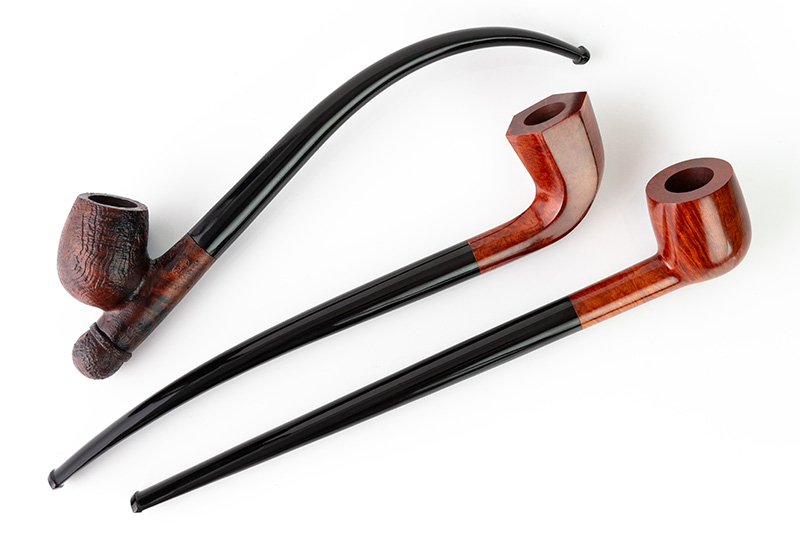
elcome back to another episode of All Pipes Considered. Today, I have the great privilege of sitting down with Sykes Wilford, founder of Smokingpipes and CEO of Laudisi Enterprises, to discuss a rare, oversized line from Ropp: Gargantua pipes. Tune in as Sykes and I discuss the line, representing pipe-making's past, brought to life again in the present.
Note: The following transcription has been edited for clarity and brevity.
[Shane Ireland]: Hey everybody, I'm Shane Ireland.
[Sykes Wilford]: And I'm Sykes Wilford.
[SI]: We're here today to talk about a really exciting new series in the Ropp line of pipes produced in the birthplace/mecca of pipes, Saint Claude, France. We're talking about Ropp Gargantua. And they're big, I was going to say, it's a bit of a spoiler, the name, but they are very big, gargantuan even. This is the kind of pipe that you just don't see on the market at all these days. Fans of Churchwardens, fans of big pipes, this is right up your alley, but I think there's a lot of ways in which this series in particular is unique and interesting. So let's back it up to Saint Claude, and I don't know, maybe a little bit of the history there, and how these things came to be, and the Ropp project in general. Sykes, you want to take us down how that got spun up?
[SW]: Sure. So about 10 years ago now, Antoine and I were at his factory in Saint Claude — the old factory, before they moved — and we just kept finding pipes that we thought would be fun to work with. Basically, we found a bunch of old bowls from the '20s and '30s that had been sitting in the attic forever and found a bunch of horn stems. He knew he had all this stuff, or vaguely knew he had all this stuff, 'cause he had multiple generations of stuff accumulate. And we just kept talking about trying to weave it all together into a project. And so he, Chapuis-Comoy Chacom, owned the rights to the Ropp brand from way back, and we decided to resurrect it and build a brand around a lot of these old things that he had to turn into pipes.
[SI]: Ropp being one of the heritage brands from the region.
[SW]: Yes.
[SI]: Going way, way back. That's awesome, that's awesome. And yeah, we've seen a ton of really the vintage style: the Vintage Series, the Algerian Superiors, Balzac, Etudiant, there's so many Ropp series that were born in this way that are super interesting, unique within the market today, and sort of simultaneously pay homage to pipe making's past, like the horn stem thing in particular.
[SW]: Yes. And in many respects, it's more than an homage, it's more than a nod. These are really old bowls, and they're being finished in the same way. The last big chunk of the work is being done today, but these are old materials.
[SI]: So speaking of old materials, I was fortunate enough to visit the Chapuis-Comoy factory for the first time a couple months ago, Sykes and I were there together, and as one does in that playground of pipe-making materials you guys were looking for stuff, and I was kind of tagging along, and I remember distinctly even where in the factory it was. I saw one large vulcanite stem sticking out from the top of a shelf, pulled it down, and held it up. You and I both instantly were like, are there more of these?
[SW]: Which is always the question we can find in this situation.
[SI]: Yes. 'Cause you often find cool stuff and there's only like one or two of it, or whatever. And there was a pretty limited number of them, but enough that we could bring 'em to the market. And stems this large made from quality vulcanite doesn't really happen.
[SW]: It doesn't happen anymore.
[SI]: Yeah, and why is that?
[SW]: Well, vulcanite is expensive, which is sort of reason one in all of this. There are a couple of ways to make a vulcanite stem for, well, there's one way to make a vulcanite stem for a factory pipe, which is a molded vulcanite stem: it goes into a mold, it gets heated, and then it gets vulcanized, and it's sort of a long, complicated process ...
[SI]: And still needs to be worked over.
[SW]: ... and still needs to be worked over. But in this day and age, no one does that with stems this big. We don't know exactly how old these stems are, but '30s, '40s.
[SI]: They've got to be old.
[SW]: Yeah, they've got to be old, maybe older. The shape of the buttons makes me think '30s. But we know that they're very old and these sorts of things are not being done anymore, except in artisanal pipe making.
[SI]: Yeah, where you can afford the handcraft necessary, the time investment, and the material investment necessary.
[SW]: And you're talking about a $1000 pipe now.
[SI]: Exactly, exactly. So again, there's no real number we can put on this, but I think it's safe to say that if somebody went right now and tried to put vulcanite stems of this size into production, the pipes themselves would end up being very expensive.
[SW]: Much, much more expensive. Double, triple.
[SI]: Yeah, yeah, for sure.
[SW]: Even if nothing else has changed.
[SI]: Even if nothing else has changed. So we thought this was super cool, because the stems themselves were a rarity. And then also, it allowed us to pair them to a bunch of really interesting shapes. And like I said, I think that the Gargantua overall ... they're big. I mean, you can see that, Sykes, you're holding up pretty much a regular-sized pipe there.
[SW]: A regular-sized pipe. Yes.
[SI]: Yeah. I think it's easy on the website to look at these and maybe even the measurements and think of them as sort of similar to Churchwarden-sized pipes, but they're bigger than that. I mean the length and the proportions, yes, I think they appeal to your Churchwarden smoker.
[SW]: These are also just much bigger than most of the Ropp line, which are generally not really big pipes.
[SI]: Yes, exactly.
[SW]: It's not exclusively true, there's the Geant in there.
[SI]: But I mean if you're talking about group size, this is a Group 6.
[SW]: Yeah. That's Group 6.
[SI]: It's a Group 6 pipe with a long vulcanite Churchwarden-style stem, with ample chambers, and really cool old shapes. Also just killer shapes, like this one in particular is gorgeous, the lines are amazing, and I really love the paneled bent Dublin. And even the Prince as, I would say, maybe the least capacious chamber-wise, has a big enough bowl that your average smoker's going to be pleased with it, and even if you're a large pipe smoker ... it's a pocket pipe for you.
[SW]: You'll need really deep pockets.
[SI]: Really deep pockets.
[SW]: It's not as a metaphor, 'cause it's actually not that expensive.
[SI]: Yeah, for sure.
[SW]: But the thing I love about this is that it really is like normal proportions for a Prince Churchwarden, just writ gigantic.
[SI]: It's perfectly proportioned. Yeah. And that's true for all of these shapes. So yeah, I really love this, even if the overall limited number of pipes produced is quite limited, given what was available for the stems. We were really pleased to be able to offer them in general to our customers here in the US, and they are really striking pieces that you have to get in your hands to appreciate the actual proportions and size overall. Yeah. That could be unsheathed if you needed it too.
[SW]: Years ago someone made pipe holsters. It seems appropriate for something this big.
[SI]: For something like that. Yeah, it's also not far away from being the handle of a good walking stick.
[SW]: Yeah.
[SI]: Yeah, it just needs a little extension. So I'm kind of curious, and I've been able to see a lot of this firsthand myself, but in your years of experience putting these kind of projects together, not just with a Chacom Chapuis-Comoy factory, but all over the world, I can't really think of another example of something.
[SW]: This is it.
[SI]: This is it. Yeah.
[SW]: Yeah. So usually the sorts of things one finds that are old materials that are still available to make into something — and this has been true in my experience at Peterson, at Savinelli, at Chapuis-Comoy and elsewhere — it's usually smaller bowls and stems in a variety of sizes. But you have to think back: in the 1930s, they were buying stems by the millions, and you know, there are like 375 left.
[SI]: Yeah.
[SW]: And that's enough to do something interesting for us. But usually these are the smaller things, they're things that were more typical of the era. Usually on a project like this, you wouldn't see this, because in the 1930s probably what happened with something like this is that they were very carefully monitoring their stem usage relative to the bowl, so it's not like a stem you would use on a whole bunch of different series. It's going to be particular to this. So these niche things that are unusual, you don't see that frequently, and this is definitely special.
[SI]: And it's also safe to say historically that, again, you go back and the trend towards smaller pipes has a lot to do with tobacco being a relatively expensive commodity, and something like this is much more likely to belong to an aristocratic individual back in the early 20th century.
[SW]: Probably so.
[SI]: I mean, not a lot of people were flexing that hard to be able to pack that much tobacco into a bowl at once and sit and enjoy it. Yeah, I mean even if you look back at old catalogs and stuff like that, pipes like this were not the norm, and they were rare even at that time, and to be able to offer them now is like, yeah, unheard of in our 20-plus years of experience.
[SW]: I can think of a number of examples from different factories. If you go back to the '20s, they would have all of their normal-sized pipes, which by today's standards would've been small. And then, they would have maybe one or two giant things like this. Peterson would occasionally have in their offerings something like what today is the House pipe, but early progenitors of it. And the WDC Wellingtons were sort of giant; the giant-stemmed, quasi-Peterson System knockoffs. But it's rare, like really, I can think of three or four examples from that era where you see giant pipes like this.
[SI]: Yeah. Super cool. It was a lot of fun to be in Saint Claude and to see this project come together.
[SW]: And these are all available on the website right now. The quantities are very limited though.
[SI]: Yeah. Act fast if you're a big pipe and/or Churchwarden fan —
[SW]: Thanks so much.
[SI]: — or a fan of historical stuff.
[SW]: Yeah.
[SI]: See you guys.
[SW]: Thanks everybody.
You may also enjoy:






Comments