


 |
|
 |
|


J. Allen Hynek: Pipe Smoking Astronomer and UFO Researcher


The universe is a fascinating place and has intrigued humans for thousands of years, continually making us question what else could be out there and if we are truly "alone." Our universe is full of celestial bodies, mysteries, and perhaps other forms of intelligent life that pass by Earth while traveling to distant planets or galaxies millions of light years away. Numerous reports exist of people seeing objects flying in the sky at incredibly high speeds with flashing bright lights. It's possible those objects could be some form of man-made aircraft, astronomical or meteorological phenomena, or perhaps an alien spacecraft far beyond comprehension. J. Allen Hynek helped pioneer the study of the aerial phenomenon known as unidentified flying objects (UFOs) and he also happened to be a pipe smoker, frequently smoking one while researching and working as a scientific advisor to UFO studies conducted by the United States Air Force during the mid-20th century.
Early life
Josef Allen Hynek was born May 1, 1910 in Chicago, Illinois to Joseph, a cigar manufacturer who immigrated to the United States from Czechoslovakia, and Bertha, an elementary school teacher. Hynek initially became interested in the stars while he was bedridden with scarlet fever at age 7. After he had read all of the children's books that were in their home, Hynek's mother gave him textbooks, with a high school astronomy textbook being the most significant. It inspired Hynek with cosmic curiosity.
Hynek excelled in school and as a teenageer he became drawn to such arcane subjects as the works of spiritual philosopher Rudolf Steiner and texts pertaining to Rosicrucian secret societies. After earning his bachelor's degree in science from the University of Chicago in 1931, Hynek remained at the school to obtain a Ph.D. in astrophysics in 1935, with his graduate studies taking him to Yerkes Observatory in Wisconsin, a place sometimes called "the birthplace of modern astrophysics." The following year, Hynek joined Ohio State University's Physics and Astronomy department, where he specialized in the study of stellar evolution, the process by which a star changes over time, and identifying spectroscopic binary stars, a star system where two stars orbit around a common center of mass.
An Introduction to Strange phenomena
During World War II, Hynek worked at the Johns Hopkins Applied Physics Laboratory where he helped develop military defense technology, including a proximity fuze that utilized radio signals to determine when an explosive device was close enough to its intended target for detonation. Following the war, Hynek returned to teaching full time at Ohio State but was soon contacted by the United States Air Force to serve as a consultant for an official government study called Project Sign that began in 1947. Sign was launched after the Air Force received several reports of mysterious objects in the sky that left military personnel puzzled and the public anxious. The primary goal of the project was to determine if any of the reported phenomena represented a national security concern, an endlessly looming threat during the Cold War years.
In his 1972 book, The UFO Experience: A Scientific Inquiry, Hynek recalled:
Before I began my association with the air force, I had joined my scientific colleagues in many a hearty guffaw at the "psychological postwar craze" for flying saucers that seemed to be sweeping the country and at the naivete and gullibility of our fellow human beings who were being taken in by such obvious "nonsense." It was thus almost in a sense of sport that I accepted the invitation to have a look at the flying saucer reports. I also had a feeling that I might be doing a service by helping to clear away any "nonscience." After all, wasn't this a golden opportunity to demonstrate to the public how the scientific method works, how the application of the impersonal and unbiased logic of the scientific method (I conveniently forgot my own bias for the moment) could be used to show that flying saucers were figments of the imagination?
Hynek agreed to help the Air Force investigate unexplained aerial sightings, with his team sorting through reports and organizing them into different categories. Many of the reports were classified as astronomical or meteorological events, such as a fast moving meteor or an unusually shaped cloud, or someone witnessing birds, rockets, or balloons in the sky. However, 20 percent of cases with evidence could not be explained and were simply classified as "unidentified."
Following Project Sign, Hynek returned to teaching and the Air Force began Project Grudge in 1949, picking up where Sign stopped to further investigate UFO reports. Though Hynek wasn't involved with Project Grudge, it would pave the way for America's most extensive and longest UFO investigative project. Captain Edward J. Ruppelt served as director for Project Grudge and noted his displeasure with the investigation procedures in his book The Report On Unidentified Flying Objects, writing, "In doing this, standard intelligence procedures would be used. This normally means the unbiased evaluation of intelligence data. But it doesn't take a great deal of study of the old UFO files to see that standard intelligence procedures were no longer being used by Project Grudge. Everything was being evaluated on the premise that UFO's couldn't exist. No matter what you see or hear, don't believe it."
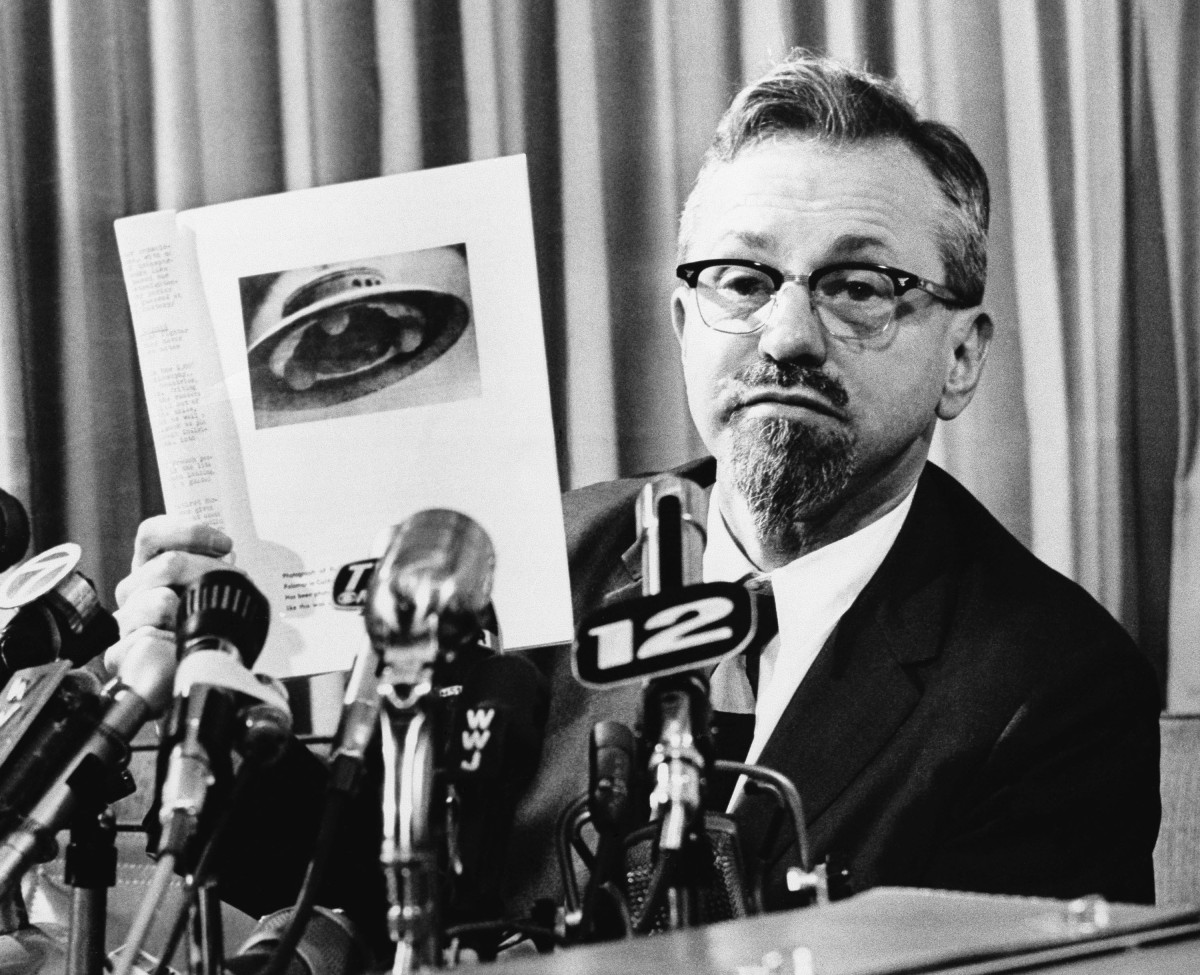
When Project Grudge ended, its report concluded that "the phenomena posed no danger to the United States, having resulted from mass hysteria, deliberate hoaxes, mental illness or conventional objects that the witnesses had misinterpreted as otherworldly." (Daughtery, 2018). As such, it was suggested that UFOs did not warrant further research. Though it seemed to be an untimely end for UFO studies, there continued to be sightings and reports, including those from Air Force radar operators. The topic of UFOs soon became popular in the national media, most notably when respected broadcast journalist Edward R. Murrow conducted a special report in 1950 and devoted an entire program to the flying saucer phenomenon. The show featured interviews and sound bites of military and civilian witnesses who offered their account of major UFO encounters. LIFE magazine notably did a 1952 cover story on flying saucers, exploring the facts given by the Air Force and offering "scientific evidence that there is a real case for interplanetary saucers." (Darrach Jr. and Ginna).
Project Blue Book
Such widespread publicity left the Air Force with little choice but to resurrect Project Grudge, which eventually became Project Blue Book and would last for 17 years, eventually coming to an official end in 1969. Hynek was hired for Blue Book and remained part of the project for its entire duration. He was tasked with reviewing reports with UFO sightings and determining if there was a logical astronomical explanation for what people saw. Though that usually involved menial paperwork, there were highly unusual cases that required Hynek to perform fieldwork and speak with witnesses.
It was a transformative experience for Hynek, coming to the realization that the people who reported the UFO sightings tended to be normal individuals, recounting in his 1977 book The Hynek UFO Report:
The witnesses I interviewed could have been lying, could have been insane or could have been hallucinating collectively — but I do not think so. Their standing in the community, their lack of motive for perpetration of a hoax, their own puzzlement at the turn of events they believe they witnessed, and often their great reluctance to speak of the experience — all lend a subjective reality to their UFO experience.
In his book Making of Close Encounters of the Third Kind: The Making of Steven Spielberg's Classic Film, Ray Morton noted:
Hynek found that a majority of these unexplainable reports were being made not by the confused and the crazy, but instead by witnesses he considered to be quite credible: scientists, pilots, police officers, and military personnel — people trained to be careful, astute observers and whose accounts needed to be taken seriously. All of this led Hynek to believe that there might be something to the UFO phenomenon. While he was not necessarily convinced that UFOs were, or even had to be, extraterrestrial in origin, he was starting to believe that they were indeed something — something that required thorough investigation. (pg. 42)
In the late '50s, UFOs became a secondary focus for the Air Force after the Soviet Union's launch of Sputnik 1, the first artificial Earth satellite. Following that historical moment, Hynek began working on a satellite tracking system at Harvard, taking leave from his collegiate teaching position, and became somewhat of a national celebrity. Hynek appeared on television press conferences to ensure the public the scientists were closely monitoring Sputnik and was on the October 21, 1957 cover of LIFE magazine with astronomers Fred Whipple and Don Lautman.
Criticism of the Blue Book project
At the onset of the 1960s, Hynek had become arguably the world's leading expert on UFOs, largely thanks to his scientific consultant role in Project Blue Book. However, following Blue Book's dissolution, Hynek wrote extensively about his criticism of the project's procedures and the lack of interest exhibited by the government in regard to the philosophical and sociological implications of the existence of UFO reports. He frequently mentioned how the project staff was scientifically and numerically inadequate to perform its assigned tasks, the statistical methods used were a travesty, and how the lack of dialogue between Blue Book members and outside scientists was appalling. (Hynek, 1972). Hynek was also suspicious that the best Blue Book cases may have been sent directly to the highest authority, especially if the reports contained top-secret or cryptographic information.
In his book, Hynek debunked the public perception of Blue Book's role in investigating UFO reports:
The popular impression through the years was that Blue Book was a full-fledged serious operation. The public perhaps envisioned a spacious, well-staffed office with rows of file cabinets, a computer terminal for querying the UFO data bank, and groups of scientists quietly studying UFO reports, attended by a staff of assistants.
The actual situation was unfortunately the opposite. The operation was generally handled by an officer of lesser rank. In the military the importance attached to a mission is usually in direct proportion to the rank of the commanding officer. The relatively low-ranking officers in charge of Blue Book were usually assisted by a lieutenant and sometimes only by a sergeant. For one long period of time a sergeant with little technical training was given the chore of evaluating most of the incoming reports.
After Blue Book ended, Hynek published his first book, The UFO Experience: A Scientific Inquiry, where he notably introduced his classification system of UFO incidents, which is arranged in relation to the UFO's increasing proximity to the witness. The first three elements within the system — nocturnal lights, daylight discs, and radar-visual primarily involve distant encounters and generally lack detailed evidence.
Close Encounters
However, Hynek's most famous creation is his three-tiered Close Encounters list:
- Close Encounters of the First Kind refers to UFO sightings involving lights or objects that are generally less than 500 feet away from an observer, though the UFO has no interaction with the nearby environment. This type of encounter can also involve nocturnal lights, daylight discs, and radar-visual sightings, but the UFO is in closer, clearer view.
- Close Encounters of the Second Kind refers to a UFO event that leaves behind physical effects such as the interference in electronic devices; scorched plants and trees; and discomfort in nearby animals. In humans, the physical effects can include temporary paralysis, numbness, a feeling of heat, or some sort of other discomfort.
- Close Encounters of the Third Kind refers to the presence of an animated creature or entity. In his book, Hynek notes that they have been referred to as "occupants, humanoids, UFOnauts, and UFOsapiens." (pg. 158).
The most popular and memorable part of the scale is Close Encounters of the Third Kind, which inspired the title of Steven Spielberg's classic 1977 science fiction film. Spielberg invited Hynek to serve as a technical advisor and consultant, which he accepted as he felt the film could be an excellent tool in promoting serious UFO research. Hynek was paid $10,000 by Columbia Pictures for the rights to his book and made a memorable cameo in the movie, playing an awestruck scientist who rushes forward to the spacecraft, briefly stroking his goatee to show his intrigue before collecting himself and putting his pipe back in his mouth.
J. Allen Hynek in Close Encounters of the Third Kind
When it comes to pipes and tobacco, Hynek's preferences remain a mystery. What is clear is that he was a devoted pipe smoker and can be seen in several photos enjoying one. He seemed to prefer quarter-bent pipes, usually traditional shapes such as Billiards and Princes, and owned smooth and sandblasted briars.
Though Hynek retired from teaching in 1978, he continued collecting and evaluating UFO reports up until his death in 1986 at the age of 75. One of his most notable creations, the Center for UFO Studies, remains open to this day and was the first national organization dedicated to the scientific study of UFOs. In 2019, the History Channel debuted a series called Project Blue Book, a highly-fictionalized historical drama in which J. Allen Hynek is the main character and works with a decorated Air Force veteran to investigate UFO sightings around the United States.
J. Allen Hynek was a significant scientific figure who demonstrated the importance of keeping an open mind when dealing with new phenomena, approaching such matters methodically rather than feeling forced to create an immediate answer or select the best available option. He was a firm believer in the scientific method and applied it in his study of UFOs, helping to pioneer the field of ufology. Hynek was driven by curiosity and wanted to further the world's knowledge about the universe, making UFO research a legitimate scientific pursuit. He possessed a brilliant analytical mind and demonstrated that when it comes to science it's sometimes important to have questions you cannot answer instead of answers you cannot question.
You may also enjoy:






Comments
Excellent and level headed discussion. As Sherlock Holmes would say, UFOs are a 3 pipe problem.
Very nicely written. I really am fond of what was said. I think most "creative" people are pipe smokers. And then there are folks just like me who love a pipe hanging out of my mouth just at the right angle. Nicely written and phrased.
Awesome UFO Smokers Pipes WOW
One of my favorite topics and subjects. I've been a UFO nerd since I was a kid, and there has been so much new footage released lately by the Pentagon and Navy airpilots that makes you really wonder. I believe, the math or statistics says that we can't be the only intelligent life in the Cosmos. If you've ever watched the Cosmos series s1, with Dr. Neil deGrasse, where they give and illustrate the Earth's cosmic address... it's just mind blowing and sublime. A three pipe problem indeed.
An interesting read. As a former civilian worker on the flight line at Edwards Air Force Base in California, the final answer is one sided for me. It is not a question of are there "any" aliens, it is a question of "how many types" of aliens are there? I have seen a F-111 being "chased" by a T-38 which was checking the F-111 to observe the functionality of exterior portions of the lead plane. Behind the T-38 were disc shaped UFO's chasing and watching both aircraft. Astronaut Cooper and others witnessed a UFO land on sand and rocks across the runway from them. It deployed 3 "struts" to support the cylinder shape of the craft. As Air Force people headed for the craft, it silently retracted the struts and lifted into the air and was gone without a sound.Then there was the time in the northern west states a nuclear ICBM site had 20 of its rockets with nuclear warheads deactivated by UFO's that were seen by many military people. Reporting to the Pentagon in Washington, the Base Commander was told it was of concern to the national security of this country. 20 nuclear rockets off line and it does not concern national security??!! When the UFO's left, the rockets came back online.
In my post about UFO's at Edwards Air Force Base:When I wrote "Reporting to the Pentagon Washington, the Base Commander was told it was of .... There should be a NO CONCERN to the national security of this country.
Can anyone tell me if there were any UFO sightings in or around Tenafly NJ around 1961 or 1962. I have a story that I have never told , but I would like to talk to a researcher on the subject.
Check out the Drake equation
I really enjoyed this write up of Hynek's history and work with Project Blue Book. Blue Book has been of great interest to me since I first learned about it. I was pleased to see History Channel release a series on Blue Book, but unfortunately it was short-lived. Aside from Hynek, I think the Smoking Pipes blog has the best material...always interesting and informative.
There's a theory called Directed Panspermia where it is theorized that that microorganisms were transported through the Cosmos by advanced beings to seed the Universe with life wherever it would be habitable. By that logic I would guess that those beings also sent the building blocks of tobacco along with every other possible configuration of life, which leads me to believe that if this theory is true....our Alien Ancestors smoked tobacco and programmed our dna to conceive the thought of pipes and tobacco. Hmmm....(Thank you, Mr.Sitts)
@Dan: Thank you for commenting! That's quite an interesting theory and I appreciate your take on it. Maybe we're not the only species that enjoys pipes and tobacco. It would be comforting to know we had that in common with advanced beings at least.
I had the pleasure of hearing Mr. Hynek speak in the late 70's. I had already red Project Blue Book, and was very familiar with his work. I too am a UFO nerd since way back...Thank you for the Article.....
Could our Universe be Someone’s Chemistry Project? | Universe Todayhttps://www.universetoday.com/153107/could-our-universe-be-someones-chemistry-project/amp/