


 |
|
 |
|



Beyond Violence: The Sociocultural and Economic Factors That Enabled the Black Patch Tobacco Wars


Tobacco Warehouse in Louisville, Kentucky 1906
In the Western regions of Kentucky and Tennessee there is an area known as the Black Tobacco patch. The name comes from the dark tobacco crops raised in the region — many dark-fired tobaccos are made here. It's comprised of about 30 counties in southwestern Kentucky and northwestern Tennessee. At the turn of the 20th century, this region would see a lawless, violent conflict erupt that would terrorize the region for three long years: The Black Patch Wars.
In the Black Tobacco patch, farmers depended on tobacco for their livelihood; just as cotton was "king" in the South, tobacco was king in this western region. Tobacco is one of the most intensive crops to produce. It's a year-round endeavor with the harvest of one rotation immediately leading into the next batch being planted. Between 1875 until about 1900, the life of tobacco farmers was difficult but liveable. Many farmers would barely have enough from harvest to harvest to make a living for themselves but they persisted nonetheless. Tobacco farmers faced crop failures, national and foreign market changes, and other socio-economic challenges during this time period, but the market always remained open and competition for tobacco was fierce among buyers.
To grow tobacco at a profit during the turn of the century, farmers needed to sell for about five to six cents per pound. Anything less would have them at a loss. From 1865 until the 1890s, the price was a steady eight cents per pound, but prices slowly began to fall from 1890 until about 1904 when they reached as low as one to three cents per pound, depending on the quality of the leaf. Farmers during this time referred to this pricing structure as "3-2-1 and a'cussin." Part of the reason we began to see this change was the development of tobacco trusts. One in particular, to be exact.

James B. Duke, Courtesy of Duke University
James B. Duke in 1890 founded the American Tobacco Company, created by merging the five leading tobacco companies in the United States: W. Dukes; Sons and Company; Allen and Ginger; Kinneney Tobacco company; W.S Kimball and Company; and Goodwin and Company. Duke also helped establish the Imperial Tobacco Company of Great Britain to serve as an appendage of the ATC to handle the European market. The Great Britain division would be handled by a European tobacco company called the Régie. By 1910, the ATC controlled 84.9% of the plug-tobacco market, 76.2% of smoking tobacco, 80% of fine-cut tobacco, 97% of snuff, 86% of cigarettes, and 91% of the little-cigar markets.
They quickly earned a reputation among farmers, and were simply referred to as the "Trust." Before the Trust, the traditional method of farmers selling their crop was for them to take a sample of the crop to an auction where it would be bid on and sold to the highest bidder. But with the formation of the Trust, the process of tobacco buying shifted from auctions to barn-buying. In barn-buying, a buyer would come to the farmer's barn, examine the crop, and then make an offer for the entire lot.
By 1904, it was clear to farmers that the American Tobacco Company, Imperial Tobacco Company, and the Régie were in league with each other and wouldn't bid against one another during the barn-buying process. The three companies would divide a county into sections and one company wouldn't send buyers into another's territory. This meant if a farmer refused to sell his crop to that territory's buyer, there would be scant hope for another to swoop in, leading the original buyer to come back and make an even lower offer than before and forcing the farmer's hand.
Due to this practice, the situation in the Black Patch was unbearable and it was up to the farmers to do something. On September 24th, 1904, farmers scaling from large landowners to sharecroppers met in Guthrie, Ky., to form the Dark Tobacco District Planter's Association of Kentucky and Tennessee. Rolling right off the tongue, it quickly became known as "the Association." The plan of the Association was simple: If farmers band together and store their tobacco in the same warehouse and refuse to sell, then eventually the Trust will have to meet their price. Guthrie would serve as the headquarters of the Association and a number of towns were designated to have Association warehouses.
... if a farmer refused to sell his crop to that territory's buyer, there would be scant hope for another to swoop in, leading the original buyer to come back and make an even lower offer than before
Three figures stood out as the leadership of the Association. Charles H. Fort was a prosperous farmer from Adams and was elected president, and his brother, Joel Fort, became the Associations' most vocal spokesman touring across the Black Patch. Perhaps the most important role was played by Felix Ewing of Glenraven, Robertson County. Ewing was elected chairman of the executive committee that was made up of one member from each county belonging to the association. This is where the real power was held, with the president being a figurehead.
From 1904 to 1910, Ewing would be the driving force behind the Association and the most recognized leader of the movement. With these elected officials, the Association moved toward its goal of helping farmers get better prices for their tobacco. Another important goal of the Association was to help voluntary farmers reduce crop overproduction, which could have seen a 25-30% decrease in the total amount of tobacco grown in the Black Patch.
The Association had guidelines for planting, and also worked to educate farmers in the use of modern farming techniques and ideas, and spread the word of new types of seeds. Beyond the Black Patch, the Association lobbied in Washington for the repeal of the federal tax of six cents per pound on cured tobacco that had been in effect since 1872. A bill to repeal the tax passed the House, and the bill died in the Senate in 1906.

Newspaper Headline, Courtesy of The Museums of Hopkinsville
Despite the work being done by the Association to improve the situation for those who were members, not all Tobacco farmers were in. Farmers who refused to join and continued to sell to the Trust were called "hillbillies" by Association members. It's not documented why they particularly chose hillbilly because there wasn't a large difference in social, geographic, or cultural situation between members and non-members. There were two distinct groups of Hillbillies: Those who simply couldn't afford to not sell to the Trust, and those who were stubborn and wanted to do it their own way.
Hillbillies quickly became a source of danger to the Association, mostly due to the Trust being able to refuse to buy from the Association and buy from the Hillbillies for prices as high as nine to 12 cents per pound of tobacco. A new level of discrimination was formed in the Black Belt region with hillbillies being despised and shunned by neighbors. Churches and schools would be split in two because Association members would not worship with hillbillies or allow their children to attend school with hillbilly children. The term would extend to apply to those farmers who originally signed contracts with the Association and then broke these contracts when lured by the Trust's money. The Association held enough political power in Nashville to get the Triple Damages Bill passed by the Tennessee legislature in 1907.
Farmers who refused to join and continued to sell to the Trust were called "hillbillies" by Association members
This new law states that contracts between farmers and selling agents were legal and binding and if they were breached, those responsible would be liable for triple the amount of damages resulting from the breach. It also made it illegal for third parties to influence one of the parties to break the contract. With the Trust threat and Hillbillies, the Association would work tirelessly to solidify its position in the Black Patch. Membership in some counties ran as high as 90% to 95% and as low in others as 50% to 55%. The general average for most counties was somewhere between 70 to 80% membership. Among the most persuasive propaganda used by the Association to promote membership and its ideas was their very own newspaper: The Black Patch Journal. The Journal was started in Springfield in May 1907 by John R. Love and C.M. Blackburn.
The Journal had a few stated purposes. One was to promote the interest and welfare of tobacco growers in the Association, to promote the interest of the seller (the farmer), and to protect and build a strong Association. The Journal declared it would "Vehemently oppose any man, combination of man, monopolies or trust that seek to satisfy their greed for gold by oppression and that continually strive and scheme to unjustly deprive an honest tiller of the soil of his due." The Journal used a combination of articles, cartoons, and poems to attack the Trust, praise the Association, and lampoon hillbillies. An example of a typical Journal poem is this one by Joel Fort.
Let croakers croak, and grumblers growl
And all the Hillbillies rant and howl.
Never give up till the victory's won
Stand by your guns.
Love not yourself, your neighbor hold
Self-love's a treacherous elf
Love God with all thy strength and soul
And thy neighbor as thyself.
The Journal was also instrumental in implementing a boycott of firms and businesses in Robertson County that weren't friendly to the Association. On an interesting note, the Association and the Journal went through great pains to make black farmers welcome in the Association. Records show that the Association treated black farmers as equal to white farmers within the group and the black-raised tobacco was sold alongside white at the same price. This led to black farmers joining the Association in larger percentages than most white farmers, but not out of a belief of equality or comradery. The Association's treatment of African Americans stemmed from the belief that if economic conditions got much worse that the African American population would migrate north and leave the Black Patch with an acute labor shortage.
The Journal used a combination of articles, cartoons, and poems to attack the Trust
Shortly after the Association was formed, the reality of the situation for both the Association and the Trust became clear: they were in a deadlock. The Association's failure to recruit the hillbillies left the Trust able to purchase tobacco but the trust couldn't lure enough Association members away to purchase the supply they truly needed. At this stage in the conflict, we began to see violence blossom. This violence would be one-sided, stemming from the Association rather than the Trust. The Trust didn't engage in violent behaviors because even at the nine cents per pound that they were paying the hillbillies, they were making massive profits. The Trust was also aware that dark-fired tobacco could be raised only in the Black Patch, so they couldn't afford to alienate farmers further.
The Trust's seemingly endless cash flow encouraged them to wait out the conflict, a luxury the farmers literally couldn't afford. While the Association was building a platform, it wasn't fast enough and soon some members would turn to steel and gunpowder. Inspired by the Association's constitution, which stated that "each member of this association also obligates himself to use his influence and strong endeavor with those tobacco planters who are not members of this association, to become members." In 1904 and early 1905, this covenant would see Association members carry out peaceful visits to non-members in attempts to reason with them and urge them to join. But these visits would turn into threats, and violence would soon follow.
However, in October 1905, 32 members of the Robertson County branch of the Association would meet at the Stainback schoolhouse and dub themselves the "Resolutions of the Committee of the Possum Hunters Organization". These "possum hunters'' aired their grievances against the Trust and the hillbillies and stated their intent to visit these buyers and hillbillies in groups of no less than five and no more than 2,000 to convince them to "peacefully" see their side of the story. Now, of course, these were hard-working men during the day so their peaceful visits just had to be at night, no way around it.
... this covenant would see Association members carry out peaceful visits to non-members in attempts to reason with them and urge them to join
The example the possum hunters set spread throughout the Association and many across the organization adopted similar resolutions. One in particular stands above the rest of the possum hunter groups: the Night Riders in Robertson County. Robertson county held a large number of Association members and leaders, so this county wouldn't see much of the night riders' terror. The night riders were organized into a secret fraternal organization known as the "Silent Brigade" or the "Inner Circle." They had three outlined purposes: Force all growers into the Association, force all independent tobacco buyers to cooperate, and force the Trust to buy only from the Association.
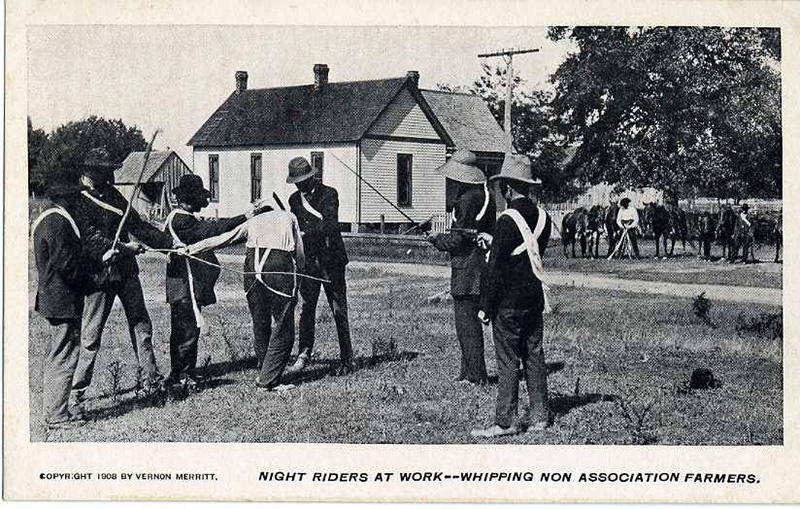
The Association would publicly disavow the Silent Brigade but many members held high positions in both organizations. The Silent Brigade was organized like the military with a general and lieutenant commander in charge, with colonels heading country units, and captains in charge of each lodge. The General for the Silent Brigade would later be identified as Dr. Frank Amoss, a physician of Cobb, Caldwell County, Ky., and a high-ranking Association official. Guy Dunning, an Association tobacco grader and general inspector, was the second in command. The brigade had new members take blood oaths on Bibles and undergo mysterious initiation rituals. They had their own elaborate and secret set of passwords, signs and signals, and often wore disguises during their raids. The brigade saw themselves as embodying the spirit of the Boston Tea Party and the Ku Klux Klan.
Chuck Stanion has gone into great detail of the Silent Brigade's reign of terror during the Black Patch Tobacco Wars and to avoid retreading I'll point you to that article for a detailed look at their exploits. However, there are a few other things to highlight about this run of bloodshed. One is that the Silent Brigade considered themselves above the law. While many law enforcement officers attempted to stop or punish the Silent Brigade, the brigade was so well-organized that these attempts often failed before going into the courtroom. On the rare occasion a case made it to the court, a series of strange happenings would often interfere.
Witnesses would suffer lapses of memory, often due to threats from members of the Association or because they were members themselves. On the very rare chance this didn't happen, and the case was air-tight, it wouldn't matter due to juries being loaded with members of the association who would deliver not-guilty verdicts. One of the more infamous examples of both of these scenarios was in May 1907, when Mott Ayers, the State Fire Marshal for Trigg County, Ky., stated he could not appear before the court due to the illness of his wife but was sending proof of the man who had written threatening notes to Robert Wallis whose tobacco barn had been burned down by the brigade.
... the Silent Brigade considered themselves above the law
The man who had threatened and probably burned down Walli's barn was a prominent figure in Trigg County, leading the jury to deliver no indictment. The jury did say that they had "sought diligently to discover who had committed the offense." These instances of the law failing to deliver justice led the Silent Brigade to be completely defiant of the law and as they committed their crimes, they would boast to victims, "We fear no judge or jury."
The historical culture of the area helped foment the violence that followed. The American South has a long and bloodied history and inherent tenacity for violence, along with the belief that certain situations arise where violence is the only logical answer. C. Vann Woodward, an American historian with a focus on the South, wrote that the South "seems to have been one of the most violent communities of comparable size in all Christendom."
These instances of the law failing to deliver justice led the Silent Brigade to be completely defiant of the law
Across the world, religion and culture often become interdependent, but this relationship is particularly evident in the historic American South. There are several different aspects of Southern religion that have helped to nurture the use of force in Southern culture across history but one of the key aspects is the South's tendency to view God in terms of the Old Testament. This view carries a certain pessimistic view of humanity and a willingness to approve of violence in specific instances. Wilbur J. Cash described the relationship between the southerner and his religion as "what our Southerner required ... was a faith as simple and emotional as himself. A faith to draw men together in hordes, to terrify them with Apocalyptic rhetoric, to cast them into the pit, rescue them and at least bring them shouting into the fold of Grace. A faith not of liturgy and prayer book, but of primitive frenzy and the blood sacrifice. ... The God demanded was an anthropomorphic God — the Jehovah of the Old Testament."
Southern churches historically have leaned more Protestant and Evangelical, more concerned with humanity's relationship with God than with mankind. A progenitor of this dynamic was the Great Revival of the early 1800s, which had a deep and lasting impact on religion in the South. The Reverend Samuel McGready of Logan County, Ky., wrote many sermons and traveled around the Black Patch region during this time preaching to different congregations. The following is an excerpt from one of these sermons:
He died accursed of God when his soul was separated from his body and the black flaming vultures of hell began to circle him on every side. ... When the fiends of hell dragged him into the eternal gulf, he reared and screamed and yelled like a devil. ... Now through the blazing flames of hell he sees that heaven he has lost. ... In those pure regions he sees his father and mother, his sisters and brothers ... but he is lost and damned forever.
As Dr. Rick Gregory of Tennessee State University wrote "Not only did the Great Revival reinforce the belief in a violent God, but also it helped develop a pessimistic Southern world view — a belief that man is so sinful that sometimes violence is the only thing he understands." The Black Patch region was a region with this deep set belief in a vengeful, wrathful God, and it bled over into how these people lived their lives.
When Black Patch inhabitants felt themselves or their way of life threatened, then anything from duelling, lynching, guerilla warefare, or any violent work was a possible response. This trend predates the Black Patch Tobacco wars but is the exact thing that helped to allow the violence committed by the Silent Brigade to not just exist but thrive. As mentioned before, a large-scale discriminatory effort manifested between members of the Association and the Hillbillies that began in churches and in schools.
Religion played a major role in the Association and Silent Brigades' ability to recruit and maintain control. Local Association meetings were often held in churches, with prayers opening and closing meetings. When the Association would visit these hillbillies and they would refuse membership, they would have these farmers and buyers get on their knees and pray to God to show them the light. Charles Fort, the President of the Association, joked when asked about the Silent Brigade, "The Lord Sent down those fellows to ... [m]ake the principles of the Association more closely adhered to by all." The Silent Brigade was even referred to as "Charlie Fort's Angels."
... anything from duelling, lynching, guerilla warefare, or any violent work was a possible response
The Clarksville Leaf-Chronicle and other similar publications in the Black Patch region wrote extensively to remind farmers that the Association was righteous in their cause, that Felix Ewing was the Moses of the Black Patch, and referring to the Trust as "His Satanic Majesty." This isn't saying that religion was solely responsible for the Black Patch Tobacco War's violence but it is certainly part of what allowed violence to thrive. In addition, those of the Silent Brigade, and the Association as a whole, were desperate men motivated by an increasingly distressing economic situation and they viewed their only hope of survival as having a strong and committed Association. There were also personal reasons for the violence; whether it was feuds or revenge, all were performed under the guise of the Association being the tobacco farmers' only hope.
But while the Silent Brigade and Association reigned over their own brand of retribution, the Government began the process of bringing its own justice to the Association. Press around the nation was aflame with the exploits of the Silent Brigade, leading to both the federal government and state governments of Tennessee and Kentucky to levy pressure against them. Something the Silent Brigade hadn't considered was foreign influence. The Italian ambassador to the United States made a formal complaint on behalf of the Italian government to the United States' Secretary of State, Elihu Root. The ambassador complained that Italian citizens doing business in the Black Patch region were being harassed and that thousands of dollar's worth of property belonging to the Régie had been destroyed, requiring reparations.
... desperate men motivated by an increasingly distressing economic situation
This made Elihu Root put pressure on the governors of Kentucky and Tennessee. While the Silent Brigade feared no local courts or law enforcement, their tune would change when brought to the federal level. In May 1908, a Federal court found a number of Silent Brigade members guilty of violating the rights of Robert L. Hollowell, a victim of their raids, and gave Hollowell an award of $35,000 against the Silent Brigade. This opened the door to many other victims filing federal civil cases against the Silent Brigade, which began to taper their raids and numbers due to the fear of financial ruin.

Downtown Reenactment, Courtesy of The Museums of Hopkinsville
In Tennessee, two laws were passed in 1907 to curb the Brigade's bloody campaign. The first law passed was "to preserve the public peace and make it illegal for a person to prowl, travel, ride or walk through Tennessee with the purpose of terrorizing any citizens of the state." The Second act made the damage or destruction of plant beds and tobacco crops illegal with a heavy penalty for those who commit the infraction.
By 1909, the Association was a commercial success. The Trust was forced to buy tobacco from them with prices as high as nine cents a pound on average and the Association had proved that farmers with organization could affect the price of their crops. With the rising tobacco prices, prosperity returned to the Black Patch region. However, the cost in property, human life, and decency was too much. The actions of the Silent Brigade had a deeper impact spreading throughout the region, as far as into Indiana and Ohio where cotton farmers took their cue from the Silent Brigade and an outbreak of violence plagued the cotton region of the United States for a number of years.
In 1911, the Supreme Court ordered the dissolution of the American Tobacco Company Trust. Later, Congress would repeal the tax on dried-leaf tobacco. The Association's efforts to educate farmers in scientific farming and crop reduction, in addition to their influence on crop prices, helped set in motion precedents for the future of agriculture for years to come. The Association had a short life, being officially dead by 1913, just nine years after their inception. While the Association succeeded in many ways, their legacy is forever tainted by unforgiveable bloodshed and violence.
Bibliography
- Reynolds, A. Lee. (1958). War in the Black Patch. The Register of Kentucky Historical Society, 56
- Marshall, S. (1994). Violence in the Black Patch of Kentucky and Tennessee. University of Missouri Press.
- Gregory, R. (1993). Beliefs of Their Fathers: Violence, Religion, and the Black Patch War, 1904-1914. Border States: Journal of the Kentucky-Tennessee American Studies Association, 9.
- Gregory, R. (1980). Robertson County and the Black Patch War, 1904-1909. Tennessee Historical Quarterly, 39 (3).
- Campbell, T. A. (1991). "Hard Times" and Insurgent Politics: Origins of the Black Patch War, 1875-1904. The Register of the Kentucky Historical Society, 89 (4).
You may also enjoy:




Comments
The article on Black Patch Tobacco Wars was brilliant . More than a "story " .. integrated culture , religion , etc to produce excellent essay . Enjoyed ! Thank You .
Great piece! Loved it.
And still today, unbridled greed and the desire of some for more and more power, countered with primal tendencies to violence and coercion cloaked in convictions of righteousness, honor and the greater good, cast lingering shame across our country. We are a nation of robber barons and night riders, sometimes side by side but staring straight ahead, not to be bothered by facts or transparent lies.
Wonderful article; thank you! Could you provide a link to or bibliographic information for Chuck Stanion's article on the Silent Brigade?