


 |
|
 |
|



Cornell & Diehl Small Batch: Fires on the Levee Roundtable


Welcome back to another roundtable chat, and today we are chatting about a super special Small Batch from Cornell & Diehl, inspired by a Christmas Eve tradition from Louisiana: Fires on the Levee, available on December 16, starting at 6:00 p.m.
Note: The following transcription has been edited for clarity and brevity.
[Andy Wike]: I'm joined here with Jeremy Reeves and Steve Mawby to discuss C&D's brand-new Small Batch blend, Fires on the Levee. Jeremy, I know this is a blend that's been super close to your heart. Can you tell us a little bit about it?
Bonfires on the Levee in Louisiana
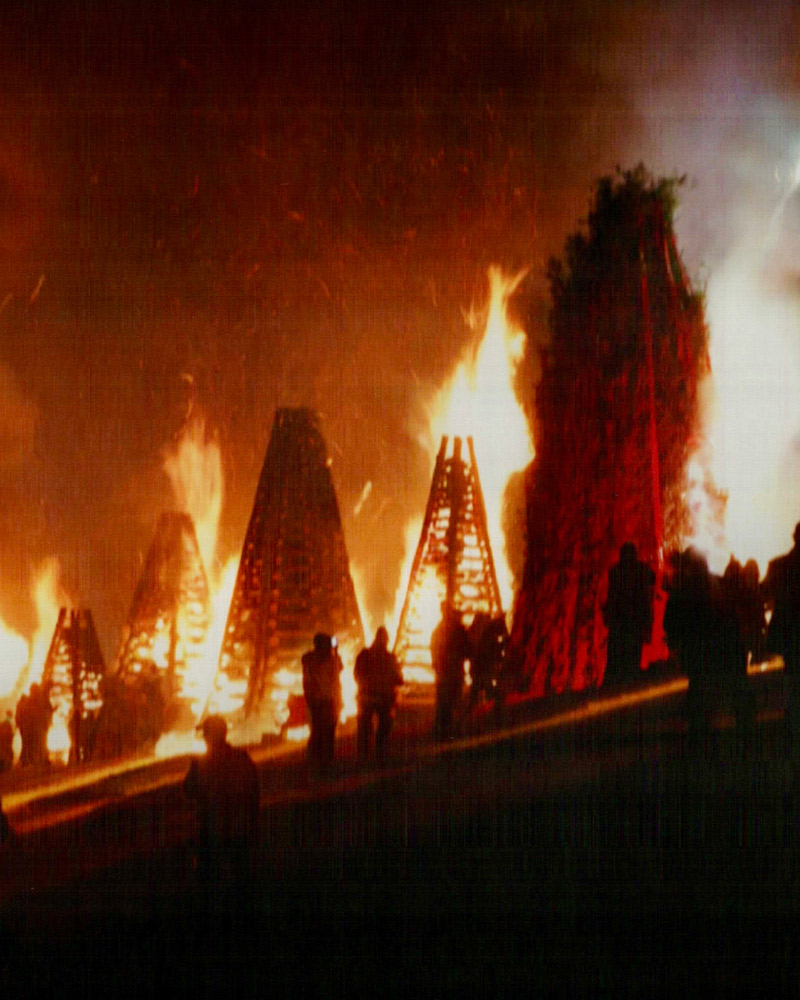
Fires on the Levee
[Jeremy Reeves]: Going down to St. James Parish, Louisiana, over the years, there were all sorts of really cool things about their history, the lore of the place, and the culture that I just found as fascinating as Perique itself; It's a window into how Perique might have become such an important thing to this area for the time that it was.
Along the way, one of the stories that I learned was about this ongoing practice of building these intricate, thought-out, tight teepee wood structures that they used for bonfires that are built so they can burn for a really long time. The reason that they do it now is a Christmas tradition for Santa. Papa Noël, the Cajun version of Santa Claus, uses all these fires lined up on the levee as a guide to be able to bring presents.
But the real historical root of this is that in Louisiana there are parishes. The reason they're called parishes rather than counties is because there was originally one Catholic parish for each region. The Catholic parish was on one side of the Mississippi River but St. James is split across the Mississippi, so there were people on one side that, in order to go to church, would have to cross. This was a laborious task. Thus, a lot of people would only go to church once a year, and they chose midnight mass on Christmas Eve. The lore is that they started this bonfire event so that they could find their way there and then back across.
[AW]: Interesting. So this whole bonfire tradition is super local to this one region of Louisiana.
[Steve Mawby]: Much like Perique.
[AW]: This area is the only place where Perique is grown and it's just really cool to see another timeless tradition from this super culturally interesting place just evolve and take on its own life. There's this feeling of celebration around this particular festival and I understand that you actually had the opportunity to talk to Ricky and Barbara Roussel recently.
[JR]: That's right. They came to visit. Ricky is a walking history for the whole area, and he's so passionate about the things that happened in this little 12 and a half mile square region.
A Conversation with the Roussels
[JR]: I have two very special guests with me here, Ricky and Barbara Roussel, proprietors of 31 Farms. They produce the only Perique that C&D uses. They're one of two Perique farmers left in St. James Parish, and I just wanted to ask you guys to share a little bit about the Christmas traditions from your area with us. Tell me more about the bonfires. Where did the bonfire practice start and what does it mean culturally?
[Ricky Roussel]: It started years ago. Grandpa would always say, we've gotta build a little fire because we have to light the way for Papa Noël to come down. You're not gonna get any presents if you don't light a fire. That's the only way he could see. He'd say, there's no street lights, so he follows the river and he goes down and if we light bonfires or fires on the levee, we will bring Papa Noël to the house. That's the tradition that was handed down over generations.
[JR]: Okay. I also understood that before that story, there was a more practical purpose for the bonfires because there was only one Catholic church in St. James Parish on the other side of the river, so people would only go to midnight mass every year because crossing the river was too much trouble. Families were allotted sections on the levee to set up bonfires so they could find their way back home. Is that true?
[RR]: That's right. On our side, we had St. Michael's church, so the bonfires would light the way to the church for carriages riding in. They were the streetlights at that time, and it was done specifically on Christmas Eve.
[JR]: Barbara, do you have any childhood memories around the bonfires from Christmas?
[Barbara Roussel]: I lived on Martin Street. My grandfather had eight children and they all lived on that one street, except for maybe one or two of my uncles. We would all get together. I was very little, where my mom didn't even want me to cross the road to go onto the levee, but we would go anyway.
[RR]: She was a little tomboy.
[BR]: We would climb these logs just like the guys would do and help them with the bonfires. The bonfires were very tall back then. We had at least 25, 30 feet of bonfires.
[JR]: Yeah, they didn't have any restrictions back then.
[BR]: No restrictions back then. On Christmas Eve, my mom would cook gumbo, and my dad would cook raw oysters. People just gathered together and had fun.
[JR]: That's amazing. How are the bonfires made?
[RR]: First, you select a good, straight tree and cut it down. Most of the time, that tree is anywhere from 6 to 10 inches in diameter and 20 feet tall. Then, you dig a hole two feet down in the levee and place the wood inside. There's no nails allowed. You'll put one pole and then a couple of people will hold that one pole on edge while you use another to create a cross section. And then repeat and you'll get a pretty steady skeleton of the structure.
[BB]: There is a limitation now. You can't go further than 20 feet.
[RR]: When we were kids, we built levees that were 30, 40 feet tall.
[BB]: Yeah, that was because it was a competition at that point of who could build the biggest and the best bonfire structure.
[RR]: Yeah, 75 to 80 years ago, it was a competition. Who would have the biggest? Reserve or Garyville or Gramercy or Hester? Now it's judged on what's the prettiest bonfire and who has the best fireworks shows. It's just a different thing, but it's a fun deal.
[JR]: There are bonfires that are almost like sculptures too, right?
[RR]: We have an engineering group that's in Garyville, about six miles down river from us. These guys work for Marathon Oil Company. They'll go ahead and draw something to scale and then build a replica out of matchsticks, or twigs. They use that to build a bigger-than-life structure. Each year it can be different, whether it's a turtle, an alligator, or a reindeer.
My brother-in-law, which is where we began our family tradition, passed away two years ago. As a tribute to him, my godchild, his son, built a John Deere 1952 or 1953 tractor.
[JR]: That's amazing. The amount of attention to detail that goes into something you're gonna burn is very interesting. In some ways, it's like Perique. It involves a bunch of hard work that ultimately is burnt for people's enjoyment.
St. James Parish: A Place Outside of Time
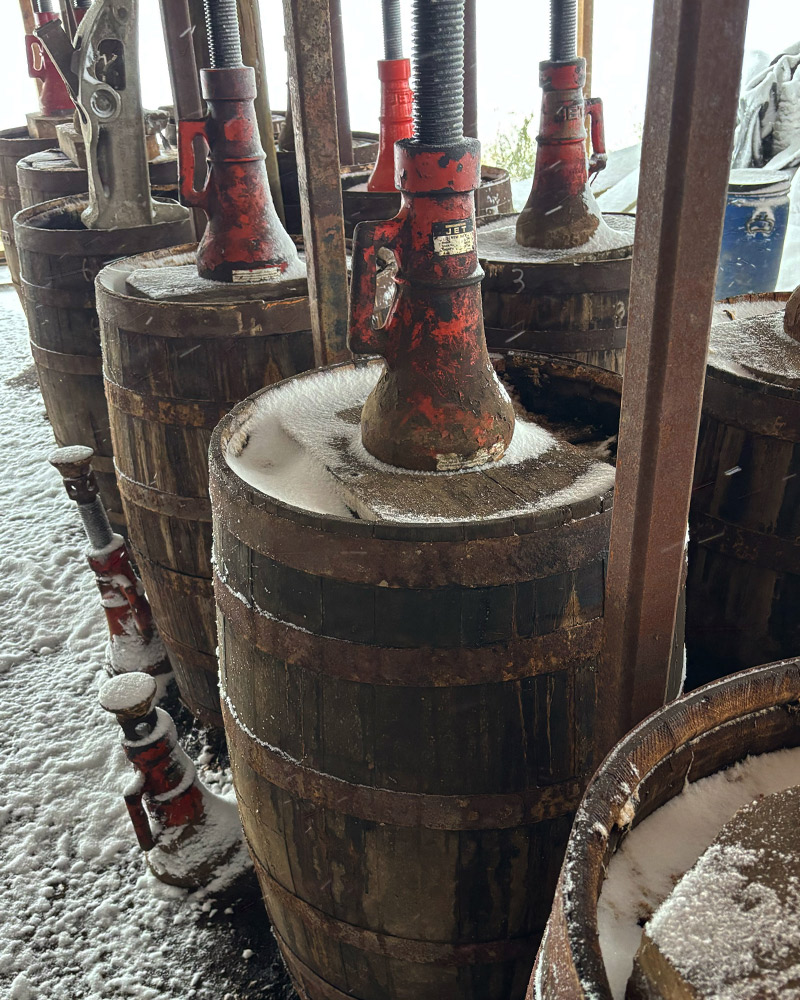
Perique, 31 Farms
[AW]: Wow. That was pretty cool.
[JR]: It's always eye-opening and amazing to ask them open-ended questions. They are such sweet and generous people, and there's so much understanding and knowledge of, not only their family lore and history, but the history of the whole region.
[SM]: It's so cool hearing their perspective of how the bonfire and the whole ceremony around it has evolved.
[JR]: Barbara talks about how she grew up on Martin Street. What she failed to point out is that all of her family were Martin. The reason they all lived there was that that was their family street. If you go around St. James Parish, you'll see Maturin Road, and that's where the Maturin family lived. There's Micah Street and there's Roussel. So everybody that is there, there's evidence of their family history in the roads.
[AW]: Every time I've gone, I've felt that St. James is a place outside of time. There's traditions and cultures that are suspended against modernity. Even the revival of Perique for the Roussel family is very much like that. Derek, Ricky and Barbara's son, wanting to do things the proper way and looking at memories of their fathers and grandfathers the way that things used to be done when there were 200 Perique farmers instead of just two.
[SM]: I also had a chance to talk to Ricky and Barb when they were in town recently and Ricky was talking about how, before one of their local high school football games, they cooked a meal for 120 some odd high school football players in their kitchen. You're talking about rejecting modern monoculture, whatever you wanna call it. They're getting home-cooked meals, like authentic gumbo made with care.
[JR]: Having visited and been in their homes, the kitchen is clearly a place that their family spends a lot of time. They have restaurant-size ovens and stoves. Everything is built around cooking for a big group of people.
Folk Art-inspired Tin Art
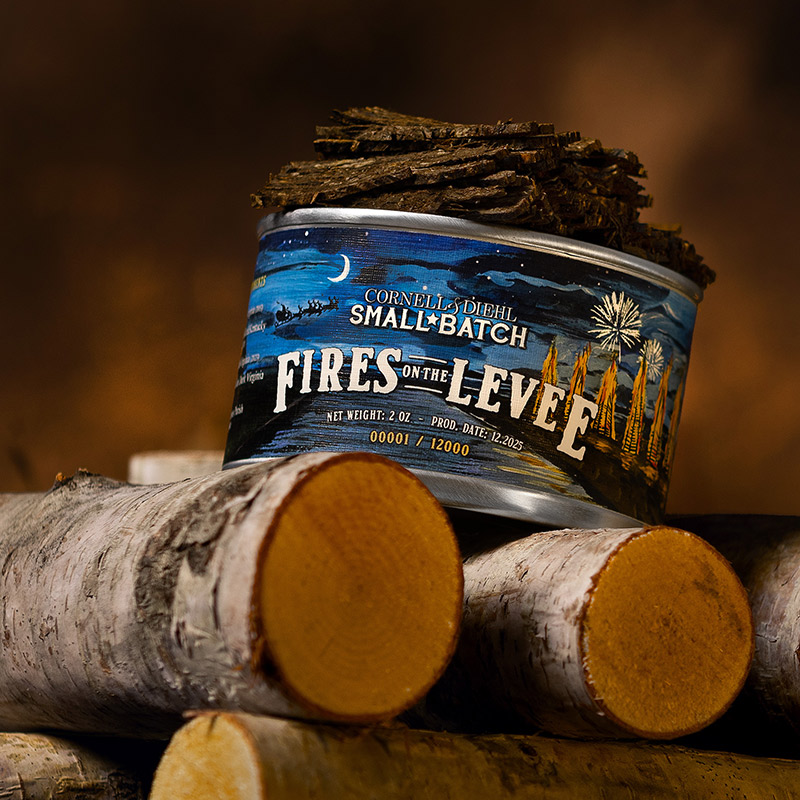
Cornell & Diehl's Fires on the Levee will be available December 16, starting at 6:00 p.m.
[AW]: Speaking of that out-of-time feel, the artwork for the tin this year is inspired by folk art. Jeremy, this is something that you and I have been flirting with for probably five or six years.
[JR]: The bonfire story stuck with both of us. We've talked about it many times and for some reason it never really occurred to either one of us before that it could be something that we could explore in tobacco, which was a cool realization you had, Andy.
[AW]: The style of the painting on the label itself is actually inspired by a whole bunch of folk art that you and I saw in Nobiles, which is this old saloon-turned-restaurant in St. James Parish, with the best butter beans ever. I dream about those butter beans sometimes.
[JR]: So many of those paintings in the restaurant are by Ricky's cousin, Ernie Roussel.
[SM]: That's pretty awesome. So part of the art is inspired by another family member.
[AW]: Yeah, exactly. Nobiles basically uses local artists' work to fill up all of their walls. They have a bunch of folk art paintings of the bonfires, swamps, bayou birds, fish, crabs, newspaper, beer.
[JR]: Things that are really still life.
[AW]: Still life on the bayou.
[JR]: Yeah, absolutely. Also things that are really indicative of this time and this place, or this place out of time, like we mentioned earlier.
Tobacco That Shares A Story
[AW]: Let's dive into the tobacco itself and discuss how we're capturing this tradition in the actual tin itself.
[SM]: While we're packing our pipes, I have a question for you, Jeremy. It's obvious to me why you used the Perique in this blend, but since it has a lot of bonfire inspiration, a lot of pipe smokers might associate bonfires with Latakia. With this blend, you went with Perique, Virginias, and Dark Fired. What informed that decision?
[JR]: I think that it's hardwood fires that are mainly burning. There's a lot of cooking going on down in Louisiana there as well. The smell of food and the smell of the bonfires all kind of led me to the sweeter hardwood aroma and flavor that Dark Fired has. The Perique and Dark Fired mingled really nicely together.
And then, to add to that sweetness created by the Perique and the Virginias in this blend, to me, it reminds me of the idea of the smoke of the bonfires, the presence of the Perique in this place, and the sweet notes, if you will, of kin and community. While developing this blend, I was thinking, how can I, to the best of my ability, tell a story with what we put together?
[AW]: That's so awesome. I do feel like the experience of smoking Small Batch blends, in particular, is like experiencing a story.
[SM]: It's a lot more personalized than picking up a blend that you can get any time or whatever. It's more of a special, unique experience. It's a lot more abstract and profound than anything that I would've thought of. That's why you're you, Jeremy, and why you do what you do and why I just smoke this stuff.
[JR]: I think that telling stories with the Cajun culture and particularly in St. James Parish how all of these things get passed down was important. It just seemed like the right way to commemorate and share this story.
I really love the way that these tobaccos work together. We've got some vintage Dark Fired from Kentucky that's providing the smoky note, and then some very nice Red and Orange Virginias that are adding sweetness, combined with the Perique. There's something about this that reminds me of food. There's a meaty element to it and also a sweet note there that feels like something's cooking. Something you're excited to sit down and eat.
[SM]: That's a good way of putting it. I feel like I'm just marinating in the smell of something delicious right now.
[AW]: It's like pork in the smoker. There's desserts being baked. There's a bonfire in the background. It's a whole experience. The progression of the flavors, I think, are really interesting.
An Intriguingly Sweet and Smoky Blend
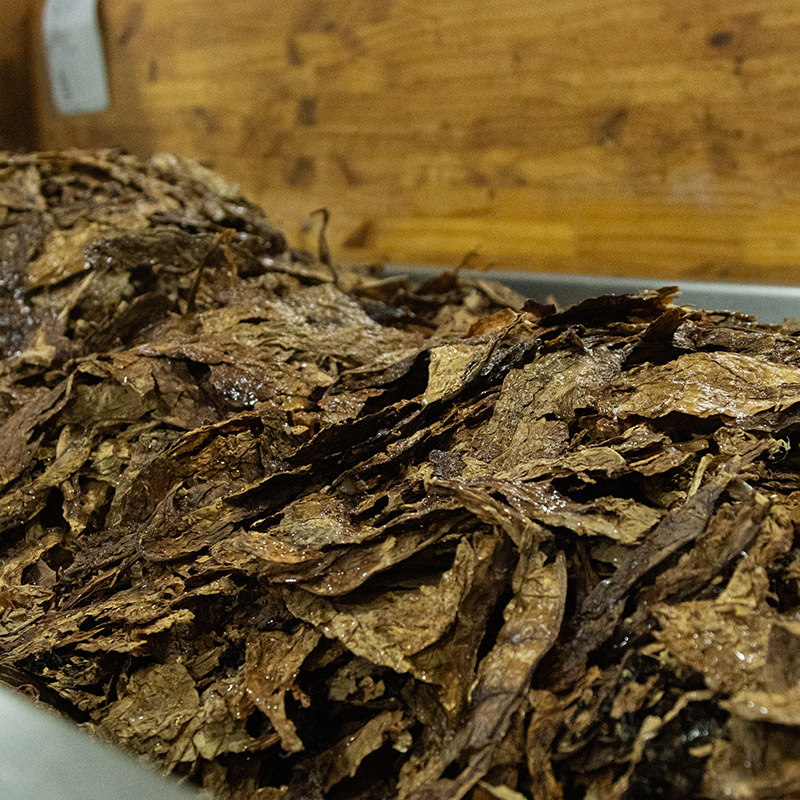
[AW]: The tin note is incredible too. It's a little malty. I'm getting that mesquite wood smoke and a sweet Virginia note. There's citrus and creaminess, as well as some funk.
[JR]: I love that umami character that Perique can bring.
[AW]: Perique is such an interesting component. You could use it in so many different ways and have completely different experiences from it.
[JR]: You've probably heard me say this before but I think of smoking straight Perique as standing in a really beautifully decorated room with all the lights out. It's so concentrated and dense that you can't really see what it has to offer fully. However, adding something like Virginia pulls back a sliver of the curtain, letting some light in, and you can begin to appreciate what this tobacco is doing by the way that it interacts with other things.
[SM]: The Dark Fired is more subtle than I was expecting in the flavor, in a good way. I was expecting more of a bonfire vibe, and this is more subtle. The sweetness is a lot more prominent. Everything's interacting and playing together very well.
[AW]: There's also a lot of sweetness. It's like maple-glazed, candied bacon.
[JR]: I like that analogy. Every once in a while, you get some spicy notes. Especially as it builds in the bowl, you get all of these characteristics in a more concentrated way.
[SM]: I'm definitely getting baking spices in there. This reminds me of being at Clark's up the street where they have the bacon hanging on the racks. That's what this tastes like.
[AW]: This is the first thing I'm smoking today. It's still pretty early. I think this could be a morning smoke.
[JR]: I actually think so.
[AW]: Despite all of the meaty, smoky flavors, it's really nice on a fresh palate. I was anticipating that this would be more of an after-dinner smoke than anything.
[SM]: This could be an all-day smoke. I can see myself smoking this pretty much anytime.
[JR]: It's got a depth of flavor that I think is pleasant for any time and it's pronounced enough that you could smoke it after dinner, but it's not so heavy. I would say in terms of strength, barely medium. The thing I always try to do in a blend is think about where certain tobaccos are really gonna register on the palate and then try and balance that so that you get a whole palate experience.
[SM]: You did a really good job of that on this blend. It's a whole mouthfeel. I can't pinpoint any spot in my palate where it's more prominent than any other. It's awesome.
[AW]: I'm used to thinking about that when it comes to cigars. I haven't really considered that with pipe tobacco. Where does Perique typically hit on the palate for you, Jeremy?
[JR]: That really depends on how it's combined in a blend. Smoking straight Perique, it is basically all mid palate, tongue, and back. But if you add some Virginias to the mix, that draws it more forward. Using Orientals with Perique will help bring it up into an olfactory experience, where your sinuses are really more engaged because Orientals are so naturally aromatic.
Perique is an interesting and unpredictable character in terms of the ways that it can move like a chameleon with what it's interacting with in tobacco. Perique and Burley intensifies that mid and back of the palate sensation. Dark Burley accentuates the spicy character of Perique a lot.
[SM]: I am definitely getting more and more spice as I go through this, especially on the retro. My sinuses are tingling a little bit in a way that I very much love.
[AW]: It's the perfect percentage of Perique.
A Special Blend for C&D
[AW]: The Dark Fired sits in the background. It's almost like this smoky ambiance that is in the atmosphere in which you're enjoying these Virginias and Perique.
[SM]: Almost like there's a bonfire going on in the background and you're just hanging out smoking a pipe right here.
[AW]: Again, it tells a story.
[SM]: It puts you right there. I've never been to the farm or to St. James Parish, but I feel like I'm sitting there right now in the dark with all those fires burning and just a bunch of people around while having a smoke.
[AW]: There's something very festive about this too. Obviously the tin art is a bit more holiday related. We have Papa Noël flying over the bonfires and everything. It's certainly not an Aromatic but I think all the flavor profiles work very well for this specific time of year.
It's a really interesting entry into the Small Batch line. There's aspects that remind me of Steamworks when it comes to the sweetness and the mouthfeel, and a little bit of that Firebird-like spice to it. Then there's also molasses sweetness, a little grassiness, and citrus that I expect from Carolina Red Flake with Perique. There are similarities to some of these other Small Batches that have grown and taken on an identity of their own but it seems wholly unique to me. There's only so many different components but this tastes very different than anything else I've experienced in this family.
[JR]: One thing I failed to mention is one particular component. I mentioned the vintage Virginia, but there's a 2003 Red Virginia that I used here. It's the same 2003 Red Virginia that historically has been used for Bijou.
It was important to me to try and use that particular tobacco because the connection that I have to it is that that was the mainstay Red Virginia component at Cornell & Diehl when I first started there. The Red leaf from crop year 2003 was the Red tobacco used in every blend that called for it. That was in late 2014.
As we drew down our supply of it, I felt like I needed to find something that we were going to migrate into Red Virginia for the factory to use as a main ingredient and wanted to find some way to stretch this and use it to really showcase it because it was so special. The last few cases have just been used for Bijou but this tobacco is, I would say, as emotionally engaging to me as the story of the bonfires and the work that I've done with the Roussels.
[AW]: That's so cool.
[SM]: We've got the St. James history here with all the bonfires, Cornell & Diehl history, and some Jeremy Reeves' personal history in there.
[AW]: I think it's a really cool vignette into the relationships that make C&D so special.
[JR]: Absolutely.
[AW]: Our relationships with farmers, with people like Ricky and Derek, and the idea of identifying and elevating traditions that in this day and age might go away to preserve them is very important. We're very committed to the idea of upholding tradition, yet giving it a new spin.
[JR]: And being a good steward of it.
[AW]: Being a good steward of tobacco and of the pipe-smoking hobby.
[SM]: That's one of the things I love about C&D. Everything is just done the right way. And everyone is so enthusiastic and honored at C&D to be a part of it. And it shows in the product.
[AW]: All of your team, man. Absolutely. You have such an incredible team. This is our culture. This is C&D's culture too. Fires on the Levee is a really cool product that encapsulates not only this tradition out of time, but also this current moment of Cornell & Diehl. I think that's what's so special about Small Batch is that it really is like a timestamp of what we're interested in and the types of tobaccos we're feeling at one point in time.
What Pipes Are We Smoking?
[SM]: Today, I'm smoking my Il Cerchio Long Shank Apple. It's one of my favorite pipes.
[JR]: I am smoking a second of a pipe, manufactured in England. I bought this as an estate from Iwan Ries.
[SM]: Oh, wow. So a lot of history there in that pipe too. That's really fitting.
[AW]: I'm smoking a Canadian from Emiliano. There's a really nice blast on this.
[JR]: It's beautiful.
[AW]: Jeremy, thank you so much, again, for sitting down with us and talking a little bit about the brand-new Small Batch: Fires on the Levee. This will be available December 16, starting at 6:00 p.m., and we're really excited to get this one out there. I know I'm gonna cellar this one deep because it's just really awesome.
[SM]: If you're a fan of Cornell & Diehl, really old, good Red Virginias, St. James Perique, and candied bacon on croissants, this is the one for you. Give this a try. This is a really good blend.
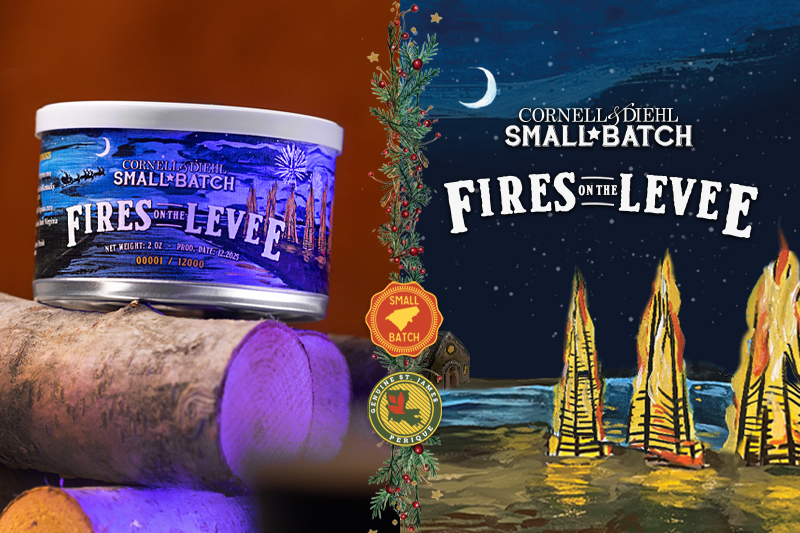
Cornell & Diehl's Fires on the Levee will be available December 16, starting at 6:00 p.m.
You may also enjoy:


Comments
又到了cd嗯讲故事的时间了
是的我会抽斗,也喜欢cd的各种斗草
VERY interesting, thank you! I was born and raised upriver from St James Parish; I miss the people and food and lifestyle of South Louisiana all the time. I didn't know this about Perique tobacco--I'll add it to my "gotta try this" list. Thanks for the interesting interview!
很期待尝试cd的新斗草,堤坝上的火灾
是的很期待尝试cd的新斗草堤坝上的火灾
Well, another interesting mixture I need to get a couple of tins of.
非常感兴趣,希望届时能买到
非常感兴趣,希望届时能买到
听得我口水都要流出来了,希望能抢到几盒。
期待尝试新草,最主要的是一出不好买的就封IP,这点心里甚是难过
Sounds like you might be tempted to just pop one of these flakes into your mouth and chew it like a stick of gum. Here's hoping it's not sold out before I can taste it! Also, glad to see the "Morality Police" still haven't completely stamped out tobacco smoking in China - 不要想当然。It's a tradition symbolic of Free Thought everywhere you go. Merry Christmas!
when can I buy it?
December 16th @ 6pm
I will when its avaiable
Notify me when avaiabe
very intresting!
Really looking forward to this sweet & Smokey blend.
Bravo again Jeremy & team-sounds yummy.
Will save for Christmas Eve.
This is a new favorite and I’m not sure I’ve ever smoked anything in the same ballpark.
Got a tin from my local brick and mortar yesterday evening after ordering some online. Popping the tin produced what might be the sweetest natural tin note I’ve ever smelled. Nothing artificial, but somehow I felt like I was smelling raisin cookies (or maybe raisin cookie dough).
The blend itself is a real flavor bomb. Dark-Fired Kentucky leads the way, the Perique provides depth and contrast, and the Virginias hold everything together.
Between this and Firebird Flake, C&D is producing outstanding blends that push the boundaries of what we think of as classic pipe tobacco categories. These blends aren’t just iterations on something classic—they’re something new under the sun. (Not that there’s anything wrong with iterating on tried-and-true formulas the way, say, Palmetto Balkan and From Beyond do.)
Just outstanding. I hope it comes back in the future.