


 |
|
 |
|


The world's oldest continuously operating briar pipe manufacturer has a rich history spanning 160 years that has been told in various websites, blogs, and books. However, Charles Peterson's early life has yet to be discussed in depth here on the Daily Reader. In honor of Kapp & Peterson's anniversary this year, today I will be diving into Charles Peterson's origin story, from Latvian roots to Irish acclaim.
Charles Peterson's Lineage
Charles Peterson was born Kristaps Pētersons, hailing from a community near Riga, Latvia. Sandra Bondarevska, a Latvian journalist who lived in Dublin and conducted archival work in Peterson's oldest factory, wrote The Petersons In Ireland book, which was translated from Latvian to English, providing a comprehensive account of young Charles. "The man who created the pipe that bears his name, whose personal efforts at a Dublin shop launched a world-famous business, was a Latvian-born pipe carver," Bondarevska writes. "His birth record indicates Kurland, Zaļenieki village, on a farm named Lejas Micaiši."
The Peterson Pipe: The Story of Kapp & Peterson by Mark Irwin and Gary Malmberg also provided background information about Charles' early life in Latvia, according to Latvia's former ambassador to Ireland, the Honorable Pēteris Elferts: "'When Charles/Karlis Peterson was born, the territory was part of Imperial Russia, but controlled locally by German land barons. The administrative language was German and many Latvian names and surnames were Germanized, some voluntarily, others not. The Germans thought the Latvian language was simply the language of the local peasants.'"
Bondarevska provides some insight into Charles's great-grandfather's heritage and the Peterson name: "His great grandfather is recorded in church records as 'Janne son of Petra," or Petrs. Early Latvian names did not include a surname in the modern sense, but Charles's surname probably derives from his great grandfather."
Neither name, Janne nor Petra, is native to Latvia, indicating that Janne could have been a Scandinavian immigrant who married a Latvian, Anne. "Very little detailed information about the lives of rural villagers in Latvia is to be found aside from church records, which can often be sketchy."
Bondarevska's text suggests that the most probable theory for the Peterson name derived from a local German nobleman assigning last names to Latvian farmers. Once serfdom was abolished, the last name "Peter-son" was given, acknowledging that Kristaps was the son of Janne, son of Petrs.
During the 19th century, farmers were given freedom of movement by law within their governorate territory. In Mitau, Zemgale, which was the territory of Kurzeme now known as Jelgava, farmers were also given permission to own their own dwellings in 1804, though Bondarevska shares that this wasn't a reality until the 1860s.
An old family tale highlights the manner in which the Peterson family came into their own property on a plot of land in Zaļenieki, the Klijeni house, which served as an anchor for them through centuries:
According to the story, the family came into its property by means of a horse with a full bladder. As Zane Jakovica, a Peterson descendant, tells it: 'Once, when Kristaps was the Baron's coachman, the Baron's mare very rudely urinated on Kristaps's beard! To compensate him for such embarrassment, the Baron gave his coachman a piece of land from his estate, allowing Kristaps to build Klijeni house.'"
Zaļā Manor, or Zaļenieki Parish in the Jelgava District, is located in central Latvia. The surrounding estate was owned by Duke Ernst Johann von Biron and was designed by architect Francesco Bartolomeo Rastrelli.
After the manor changed hands through most of the 19th century, in 1874 it was passed to Countess Alexandrina von Medem née Liven. "From these owners comes the first record of the famous pipe maker Charles Peterson's ancestors, who were simple country folk who fought stubbornly for prosperity and would, in the course of time, accomplish some remarkable things."
An old saying about Zaļenieki captures the spirit of the parish, noted by Bondarevska: "This is the land of plenty. People here are happy, content and hardworking - the grass couldn't be greener anywhere else, so let's call it Zaļenieki - the Green Place."
Klijeni Farm & Charles's Early Life
During the construction of the Klijeni farm, Charles's grandparents, Kristaps and Lavīz, continued to live and work as servants in the Lejas Micaiši household. The couple were both born in 1789 and were likely childhood friends before they eventually married. At Lejas Micaiši, their fourth son Indriķis was born, who was Charles's father.
The parish census of 1835 recorded Kristaps and Lavīze having built and moved into their new home, where their youngest child, Lavīze, was born and named after her mother. She was the first in official church documents to bear the surname Peterson, marking the transition of the Petersons from humble servants to prosperous farm owners.
When Indriķis grew up, he married Grieta née Berg in 1846 in Dobele. During their house's construction, they worked as servants. Indriķis was known as the master's favorite worker due to his talents and hard work ethic as a bricklayer.
Indriķis and Grieta had five children in total, with Charles being their second, born early in the morning at 4:00am on Thursday, March 4, 1852 at Lejas Micaiši. Charles had three brothers: Janne, Dāvis, and Jānis; and two sisters: Trīne and Lizete.
Charles's family had established themselves permanently at the Klijeni house in 1857, when he was just five years old. At a young age, he began to attend the local parish school in Zaļenieki; however, little else is known about Charles's childhood from the age of five until he was sent to Mitau to study woodturning when he turned 16.
Charles's Education & Departure From Latvia
Charles arrived in Mitau in August of 1868 to begin his woodturning education, apprenticing under Johann Janson for four years, and earning a certificate of mastery. This certificate was issued on September 2, 1872, from the Mitau Craft Guild, which qualified the 20-year-old as a craftsman. It served as an important document, signed by Janson as well as Julius Seiffert. On the certificate, his name was Germanized to Karlis Christow Petersohn.
By the time he left Latvia, Charles knew three languages: Latvian, Russian, and German. Bondarevska noted: "His linguistic skills would later prove indispensable when he partnered in an export business that exported its tobacco pipes to all parts of the globe."
After completing his woodturning education, young Charles gathered the necessary documentation and went to St. Petersburg, Russia, a notably popular place where young people went to seek their fortune.
His departure thereafter from Latvia is clarified by her research:
While we don't know his itinerary or rationale for leaving home, we follow at least part of Charles's journey from the evidence of two testimonials that have survived - what we might call today letters of recommendation. Both were written in the ancient German Hanseatic city of Lübeck. Both are signed by workshop master H. Teninger and businessman V. Henning. The first states that the woodturner Charles Peterson arrived in Lübeck from St. Petersburg in 1872. The second states that he worked for Henning from October 11th, 1872 to April 30th, 1875. Peterson is also praised in his letter for his good manners and excellent health.
It is difficult to track Charles's whereabouts before arriving in Dublin. Known records make it impossible to trace every step of Charles's journey from Zaļenieki in 1872 to Dublin, though some records of his passports and visas remain.
Charles Peterson Arrives In Dublin, Ireland
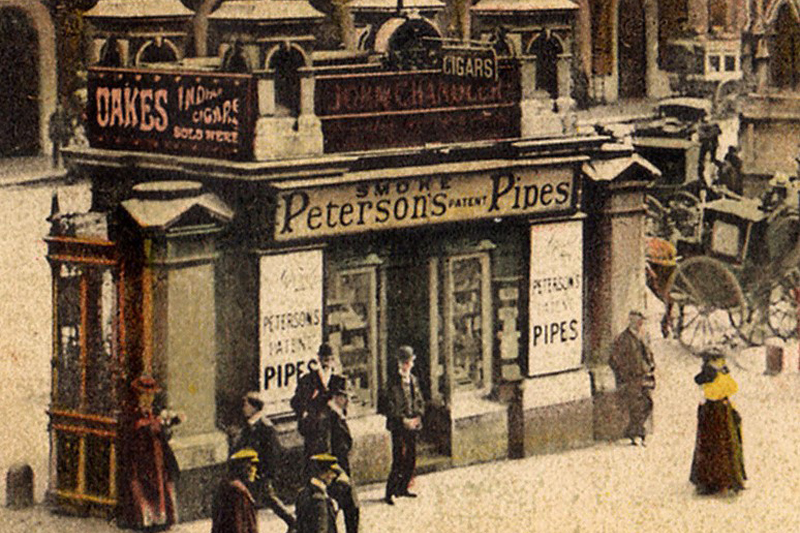
It seems the exact year conflicts between sources as his arrival being 1875 or 1876, which Bondarevska suggests: "He arrived in the Emerald Isle in the last quarter of the 19th century in either 1875 or '76." Mark Irwin however points to a more direct arrival in 1875 in his text: "Charles appeared in Dublin with his certificate and recommendation in 1875, where he seems to have immediately became an employee of the recently opened Friedrich Kapp shop."
It remains a mystery as to why Charles went to Dublin and how exactly he first met Friedrich Kapp. It's highly probable that they met through the woodturners' guild, and they quickly formed a deep bond before securing the job.
Bondarevska supports this theory, and explores more in depth how he likely landed this pivotal role in the first place:
Peterson quickly immersed himself and became comfortable in his adopted country. That he secured employment at Kapp's shop was doubtless due in no small part to the guild certificate from Mitau he brought with him, which would have been recognized everywhere in Europe. Henning's letters from Lübeck would also have increased the young Peterson's odds in their assertion that he was reliable and trustworthy. And of course, the fact that he was educated and trained in the German language would have been that extra touch to cinch the deal, since of course Kapp was himself German.
Regardless of the means of starting employment, 10 years had passed since Friedrich and Heinrich Kapp opened their shop in 1865, making them a well-established and somewhat prestigious business. This job opportunity was a boon to a young Charles, who at just the age of 23 started at the Kapp pipe workshop in the heart of Dublin, Ireland, at 53 Grafton Street. Irwin's text shares how this experience would be the foundation of what would become Kapp & Peterson: "For most of the twentieth century, Peterson ephemera would promote 1875 as their founding year, 'when Charles Peterson arrived in Ireland from Riga, Latvia.'"
While working at the shop, Charles notably spoke broken English and had a heavy accent that blended Latvian, Russian, and German into one. He would sit by open windows to work while he listened to people speaking English, hoping to learn from them in the process.
An apocryphal story circulated about how Peterson arrived one day at Kapp's shop and announced the new and unique pipe that would change the pipe-smoking world, that being his famous, and eventually patented, System innovation.
Bondarevska expresses: "The truth is that Peterson hadn't even begun work on his patent pipe at that point and was simply hired by the progressive and well-established Kapp as a briar pipe carver. The Kapp & Peterson archives preserve some of his early work from the Grafton Street workshop, offering ample evidence of his talent and skill."
While working at the shop, Peterson was known for his pleasant disposition, exuding a warm personality with a charm that made him rather popular among Dublin's pipe smokers.
Evidence for this is seen in 'A Champion 'Piper,' a charming portrait from 1910 which introduces Kapp & Peterson's director with a reference to Riga from an old English limerick: 'In the year 'seventy-six' a young man arrived in Dublin from Riga - that city by the Baltic... Well, the young man from Riga, one of Charles Peterson, turned up in Grafton Street, and for many years might be seen in Kapp's miniature workshop in the front window turning everything he could lay his hands on into pipes, cigar holders, and such like, and all the while smoking, and he worked, like an Atlantic liner.'
Friedrich Kapp passed away in 1881, about five years into Charles's employment, which raised Peterson from craftsman to director of the Kapp Brothers business. In his new position, Charles helped shepherd the company to global success, most notably through his iconic innovations patented between 1890 and 1898, which collectively would comprise the iconic System pipe as we know it today.
Charles Peterson's Legacy
It is unclear whether Charles missed his home in Latvia during this time or how often he returned to visit those he left behind. Bondarevska cites his 1889 passport issued in Mitau as evidence that he returned at least once, with other sources suggesting additional visits to his homeland, despite the distance.
The Peterson name was less known in Latvia than Ireland and other countries. "Every person I approached during my research in Dublin knew the story of the Latvian Charles Peterson," said Bondarevska. "Among pipe smokers the legend of the young 'Roosian' who boldly walked up to the Grafton Street pipe shop and announced that he knew of a pipe design that would revolutionize the industry is even more well-known than 'sweet Molly Malone of Dublin's fair city.'"
There are still Peterson in Latvia today, the youngest descendant being Reinis Peterson's son, Janis Emils, who lives in Riga with his parents.
The Peterson family had an incredible impact on both Latvian and Irish histories, and the lasting impressions are seen in the very pipes Peterson continues to release to this day. As we celebrate 160 years of the storied marque, Charles' legacy of innovation continues to inspire all who work on the most famous of Irish pipes as well as the discerning smokers who delight in these creations.
Bibliography
- Bondarevska, S. (2024). Petersons in Ireland. ADMIT HUB REF SERVICE PR.
- Irwin, M., & Malmberg, G. (2019). The Peterson Pipe: The Story of Kapp & Peterson. Briar Books Press.
You may also enjoy:





Comments