


 |
|
 |
|


It was once said that "the power of radio is not that it speaks to millions, but that it speaks intimately and privately to each one of those millions." With many legendary figures in the field, there was one pioneer who was miles ahead of the rest: Gilson VanderVeer Willets. A man of a thousand lives, his professional career alone spanned not just across the country, but worldwide. His personal experiences led him to a range of organizations and lifelong friendships that impacted the trajectory of his life. A fan of both briar and cigar alike, this is the story of "Radio Rex" and the legacy he built.
Gilson VanderVeer Willets' Early Life
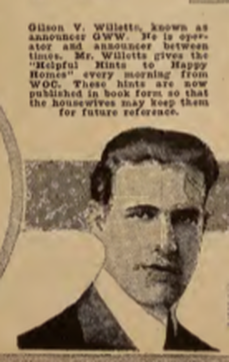
Gilson VanderVeer Willets was born in New York, New York, on November 19, 1898. At an early age, he was able to learn morse code, which would come in handy in one of his future career paths. When he was 12, he went to live with his grandparents in New Castle, New York, and in the 1915 census he was reportedly living as a lodger in Yonkers attending school at St. Ann's Academy.
After graduating from St. Ann's, he went to study at the New York Military Academy near West Point. After his school days, he set up a one kilowatt radio station right from his bedroom, with call letters "GW" in Yonkers, New York. According to an article in CQ Magazine for Commercial Radio Operators and Technicians called "Gilson Willets, Old Timer," he set up this station and officially became a licensed wireless amateur in New York City, where his first station call license was 2WQ.
"The law permitted an amateur a power input of one-kilowatt but I used five. Quickly the federal radio inspector appeared at my home and adjusted the input to my 5-kw Thordarson power transformer so that its maximum power output would be a single kilowatt," Willets stated in an article called, "Radio Rex" from the Society of Wireless Pioneers (SOWP). "Among the numerous amateur wireless calls assigned to me were 9XG, 4NFK, and 2XAL."
He exchanged his ham license for a commercial license, sailing as a junior on the S.S. El Oriente: "From this small beginning, Willets passed on and up. KVK, KEG, KEC, KVL, and a score of other American Marconi vessels passed their brass keys under his hamlike fist. (He is six foot 3 inches tall and weighs 227 pounds)."
Willets' Illustrious Career At Sea, Traveling Worldwide
After his time at sea, he wound up as a technical instructor in Camp Martin at Tulane University in New Orleans, Louisiana. It is documented in the 1930 census that he was first married in 1917 at 19 years old. He lived in New York with his first wife, Phylis, working as a radio instructor at a YMCA radio school right around the same time as he served time in the Signal Corps in Louisiana.
"In 1917 I relinquished my connections with Marconi-RCA and sought employment with the United Fruit Company's Tropical Radio subsidiary. I worked on the Metapan, KLF, and as a relief operator at UCJ, a shore station at Santa Marta, Colombia. This was an exciting era in my wireless career. The following year I transferred to the Ward Line, where I served with Harvey Pierre Boucheron on SS Mexico. Pierre, as he is widely known, is one of the world's earliest and foremost wireless pioneers," said Willets.
He would spend three years traveling the world to set up stations in Europe, Central America, and South America. These globe-spanning travels were also noted within a profile piece from JoshuaBluBuhs.com, stating, "He worked his way around the world on various ships and to various countries as a wireless operator ... like a character in his father's stories, a bodyguard for a Russian prince, a soldier of fortune in Central America, a tramp through the tropics — three years at sea, all told. According to one report, when America declared war on Germany, in April 1917, he was in Mexico doing confidential work for the Mexican government."
His journeys continued at sea, where he served in the Mallory Liner Concho, KEC. From there, he transferred to the Mexico Segundo, XBB, where he became a writer and wrote a fiction story called "Blacklisted." He took the story to Peter B. Kyne who sold it to Cosmopolitan magazine. Kyne would become his mentor throughout his life.
He reportedly registered for the World War I draft in September of 1918, three months before the armistice. After serving in the Great War, he went back to sea with the USSB and later, he moved on to the National Electric Signaling Co.. Throughout these years at sea, he experienced a variety of life forms. "As time went by, Willets passed through a gauntlet of adventure and romance that took him all over the world as operator, soldier, hobo and T.T.T. (typical tropical tramp)."
According to a ship log in 1919, he was aboard the Esperanza, returning to New York from Cuba. The 1920 census reports were unclear on his whereabouts at this point as he was living in New York at the time. However, he was listed as a seaman and was also marked as single. It can be inferred that throughout this time at sea and away from home, his marriage likely fell out.
Willets met Lee De Forest and worked in Highbridge, New York, building radio telephones for the Navy during this time. Willets and De Forest would become lifelong companions, and De Forest would help Willets learn extensively about wireless during this time. "He had been my greatest friend, my bosom companion, for almost 53 years thereafter," Willets stated within his profile piece for SOWP.
Radio Rex
He received the nickname "Radio Rex," from "a lordly Britisher who once was his neighbor. Rex had often repaired [their] wireless outfit, so he pronounced Willets King of the Wireless, and named him Rex," which followed him for the rest of his life. The first speech recognition machine from 1920 was called The Radio Rex, which may have inspired this clever nickname.
From there, he became the manager of the recently established WCI station in Newport, Rhode Island. Willets would recall a humorous encounter with death during his tenure at WCI.
Let me tell how I once had died. I was station manager of WCI in 1920. My tour of duty ran from 12 to 14 hours without a break, seven days a week. One night I developed pneumonia and was rushed to a local hospital. It happened in Newport, Rhode Island. I was the only wireless operator, and when I went to the hospital the station became silent. Ships continued calling with no response. One operator reported to the home office: 'WCI dead.' That did it. Rex WiIlets was reported dead in the morning press, and a replacement was sent to the station. With him came Chet Underwood from the Boston office of the company. I Iearned they were on the way but I did not know why. I went to the docks to meet their incoming river boat. Down the gangplank came Underwood. And from the hatches came a coffin. For me. I walked up to Underwood, extended my hand, and he alI but dropped dead. A walking corpse, no doubt, he surmised. 'Say Willets,' he said, 'you are supposed to be dead. We came here to bury you.' The expression on his face was one of stark horror. Then we put our heads together to get to the bottom of the mess. One of the wireless men on shipboard had tried and tried to raise WCI without success. He had never experienced such trouble, was always able to raise the station sometime during the night, no matter the hour. And on this occasion, after trying all night, he reported merely: WCI dead. And the home office thought it was me.
While at WCI, he also became Special Representative for the Postal Telegraph Co., balancing his time with Western Union as WCI had radio lines between both of these companies. By 1921, he would become an instructor at the Cincinnati Wireless Telegraph School in code and theory. He bounced around to Detroit, Michigan, Toledo, Ohio, and then became principal of a railroad telegraph school in Cincinnati, Ohio.
Willets would change directions once again in 1922 when he organized and directed the world's first department store radio department for The May Company in St. Louis, Missouri, where he'd eventually become the Radio Purchasing Agent. He was tasked with calling every major radio factory in search of merchandise, a task for which he was compensated $1 million dollars to achieve. This was a feat Willets was proud of.
"I put the May Co. into the radio business on a big scale, the first department store chain to go alI out on a new Iine of goods." It was there in St. Louis that he would establish his own radio company. However, this venture failed, leading him to Jefferson City, Missouri, where the governor prompted him to become "Radio Engineer for the State of Missouri," holding the first state political radio position in history. He'd also be the first person to organize a State Marketing Bureau for farmers and establish the first prisoners' band from the state penitentiary on the radio.
Willets In The Midwest
In 1922, he found himself in St. Joseph, Missouri, where he established radio station WOS. From there, he transitioned to Davenport, Iowa, where he would establish WOC, which would become a superstation (a radio or television station broadcast nationwide by satellite) in the area, according to The Davenport Democrat, now known as the Quad-City Times.
During this time of his career, he organized "the General Radio Research league, a national organization for those who wish to better the radio broadcasting and reception." Willets served two years as the national president and had a brief stint as national secretary of the league before resigning. He also helped organize the Veteran Wireless Operators Association, and in August 1923, he broadcast a show about household hints and cooking called the "House Hints Of Service," which would later become a WOC cookbook of compiled recipes from radio listeners that sold more than 100,000 copies. He also organized a club that became known as the Happy Homes Club. While he was planted for a short time in the midwest, he lectured at a variety of radio stations.
He married a second time to Anne Burke Conlan while in St. Joseph, Missouri, in September 1922. They had a daughter together, Willets' only child, Thuvia, born on November 20, 1923. Willets' adventurous itch persisted. In the summer of 1924, Willets and a radio engineer journeyed on a canoe trip from Turtle Creek, Wisconsin, to Davenport, Iowa, on a 268-mile trek for the fun of it.
Willets' Return To New York
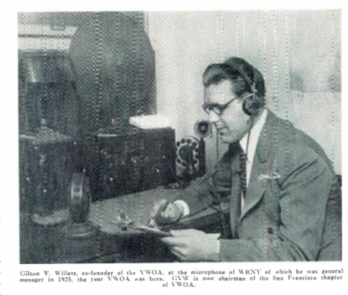
He announced his departure from Davenport, Iowa, station WOC in early 1925 to transition back to N.Y. and set up a new station, WRNY, for the Radio News, the largest radio magazine published. Before his departure, listeners of the WOC allegedly begged Willets to stay on the Iowan station. He reportedly dismantled and freighted the old transmitter from WOC and shipped it away to Radio News for use in the new station, WRNY, which would go on to be broadcast from Hotel Roosevelt. He would be working for Hugo Gernsback — the father of modern science fiction and the publisher of Electrical Experimental, Science and Invention, and Motor Campers and Tourists.
"WRNY had many firsts. The most noteworthy was our first trans-Atlantic link between a British station in London, 2LO, and our own in New York, WRNY. The noted dramatic actor Wheeler Dryden, then playing New York in 'White Cargo,' was first to use the wireless circuit linking both English-speaking continents. He conversed with his father in London, the test proving eminently successful. Permission to conduct it was first required from then Secretary of Commerce, Herbert Hoover, who later became President of the United States," said Willets in his profile piece from SOWP.
Upon his return to New York, Willets would settle down with his family in Queens. However, he decided to move again. "Neither his family nor New York could hold him, though," wrote Joshua in his profile piece for his blog, JoshuaBluBuhs.com.
Willets' In The West
Willets took over the management of the radio station, WDBO, in Orlando, Florida, in February 1926 for about a year. In the CQ magazine article, we get this recollection of this time in Willet's life:
On November 1, 1926, Willets decided that his life as a radio man would never lead to fame and fortune. Accordingly, he quit his ship, determined to settle down and become an author! His friends laughed and shook their heads knowingly. His first job ashore was janitor for a radio store in San Francisco. From this he jumped to General Manager of KFWI. After several months' service, during which he saved his money and spent his spare time writing stories, he resigned. One last fling at sea aboard the Yale and Harvard (WRY and WRH) and he re-signed forever from radio work, having seen service in every conceivable branch of the business. Eight months after making his resolution to quit radio, he made a further resolution never again to work for a salary. He never has.
Willets himself recalled this time, stating, "In 1926, while stranded in San Francisco temporarily only, I sought employment with station KFWI of Radio Entertainments, Inc... KFWI was a real headache." This station was not profitable for the owners, so Catton sold it to the local Christian Science Church, the radio division entrusted to Reverend C. Gale. Willets accomplished his mission of securing advertising contracts, and also convinced Rev. Gale to grant equal opportunities to all denominations. "Soon KFWI began broadcasting services from churches of other faiths in the 'City By The Bay.'"
Willets' As A Column Writer
Willets resolved to become a writer, and in 1927 he began writing for the San Francisco News as a columnist. In California, his literary mentor Peter B. Kyne likely helped him become an established writer in San Francisco. The City by the Bay was the home of Kyne. It was during this time of Willets' life that he developed an interest in the world of contests. "He was a man of passionate enthusiasms, of that there is little doubt." He devoted his daily column to announcements, reviews, and all things related to a variety of contests for the next three years, naming his column The National Contest News.
He was so dedicated to this hobby that he, along with 11 other men, founded the National Contest Forum in 1928, writing a constitution, bylaws, and even adopting an insignia. This passion persisted to the point where he started referring to his own home as the "International Contest Headquarters." This daily column transitioned into a weekly report in 1930. He announced a yearly award for the "All-American Group of ConteSTARS," which highlighted the 10 best contests of the year. In the 1930 census, Willets reportedly considered himself a fiction author and curiously listed himself as widowed, though his wife, Anne, and daughter, Thuvia, were still alive and living in New York, according to the 1940 census 10 years later. He also wrote the introduction to a book called Contest Gold in 1934.
Willets found new love once more in his third wife, Bernice "Bunny" Bowne, who entered contests as a hobby herself. She is believed to have inspired his interest in contests as she reportedly encouraged him to enter one in which he won $5,000 (equivalent to around $90,000 in 2024), which further encouraged his passion. The pair married sometime between the late 1920s and early 1930s. This was the marriage that stuck as they were together for the rest of Willets' life.
An article called Prize Winner, written by Willets in 1936, provides insight into his devoted interest in the world of contests. "Try prize contests. They can and do help millions of other people to earn all the things which we have mentioned — and more! A pen, a line, a few minutes' time ... and you can pluck from the thousands of prize offers now in progress, the very things which you have always wanted, as well as the luxuries of which you have always dreamed."
Willets Cryptography & Boys Town
Throughout his later years, Willets continued to write letters and articles for electronics publications. During WWII, he was asked by the Signal Corps of the U.S. Army to conduct a training school for cryptographers to help read "the secrets of other nations."
His life took yet another turn in the early 1940s: he became enamored with Father Flanagan, the proprietor of Boys Town, a non-profit organization in Nebraska. He wrote an article in 1943 referencing the Spencer Tracy movie made a few years earlier, Men of Boys Town, released in 1941. This story followed Father Edward Flanagan, head of the Boys Town home for troubled boys, attending the trial of a young paraplegic charged with murder.
Willets closed up his contest column when he was invited to spend a year in Nebraska with Father Flanagan, gathering material for Flanagan's biography. This story was never published on its own, though it was incorporated into Oursler's Father Flanagan of Boys Town, which came out a few years later in 1949.
Willets' Late Life
Willets returned to San Francisco in 1944 and worked for the Office of Price Administration, United Nations Rations Board, and served as secretary of the Irving Street Merchants Association. He fell ill for several years and underwent a variety of operations after this period. Though information is limited regarding these operations, illnesses, and the latter years of his life, we know that he did back away from most of his obligations and organizations, aside from the Merchants Association, but by 1948 he gave that up as well.
He moved out of San Francisco and headed up north to a property along the Russian River in California at Villa Grande, "in the shadows of the famed Bohemian Grove," where he lived out the rest of his days. He was allegedly a charter member of the Lee De Forest Pioneers, even hosting De Forest himself in his rural home for a time. In 1955, the area flooded, and he made it into the paper, where he was credited as a Civil Defense Director, even requesting that the air force send aid immediately to the area.
He reportedly loved his organizations throughout his life, dedicating much of his time to them. Willets wrote about stamps for the American Revenuer in 1971, as well as recounted his various careers, travel stories, and decorated life in the article, "Radio Rex," for SOWP. Gilson VanderVeer Willets lived to the age of 77, passing on January 7, 1976.
Willets' Connection to the Fortean Society
Aside from his world exploration and illustrious career in the radio industry and in print, Willets was also a member of the Fortean Society. This organization preserved the works of Charles Fort, chronicler of the unexplained and bizarre phenomena. This society was founded by Tiffany Thayer on January 26, 1931, according to Encyclopedia.com. "The first issue of the Fortean Society Magazine appeared in September 1937. With the eleventh issue (Winter 1944-45) the title was changed to Doubt, emphasizing Fort's characteristic preoccupation with healthy skepticism toward dogma. Thayer died in 1959 and the society languished. Doubt owed much to Thayer's indefatigable enthusiasm, and issue no. 61 was the last."
Willets was mentioned in a variety of editions, including Doubt 17, published in March, 1947, where he was listed among those who provided the most interesting clippings. Willets was skeptical of contemporary scientific consensus. His name appeared alongside phenomena clippings in 18, 19, and 21. There was no mention of Willets in 20, most likely because he was organizing a new outpost for Forteanism to flourish on the West Coast. Encyclopedia.com documents the formation of "Chapter Two" on the West Coast.
In Doubt 21, July 1948, Thayer announced the formation of 'Chapter Two': The San Francisco and Bay Area members have met informally as guests of MFS MacNichol, who shares honors for the idea with MFS Drussai and the labors of assembly with MFS di Gava. Gilson Willets presided and Wakefield kept the door. We do not have a complete roll call nor minutes, but all reports agree that the talk was high, wide and gratifying. The members wrote their names in a book which--with unanimous approval--was named 'The Book of the Damned.' Somebody brought up the subject of a 'charter' from 'headquarters' and the booing was gratifyingly terrific.
The Chapter went on to be irritated with Thayer's politics, Pacifism, and theories about WWII. As 1948 ended, there was no more Chapter Two. After that, Willets' name did not appear in Doubt again after 23. "As with the others, he may have been irritated at Thayer's lack of patriotism — Thayer hated the Civil Defense, which Willets joined."
Willets' Pipe and Cigar Smoker
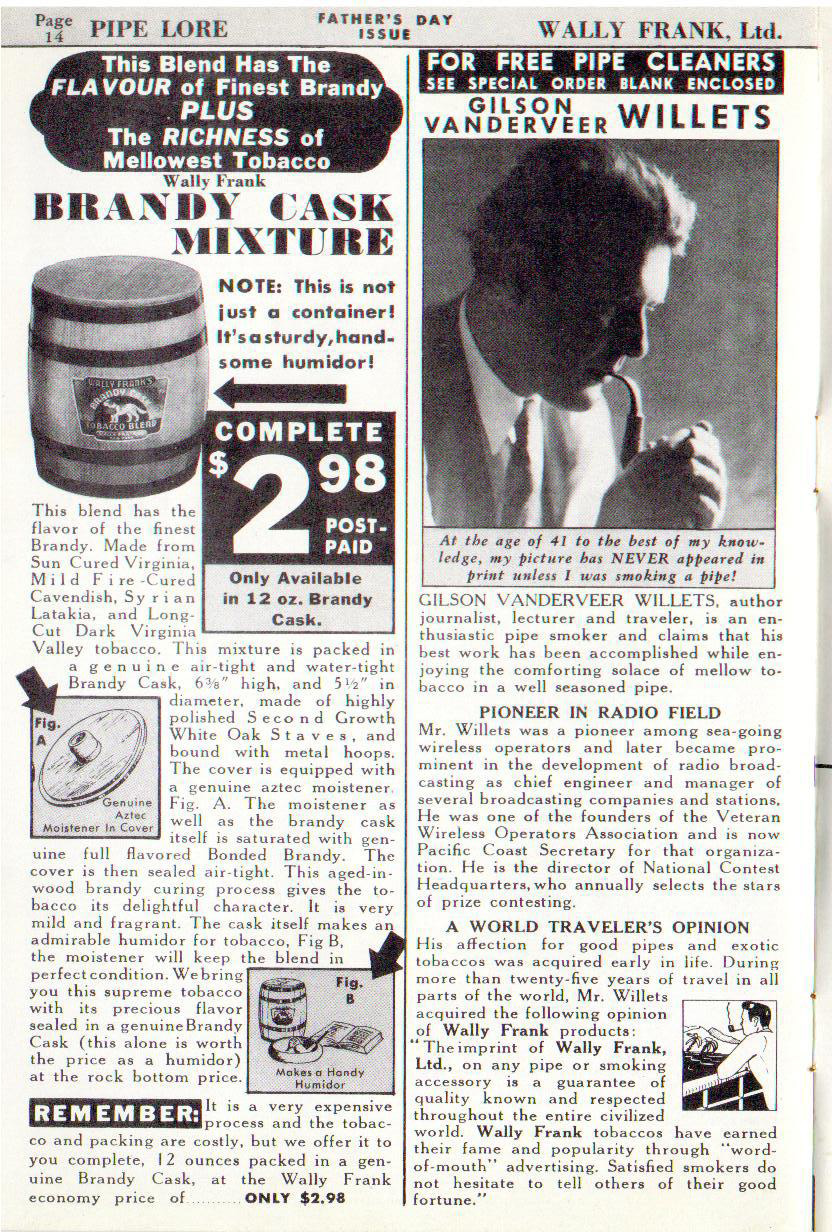
Gilson VanderVeer Willets, wearing many hats, was also a pipe and cigar smoker throughout his life. Within a news clipping from the Father's Day issue of Wally Frank Ltd., a profile piece reveals that he attributes his affection for good pipes and exotic tobaccos to his more than 25 years traveling around the world. He is documented with pipes, stating, "At the age of 41 to the best of my knowledge, my picture has NEVER appeared in print unless I was smoking a pipe!" He is also referred to as "an enthusiastic pipe smoker and claims that his best work has been accomplished while enjoying the comforting solace of mellow tobacco in a well seasoned pipe."
He enjoyed smoking Wally Frank tobaccos: "The imprint of Wally Frank, Ltd., on any pipe or smoking accessory is a guarantee of quality known and respected throughout the entire civilized world. Wally Frank tobaccos have earned their fame and popularity through 'word-of-mouth' advertising. Satisfied smokers do not hesitate to tell others of their good fortune." (Wally Frank, Ltd. 14).
He also had experience with cigars in his lifetime. One notable story came in 1917 aboard the Mallory Liner Concho, which Willets discussed in his profile piece for SOWP.
... here I gained near-fame. The infant daughter of a wealthy Cuban cigarmaker, Upham by name, had fallen overboard. I dove in after her and rescued her in the nick of time. Mr. Upham invited me to his estate where I was to be his guest. His cigars were world-fames, made expressly and exclusively for the crowned heads of Europe. Each emperor, king, kaiser, czar, or head of state had his own particular brand of cigars hand made by the Upham people, each with its own colorful cigar-band wrapped around the aromatic leaves.
In addition to this experience, he also manufactured cigars for a period of time:
I was made station manager for WOC, Davenport, Iowa. It was my job to make the station pay, somehow. Commercials were forbidden in those good, old days. I hit upon an idea, as a result of my earlier meeting with Mr. Upham, the cigarmaker. I too would manufacture cigars. 'WOC Cigars' and good cigars they were. Everywhere we urged people to buy our brand if only to help finance more and better programs for the Davenport station. It worked! It kept the station on the air for a long time.
Radio Rex: A Man Who Lived Many Lives
A summary of Gilson VanderVeer Willets' illustrious and ever-changing life appeared in the Yearbook from 1971 of the Society of Wireless Pioneers, of which Willets was a lifetime member. "Radio Rex, the Society's Historian and one of founding officers, was also founder of VWOA and has had a fantastic experience in the field of wireless/radio - from early day marine operator to executive who established some of the largest broadcast stations in the United States." Willets' life was surely one filled with a variety of accolades, all with his trusted pipes and cigars in hand to accomplish his very best, across careers, nations, and among his closest buddies.
Bibliography
- AllMovie.com. (N.d.). "Gilson Willets." Historic America.
- Buhs, J. B. (November 2, 2015). "Gilson V. Willets As A Fortean." From An Oblique Angle. JoshuaBluBuhs.com.
- CQ. (November, 1931)."Gilson Willets, Old Timer." CQ Publishing Co.
- Oursler, F., & Fife, H. (1978).Father Flanagan of boys town. Yohan Publication.
- Anonymous (n.d.).History of WDBO, Orlando. jeff560
- IMDB. (N.d.). "Gilson Willets." "Men of Boys Town."
- Fort, C (n.d.).Fortean Society. Encyclopedia.com
- Quad-City Times. (January 22, 1925). "Popular WOC Announcer Is Going To N.Y.." Newspapers.com by Ancestry.
- Radio Service Bulletin. (March 1, 1920). No. 35. "New Stations." U.S. Bureau of Navigation, Department of Commerce.
- Society of Wireless Pioneers. (N.d.). "Gilson V. 'Rex' Willets, Wireless Author Engineer, Historian."
- Society of Wireless Pioneers. (N.d.). "Historian The Yearbook 1971."
- The Author and Journalist. (June 1932). Volume 17, Issue 6. Farrar Publishing Co. Internet Archive.
- The Moving Picture World. (N.d.). "The Online Books Page." Moving Picture Exhibitors Association.
- The Moving Picture World. (September, 1917). "Gilson Willets With Pathe." Moving Picture Exhibitors Association.
- The Moving Picture World. (June 22, 1918). "GILSON WILLETS IN NEW YORK" Moving Picture Exhibitors Association.
- The Moving Picture World. (December 25, 1920). "Only Best Screen Authors will Survive, Says Gilson Willets, Talking Production." Moving Picture Exhibitors Association.
- The Moving Picture World. (June 10, 1922). "Gilson Willets Dies in Los Angeles Hotel." Moving Picture Exhibitors Association.
- Wally Frank, Ltd. Father's Day Issue. "Gilson Vanderveer Willets." From Wally Frank Archive
- Willets, G.V. (May 30, 1936). "Prize Money." Radio Guide.
You may also enjoy:





Comments
Fantastic article. Great piece.
There are lengthy letters from Mr. Willets about his career and smoking habits in The Pipe Smokers Ephemeris issues Winter-Autumn 1972/Winter-Autumn 1973/Winter-Autumn 1974.