


 |
|
 |
|


The "breakfast-table" effect is a sociological phenomenon that helps explain why many children follow the same career paths as their parents. It regards the significance of at-home conversations about job details and work life, making them more likely to pursue a similar field. The New York Times reported in 2017 that children are nearly three times as likely to have the same profession as their mothers or fathers.
While such statistics are not ubiquitously represented across the pipe-making community, generations of pipe makers are well known. The Ivarsson family's three generations of artisan pipe makers immediately springs to mind, continued today through the work of Nanna; Federico Becker likewise upholds the tradition established by his father and grandfather before him. Alex and Dasha Florov are father-and-daughter pipe makers, as are Hiroyuki and Yuki Tokutomi, and Marlene Micke follows in the footsteps of her late father Jørn.
It makes sense that these children of pipe makers would be attracted to the craft, having grown up in their parent's workshops surrounded by unfinished stummels, roaring sandblasting compressors, and whirring lathes. And, if they decide to pursue pipe making, their early careers are blessed with the advantages of hands-on, familial tutelage and ready access to established workshops. Children of pipe makers may or may not choose to follow their parent's pipe-making career, but if they do, they often excel quickly.
Children of pipe makers may or may not choose to follow their parent's pipe-making career, but if they do, they often excel quickly
Glenn Tinsky, the son of pipe maker Mark Tinsky, adds another branch to the list of multi-generational pipe-making family trees, yet he came to the craft via a different avenue than most. "When I was just a child, I used to hang out in the shop, and dad would set me loose with a hammer and some nails," says Glenn. "So, it started out as a pretty early influence." Before he was even a teenager, Glenn was making pipes but only as a hobby. "I did sell some pipes in high school and was considering following in my dad's footsteps, but he didn't think it was a good idea." This was around 2004, and at that time, smoking bans were rising exponentially, and the future of pipe smoking — and by extensions, pipe making — wasn't looking lucrative or wise as a career choice for someone graduating high school.

Such a perceived trajectory sent Glenn, then, on a different course. "I was working as a dishwasher in high school, and they eventually promoted me to cook," he says. "I didn't really know what I wanted to do with my life, so I wasn't convinced that I should enroll in a four-year college program." Instead, Glenn attended culinary school. Being a cook at the time, it made sense. "That was around 2005 or '06, and I continued working in restaurants as a chef, but also as a sommelier, and then as a restaurant manager too. I did pretty much everything in restaurants, and I spent about 17 years in that industry."
Years in, however, the novelty of working at a restaurant began to wear off, and seeing the freedom that being a pipe maker afforded his father, Glenn began considering a change. Sailing is one of his passions but is difficult when one's time is dictated by restaurant schedules and responsibilities. "What my dad was doing started to look very appealing to me," Glenn says. "I see him fishing all the time, and sailing and fishing are somewhat similar in that respect: You want to go when the conditions are good, but that's difficult when you're working a regular job. For him, though, he can just pop on down to the river pretty much whenever he feels like it. So, I thought, 'Gosh, that sounds nice, I'd love to be able to do this with sailing.'" The concept of spending time outdoors and sailing on good-weather days, and making pipes in the evenings and during unfavorable weather began pulling Glenn toward his father's craft, attracted by the freedom and autonomy it provides.
"What my dad was doing started to look very appealing to me"
In 2020, the global COVID-19 pandemic prompted Glenn to transition. With restaurants closed, his former career was now stagnant. It was the perfect time to devote his energy to pipe making. With his father as a resource, Glenn outfitted his own workshop in Portland, Oregon, procuring a number of hand-me-down tools and machines. "In fact," he says. "A lot of the stuff originally came from a guy named Jack Weinberger, who made JHW pipes. He was the guy who taught my dad to make pipes."
Building on his pipe-making experience throughout childhood and adolescence, as well as honing his skills under his father's tutelage, Glenn has now been crafting handmade pipes in Oregon ever since, and we're excited to welcome his work to Smokingpipes.
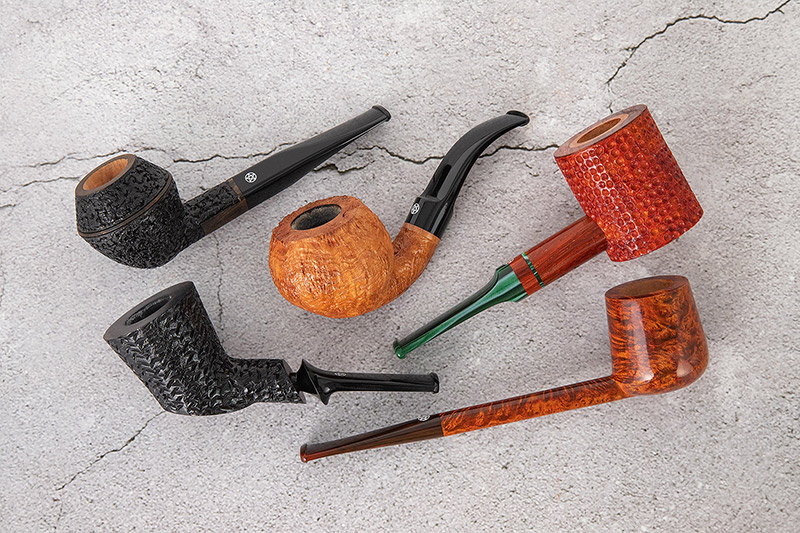
As a pipe maker, Glenn seeks to continue the shaping aesthetic of his father, furthering the Tinsky pipe making legacy, but he also draws creative inspiration from other pipe makers around the world. "Obviously, my dad is going to be my biggest influence. He does English and Italian-style shapes. On the other hand, though, I really appreciate Danish pipe making," says Glenn. "I'm a big fan of Tom Eltang, but I don't try to copy his shapes. Instead, I draw inspiration from the design elements of his work, incorporating them into my own pipes." Glenn appreciates simple shapes that prioritize proportional balance and harmonious lines, elements prevalent across Eltang's work, and he also expresses an appreciation for Luiz Lavos' pipes: "I really like Lavos' sense of symmetry and simplicity in his pipe designs. I don't think I'll ever be a Danish-style pipe maker — I'm going to stick with the English and Italian traditions — but with the refinement and elegance seen across Eltang's and Lavos' portfolios."
"I'm a big fan of Tom Eltang, but I don't try to copy his shapes. Instead, I draw inspiration from the design elements of his work, incorporating them into my own pipes"
His focus on and appreciation for the artistic, compositional elements of pipes has translated well to Glenn's shaping style, and his pipe-immersive upbringing developed an innate understanding of what works in a pipe shape. "I think my greatest talent in pipe making right now is my sense of symmetry and proportion. When I was a kid, my dad would show me a pipe and ask, 'Hey, what do you think?' So, I feel like I was conditioned at an early age to be able to look at a pipe and critique it." Adding to that, Glenn's mother is also an artist, working with paint instead of briar, and her influence combined with his father's to cultivate Glenn's skillful artistic eye. "I tend to go for very simple design elements," he says. "I think every aspect of a pipe should be in harmony. Not only the shape, but the colors and the materials. I look at it from a holistic approach."
"I was conditioned at an early age to be able to look at a pipe and critique it"
While growing up with artistically gifted parents who both worked from home certainly nurtured Glenn's artistic and creative talents, his career as a chef also brought its benefits. "It's funny because my mom has said that cooking is my artform, and there are similarities to pipe making," he says. "Within cooking, there are a lot of different variables at play, and what I try to do is balance them all out so that they fit together." Whether working with a fine cut of meat and fresh vegetables or with quality briar and acrylic stems, for Glenn, it's about balance and harmony, cohesion between the various elements.
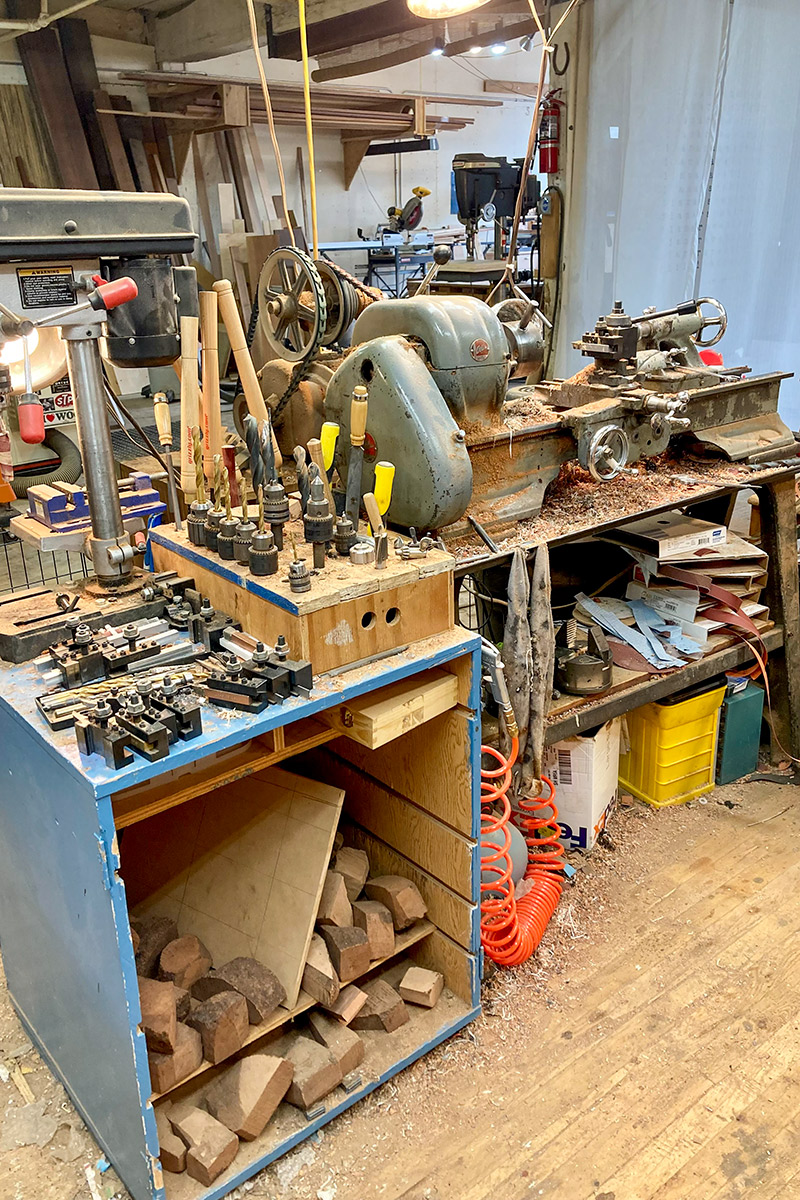
All of Glenn's pipes are handcrafted from Grecian briar, and he fits them with pre-formed stems of Italian acrylic that he modifies for optimal smoking performance and to fit the specific shape. "I want people to look at the pipe and say, 'I can't tell if that's a hand-cut stem or not,' he says. "And a lot of people can't because I get that question all the time. I do use vulcanite stems on rare occasions, but that's usually only if a customer requests it."
Regarding his nomenclature, Glenn stamps his pipes with his name and the year they were made, and his smooth and sandblasted pipes are graded in ascending order by their number of star stamps. "They range from zero to five," he says. "And it's a combination of the cleanliness of the briar block and the quality of the grain, as well as how well the briar accepted the stain."
Considering that Glenn's original venture into pipe making was displaced for fear of the industry's decline, it's impressive that he's now continuing the Tinsky pipe-making name, and moreover, it's a positive sign of our community's vitality. "Back then, we weren't sure if there was going to be much of a future in pipe making," Glenn says. "But I'm glad to say that definitely doesn't seem to be the case. Thanks to social media and the internet, I think there's probably a greater market for a new pipe maker than there ever has been."
It's always good when a new pipe maker excels and enters their work into the global pipe-making milieu, and that's especially true of those pipe makers following in the footsteps of their parents. The tradition of pipe making is one built on mentorship and tutelage, and we're grateful for Glenn's contributions and continuation of the Tinsky family tradition.
You may also enjoy:




Comments
Wonderful article Truett! Love Tinsky Pipes, just wonderful. Thanks - Lori
I have 5 of Mark’s pipes and 3 were commissioned so I am looking forward to getting a couple of Glen’s in the near future.