


 |
|
 |
|


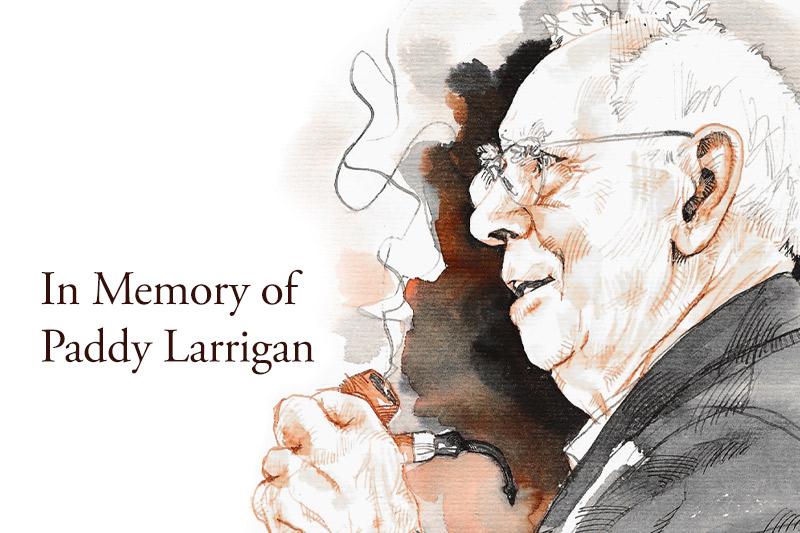
In 1924, as the embers of Ireland's civil war settled over Dublin, Patrick "Paddy" Larrigan was born. It was the same year the world was circumnavigated by airplane for the first time — a fitting detail for a man who would spend his life in quiet mastery of things both mechanical and beautiful. He was 101 years old when he passed away on Monday, February 9.

Paddy at Peterson's St. Stephen's Green location (photo courtesy of Mark Irwin)
Paddy's life before Peterson was as varied as it was characterful. He trained at Collins Barracks during the war, fed animals at the Dublin Zoo, and developed and printed photographs. He was, by nature, a tinkerer — always drawn to how things worked and how they might be made to work better. That instinct eventually led him to Kapp & Peterson, where he joined the workshop in 1946 at the age of 22. He would not truly leave for nearly six decades.
He was not alone there. Paddy came from a family deeply woven into the fabric of Peterson. His parents met while working at the company. His Aunt Nellie, who had been at Peterson for 59 years, was there to greet him when he arrived. His brother Liam, a silversmith, would spend decades at the workshop alongside him. And Paddy's son Bernard would later follow, working at Peterson for more than a decade. For the Larrigans, Peterson was not merely a place of employment. It was a way of life.
Paddy began his career in silversmithing, learning to turn bands and mounts on chisels and lathes. From there, he moved into bowl turning, repairs, and mouthpiece making — building his craft the way any true artisan does, by learning what could go wrong and how to fix it. He developed a particular affinity for Peterson's space-fitting stems, which maintain a gap between the shank face and the stem to accommodate wear over the long life of a pipe. He hand-turned those stems from vulcanite rod, and when the graduated bore of the System stem required specialized drill bits, Paddy made those too — fashioning them by hand from metal files.

Paddy Larrigan Briar Calabash (photo courtesy of Mark Irwin)
His contributions to the Peterson catalog are enduring. He designed the first Peterson System Calabash, which became the founding shape of the beloved Sherlock Holmes series, and he went on to design all of the original shapes in that line. He created the Dunmore System — a System pipe that could stand on its own — and he was responsible for the Peterson plateau-top "Plato" Freehand. "I've got an engineering mind," Paddy once said. "I was always interested in engineering... it helped me work out all these problems. I was the fellow that tried to solve all the problems."
As production grew in the latter half of the 20th century, Paddy grew with it, developing new processes and introducing automation where necessary to maintain quality at scale. Production Manager Jonathan Fields, who began at Peterson in 1997, trained under Paddy during his part-time years. "He taught me to work the lathes and other machines we still use today," Jonathan recalled. "He taught me some of the silverwork and how to bend stems." Senior Craftsman Joe Kenny, who worked alongside Paddy for two decades and has now been with Peterson for nearly 50 years, learned pipe repair at Paddy's side — including the art of plugging tobacco chambers with alabaster, a technique that left pipes smoking, as Joe put it, like new.
Paddy officially retired in 1975 after 30 years of full-time pipe making. He lasted the weekend. He returned the following Monday on a part-time basis and continued in that capacity for another 20 years, devoting much of that time to training a new generation of craftspeople. His commitment outlasted every conventional notion of retirement, driven not by obligation but by a genuine love for the work and for the people doing it.
Beyond the workshop, Paddy was a full and joyful presence. In 1947, he married Annie, his wife of 72 years, and they celebrated their 70th wedding anniversary together in 2017. He was a music lover who was always willing to sing or play a tune, and who, in later life, enlisted Alexa as his musical companion. He appeared on the RTÉ documentary series Hands in the 1970s, demonstrating his craft on camera. He was quick to embrace new technology while never losing the practical wisdom of the past.

Liam and Paddy Larrigan (photo courtesy of Mark Irwin)
I met Paddy Larrigan in 2019, when we had the honor of hosting him and his brother, Liam, at a reception in Sallynoggin held to commemorate the publication of Mark Irwin's and Gary Malmberg's The Peterson Pipe. It was a special moment: To meet and talk with Paddy was to make a living connection to Peterson's past. The current staff held him in a kind of reverence as he walked through the factory and sat at machines he once operated. Paddy was a skilled craftsman, as well as a creative inventor of many pipes that are now regarded as Peterson classics. Talking with Paddy reinforced our commitment to making better pipes, to becoming better craftsmen, and to celebrating our own traditions. I feel a deep sense of gratitude to Paddy, not only for a life spent in service to Peterson, but for inspiring a new generation of us at Peterson to commit ourselves to our traditions and pass them on.
Paddy was trained by Jimmy Malone, who learned directly from Charles Peterson himself. Through Jonathan Fields and Joe Kenny and the others Paddy mentored across the decades, that chain of knowledge — stretching back to the very origins of the System pipe — remains unbroken. That is perhaps the most remarkable thing about Paddy Larrigan: not merely what he made, but what he passed on. May he rest in peace.


You may also enjoy:




Comments
Thank you this wonderful article Celebrating the Life of a fine man, both at work with family!