


 |
|
 |
|


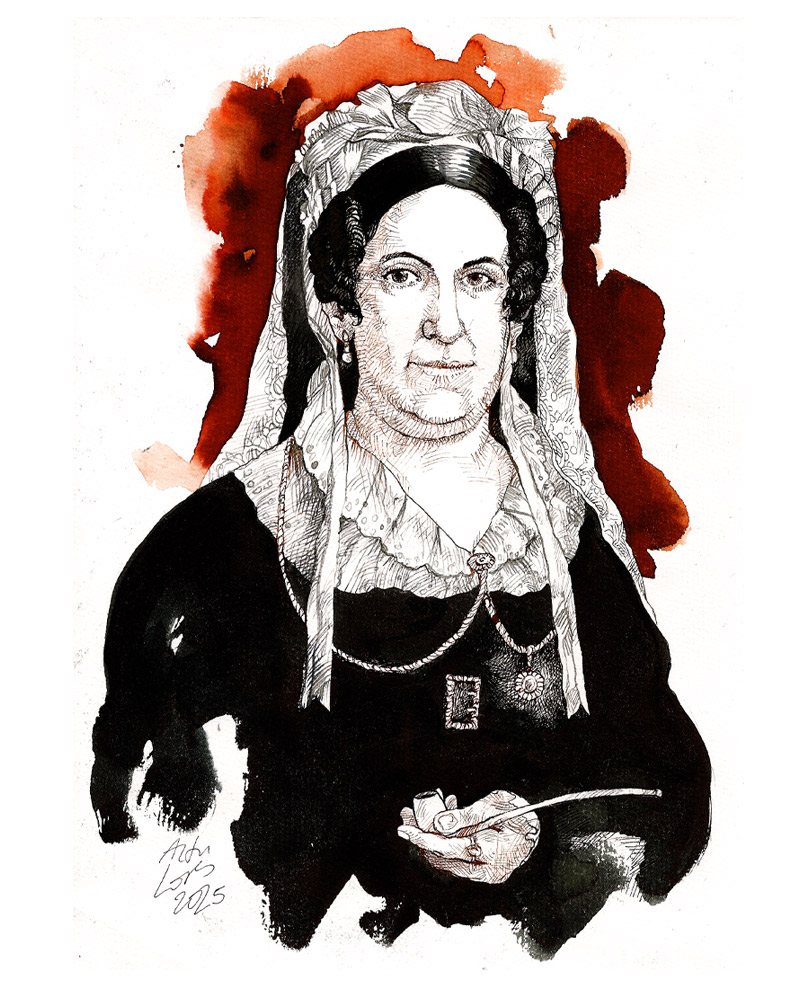
Portrait of Rachel Jackson by Artur Lopes
Rachel Jackson was a lady of the frontier who became the seventh First Lady of the United States, yet never actually lived in the White House. Despite her husband, Andrew Jackson's changing status as he rose through the ranks of political candidates, Rachel held true to her meek and unwavering spirit, even with a colorful history that followed her all throughout her life. She was also a pipe smoker, enjoying the hobby through her final days. Naturally, much of her recorded life's story is intertwined with Jackson's turbulent political and military career; however, these events provide context for Rachel's life.
Rachel Jackson: Early Life
Rachel Donelson was born near the Banister River, 10 miles from present-day Chatham, Virginia, on June 15, 1767, according to the National First Ladies' Library archives. Her father was Colonel John Donelson, the son of a Maryland shipowner, who migrated to Virginia and married her mother, Rachel Stockley, the daughter of a prominent Eastern Shore family, in 1744.
John was a Revolutionary War soldier, a foundry owner, a surveyor, a hunter, and a member of the Virginia Assembly. Most notably, he was a co-founder of Nashville, Tennessee, on the Cumberland River, where young Rachel and her family moved when she was around the age of 12 in 1780. In his book Old Hickory — the title borrowed from Andrew Jackson's nickname alluding to his toughness, as strong as hickory wood — Burke Davis writes of Rachel's father, "As militia commander and a member of the House of Burgesses he had become a friend of George Washington, and had helped to clear western lands for settlement by making treaties with the Cherokees."
According to Loving Rachel by American Historians David S. and Jeanne T. Heidler, "That fact alone made her family prominent in the community...Rachel Donelson's life was etched by the frontier." Adding to these harsh conditions, Rachel's father John was tragically murdered by unknown marauders while returning from a surveying trip in Virginia in 1786.
After John's passing, his wife took in boarders for protection. The first boarder was a bookish lawyer from Kentucky, John Overton, and the second a "gangly redhead with a long face and commanding presence" — a young prosecutor by the name of Andrew Jackson. When the pair of men arrived in Nashville, they quickly bonded and Overton would become a lifelong friend and confidante for Jackson.
Old Hickory offers additional context regarding Jackson's arrival in Nashville:...Rachel Donelson's life was etched by the frontier.
The year 1790 also brought new professional standing to Jackson, when Congress created the Southwest Territory in the country below the Ohio, and the twenty-two-year-old state solicitor became U.S. attorney general for the territory. The young prosecutor did not settle in the village itself...to become a boarder at the remote blockhouse of Colonel John Donelson's widow...The attraction may have been the widow's twenty-one-year-old daughter Rachel, who had recently returned home from Kentucky after a separation from her husband Lewis Robards."
When Jackson first arrived at the Donelson house, Rachel was married to Lewis Robards, a Kentuckian from a solid Virginia family. The two wed when Rachel was 17 years old, and she spent four years in her mother-in-law's mansion near Harrodsburg, Kentucky, far from her girlhood home. Whether the marriage was loveless and arranged or blossomed from a true romantic connection is unknown; records suggest she lived happily in Harrodsburg until their marriage began to sour due to Robards' jealousy and verbal and physical abuse.

Rachel Jackson's signature
Robards believed that Rachel was having an affair with Peyton Short, a young lawyer who boarded at the Robards' house, because she was allegedly more than ordinarily polite to him. Although the elder Mrs. Robards sided with Rachel on the matter, and Short also claimed innocence, Robards remained inflamed. "Robards ordered Rachel 'never to show her face in his house again.'" Devastated, Rachel returned to her widowed mother's house.
Upon meeting Rachel, Andrew Jackson became enamored with her beauty, according to Old Hickory, and Rachel likewise fell for him, though their relationship was innocent at first:
When Jackson first saw her, Rachel Robards was not only beautiful but vivacious and winning, 'the best story-teller, the best dancer, the sprightliest companion, the most dashing horsewoman in the western country.' She was also alluring, celebrated for her 'lustrous dark eyes,' and, as one of her kinswomen said, 'irresistible to men... beautifully moulded form, full red lips,' her oval face 'rippling with smiles and dimples'...He seemed to be smitten at once. George Davidson, a chore boy at the blockhouse, noted that the unfailingly polite Jackson was 'particularly so to the beautiful Mrs. Robards.'
Rachel's beauty is described similarly in Loving Rachel: "Rachel moved with a natural grace, smiles coming naturally to her and something like the aroma of earth about her."
It is important to note that many of the records describing their meeting and initial interactions are from Overton, resting on his testimony. As a lifelong friend of Jackson, he could not have been without bias. However, when approached by Robards, he vouched for his friend, defending both of their honors. After this inciting incident with her husband, Rachel lived as a recluse at her mother's house, refusing to show her face in public or at events.
Rachel moved with a natural grace, smiles coming naturally to her and something like the aroma of earth about her.
Shortly after their separation, Overton delivered a message from Robards, who, according to Old Hickory, begged forgiveness. When she relented, Robards returned and accused Rachel of being in love with Jackson. "Despite Rachel's protestations of innocence and Overton's efforts to convince him that his suspicions were groundless, Robards berated his wife so fiercely that she and her mother were frequently in tears."
Jackson also denied that he was wooing Rachel, charging Robards with injustice against his wife. This interaction infuriated Robards, who threatened to kill Jackson, yet Jackson maintained his innocence and asked to meet him in a duel, to which the Kentuckian declined.
Jackson moved to another house nearby and Robards left for Kentucky with Rachel for a brief time, though the reunion was short-lived. According to Old Hickory, "...within a few weeks, she found life with her husband unbearable, and fled after a quarrel. At the request of the Donelson family Jackson went to bring her back, a rescue soon to be given a sinister meaning by Robards in a court complaint: 'Rachel Robards, did [in] July, 1790 elope from her husband, said Lewis... with another man.' The other man, of course, was Andrew Jackson; but it was to be almost a year before he learned of the charge."
Rachel was taken by Jackson to live with her sister, Jane Hays, yet Robards followed her there, making a final plea for reconciliation. Jackson was then served a peace warrant from Robards. At a procession, Jackson subtly threatened him, as referenced in Old Hickory: "Jackson borrowed a hunting knife from a guard and made an elaborate examination of the sharp blade, glancing at Robards as he ran his thumb along its edges until his nervous accuser fled into a canebrake. Jackson appeared before the magistrate, who dismissed the case."
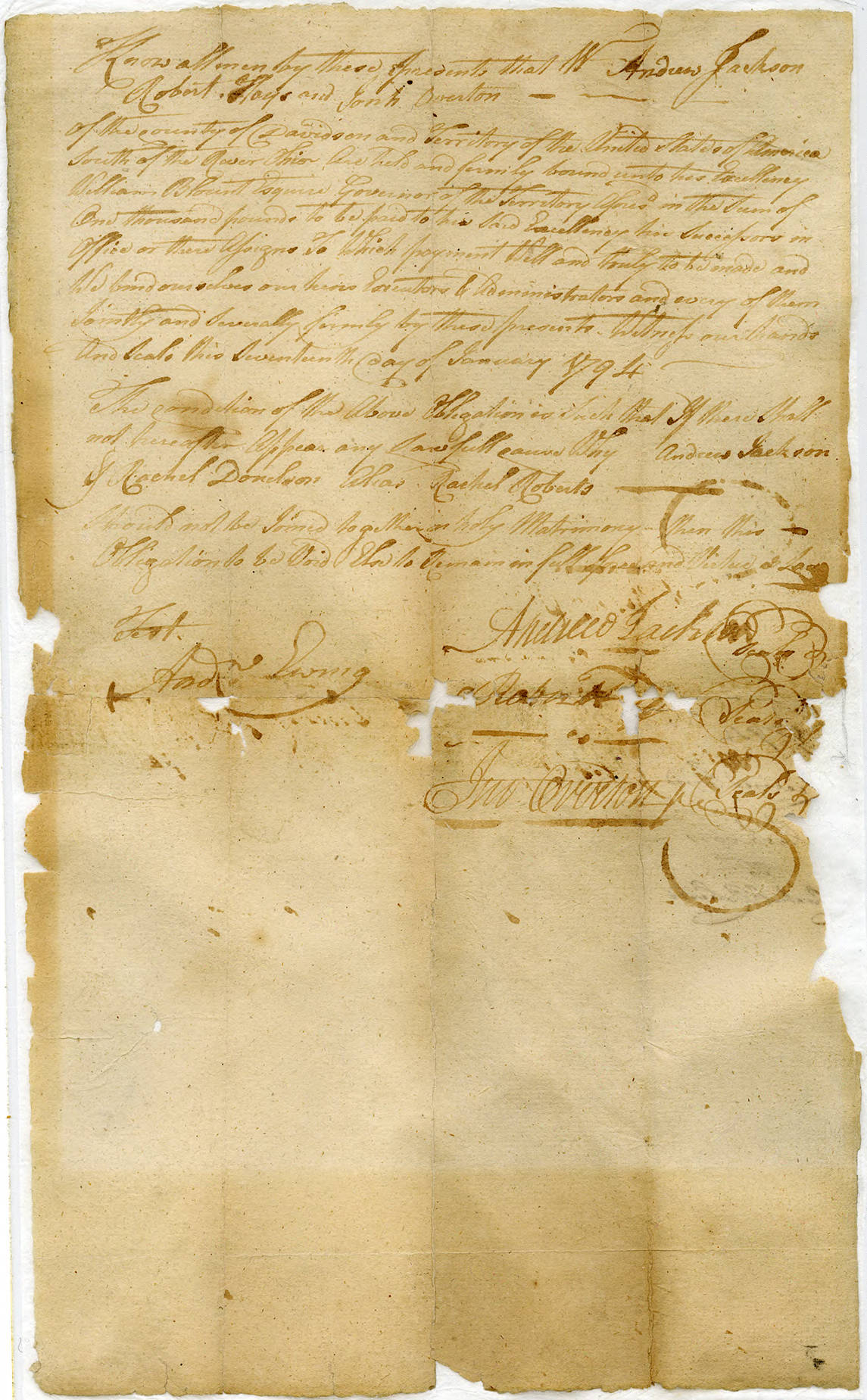
Marriage Bond of Andrew Jackson and Rachel Donelson "Roberts"
After six months, Rachel and Jackson were allegedly more involved, but continued threats from Robards caused her to make plans to escape to Natchez, Mississippi, as noted in the same source:
She was offered passage with a flatboat flotilla commanded by Colonel John Stark, an old friend of the Donelsons, who was carrying traders on a 2,000-mile journey through the wilderness down the Cumberland, the Ohio, and the Mississippi. Jackson tried to dissuade Rachel from taking the dangerous trip. When she insisted, he confessed to Overton that he loved her and regretted that he had 'innocently and unintentionally' caused her unhappiness.
Colonel Stark convinced Jackson to join the flotilla as added protection for Rachel and his own family through Native American land, leading Jackson to turn his law practice over to Overton, and leave Tennessee in 1791.
Despite any lingering rumors, Overton was convinced that Jackson joined for Rachel's safety, given his comportment around her, as noted in Old Hickory: "When he reflected on Jackson's 'singularly delicate sense of honor and ... chivalrous conceptions of the female sex,' Overton concluded that the premarital relations of Jackson and Rachel were undoubtedly 'honorable and virtuous.'"
When Jackson returned from Natchez in the spring to resume his career as a U.S. attorney, he left Rachel on the plantation of his friends, Mr. and Mrs. Abner Green, and found her mother upset due to Robards' petition for divorce on the grounds of adultery.
Instead of reacting harshly, Jackson asked Mrs. Donelson's permission to marry Rachel, according to the Old Hickory account, to which she responded, "'Mr. Jackson, would you sacrifice your life to save my poor child's good name?' Jackson's reply, by the only surviving account, was gallantry itself, 'Ten thousand lives, Madam, if I had them.'" Jackson left immediately for Natchez to be married.
Though divorce was difficult to obtain during this time period, the General Assembly in Kentucky, which was still a part of Virginia, passed a bill enabling Robards to take his case to court. The act provided a jury trial that allowed the marriage to be dissolved.
Rachel and Jackson married near Natchez in August 1791, at the home of Thomas Marston Green, Jr., and spent their month-long honeymoon in Jackson's cabin at the nearby Bayou Pierre. They returned to Tennessee in October, and Jackson bought Poplar Grove from Rachel's brother, John, where the Jacksons would settle into their life on the frontier.
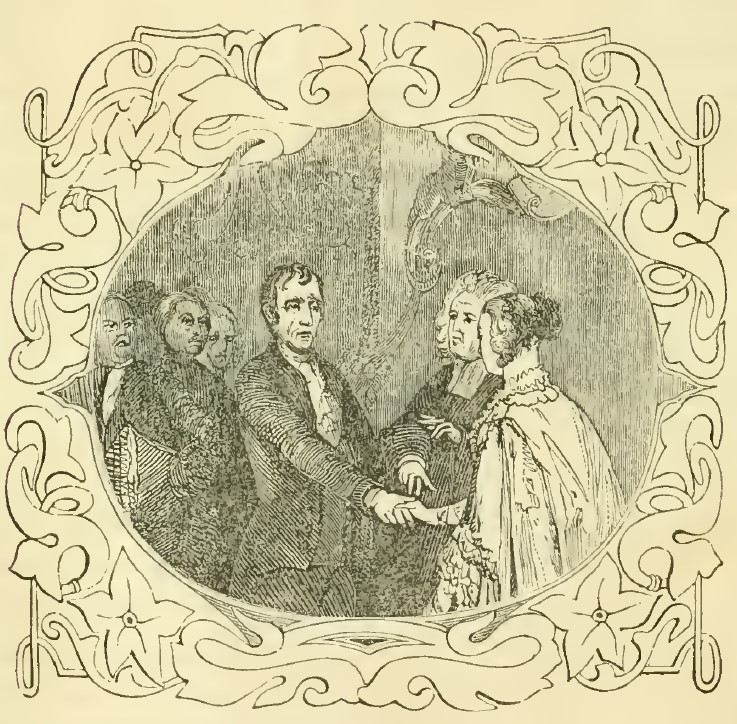
Depiction of the 1794 marriage of Andrew Jackson to Rachel Donelson Jackson
In 1793, a jury granted Lewis Robards the divorce from Rachel on the finding that "the defendant, Rachel Robards, hath deserted the plaintiff, Lewis Robards, and hath, and doth, still live in adultery with another man. It is therefore considered by the court that the marriage between the plaintiff and the defendant be dissolved."
This decision greatly shocked Jackson, who believed that the legislative act of 1791 was final, but with this new information, "they were technically guilty of adultery—and Rachel of bigamy." Robards had delayed for two years and kept the notice from publication to conceal his plans. Rachel was once again devastated, stating, "'I expected him to kill me, but this is worse.'"
When Overton suggested a second wedding, Jackson at first refused: "'Every person in the country,' he said, 'understood that he and Rachel had been properly married in Natchez, and were legally man and wife, whatever the maneuvers of Robards.'" Reluctantly, they held a second ceremony on January 17, 1794, for the best interests of the pair at the Hermitage in Davidson, Tennessee.
Rachel was deeply impacted by the scandal. In Loving Rachel, David S. and Jeanne T. Heidler describe Rachel's PTSD: "...at stray moments, Rachel's eyes could become sad and haunted. Over the years, she buried herself in her Bible for solace, puzzling out the words with fierce resolve, becoming pious as she became portly."
Rachel Jackson: Aunt Rachel
Despite the challenges, Andrew was in love, and their marriage proved to be positive throughout their lives, with warmth and mutual affection seen to the end. "Andrew Jackson loved her more than life and never minded the rough grammar, the rounding figure, nor even the pipe," according to Loving Rachel. "He cherished the simple niceness of a good person who was devoted to him with the same fierce resolve she gave to her devotionals. She would have been joyous to live the rest of her days on the Cumberland River. She was a pious woman and a private person who loved her family and made their home a sanctuary. In the refuge that Rachel made for them all, the Jacksons had a glorious marriage."
Jackson took his seat in the House of Representatives on December 5, 1796, before leaving Tennessee in early March of 1797 after Congress was adjourned. He was very concerned about Rachel and was homesick, writing of his desire to be with her, as noted in Old Hickory: "His only wish was that they would never be separated again. 'I mean to retire from... publick life... Could I only know you ... enjoyed Peace of Mind, it would relieve my anxious breast and shorten the way ... until I am restored to your sweet embrace.'"
While he was away, Rachel handled the Hunter's Hill plantation in his absence. Although Rachel was a trustworthy and reliable partner, after some time, Jackson found himself in financial trouble. He resigned his Senate seat in April 1798 and returned home to deal with his finances.. To his relief, Jackson found the Hunter's Hill plantation thriving under Rachel's watchful eye. Even still, due to his financial troubles, he moved Rachel to the Hermitage farm in a log house to begin life anew, where the family lived for around fifteen years thereafter.

Miniatures of Rachel Jackson and Andrew Jackson
After leaving Philadelphia to arrange a new line of credit and to seek the governorship of Louisiana in 1804, Jackson was rejected by the President at the time, Thomas Jefferson, in favor of William C. C. Claiborne.
Around this same time, a fight with Charles Dickinson, a lawyer, over comments made about Rachel led to a duel in 1805. "Jackson rose before dawn of May 29, telling Rachel that he must settle some trouble with Dickinson and would be gone for two days. She asked no questions."
Dickinson was a quick shot and had greater skill than Jackson. However, the danger of the duel didn't matter to him; he had to defend his wife's name. Jackson stated, according to Old Hickory, "'He's sure to fire first. The chances are nine out of ten he'll hit me—but that won't matter. I'll take my time, aim deliberately, and kill him if it's the last thing I do.'"
During the duel, Dickinson indeed fired first, but misjudged his aim due to Jackson's loose-fitting coat, missing his heart only by an inch or so. Jackson shot Dickinson shortly after just below the ribs, through his intestines. "'I'd have hit him,' Jackson said firmly, 'if he'd shot me through the brain!'"
Dickinson passed away from his wounds, leaving behind a wife and an unborn child. "Rachel, who heard the news within a few hours and understood completely, cried impulsively, 'Oh, God have pity on the poor wife ... the babe in her womb!'"
The details of the duel remained obscure to the general public, who seemed unaware of the severity of Dickinson's injuries or that his insults to Rachel had been the cause of the duel in the first place, rather than from political issues, as Jackson led others to believe. "Jackson recovered slowly from his wound. Dickinson's bullet had lodged so near his heart that removal would be dangerous; it was to remain there for the rest of the general's life." Due to the bullet's presence in his chest, Jackson suffered from life-long chest discomfort and congestion.
After the duel, Andrew spent more time at the Hermitage while he recovered, which contented Rachel. Utilizing advanced farming and equipment, Jackson made the Hermitage into a model farm, even keeping pace with Black slaves in the field despite his weak health. Rachel's joy was clear:
His presence alone brought new happiness to Rachel, who mothered him as she did virtually all others on the farm, black and white. The misery she had known during his twelve years of almost constant absence had ended, forever she hoped. At forty-three she retained some of her youthful beauty despite her short, thickening figure; her hair was still jet-black, she seemed as lively and vivacious as ever, and her sweet, kindly face was usually wreathed in smiles. Except for the fine lines caused by long exposure to the sun, her dark, round face was unwrinkled. She still wore the plain dress of the mistress of a working farm and her unaffected manners and speech were those of the frontier. Even visitors who were prone to criticize her lack of education took note of her intelligence and her warmth and friendliness. She had taken solace in religion during the years of Jackson's absence and was endlessly busy helping others, the slave families, neighbors, and passing strangers. To the people of a wide neighborhood she was known universally as Aunt Rachel. The chief sorrow of her life was that she had no children of her own; several miscarriages and infant deaths had ended her hopes of raising a family at the Hermitage.
.jpg)
Portrait of Andrew Jackson's adopted nephew, Andrew Jackson Donelson (1799–1871) from the Hermitage collection
The couple never had any biological children, but the Jacksons took in several children, including her nephews John and Andrew Donelson, and later welcomed William Smith from an elderly couple. The National First Ladies' Library archive notes that the Jacksons were also the legal guardians of four children of their late friend Edward Butler and two of Thomas Butler's children. They also adopted two sons, Andrew Jackson Jr., and Lyncoya Jackson, a Native American child found by Jackson on a battlefield who was left orphaned next to his dead mother.
To the people of a wide neighborhood she was known universally as Aunt Rachel.
Despite a full house, Rachel still grieved not having her own children, as noted in Old Hickory: "Once when Jackson was tumbling on the floor at play with the Donelson boys she burst forth, 'Oh, husband! How I wish we had a child!' Jackson put his arms about her to halt her tears. 'Darling, God knows what to give and what to withhold.'"
Rachel Jackson: At Home During War
Andrew Jackson's reputation as a brave yet violent frontier hero persisted in tales spread around Tennessee. Given this reputation, his duel with Dickinson, a spat with Aaron Burr, financial issues, and lingering gossip about Rachel's adulterous past, Jackson fell into a rare period of depression in his life, as referenced in Old Hickory:
Jackson considered leaving Tennessee and following the beckoning frontier into Mississippi Territory... Jackson confessed to a friend that he could not shake off his mood of growing despair. He felt a compulsion for 'some new pursuit to employ my mind and thoughts... to divest myself of those habits of gloomy and peevish reflections...' He was also restless because he saw no warfare in his future. He feared that 'as a military man I shall have no amusement or business, and indolence and inaction would shortly destroy me.'
However, the impending war with England in 1812 rekindled his drive. Jackson rallied troops and eventually took office as a Major General. He wrote: "'War with England must come soon. They will invade Louisiana...When that day comes, the rifles of Tennessee must save the country!"
As the infantry departed in a fleet on January 7, 1813, Rachel stayed behind with the children. "Jackson wrote Rachel as the boats struggled down the Ohio, thanking her for the gift of a miniature portrait, which he said he intended to wear 'near my bosom.' He was distressed by their separation, he said, and by her grief caused by the tales of gossips, writing:
'I thank you for your prayers. I thank you for your determined resolution to bear our separation with fortitude. We part but for a few fleeting weeks when ... Providence ... will restore us to each other's arms. ... It is now 1 O'clock in the morning—the candle nearly out ... May the angelic hosts that reward and protect virtue and innocence and preserve the good be with you until I return...'"
In her return letter, Rachel urged her husband to not lose sight of her and their family in pursuit of country, fame, and honor: "You will say this is not the language of a patriot, but it is the language of a faithful wife," she wrote.
Jackson led the Tennessee militia to victory in the Battle of Horseshoe Bend in 1814, forcing the Red Stick faction of the Muscogee Creek Native Americans to cede vast amounts of land in the Treaty of Fort Jackson, signed on August 8, 1814. Jackson also led U.S. forces in attacks against Seminole villages, ultimately enabling the acquisition of Florida by the United States from Spain.
Jackson wrote to Rachel: "A few hours after concluding the most rapacious treaty in the history of Indian-white relations in North America a disagreeable business was done, and I know your humanity would feel for them."
His involvement in war took a heavy toll on Rachel, and despite news of victory, she wrote him an emotional letter, expressing her distress. "I cannot sleepe all can come home but you I never wanted to see you so mutch in my life... You have now don more than any other man ever did before you have served your country long enough."
You will say this is not the language of a patriot, but it is the language of a faithful wife
Despite Rachel's pleading, Jackson had already entered into legend. The crowds made the families' procession back to the Hermitage slow, as they were halted by people coming out to see "the iron-willed invalid who had devastated the Creek nation."

Battle of New Orleans: Painting by Jean Hyacinthe de Laclotte (1766 - 1829)
General Jackson scored another major victory for American forces in the Battle of New Orleans, leading troops against a numerically superior and battle-hardened British army. "Jackson became the most celebrated man in the country, the first genuine national hero since Washington; Americans assumed from the first that the conquest of the British was peculiarly his own."
While rumors of the war's end were spreading, Jackson knew that, without final ratification of the Treaty of Ghent, no truce was assured. He made this truth clear in a public announcement to citizens: "The Commanding General again Calls upon his fellow Citizens and Soldiers to recollect that until peace is properly announced there can be no relaxation in the army under his command." When Rachel and their adopted son, Andrew, arrived during this tumultuous and uncertain time, it provided a temporary reprieve. "Rachel was taken over at once by women of the city, who were in the midst of preparations for a ball on Washington's birthday."
Rachel was enamored with the city of New Orleans, writing, "'I have seen more already than in all my life past it is the finest Country for the Eye of a Strainger but a Little while he tir[e]s of the Disipation... So much amusement balls Concerts Plays theatres & but we Don't attend the half of them. I herd a band of musick a few Evinings since.'"
The highlight of Washington's ball was Rachel and Andrew's frontier dance, a nod to their youth at the Donelson blockhouse. Vincent Nolte described the performance in Old Hickory, "'The general a long, haggard man, with limbs like a skeleton, and Madame le Générale, a short, fat dumpling, bobbing opposite each other...to the wild melody...endeavoring to make a spring into the air...very remarkable.'"
Regarding the war, Jackson kept his troops alert, though his militia dwindled with concerns from the wives of soldiers. Rachel was astonished by her husband's unwavering discipline. At the same time, a new Hermitage was rising near their home, and the Jacksons desired a more comfortable living space. The land was chosen by Rachel herself, and when their home was built, it was filled with guests almost all the time.
Jackson then became the governor of the Florida territory in February 1821 after President Monroe announced the Florida treaty, and Jackson prepared to leave the army. When the Jackson family arrived in New Orleans again, Rachel was struck by the sinful nature of the city, as well as that of Montpelier, Alabama: "Mrs. Jackson found their next tarrying place...equally sinful, and the U.S. regulators who accompanied Jackson a dissolute lot: 'The Sabbath entirely neglected and profaned. The regiment... no better than the Spaniards ... The General, I believe, wants to get home again as much as I do ... He wishes he had taken my advice ... Amen.'"
Jackson arrived at the Government House in Florida with the departure of the Spanish and sent Rachel into Pensacola in advance until they withdrew from the city. Here, too, Rachel was disturbed. "The pious Rachel also found the mores of Pensacola unbearable." She insisted on observing great order in the city, keeping the Sabbath holy, to which Jackson followed suit. "Mrs. Jackson's reform had only begun. At her insistence the general closed theaters and gambling houses on Sunday, and reserved for Pensacola's new mayor and council the right to make any regulations they wished as to the observance of the Sabbath."
...The General, I believe, wants to get home again as much as I do ... He wishes he had taken my advice...
The couple were desperate to leave the city, especially upon hearing terrible news of a depression among their friends in Tennessee. Moreover, Jackson suspected that he was appointed the governor of Florida because his enemies in Washington hoped he would disgrace himself and help William Crawford's chances in the presidential race of 1824. Jackson resigned from his post once the acquisition of Florida from Spain was complete, and the pair left Florida to return to the Hermitage.
Rachel Jackson: Complicated Reputation
The race for presidency in 1824 was underway, and Jackson was considered a strong potential candidate, which caused Rachel much distress. She expressed her concern in a letter, detailed in Old Hickory: "He has done his share for our country... In the thirty years of our wedded life ... he has not spent one-Fourth of his days under his own roof. They talk of his being President, Major Eaton, General Carroll, Mr. Campbell, the Doctor and even the Parson. In this as all else I can say only, the Lord's will be done. But I hope he may not be called again to the strife and empty honors of public place."
Aside from Jackson's absence from family life, Rachel was also greatly concerned about her husband's health, which had worsened since the spring of 1822. Nevertheless, he was reluctantly made a candidate by his friends and supporters who comprised a group in Nashville, Tennessee, known as the Junto. Jackson's candidacy faced challenges, however. Fears of the taboo nature of his and Rachel's marriage resurfacing and used as political ammunition loomed large. John Overton was the only member of the group rallying behind Jackson who knew of the details.
Andrew returned to Washington as a senator and lived in the Franklin House in December 1823. He made great efforts to "efface his reputation as a wild woodsman." He settled quarrels with the other candidates for presidency, inviting them to a dinner party. John Henry Eaton was his secretary at the time, writing to Rachel that he was in good spirits and better health.
Despite these social connections, Jackson kept his distance and shirked the attitude of behaving like a candidate. He wrote to Rachel, saying, "I get on pretty well amidst the intrigue for the next presidency, as I touch not, handle not of that unclean procedure."
In this as all else I can say only, the Lord's will be done. But I hope he may not be called again to the strife and empty honors of public place.
Rachel still longed for him to return to the Hermitage, noting that he had been gone for many months at a time: "... as often as you find a Leasure moment from Every Public business spend that with me." Andrew longed to join her back at home, writing in response, "I never was designed for a Legislator... I hope in God we will never be separated again until death parts us."
Jackson's opposition continued to slander his reputation. Notably, Rachel was mentioned in the Raleigh N.C. Register, the first publication to attack her own reputation in Jackson's campaign: "I make a solemn appeal to the reflecting part of the community, and beg of them to think and ponder well before they place their tickets in the box, how they can justify such a woman as Mrs. Jackson! At the head of the female society of the U. States."
These maneuvers gained little purchase with the public, however, and as Jackson continued to amass support, the desperation of other candidates became obvious. He was so confident in his victory that he took Rachel with him to savor it together in Washington. However, Adams won most of New York's votes, meaning that the election would be decided by the House of Representatives.
Despite the slanders that Rachel was awkward and ignorant, not to mention an adulteress, one observer shared that they were "captivated by the unassuming air of the general's wife," praising her for her good manners and even greater heart. The couple largely avoided public life during the remainder of the race, withdrawing from Washington society. An informant warned Jackson that documents revealing Rachel's past had been reported in Alexandria, to which he responded: "'I can assure you that whenever my enemies think it worthwhile to investigate... the character of Mrs. J I fear not... as I know how to defend her.'"
While Jackson's deteriorating health remained relatively hidden from the public, it became a serious concern for Rachel and his closest friends after he suffered a fall, which reopened an injury from his duel with Dickinson. At the end of the presidential race, a single vote in New York determined the election: John Quincy Adams would become the sixth President of the United States.
Jackson was once again nominated for the Presidency in October 1825. This time, Jackson resigned from the Senate and declared his commitment to democracy in the U.S.. The Democratic party forged into a powerful force at this time.
I can assure you that whenever my enemies think it worthwhile to investigate... the character of Mrs. J I fear not... as I know how to defend her.
Unfortunately, the scandal of the Jackson's marriage resurfaced again in this second campaign when Charles Hammond wrote in his Truth's Advocate and Monthly Anti-Jackson Expositor: "Ought a convicted adulteress and her paramour husband to be placed in the highest offices of this free and Christian land?" This attack on the couple's relationship, noted by Old Hickory, was disseminated in print, alongside accusations about Jackson's mother, which greatly distressed him.
Despite these attacks, "Old Hickory" became a national symbol, and Andrew Jackson won the presidential election with an overwhelming majority of electoral votes, making him the seventh President of the United States. Upon hearing the news, Jackson wrote to John Coffee, saying, "I am filled with gratitude. Still, my mind is depressed."
Rachel Jackson: The First Lady
As evidenced in her correspondence, Rachel never wanted her husband to be a public figure, much less President. She also knew that her reputation preceded her, and that she would always be the target of sidelong stares about her clothes, her grammar, her appearance, and her past. "Rachel heard or read most of the campaign attacks upon her, and it was useless to attempt their concealment from one so alert and sensitive. Her only recorded comments were notable for their restraint."
As referenced in Loving Rachel: "Jackson's enemies described her as an adulterous bigamist, a woman who had never led a virtuous life either before or after her two marriages, an 'American Jezebel.' Rachel preserved a calm dignity throughout the ordeal, but nobody could shield her from the stories."
She allegedly told William B. Lewis, regarding the election results, as quoted in Old Hickory. "For Mr. Jackson's sake I am glad. For my own part I never wished it." One of her friends noted a depressing change in Rachel upon receiving news of Jackson's victory at the Hermitage: 'From that moment her energy subsided, her spirits drooped, and her health declined. She has been heard to speak seldom since.'"
The weight of her husband's service and attacks on her character didn't help Rachel's strained heart condition, manifesting in 1825. When her son, Lyncoya, aged 16, passed away in June of 1828, it only added to her stress.
For Mr. Jackson's sake I am glad. For my own part I never wished it.
Over nearly forty years, the Jackson couple never spoke an unkind word to one another, aside from their differing opinions on his acceptance of public life; she had always opposed it. She hoped to remain at the Hermitage until he was inaugurated, but Eaton wrote to her that everyone would be disappointed if she didn't come soon, saying, "If you shall be absent how great will be the disappointment. Your persecutors may then chuckle and say that they have driven you from the field."
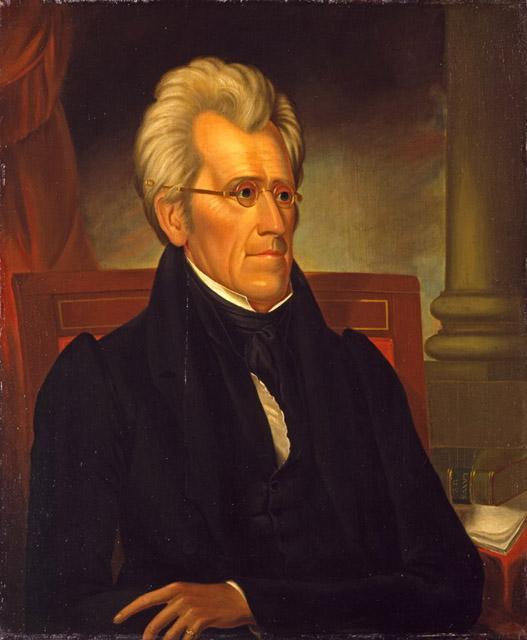
Portrait of Andrew Jackson by Ralph Eleaser Whiteside Earl c. 1830-32
In her later years, Rachel was described as plethoric and obese, having trouble breathing. Henry Wise, a visitor from Virginia, described her as such, adding that she said quietly while preparing to leave: "'I assure you I had rather be a doorkeeper in the house of God than to live in that palace at Washington.'" It surely didn't help that Jackson's political managers wanted to keep her out of the spotlight, "fearing the exposure of 'her dowdyfied figure, her inelegant conversation, and her total want of refinement."
Rachel's friends took her to be fitted for new clothing worthy of the First Lady, to which she was reluctant. While waiting in the parlor of the Nashville Inn, she heard friends discussing how hard it would be to make her look presentable as a First Lady. She also uncovered additional accusations about her from Jackson's presidential campaign that he had attempted to conceal, noted in Old Hickory: "Her companions returned to find her hysterical, crouching in a corner and sobbing uncontrollably. Rachel called for her carriage at last and stopped on the way home to wash her tear-stained face in a creek before she confronted Jackson."
I assure you I had rather be a doorkeeper in the house of God than to live in that palace at Washington.
She was diagnosed with asthma, which became increasingly painful. She now spoke in a low-pitched voice with a wheeze, and also suffered from heart palpitations. She suffered a stroke on December 17, yet she was apparently on the way to recovery after three days of rest.
On Sunday, December 22, while seeking treatment for a cold, her doctors found signs of pleurisy, an inflammation of the two thin membranes, the pleura, that line the lungs and chest walls. She was given hot fluids and was put to bed. She awoke twice in the night, sitting by the fire while smoking her pipe. She fell unconscious as Jackson pleaded with the doctors to bleed her out and to find a sign of life.
"The doctor saw that the old man's agony was almost unbearable, and he lanced Rachel's arm," according to Old Hickory. "There was no flow of blood. Jackson urged him to try her temple, but only two dark drops welled onto the pallid skin. The doctors ordered the body laid out, but Jackson refused to leave Rachel's side."
Rachel Jackson passed away aged 61 years on December 22, 1828. Andrew was in a state of shock, telling Coffee, "John, can you realize she's dead? I certainly can't." He remained by her side all day, and his doctors and friends worried that he would collapse due to his enfeebled state.
She was buried on December 24 at 1:00 p.m. in a spot in the garden that the couple chose long before her passing. "On the morning of the funeral a crowd of 10,000, twice the population of Nashville, converged on the Hermitage by horseback, in carriages, buggies, farm wagons, and coaches, people on foot, people of every condition 'rich and poor, white and black... as if impelled by instinct to the grave prepared for Rachel Jackson.'"
One of Jackson's biographers, Marquis James, stated, "Davidson county mourned Aunt Rachel for reasons with which her husband's fame and station had little to do." At her funeral, Jackson was said to have aged twenty years overnight.
Reverend Dr. William Hume spoke of her in a tribute at the funeral: "While she rejoiced in the honor of a nation, yet no unbecoming elation of mind, no haughtiness, no overbearing conduct, could ever be seen ... in this amiable lady. She was adorned with the ornament of a meek and quiet spirit ... By her kindness and affability, her husband was more happy in his own family than in the midst of his triumphs."
Davidson county mourned Aunt Rachel for reasons with which her husband's fame and station had little to do.
He also mentioned the cruel accusations against her during the campaigns: "Under this cruel treatment, Mrs. Jackson displayed the temper of a disciple of Him who was meek and lowly of heart ... She felt the injustice of the warfare ... Her tears flowed, but there was no malevolence in her bosom... While we cordially sympathize with the President of the United States in the irreparable loss he has sustained ... we cannot doubt but that she now dwells in the mansions of glory in company with the randomed of the Lord."
After Reverend Hume's statement, Jackson broke down, crying for the first time since she passed: "He swallowed convulsively in a vain effort to control himself. 'I know it's unmanly,' he said, 'but these tears are due her virtues. She has shed many for me... In the presence of this dear saint I can and do forgive my enemies.' His voice rose, 'But those vile wretches who have slandered her must look to God for mercy.'"
The National First Ladies' Library archive also shared part of Jackson's speech at the funeral, addressing the crowd as he prepared to step into his presidency without her: "Jackson spoke at the ceremony: 'I am now President of the United States and in a short time must take my way to the metropolis of my country; and, if it had been God's will, I would have been grateful for the privilege of taking her to my post of honor and seating her by my side; but Providence knew what was best for her. For myself, I bow to God's will, and go alone to the place of new and arduous duties...'"
In her epitaph, Jackson wrote kindly of his late wife:
Her face was fair, her person pleasing, her temper amiable, her heart kind. She delighted in relieving the wants of her fellow creatures and cultivated that divine pleasure by the most liberal and unpretending methods. To the poor she was a benefactor; to the rich an example; to the wretched a comforter; to the prosperous an ornament. Her piety went hand in hand with her benevolence, and she thanked her Creator for being permitted to do good. A being so gentle and so virtuous slander might wound but could not dishonor; even death, when he bore her from the arms of her husband, could but transport her to the bosom of her God.
With a broken heart, Jackson moved to Washington and into the White House. He wrote to John Coffee a few weeks later, stating, "My days have been of labor and my nights have been of sorrow; but I look forward with hope once more to return to the Hermitage and spend some days near the tomb of my dear departed wife." He was also devastated by the slanderers who he felt had murdered her with their hurtful words. He was unable to forgive them as he knew Rachel had.
When Jackson took office, he appointed Emily Donelson — daughter of Rachel's brother, John — as the acting First Lady, according to the National First Ladies' Library archive. She was just 21 years old. Emily gave birth to her daughter, Rachel, and two other children while living in the White House.
After his presidency ended in 1837, Andrew Jackson returned home to the Hermitage, where he remained until his passing on Sunday, June 8, 1845, aged 78 years, according to Old Hickory: "At last Jackson was at rest beside Rachel, of whom he had so often said, 'Heaven will be no heaven for me if she is not there.'"
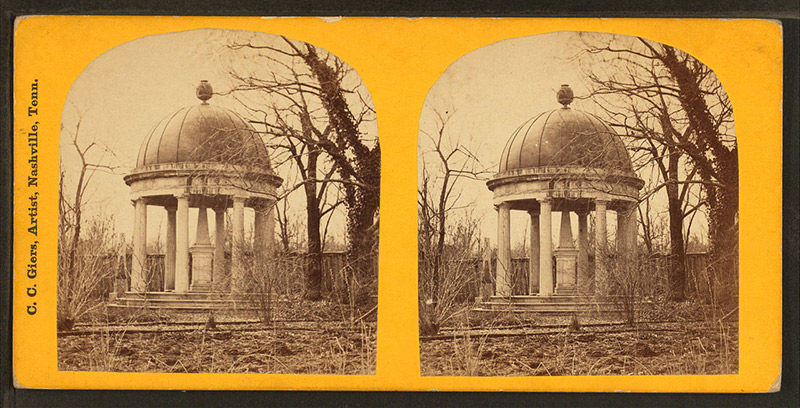
Tomb of Andrew and Rachel Jackson
Rachel Jackson: The Pipe Smoker & Frontier Lady
Rachel was an avid pipe smoker throughout her life. In the National First Ladies' Library archive, she is noted as smoking a long-stem clay pipe. She also allegedly smoked another common pipe of the time, a corn cob. Aside from pure enjoyment, it is noted that she smoked for health reasons, as it was reportedly prescribed to her to treat shortness of breath.
Andrew didn't seem to mind that she smoked a pipe, as outlined in Old Hickory: "Her charms for Jackson evidently were not diminished by the fact that she smoked a pipe, like many women of the frontier." Both Rachel and Andrew enjoyed pipe smoking, according to The Cambridge Sentinel. "James Parton, Jackson's biographer, says 'It was not uncommon for Jackson and his wife to sit for hours smoking their pipes before their fire in the Hermitage, near Nashville."
Her pipe smoking did little to improve her reputation as an unsophisticated, frontier woman, but the added criticism never drove her to stop; even in her last few hours of life, she enjoyed her pipe into the night.
It was not uncommon for Jackson and his wife to sit for hours smoking their pipes before their fire in the Hermitage, near Nashville.
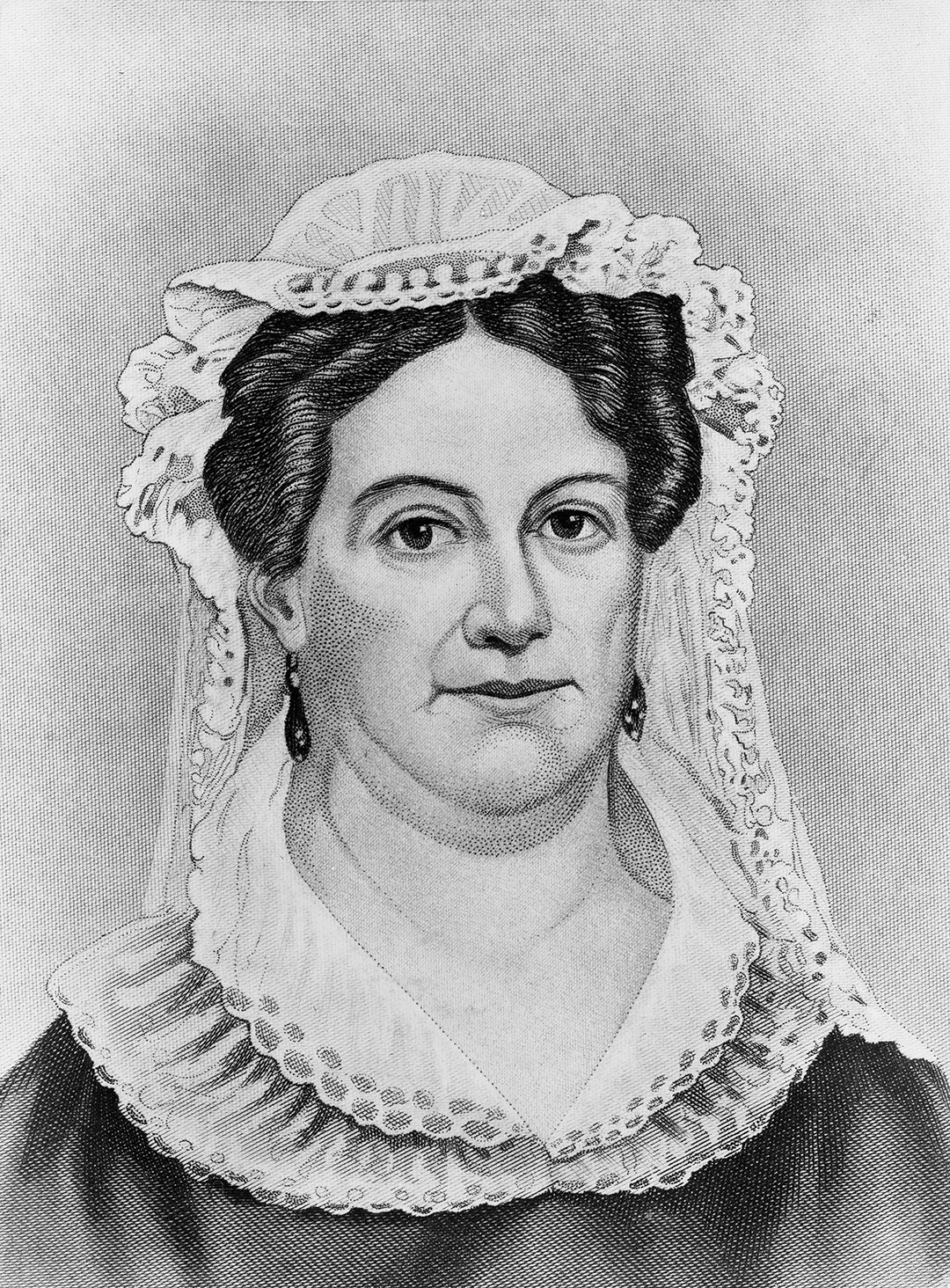
Portrait of Rachel Jackson by John Chester Buttre (1883)
In other ways, the habit added to her charm and warmth. When she was preparing to move to Washington as the new First Lady, Rachel's easy familiarity resonated with an army officer as she lit her pipe, drew from it, and handed it over to him. Her calming presence and kind personality prevailed over the terrible claims against her character. She also developed a taste for cigars while living in New Orleans.
Andrew Jackson always praised Rachel as a model wife. He was quoted in Old Hickory telling one of his nephews, "'Recollect the industry of your dear aunt, and with what economy she watched over what I made, and how we waded thro the vast expense of the mass of company we had. Nothing but her care and industry, with good economy could have saved me from ruin. If she had been extravagant the property would have vanished and poverty and want would have been our doom. Think of this before you attempt to select a wife." He also advised Andrew Jackson Hutchings, his ward, to choose a wife with great care, saying, "'Look at the economy of the mother and if you find it in her you will find it in the daughter.'"
Rachel Jackson was a resilient lady of the frontier, turned First Lady, who carried the same charm and grace from her youth into her later years, modeling the character of a kind person despite her complicated reputation.
Bibliography:
- Davis, B. (1977). Old Hickory: A Life of Andrew Jackson. Dial Press.
- Heidler, D. S., & Heidler, J. T. (2019, March 24). Loving Rachel. heidlers.
- Mahoney, H. J. (Ed.). (1929, July 27). President's Wives Smoked. The Cambridge Sentinel, pp. 2–2. Retrieved 2025.
- The National First Ladies' Library. (n.d.). First Lady Biography: Rachel Jackson.
You may also enjoy:





Comments
Very informative and inspiring. Thank you.
Fantastically researched with excellent story flow. If my wife smoked with me, we’d both be wrong. The SP daily comic regarding pumpkin spice season is closer to our reality.
Just flat out well done!! Kudo's!!
M.
Kayla, wow!!! An excellent article. Thank you. I would encourage others to visit The Hermitage as I have. This article brings that visit into a warm resonance. Here at home, we can visit Sam Houston’s home. There are some similarities.
Very well done. I learned much and was so engrossed in the story I felt like I was there. Thank you for writing it.
I love any biography that is written by the talented writers of smoking pipes. However this one was particularly great. From a pipe smokers perspective, I do wish there were a little bit more information detailed about Mrs. Jackson, and even Mr. Jackson’s pipe, smoking habits, and perhaps what tobacco they may have smoked back then. I enjoy smoking the same tobacco of his historical figure figures while reading works from them or about them. With that being said, I thoroughly enjoyed this biography. I would love to see more on early United States leaders and our families!
Wonderful piece of writing, throughly transported as I smoke my pipe!!
I can only say to Kayla Ivan: “BRAVA! Well done!”