


 |
|
 |
|


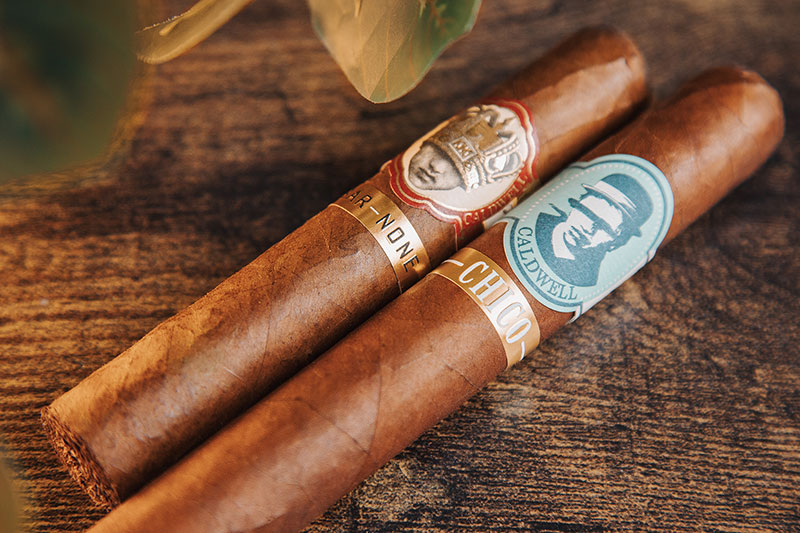
Welcome back to another edition of Smoke Rings. On today's episode, I'm chatting with Robert Caldwell of Caldwell Cigar Company. Tune in as we discuss new Caldwell releases, working with Chico Rivas to extend the Blind Man's Bluff series with Super Toro, Chico White, and Chico Gold cigars, as well as a discussion about Long Live The King Bar None, which is sure to be a favorite among fans.
Note: The following transcription has been edited for clarity and brevity.
[Shane Ireland]: Welcome to a very special edition of "Smoke Rings." I have a guest with me today, Mr. Robert Caldwell. Thanks for coming back, man. Good to see you.
[Robert Caldwell]: Pleasure. Nice shirt.
[SI]: Yeah, we didn't plan this. It just kind of happened.
[RC]: Yeah, we did.
[SI]: So, what's up man? What's new?
[RC]: Not much. Here, doing a little visit, enjoying the fresh weather compared to Miami.
[SI]: Yeah, that's true, that's true. So for those ... Well, actually, considering that this will air a little bit later, we're all getting ready to meet up again for the International Trade Show at the Dortmund Show. Do you guys have anything special or interesting coming out there? We have some new releases right now.
[RC]: Yeah, we never release anything at Dortmund. So, no. But yeah, we just launched these two and a half brands.
[SI]: Let's talk a little bit about what you're smoking first.
[RC]: We did a boxed 100-count 6" x 54 Cabinet series with a manufacturer named Chico Rivas, who is new from manufacturing Caldwell products. I've been working with him for years with Lost & Found stuff; he's just a really fantastic manufacturer with a very similar kind of pedigree and ethos to what we do with Tabacalera William Ventura in the Dominican Republic. But after the fire, we were limited in what we could do in terms of new releases, capacity, and things like that. So in trusting Chico, we moved over with him to do a couple special series. The first of the Chico White and Gold; they're effectively the same cigar. There's one difference on the filler tobaccos: they're both 6" x 54, and then have different priming on the wrappers. So they're very interesting cigars. They're 100-count cabinets, so if you're buying by the box, buyer, beware, 'cause you're going to get 100 cigars. Otherwise, beautiful singles. I describe the cigar as medium plus-ish. Probably like leaning on the full side for me, but I think, for the average cigar smoker, it's probably going to be like medium to medium plus.
[SI]: Yeah, yeah.
[RC]: They've been selling well, we got 'em here, so...
[SI]: Got 'em here at SmokingPipes. So this is an extension of the Blind Man's Bluff. So Blind Man's Bluff: Super Toro, Chico White, and Chico Gold. I think this is really interesting as a smoker, as a consumer, because basically you've got ... trying both of them is maybe the closest that the average consumer can get to sitting in the blending room with you —
[RC]: Yes.
[SI]: — and seeing the difference between primings.
[RC]: Small variations in cotton too.
[SI]: Are you disclosing the difference in the primings in these wrappers?
[RC]: Yeah, it's one priming difference, so ...
[SI]: So lower/higher?
[RC]: Yeah, and then one's got an HV filler tobacco that the other one doesn't have.
[SI]: Ah, okay.
[RC]: I think, say, they're probably 15 percent marginally different, so a lot of guys ... I mean, I think actually most guys prefer the White one.
[SI]: The experience is ... I smoked both of 'em yesterday to contrast and compare 'em. The experience is quite different actually, considering you're saying it's only a variable of around 15 percent.
[RC]: Yeah, and I guess it also depends on the smoker. I think some guys smoke 'em and they just kind of think, "Hey, these cigars taste the same." And I'm like, "Yeah, well, they have the same labels." So a lot of guys —
[SI]: Yeah, sure.
[RC]: — when they smoke, you change a small component on the packaging and then everybody thinks it tastes different. There's kind of a consensus on the White label. I don't smoke a lot of them. Already mentioned to you prior, 'cause I'm a smaller ring gauge smoker and don't like stuff that's got too much spice. And I think this is kind of right on the edge where, were it a bit smaller, it would be a cigar that I would have in my rotation. But due to the size, I smoke 'em when I make 'em and to make videos.
[SI]: Yeah, absolutely. So that's really interesting. I do recommend smoking back-to-back, but, you're going to want to do it a couple of times, I would say. I smoked the White first and then the Gold yesterday, and I'm going to do the opposite on a clean palate, probably tomorrow. We talk about this with pipe tobacco too. To really get to know a cigar in a particular vitola or a blend across many vitolas; you gotta try 'em in a couple of different settings, different times of day, before and after a meal, coffee, no coffee. Like, there's so many variables here on the personal side of it. But like I said, it is really interesting as a smoker and a consumer to contrast these two and see how much of a ... I feel like there's a significant difference in the experience with only a little bit of difference in the blend and the priming of the wrapper. I also think on the pipe tobacco side, we talked about this a little bit more, but to me, this feels like a cigar that's going to age pretty beautifully.
[RC]: Oh, yeah, 100%.
[SI]: Yeah. I know that's built in or implicit to the blending process for a lot of you guys. But in the cigar industry, I feel like we don't really talk a lot about the potential for aging that cigars have, and I think these have that.
[RC]: And so, actually back to the point, the interesting thing with Chico, Chico's history as a manufacturer is fairly ... Well, it started, I guess, working on the tobacco side. So he went and worked with a grower named Leo Reís who we worked very closely with on a lot of tobacco. But to really understand the processes of tobacco and what makes Chico a unique manufacturer is the way that he continues to process the tobacco that he gets, and part of the additional processes that he does — he also ages the tobacco. He's very selective in what he does. And I think that all of the cigars that he makes are kind of built with that aging concept in mind. Not deliberately but, I mean, when you smoke them, I think a lot of them make you say, "Wow, if I put this down for six months, it's going to be a completely different cigar in a positive way."
[SI]: Yeah, the balance, the Aromatic complexity that it has naturally, like you said, that spice, I really think that. I mean, it kind of depends. There's a lot of factors here, but I personally am looking for a decent balance between natural sugar content and spice, because something that's too mild, yes, it can age gracefully, but it's not likely to get more complex.
[RC]: Yep.
[SI]: But if you have a little bit of complexity up front, especially on the spicy side — depending on the primers that you're using and the fillers — the potential for it to become sort of mind-blowingly different with age is a little bit higher. But yeah, both of these are really interesting additions to the Blind Man's Bluff series.
[RC]: And, by the way, it's a one-time production, so we made 160 boxes, and around 40-50 of each went to Europe. There's, I think, 120 that landed in the United States. So, if you want to try it, you need to be...
[SI]: Do it quick.
[RC]: Yeah.
[SI]: Yeah, absolutely. So the other new introduction here, which I was super stoked about personally because it takes me back to my roots as a Caldwell smoker: Long Live the King Bar None. Why don't you tell us a little bit about that project.
[RC]: So this one comes in two sizes, Robusto and Toro, 6" x 52 and 5" x 52. It's the same exact blend, technically, as Long Live the King, and it's also made by Chico Rivas. The differences are primings, farms, and the factory, and then the processes that the tobacco goes through. It's a fun experiment because you can make the same exact recipe, but assuming you went to several different grocery stores to get different ingredients from different brands, when you put it together, it tastes very different. This is a perfect example of that and it's noticeably stronger than the Long Live the King that we produced at Tabacalera William Ventura; It's very interesting. It's also, if you notice the way that it's rolled, if you look at the head of the cigar when you cut it, it's got a tighter pack to the tobacco. So, it's an interesting cigar. It weighs about two grams heavier than the regular Long Live the King; The Belicoso is a comparable size.
[SI]: Interesting.
[RC]: For me, also, it's a little bit too full-bodied, but guys have been going nuts for this 'cause ...
[SI]: I get it, yeah.
[RC]: We make medium plus, at best, cigars and I think a lot of guys are looking for more full-bodied cigars. And so, I think we hit something with this. But that being said, it's also limited, so 500 boxes per size on each of those.
[SI]: Oh really?
[RC]: Yeah, and if you're a Long Live the King fanboy ... you got to get it.
[SI]: That's where a bunch of us started with your brand. I mean, it's the flagship. It's the oldest label on the Caldwell side. Yeah, you got to get it. And again, I really appreciate these projects, as a consumer, because we read a lot about the components and the processes, and where they come from, and all that kind of stuff. But if you're not tasting all of these individual components separately as a blender and as a manufacturer, you really don't understand —
[RC]: No.
[SI]: — how the blending process works and how much variability there is. And the fact that this is the same blend, just with different actual raw materials, is sort of wild to me.
[RC]: Yep.
[SI]: Yeah, it's wild. I've smoked a lot of regular Long Live the King and —
[RC]: Oh, the funny thing too is a lot of guys, they're like, "Oh, you disclose your blend. What if somebody copies your blend or can you trademark your blend?" It's like, "What? No, you need to know it's so much more than that." The primings are very important.
[SI]: Yep, the processing.
[RC]: The processing, how they're processed, who processes them, where they grow on the farm, the exposure to light, the country of origin; All these things dictate where you could have an 80-90% different smoking experience from the same recipe.
[SI]: Yeah.
[RC]: And I think that that's a very ... It's just fun, I think, to have done that project. And weirdly enough, it wasn't planned to be that way, but I mean, the baseline, we wanted to do a limited release of Long Live the King. We couldn't do it with Ventura and we went over to Chico. And I said, "Okay, let me start with the Long Live the King blend that we have with Ventura." And I gave him exactly the components and he said, "Where was the tobacco sourced from?" These types of questions, "What primings are you using?" "Well, no, let's just put it together and see how it goes." And he put it together, and that's what it was. Just the first shot.
[SI]: Amazing.
[RC]: And it was such a polarizing, different experience for me versus the Long Live the King we produced. And I thought it would be not only a fun, limited concept to release, but also fun to explain to people if you smoke them side by side, this is what the differences are.
[SI]: Exactly, it is. I would say that the spirit of the Long Live the King is in there, but yes, I'm getting more spice, more strength, maybe a similar amount of body, maybe a pretty similar flavor profile. But side by side, blindfolded, doing the Pepsi challenge, so to speak, I would guess they were 100% different blends, which is wild. So if you don't mind me asking, for those of us with a limited understanding of the difference in processing, we talked a lot about raw material. I've had a couple of opportunities to see some of this stuff in person and I still have a really limited understanding of the magic behind this. Because for those of you that might not know what goes into processing raw material, raw tobacco into cigar leaf is not a laboratory situation, right?
[RC]: No.
[SI]: You're not talking about machine-mechanized, very sterile environments. This is old-world know-how, right?
[RC]: It's an artist mixing paint on a palette.
[SI]: Exactly. That is a good way to put it. So, basically, piling the leaf and how often you turn the pilónes, the temperature that it's at, the humidity that it's at, like, so much of it is done by feel, and so much of the little extra couple of percentage points of magic is what differentiates how they do it at X farm versus Y factory. Can you just give us a brief idea of how playing with primings and playing with processing can dramatically change your flavor profile?
[RC]: Sure, so the primings ... First of all, the leaf size is different. Secondly, the sun exposure is different. So, the leaves towards the top of the plant are going to get more sun exposure. And then lastly, the purpose of the plant is to deliver nutrients to the flower, which we grow on top. And so, as long as the flower's on, all the nutrients are going to get delivered to the top. They usually cut the flower. Not usually, but very often they'll cut the flower off, and then the nutrients will trickle back down into the rest of the plant. But most of 'em are captured at the top leaves. So on the top down, you're going to have spicier, more nicotine-heavy, more oily, and thicker tobacco with bigger veins.
[SI]: You were saying, yeah.
[RC]: Then, as you work your way down, you end up with tobacco leaves that grow very large and get more thin; they have less oil, thinner veins, and a lot of the veins capture that nicotine. And the reason that they're growing outward is so that they can get the sun that's hitting it over here, 'cause the top leaves are blocking them there.
[SI]: Understood.
[RC]: So you'll end up with a different mixture of nicotine and also a different density of the leaf and —
[SI]: Burning property and elasticity.
[RC]: — structure and components. Yeah. And then, when it comes to the processing, you mentioned fermentation. So they're going to ferment the tobacco and then, the differences in processing would be the temperature. So then tobacco, when you pile it up, as you mentioned, it's naturally going to heat itself up as you would consider a pile of something that's kind of decomposing, but more or less controlled destruction.
[SI]: It is controlled.
[RC]: And then how hot they let it go and how long they let it sit there before you can completely ruin the crop is also controlled. Maybe you do low and slow, with a lower temperature for a longer period of time, flipping the barrel more frequently. And you can repeat the process a variety of times to dictate what you want the tobacco to do. And then, lastly, correlating to actually pipe tobacco, which we were talking about before, is pressure. So you can get a bale and you can cover the bale with a ton of scrap tobacco, which will amp up the heat very quickly. But the pressure will add some components from the extra weight. So there's a variety of tricks of the trade. I think some of them are ... You know, you're asking me, "Is some of the stuff provided?" It is, but everybody kind of does the same thing. It's just how they do it.
[SI]: How they do it. Yeah.
[RC]: So everybody's got the same things that they do. It's just when and how they do it, and, back to the artist's palette, what colors are you mixing together? A little bit of this, a little bit of that. Sometimes, you can end up with a similar color —
[SI]: Yeah.
[RC]: — but you've used different colors to create the color. And I think that, on the processing side, that's kind of the magic. And you get something that's very different. Most of the tobacco that we use is fermented low and slow. Typically, on our factory side, we're adding an additional fermentation and we have our own processes that we do, whereas Chico would have his own processes. And that's, I think, where the split comes; They're not going to be the same. Or, even if they're the same processes, depending on when they occur and how they occur, you can end up with differences as well.
[SI]: Differences such as where the material came from originally, what part of the farm, and which part of the country it was grown. That's the crazy thing too; I've been able to — at least a little bit, not nearly as much as yourself — taste a couple of these raw components where it's like, "Okay, here's a few different primings and a few different crop years from Condega," or whatever. And even between bales, primings, and crop years, the amount of differences in flavor, strength, and body is wild.
[RC]: You can have one farm that produces all the same tobacco and they'll end up with four or five or six different flavor expressions just from the same exact soil. It could be rocky here, sandy here, muddy there. This one's facing south, like on a hillside or something like that, and they're getting more light exposure. So you can have all these slight variables that will dramatically change the flavor of the tobacco that's produced on the same farm and of the same varietal.
[SI]: That's crazy. It's crazy. So, if you're like me and you want to learn more about this stuff and really experience the difference between primings and slight changes in the blend, Blind Man's Bluff, Super Toro, Chico Gold, Chico White, you've got to smoke those back to back more than once. And again, for the Long Live the King fans, the Bar None is —
[RC]: Bar none.
[SI]: It's Bar None. It's an amped up Long Live the King, and it's going to make me revisit the original blend too, side by side, because that's just fun, right? Robert, thank you so much, man.
[RC]: My pleasure.
[SI]: Good to see you again.
[RC]: Likewise.
[SI]: Looking forward to the next release.
[RC]: Sounds good. See you next week. We've got to dress the same.
[SI]: That's right. We will. See you, guys.
You may also enjoy:



Comments