


 |
|
 |
|


W
elcome to another episode of "Tasting Notes." I have a unique new product to discuss today, and for that I have a guest with me: Sykes Wilford, the Founder, CEO, and President of Laudisi Enterprises and Smokingpipes. Today we are discussing Samuel Gawith's Full Virginia Flake Burnt Ends.
Note: The following transcription has been edited for clarity and brevity.
[Shane Ireland]: Thanks for being with me, Sykes.
[Sykes Wilford]: Thank you, Shane.
[SI]: So, what are these crazy big strips of tobacco we have in front of us, and how did we get here?
[SW]: It was a sort of circuitous route, but first some backstory about Samuel Gawith, Gawith Hoggarth, and the tobacco processing methods used to make flake tobaccos. In the UK, there's this tradition of hot-pressing tobacco, and then there's huge, old iron steam presses where pressure is applied, but also heat is applied. And so one of the things that makes Gawith's products distinct is that they are cooked while being pressed. So that's different from Danish flakes, and that's also different from what Cornell & Diehl does, for example. So we — Jeremy Reeves of Cornell & Diehl and I — were there in March of this year, and we spent a lot of time, partly because we are just less familiar with that. We were really curious about the steam presses.
[SI]: Right, right, yeah.
[SW]: We don't know much about steam presses. I mean, we knew they existed, but we'd never really got to ...
[SI]: ... Have experience with them.
[SW]: Yeah. And so, over time we've just started talking more and more with Chris Gawith and Rachel Gawith about steam pressing, and they were walking us through the process, and basically they cut the edges off of the brick and then they sliced the brick into the flakes that you know. So in this case, Full Virginia Flake. And I'm not quite sure how it came up in conversation, but I was really curious, and asked what happened to the edges and has anybody tried smoking these?
[SI]: Right, yeah. So then fast forward to the InterTabac Dortmund Trade Show and again meeting with Rachel and Chris, we were actually super curious about this.
[SW]: And they had the samples first.

[SI]: They gave us some samples that we smoked. And what we realized was because you have basically the whole leaf going into this heat press and then ending up in a big brick that gets sliced, the outer edges end up maybe a little less aesthetically pleasing, but they are more, I mean that's where the surface area is, where the heat is hitting caramelized sugars on the edge of this brick. So that's where the nomenclature came from, Burnt Ends, which is of course a nod to something very American, the tradition of burnt brisket ends, which are amazing. And we started smoking the samples, and I mean, it's really sweet.
[SW]: It's really sweet with so much depth.
[SI]: Yeah. It kind of tastes to me like pre-aged Full Virginia Flake. And I guess it's also a little bit different from a normal plug in the sense that you don't have these square or rectangular plugs. It really is just the caramelized burnt end pieces from the brick. So before we talk about what we're tasting and the tin note and all that good stuff, I did want to talk a little bit about preparation because this is very unique. I mean, singular.
[SW]: This was also something we had to figure out.
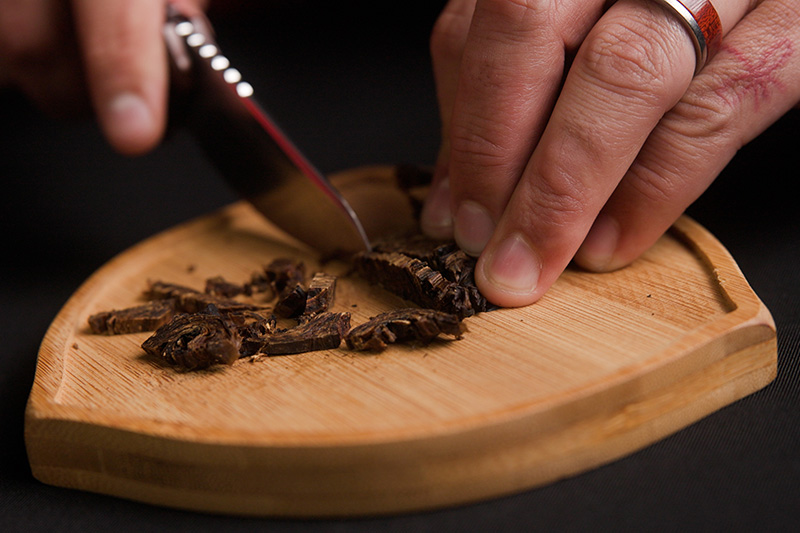
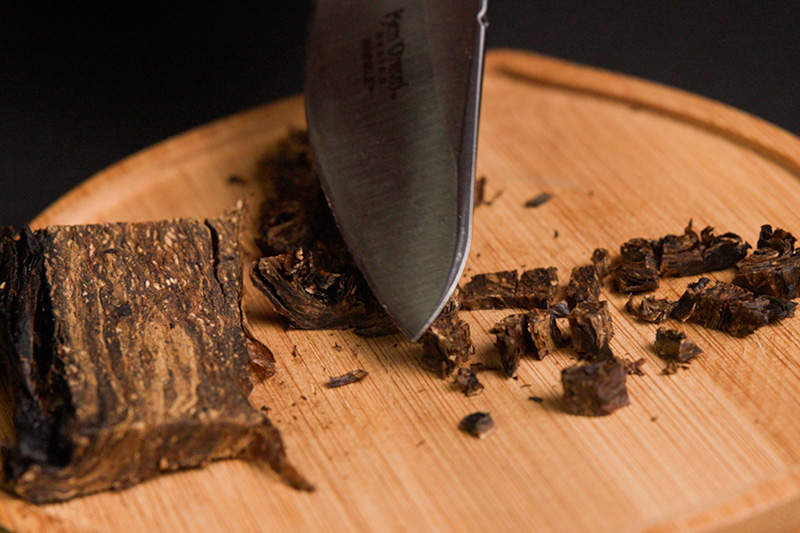
[SI]: Yes, yes. So basically much like a plug, you are going to need to cut this up. I think that it is a little bit too dense and a little bit too firm to be able to be broken up by hand easily. But because the strips are on the thinner side compared to a regular plug, what I end up doing and what I think works best is cutting against the grain, and what you end up with is somewhat of a cube cut. You can cut against the grain and rub it out just that way. And it's a little bit of a wild cut. You have some bigger pieces, some whole leaf pieces, and some smaller pieces, or you can cut lengthwise and then cube it. The result is a rough-looking plug of Full Virginia Flake that has been exposed more to the heat pressing, which is a signature of this style of flakes made in Kendal. And yeah, it's a unique experience, for sure.
[SW]: So this is what it looks like when it comes off of the presses, you know, and they cut it off of the brick and the bricks are like this.
[SI]: Quite large, yeah.
[SW]: So these are one edge and then it is packaged in these standard Samuel Gawith eight ounce units and is exactly the same thing, but cut down to a more useful size.
[SI]: Yeah, let me take a look at that packaging here just so I can get a whiff. As for the tin note for this, I'm not getting much that is dramatically different from the standard Full Virginia Flake. There's that nice underlying citrusy quality. The stoved Virginia is tangy. Maybe there is a little more sweetness. Now smelling sweetness is something we kind of argue about a little bit when it comes to tasting stuff. But you can feel it, you can feel the sensation of something that is sweet. Like I said, it has a little bit of a baked-goods quality. Yeah. It just smells to me like a mature steamed Virginia flake. Like it has a little bit of age on it.
[SW]: Just like the age tanginess.

[SI]: Yeah, yeah. It really does. And you know what, you see what I mean about the sweetness as well? It's hard to describe what that smells like, but I mean, I've heard Jeremy describe it as literally smelling like a bag of powdered sugar or something. And that's not terribly dissimilar from what I'm getting. It's a little bit unassuming in the tin note like most straight Virginias are. But I think it gives you a good idea of the added richness that these Burnt Ends have compared to the regular flakes. It gives the smoker the ability to determine, to a certain extent, what the cut is, how thick you want it, and whether you want to cube it or not. And also whether you're just cutting razor thin against the grain into little flakes. But beyond that, I think the experience is maybe just more intense straight out of the tin when compared to a fresh tin of the flake.
[SW]: On another axis, it's also softer. It has that same character that aged tobacco has where a bunch of the bright notes are more muted and there's more depth and richness underneath it.
[SI]: Yes. I think the intensity of its sweetness was maybe what I meant to say.
[SW]: Yeah.
[SI]: Yeah, and I'm sure this is true for both of us, but we have both been a fan of Full Virginia Flake for many years and have smoked many vintages at many different points in their life of aging. This reminds me of some tins that I smoked a few years ago that were super old at the time.
[SW]: Mmhm. There's also a certain character here, if we have another spectrum or axis, it's more Full Virginia-y than Full Virginia too.
[SI]: Right, right.
[SW]: It's all those things we chase, or at least I chase, in Full Virginia, times one and a half, or something.
[SI]: Yeah, exactly. The increased sweetness is the most noticeable I would say. It's a lot less zesty and bright, and a lot more tangy, and it has just a bit of that fermented barnyard funk kind of thing. It has just a bit of that fermented character that usually takes many years in the tin to develop in a straight Virginia.
[SW]: To be really honest, this is the coolest, weirdest product we've encountered in a long time. We've smoked a lot of really good tobacco.
[SI]: Exactly.
[SW]: But this is both good and strangely esoteric and requires a little bit of extra effort, such as in the cutting process. It's a process. You'll notice we're relighting a bit more than we normally would. There are a lot of things about this that are a bit of a process, but the rewards are totally worth it.
[SI]: Oh yeah, absolutely. And that's the thing, like a normal plug has its advantages in that it gives the smoker a lot of control over the cut and that in the long term, I mean the really long term, you're going to have a very nice, slow, and consistent age through that product. I think what's interesting about these is smoking them now, smoking them fresh, I do think that these are going to develop over time and that they have long legs, kind of like any pressed Virginia would. But I would encourage people to try this now. It gives you an idea of what heat pressing does to the tobacco beyond just normal pressure or heat by itself. I don't know, it's just a really interesting snapshot into this very old production method from Kendal that produces very special tobaccos. And like I said, it's kind of like, maybe this is a weird reference, but if you've had really nice aged balsamic and then you go to the 30- to- 40-year-old stuff, all of the same flavors are amplified and just way more viscous and way more syrupy — I feel that way about the smoke here too. It is a little more dense on the palate, a little heavier, and a little more rich. It's really interesting and difficult to describe if you've spent, like we have, most of the time smoking regular flakes and regular plugs.
[SW]: It's a departure.
[SI]: It's a bit of an adventure. Yeah.
[SW]: It's really cool.
[SI]: And can we expect maybe more iterations of the Burnt Ends series?
[SW]: Yes. So given the nature of this process, this happens to most of or all of the tobaccos that they press this way. So there will be other iterations, but not a lot of it actually gets made because you have to make an awful lot of flake in order to get four of these burnt ends.
[SI]: Yeah.
[SW]: It's like 10 kilo bricks, I think, to get these four little pieces. So we started with Full Virginia Flake, and some of the other best-selling flakes from Gawith Hoggarth will happen. But basically when they have a bunch, they're going to make it and package it up and send it our way and that's it until they have a bunch more. So yeah, keep smoking the other stuff so we can keep getting this stuff.
[SI]: Exactly, exactly.
[SW]: Yeah.
[SI]: Yeah, it's like the tuna cheek or, I guess, the real burnt ends on a brisket.
[SW]: Yeah, exactly. Yeah. You can't eat just the burnt ends, right?
[SI]: I try to, but that's a lot of waste. There's a lot of waste if you don't eat the rest of the brisket. But yeah, again, having smoked Full Virginia Flake, specifically, for a very long time, nearly two decades, and the plug version, Full Virginia Plug, Full Virginia Burnt Ends is a unique, singular experience. And I'm glad we were able to try it and I'm glad we were able to share it with everybody. Thanks guys.
[SW]: Thanks everyone.
[SI]: See you next time.

You may also enjoy:





Comments
What pipe is SW smoking? Looks like a Peterson spigot sandblast with a fishtail. Is it the 317?
Reminds me somewhat of ripe Puer tea. An artificial/speed up aging process that comes up with a special taste in its own right, that will find its fans. It doesnt have to be necessarily compared to „classic“ aged tobacco.Why not?
Could this be a type of pensioners mixture? I never tried it but it was less expensive.
可以切掉边角料去另外卖 为什么还不把砖块做的完美些 真是做的越来越难看 有损品牌形象