


 |
|
 |
|


The Aganorsa Experience: Components Tasting with Terence Reilly


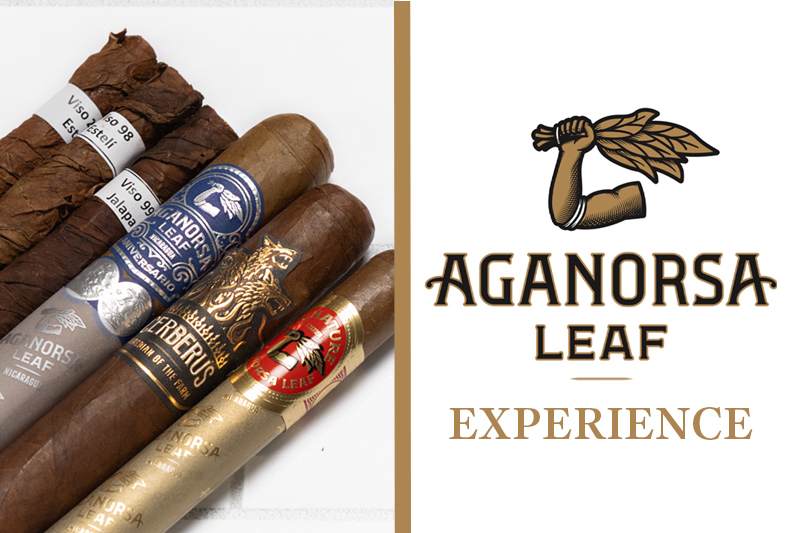
I sat down with Terence Reilly of Aganorsa Leaf to chat about The Aganorsa Experience. For those who don't have the privilege of attending an event, we've got tasting components packs available on-site with the cigar leaf components to conduct your own Aganorsa Experience from home.
Note: The following transcription has been edited for clarity and brevity.
[Tyler Caldwell]: At your events, Terence, you do what is known as the Aganorsa Experience where you will get some components and taste and have the privilege of being educated on why this tobacco is unique, as well as learn a little bit of the process of the the tobacco you use in your cigars.
[Terence Reilly]: Yeah, the idea is to provide a sense of how the cake is made. Two of these fumas that we're gonna be enjoying are in every Aganorsa cigar. It's kinda like the sugar and butter of a cake, or the corn that every bourbon has. There's that base and then there's other ingredients.
Differences in Varietals
I'd like to briefly explain what the years on these varietals mean. It doesn't mean the tobacco was grown that year. Instead, it means that varietal was utilized in Cuba for the first time that particular year. The original Cuban Corojo in the '70s was decimated by blue mold. The Cubans actually blamed the CIA, but that's a different story.
They started growing different variants in Cuba and the year that they started commercially utilizing that varietal was the year that it's named after. They're growing for disease resistance, yield, and other factors. That's why there's a Habano '92, Corojo '99, Criollo '98, Habano 2000, Corojo 2006, Corojo 2012, and so on and so forth. All that year means is that varietal was used that year for the first time in Cuba, and some of them last.
Criollo '98, for example, is still growing in a lot of places throughout the world. Corojo '99, nobody's really growing anymore.[TC]: I'm really glad you explained that because, coming from the retail side of this business, those are often questions that are asked.
Corojo '99
[TR]: The first one we're gonna start off with is called Corojo '99, a Cuban seed varietal. We're the only major growers of it left because it has a low yield, and from a financial perspective, it is less attractive for a farmer to grow. We still grow it because we love the flavor and aroma.
It's grown in the Jalapa Valley, which borders Honduras, and it is very similar to Pinar del Río in terms of climate conditions, which is the best growing region of Cuba. This particular tobacco is from the viso, or middle, part of the plant. The top primings, ligeros, are gonna be your most potent, but more linear. The bottom leaves, seco, are lighter and more subtle. The viso leaves have more strength than the seco and more complexity than the ligero, so that's why we use it for this tasting.
When we light this up, be careful on the draw; it's not a cigar, it's just a rolled-up leaf. We're gonna experience three main tastes here. You're gonna get salivation on the sides of your mouth, spice on the tip of the tongue and through the nose on the retrohale, and a lingering sweetness. It's a clean finish. It's not syrupy sweet or something, not like candy, but definitely a clean, sweeter finish. As we smoke these, you'll want to pay attention to flavor and aroma. I can tell these apart not only by taste, but by the actual aroma that they produce. It's pretty cool to see how each one gives you different qualities.
[TC]: What's interesting about it is that if you've never been to a factory to see or go through tasting and blending cigars, for a lot of people who are out there, this is how you can have the opportunity to do that. You get the leaves and can sample through what they taste like.
[TR]: It's like when you're cooking. You need to know what the ingredients taste like, and ours is intended to be something that, regardless of your experience level, you can enjoy. With someone like you, we could do a much more complex version of this where we take a whole cigar and break down every tobacco and everything like that, but not everybody is ready for that in their cigar journey. What you need is something that an experienced person can appreciate and enjoy, but also somebody relatively new to cigars can come in and get something out of it, and really appreciate the flavors and the differences.
That's really what's different about ours. We didn't invent tasting but ours is more versatile in terms of the audience.
[TC]: Gotcha. I definitely get that salivation you're talking about. With the first puff, instantly and on the retrohale, it's a nice spicy kind of profile. Tingles on the tip of the tongue there as well.
[TR]: It's interesting too to see how some people get that spice and they like that in their cigar, while others don't like spicy cigars. It's cool to see how you experience it by itself and then later on we're gonna see how they compliment each other.
[TC]: Do you get a lot of folks who don't want spice? I think there's that misconception of peppery spice and strength.
[TR]: Yeah, sometimes people associate strength with spice. They'll say, I don't like strong cigars. What they really mean is they don't like spice but they want strength, or they like spice but they don't like the kick that they can get.
[TC]: For sure.
[TR]: Corojo '99 is in every cigar we make. It could be the wrapper, binder, or filler. It could be a high percentage of the blend or a lower percentage, but every Aganorsa cigar that you smoke will have some Corojo '99 Jalapa in there somewhere.
[TC]: Do you suggest any particular cigars that are more dominant in Corojo '99 if you like it?
[TR]: Definitely our Supreme Leaf is definitely gonna feature Corojo '99 dominantly. That's a really good example. That's more of a limited run. If you want something that's available pretty much anytime, our JFR Corojo is a good example of that. Our La Validacion Corojo as well.
A good guideline to follow is that if the wrapper says Corojo, you're definitely gonna get a pronounced Corojo flavor because it will also have filler and binder that's Corojo. Now that you have a sense of that leaf, let's save that to come back to in a little bit.
Criollo '98
The next one is Criollo '98 from Estelí. This is a different seed varietal. Criollo '98 is very commonly grown, not only in Nicaragua, but in a whole bunch of countries. It's just a Cuban seed that's been successful in a lot of places, and people like it. This one was grown in Estelí.
Estelí has that very dark, rich, volcanic soil, and it's totally different from Jalapa, which has a brighter sandy soil, where the Corojo '99 is from. It's the viso part of the plant, so we've kept that consistent but we've changed the varietal and the region, and it creates a totally different flavor. This is gonna be earthier, grittier, and it's not gonna have the pronounced spice. There's more body and you'll even get a little bit of salt on the roof of your palate.
[TC]: It's very much different. There's more of a floral note in the aroma and taste.
[TR]: It's totally different. Another benefit of doing this with a variety of different consumers is that nobody tastes these two and can't tell the difference. As you get experience, you can pick up on more subtleties in the notes. Similar to scotch, when you first have it, they all taste the same, but then you realize one has a sherry cask finish, and another is more peaty, or whatever. It's the same thing with tobacco.
Usually at this point in a tasting, we would ask which one did you like better? There's no right answer. Sometimes everybody likes the '99 more or the '98 more. Sometimes it's balanced down the middle. The key aspect with these tobaccos is that they have to go together because they're in all of our cigars. '99 is in all parts and the '98 are used for binders and fillers.
Tobaccos are like people. You can have two wonderful people, but together they might not get along.
At this point, we're gonna have a Cheech & Chong moment. We're gonna puff them at the same time and it's gonna become more balanced, more complex, and more nuanced.
It gets more balanced. This is usually the light bulb moment at an event where you see how they come together. Combined, it's more like a cigar.
It shows people that cigar blending is really intentional to create a flavor and this is the backbone of Aganorsa. Every Aganorsa cigar is going to have these two tobaccos as a base for the blend.
[TC]: Sure. When you smoke them separately, you can get the distinctive flavors, but when you smoke them together, it's almost like you're getting a whole new flavor.
[TR]: Like I was saying about cake, it has egg, butter, and sugar, but a cake is more than any of those things by themselves.
Corojo 2012
This is usually where the tasting part of the fumas ends and we go on to talk about the cigars. However, you carry a blend of ours called Guardian of the Farm Cerberus. Cerberus is the mythical beast, the three-headed dog, from Greek mythology. That cigar uses all three of these components, the third of which is called Corojo 2012.
The Cerberus is one of the only cigars that utilizes this tobacco. We more recently started using it. This one is going to usually be everyone's most favorite or least favorite. It has a very leathery flavor and it coats the palate. It hangs on, whereas the Corojo '99 was clean. This lingers on the palate and it has almost a Perique aroma to it. I still haven't found the right word for what that aroma is but it's very distinctive.
[TC]: You can tell, right off the bat, the color difference from the other two as well. This is viso 2012.
[TR]: Yeah. We've kept everything viso to keep that as one constant between them all. We've just changed the seed varietal and regions.
2012 was over a decade ago, so why did we just start using it now? For one, they have to transport the seeds out of Cuba, and then you have to grow a test crop, which takes 75 days to grow, 45 days in the curing barn, and then fermentation occurs for six months to years plus, to even longer aging. After you do all that, you can start playing with blends and seeing if it works. Now, if it works, then you need to do that whole process over again on a much larger scale. That takes years.
[TC]: I will say, with the first two, as different as they are, there were similarities, where this one is a polar opposite.
[TR]: It is radically different, yeah. Personally, I don't like it by itself, but again, it's another good example of how something becomes a great component when combined with other things, like vinegar is improved when it comes to barbecue sauce or a balsamic vinaigrette.
The Aganorsa Experience
Now, we can put 'em all together at the same time, and again, it changes the flavor entirely. It's much more complex. This does give you a good idea, despite it being more complicated with different farms, regions, and primings, of how it will end up in a cigar blend.
I always say, even if you've had our cigars before, after you do this, it's almost like having them for the first time. You'll start to pick up on the components, like the Corojo '99, there's that spice, I'm salivating. There's that Criollo '98, I'm getting that little salt and floral notes, the 2012 with the leather. It's like music. I've listened to music my whole life, I don't know what B flat sounds like, but if somebody hits the piano key over and over again, I can start hearing it in the symphony, and because we've isolated these flavors here, when you go back to your cigar, they're more prominent.
A great cigar to do this with is the Lunatic Torch, which is a brush foot. On that one, there's no wrapper on the first half inch, so you're tasting binders and fillers, and then it hits the wrapper. It's a great transition to do from the individuals to the combination, to a cigar without the wrapper, to the cigar with the wrapper.
[TC]: Right, that's one of the reasons why the Torch has always been a favorite of mine out of your portfolio because I like knowing I can taste the filler, binder, and everything first, which opens up my palate.
[TR]: Yeah, it wakes up the palate.
[TR]: That is the Aganorsa Experience.
[TC]: Thank you for this experience. Like I've said before, if you can attend an Aganorsa event, you definitely should. If not, hopefully you got a little more education on the process of Aganorsa and, if you have experienced an event and you've experienced the components here, let us know what you think down below. Be sure to check out our Aganorsa Experience Sampler Pack, out now on-site.
You may also enjoy:



Comments