


 |
|
 |
|


If you've ever run out of pipe cleaners, you already appreciate their essential nature. For most of us, every smoke requires at least a couple, and we tend to maintain a good supply, especially when we've experienced the extraordinary anguish of their absence. Whether clearing a blocked smoke channel or wicking away the moisture of impending gurgle, we rely on their assistance to achieve great smokes.
Before the 1850s, most pipes smoked were clays. Some Meerschaums and other sorts of pipes were available, but they were the minority. For everyday smoking, clays were dominant — and easily cleaned. One need only leave a clay in the fireplace for a few minutes to burn away all of its internal impurities.
With the popularity of the briar pipe, however, other cleaning methods became necessary. As you may surmise, it is inadvisable to throw a briar pipe into a fire, and few of us have done so more than once (many of us even less). Briar is tough, and it's fire-resistant, but it isn't fireproof and will burn along with the gunk in its shank, leaving neither pipe nor gunk.
Pipe cleaners became more important than ever to keep away the gurgle and clean the tobacco residue from smoke channels (the scientific term for this substance, as far as my research indicates, is "schmutz," as in, "Dang it, there's schmutz blocking this pipe, and there ain't a pipe cleaner to be found," which may or may not be a direct quote from my recent life.
The modern pipe cleaner was invented by Harry Stedman and Charles Angel in Rochester, New York. It's a simple device, but it took decades of wet briar pipe smoking before it was developed. It comprises two thin, malleable wires, called the "core," twisting around an absorbent fiber like cotton. The year of the invention is hard to determine, but it was in the early 1900s, and it wasn't long before the B.J. Long company purchased the invention and began mass production.
As we know, B.J. Long is still making pipe cleaners, though mostly for the crafting industry. Pipe smokers are now a minority of the product's consumers. The list of industries served, according to the "who we service" page on the B.J. Long website, includes "medical, tool & die, laboratories, biological, veterinary, crafts, military, maritime, and manufacturing," without mentioning pipe smokers. In fact, pipe cleaners are now more often called "chenille stems."
... it wasn't long before the B.J. Long company purchased the invention
Whatever they're called, we've enjoyed modern pipe cleaners for only 100 years or so, but what came before? How did pipe smokers get by before this miraculous invention arrived?
It's said that feathers were our primary source for cleaning pipes, along with reeds, wires, straws, and long blades of grass. However, inventors kept trying to find something better because something better was desperately needed, and we can look at those inventions for an idea of how smokers experimented to find a convenient way to clean their pipes before modern pipe cleaners.
As the source for this investigation, I'm using S. Paul Jung, Jr.'s compilation of U.S. patents. It's in two volumes and titled 19th Century Patents, Designs, and Trademarks for Tobacco Pipes and Related Material Issued by the U.S. Patent Office 1858-1899 (1987). It's 1250 pages of mainly pipe patents (including the American Peterson System patent, which, it may be argued, vastly reduced the need for pipe cleaners) also included a number of ancillary products like pipe tampers, stems, trademarks, reamers, linings, covers, lighters, and improvements to current pipe designs. (These patents may also be found on the U.S. government's patent website.) Of particular interest for the current subject, a number of pipe-cleaning devices are included as well, and among the complicated machines for injecting cleaning solutions into a pipe are items similar to pipe cleaners as we now know them.
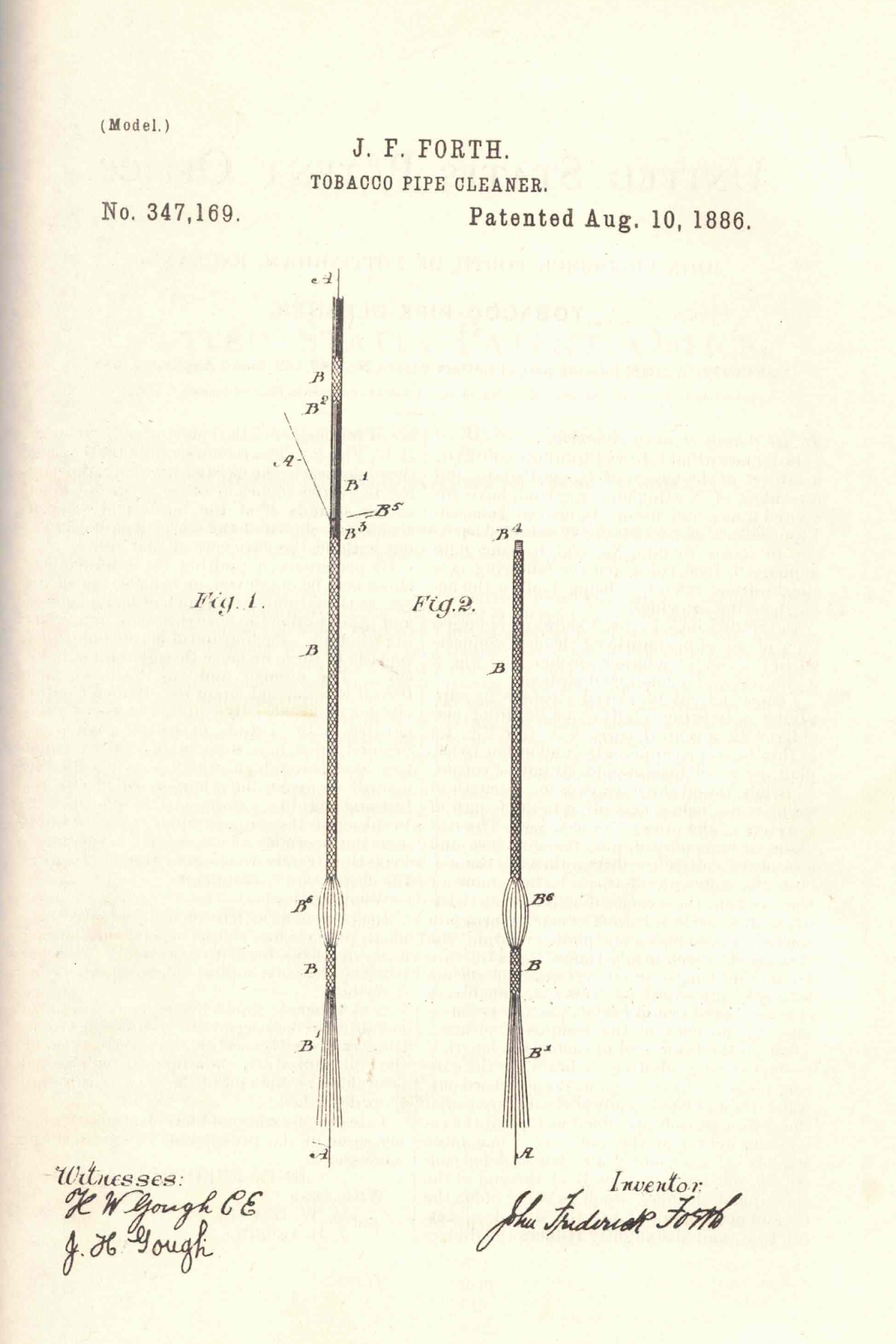
In 1886, for example, John Forth of Nottingham, England, applied for a U.S. patent for his Tobacco-Pipe Cleaner:
I construct my improved cleaners by supplying a twisting, plaiting, or braiding machine with a central core of thin brass or copper wire, and either twist, plait, or braid three or more strands of cotton firmly roud the wire core a length of six or more inches, according to the length of the stem of the pipe to be cleaned. The machine is then stopped, and the wire core and strands of cotton are drawn through the machine foa a length of three inches (more or less) without the strands of cotton being twisted, plaited, or braided. (670)
Forth's invention is obviously an ancestor to modern pipe cleaners, though it uses more and heavier-gauge metal with metal brushes at one end for aggressive internal scrubbing.
Patents like this are an indication of what was missing from the pipe world at the time and are attempts to fill the void. Multi-tools were also pursued, as with the combination tamper/stem cleaner of J. Strachan in 1889:
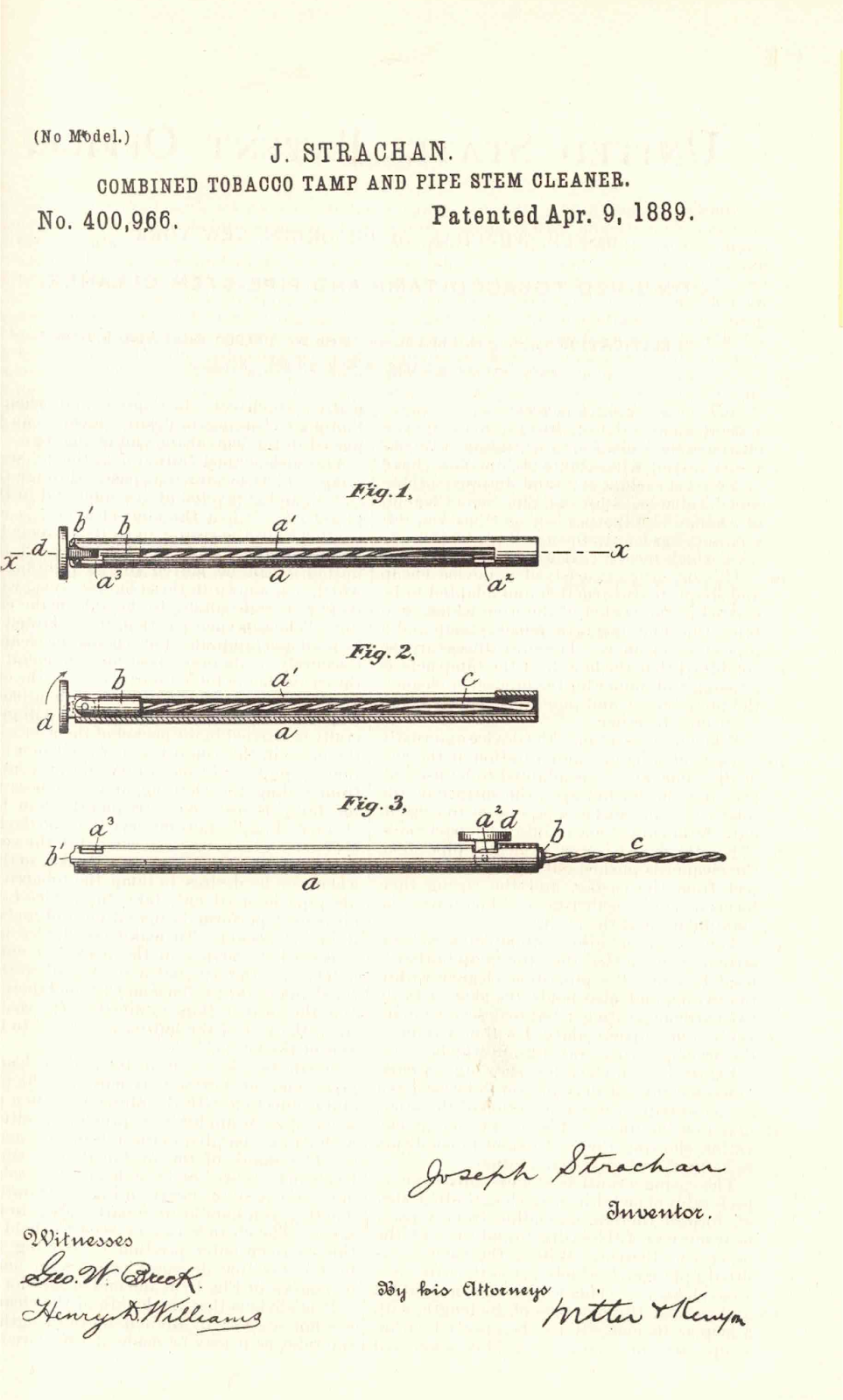
The twisting threads seem capable of pulling schmutz from the smoke channel, and the inclusion of a tamper foot just adds to its convenience. But it wasn't perfect. Moisture would still have been a problem, and it wasn't until absorbent, easily discarded material was employed that drier smoking seemed obtainable.
In 1892, Frank W. Carpenter submitted a patent approaching the moisture problem from an entirely different angle, writing in his application:
This invention has relation to tobacco-pipe cleaners, and has for its object the provision of a novel device for the use of pipe-smokers, by which tobacco-pipes of any shape or size may be readily and effectively cleaned when fouled by continued smoking and the accumulations of nicotine, etc., thoroughly removed without the necessity of washing or resorting to the disagreeable and only partially effective use of straws, wires, or the like. (827)
Carpenter's invention is a universal cap shaped as a mouthpiece for any size tobacco chamber. The device fits over the bowl of a pipe and is used to blow through it, ejecting moisture and debris via air pressure through the stem and out of the smoke channel at the lip button. The cap contains a screen so that ash doesn't blow back up at the user and can be used whether the pipe is lit or not.
... it wasn't until absorbent, easily discarded material was employed that drier smoking seemed obtainable
It's a pretty brilliant idea. Without pipe cleaners, blowing through a pipe was probably more prevalent and a good way to purge moisture from the smoke channel. But it's an offshoot of the evolutionary approach to the modern pipe cleaner.
We go even further afield with John Snyder's patent of 1896:
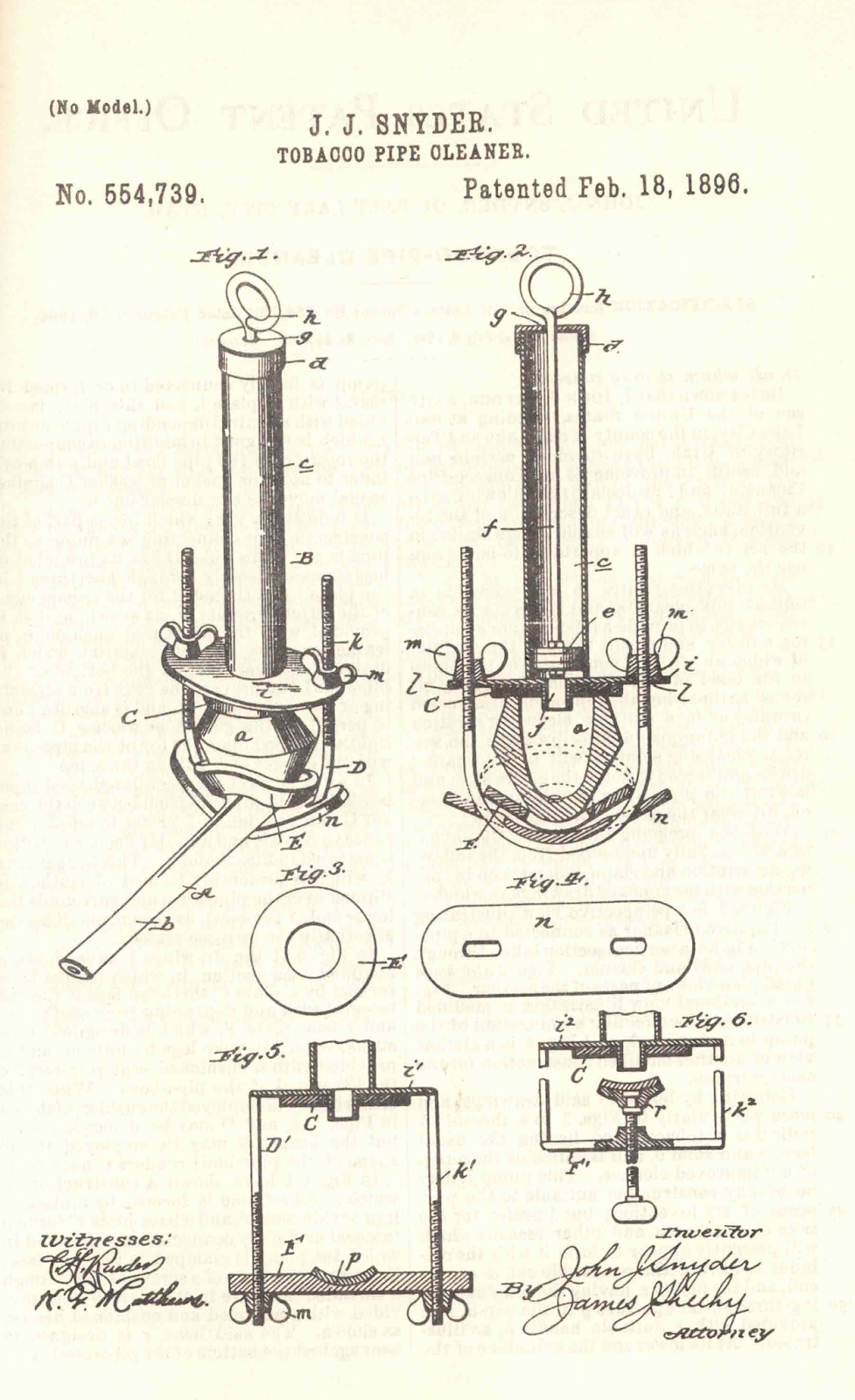
It looks pretty complex, and is not something to slip into the easily pocketable pipe-cleaner sleeves of today. It is obviously meant for thorough, after-smoke pipe cleaning and not for wicking away moisture while smoking. Its inventor writes that:
... it has for its general object to provide a pipe-cleaner comprising a pump and means through the medium of which an air-tight connection of the pump to the bowl of any pipe may be readily effected, so that when the pipe-stem is immersed in water or in a suitable cleansing solution and the pump-piston is reciprocated the water or cleansing solution will be alternately drawn and forced through the entire stem and bowl of the pipes, so as to quick and thoroughly clear the same of all sediment.
I like the word "sediment," but it is not as evocative as "schmutz." This machine reminds me of a famous pipe restorer from 25 years ago in California, Jim Benjamin, who was renowned for his results. He used a pump system with heated alcohol that may have been similar, though heating alcohol should be left to professionals and is not recommended for home use. Alcohol solutions, in my experience, are best in a glass with ice, or at room temperature for pipes. To inventor John Snyder's credit, he leaves the choice of solution to the user. It's interesting that several such pump devices were patented in the last decade of the century.
Without pipe cleaners, blowing through a pipe was probably more prevalent
A simpler patent, related more directly to modern pipe cleaners, was submitted by Ira Sturgis in 1896. He called it a "Device for Cleaning Tobacco Pipes," and it comprised a simple length of stiff wire with an eyelet in one end to thread a patch of cotton or other absorbent material. That aspect introduces a degree of reusability by virtue of the replaceable cotton cloth. The shaft of the wire was slitted lengthwise to provide a scraping action, helping to remove stubborn particles from the smoke channel.
Something even more closely related to the pipe cleaners we now know was also submitted in 1896, called, simply, a Pipe Stem Cleaner, invented by Frederick Frick of Rochester, New York. (Rochester, it seems, was a hotbed of pipe cleaner creativity during that era.) It's a disposable cleaner using small-gauge barbed wire as its core:
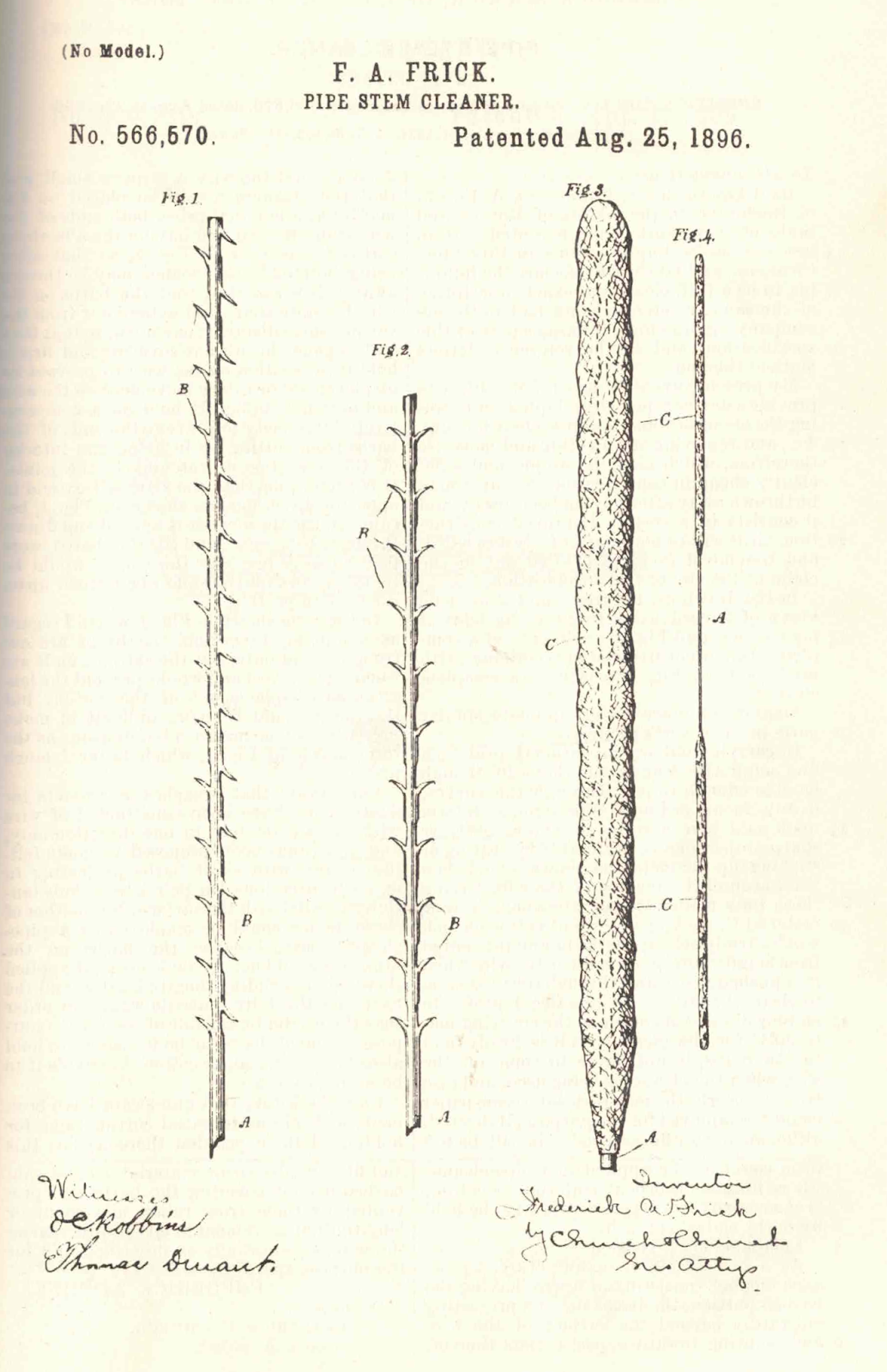
It isn't really barbed wire in the traditional sense but a wire with "a series of spurs, burs, or sharp projections, preferably by cutting or striking upon the metal." Cotton, tissue paper, or other absorbent material is then wound around the wire and the barbs keep it in place.
It seems like a recipe for gouging the smoke channel, which should be kept smooth to reduce turbulence and promote drier smoke. Though this invention is more similar to modern pipe cleaners than previous examples, it is far from practical.
William Blase's pipe-cleaning invention of 1898 is a little confusing. Called "Design for Cleaner and Smoke Deflector," it appears to be a metal wire, though the material is not specified, and is twisted, presumably to capture residue, which explains its pipe-cleaning purpose.
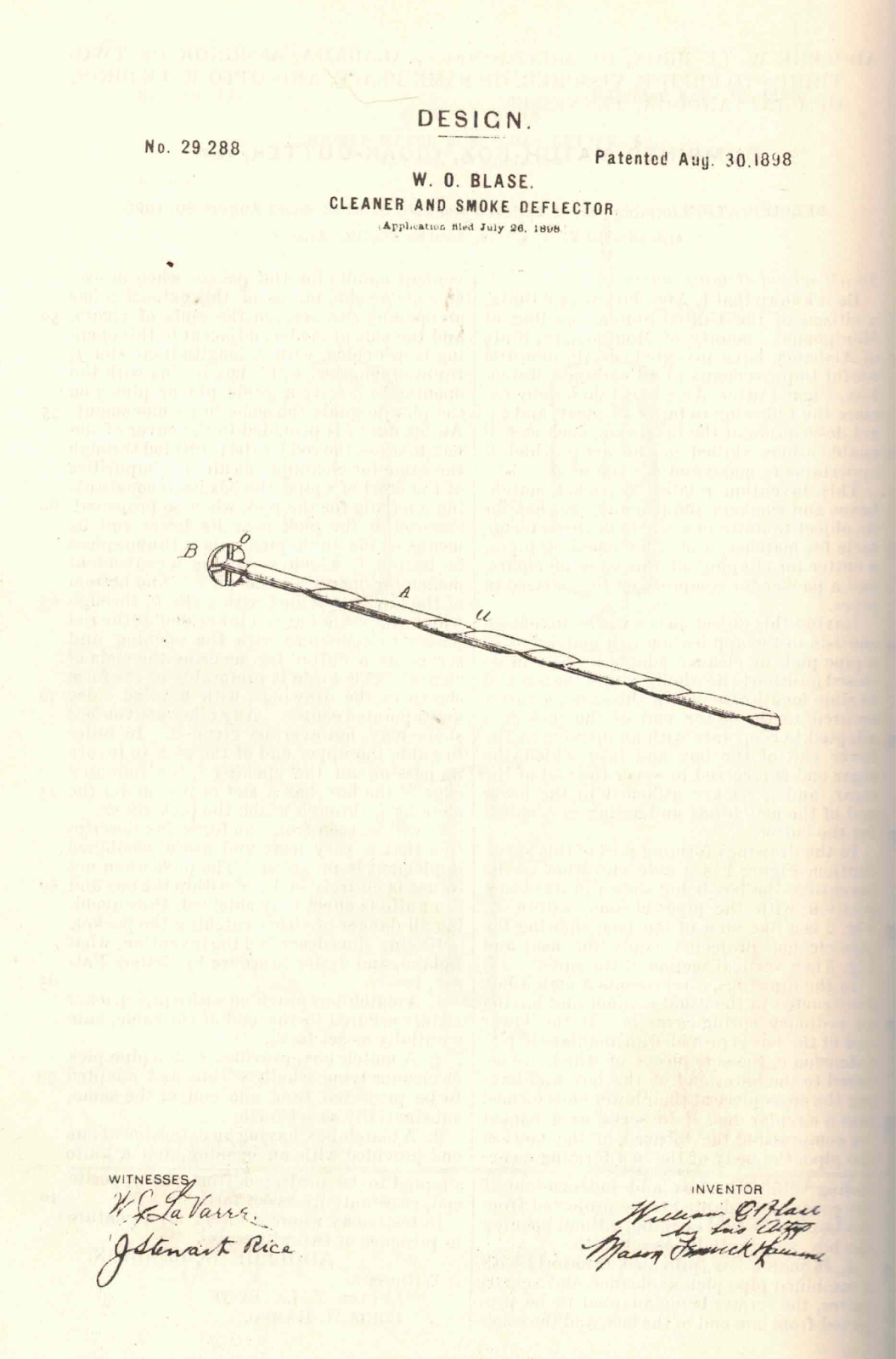
The "smoke deflector" aspect of the patent is harder to determine. The patent application reads only, "... my design consists of a stem which is provided with a spiral groove and having a head which on its underside is provided with radial grooves." There is no explanation of how this device deflects smoke.
However, Mr. Blaze submitted a modified design two months later:
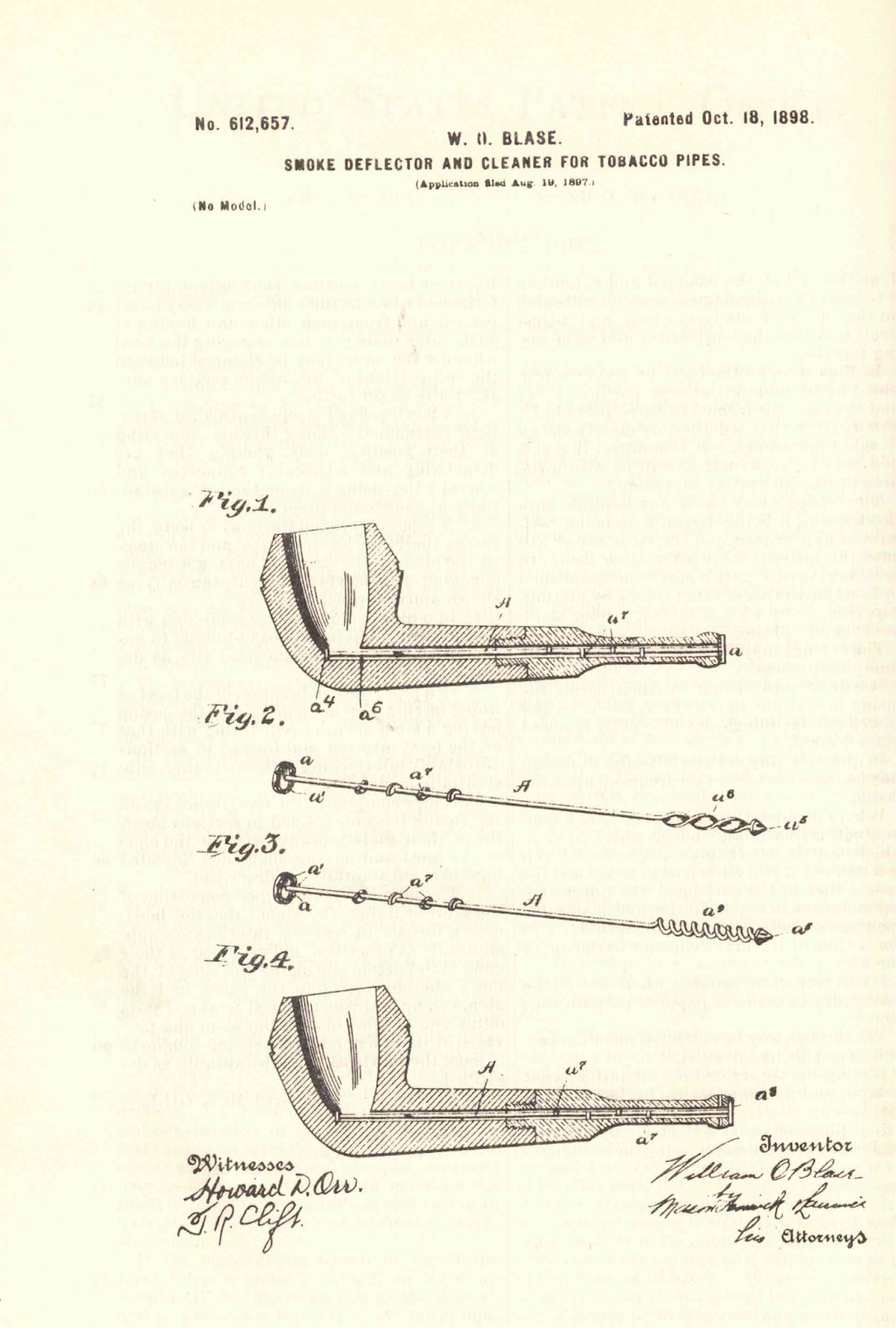
This version explains that the device is intended to remain inside the smoke channel, which would certainly deflect smoke, though it's hard to understand how any sort of draw might remain. It would be removed to clean the pipe and includes a scraper to dislodge impurities. The text provided is more in-depth than the previous model, and the question of material is answered: "... my improved smoke-deflector and cleaner ... consists, preferably, of a solid piece of suitable material — such as wire, hard rubber, wood, or wood fiber...."
It's a pretty complex device and resembles various spiral filters that would come in later pipe designs. By 1898, we had not yet found good, cheap, absorbent, disposable pipe cleaners.
The technique of blowing through the pipe to eject impurities was revisited in 1899 by John Craig in his patent application for a Tobacco-Pipe Cleaner.
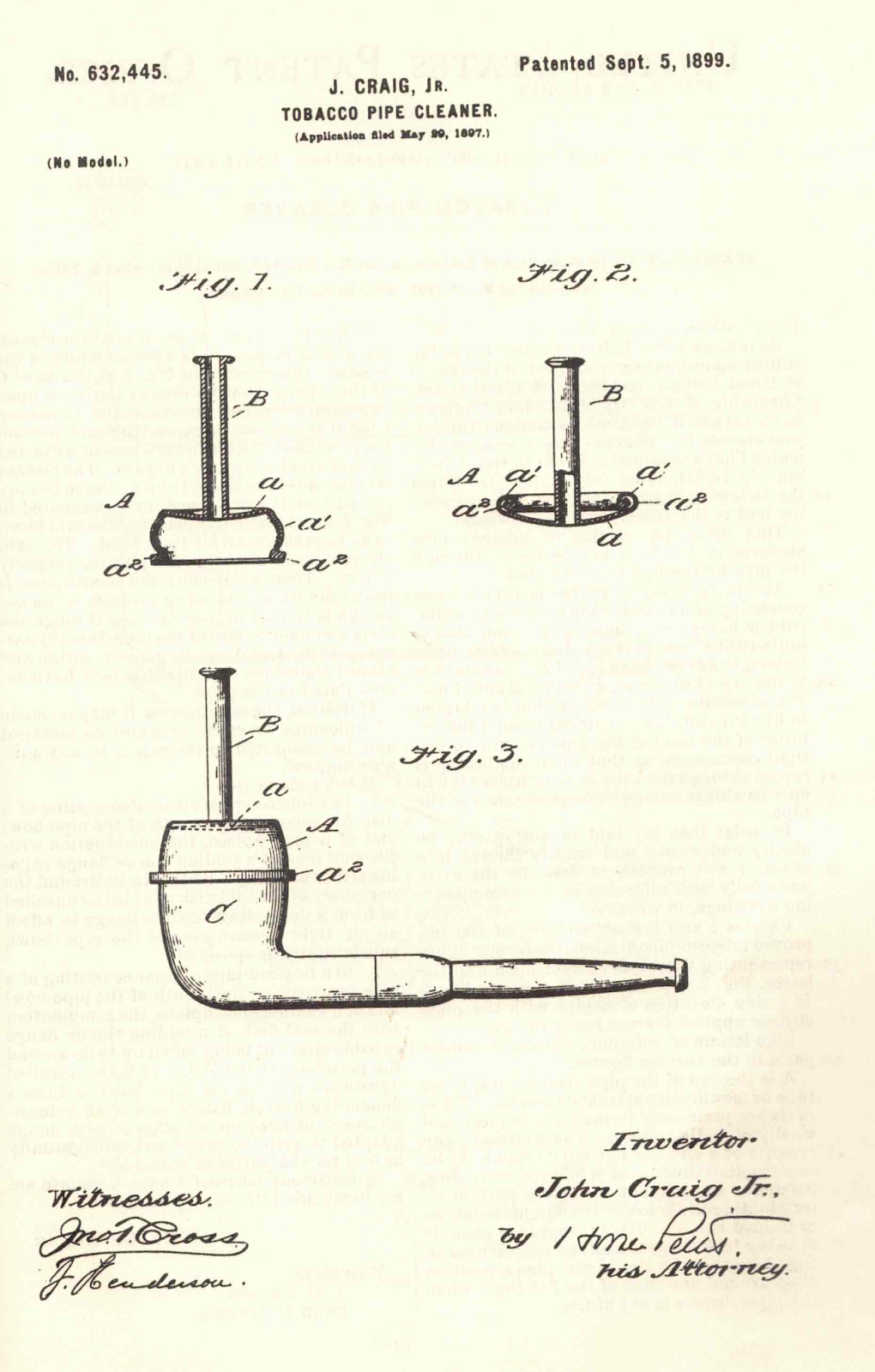
Like Frank Carpenter's patent of 1892, Craig's design provides a mouthpiece attached to a disk that provides an air-tight seal with the tobacco chamber:
I provide a cap consisting of a circular top or cover of india rubber having a cylindrical portion, also of india rubber, which is capable of rolling up to lie snugly around the edge of the circular top of the cap when the pipe-cleaner is out of use. The aforesaid cylindrical portion is adapted to fit with sufficient tightness around the exterior of the bowl of the pipe to form an air-tight connection so that when the breath is forced through the tube or mouthpiece, it will only be able to escape through the stem of the pipe.
By the end of the 19th century, patents for pipe cleaning were still proposing devices for blowing impurities forcefully from the pipe. The Stedman and Angel design for modern, absorbent pipe cleaners would arrive just a few years later and solve most of our pipe moisture and cleaning problems. A search of patents revealed no application for the pipe cleaners they developed and that B.J. Long acquired, and the exact date is lost, but sources always refer to "early 1900s."
Today we have absorbent, disposable pipe cleaners in a variety of designs for different applications. We have regular cleaners, fluffy cleaners, Churchwarden-sized cleaners, adjustable-length cleaners in continuous coils to be cut as needed, bristle cleaners for aggressive scrubbing, and tapered cleaners for multiple tasks. Pipe smokers of 150 years ago couldn't yet dream of the practicality, convenience, and economy that is now at our disposal.
The Stedman and Angel design would solve most of our pipe moisture and cleaning problems.
What's particularly interesting is all the inventiveness, trial-and-error, and experimentation that preceded modern cleaners. Pipe smokers struggled for decades to find the solution to the moisture that naturally develops as tobacco burns in a pipe. It's notable, too, that most of the patents appear in the 1890s, 40 years after the advent of the briar pipe, when pipe smokers had obviously become disillusioned and impatient with available remedies. While Charles Peterson pursued his System patents that would make pipe cleaners less necessary, others chose to keep developing new external devices to make smoking dryer and less prone to tongue bite. Today, we're lucky enough to have both.
Pipe cleaners are simple accessories that have enormously improved the pipe-smoking experience, but they didn't materialize from a vacuum. Experimentation went on for decades and discarded dozens of ideas and inventions before the advent of this essential tool in the pipe smoker's arsenal. It was a struggle of human innovation, and we're all beneficiaries of the ingenuity and resourcefulness that came before us.
You may also enjoy:







Comments
Great, informative, witty piece that fills in the period between reeds-and-feathers and the pipe cleaners of today.
Thank you for the history! I have often used a blade of grass or straw and a fine green twig or stem to clean my pipe while walking about without a pipe cleaner. I never thought about "how" it was done by our ancestors until reading this and of course realizing they did the same thing. A feather - have not tried that (yet)! Cheers!
@Fire Oak: Before you go picking up random feathers found on the ground, just know that bird feathers can carry a host of unsanitary thing-a-ma-jiggers, i.e., bacteria, parasites (like mites and lice), viruses, and even allergens which can potentially be harmful to humans. This public service announcement was brought to you by, 🎵Sunny Day
Sweepin' the clouds away...🎶Can you tell me how to get,
How to get to Sesame Street...
How to get to Sesame Street
How to get to...🎵(I think you can find it airing in the desert somewhere 🌴🐫) -🦆💣💥
Enjoy reading your stories.
Interesting and informing.
Kudos, Chuck. Another informative article. Thank you.
Always enjoy your articles Chuck. I was born and raised in Rochester and didn’t know this. He could boast about Kodak, Xerox and Bausch & Lomb, but pipe cleaners were never discussed! Thanks again 😊
What about John Harry stedman (he had a cool mustache btw)
What about John Harry stedman (he had a cool mustache btw)
One need only leave a clay in the fireplace for a few >minutes to burn away all of its internal impurities.
I did this once while I was smoking a clay pipe. I put one in the fire and it came out clean. I thought this works good so I put the clay I was smoking in the fire. Mistake, it cracked. I learned the hard way.
I have addressed the moisture issue by smoking the tobacco a little on the drier spectrum. However, if you are a clincher, this strategy does not work. I cannot smoke a pipe and work with my hands due to the excess saliva produced.