


 |
|
 |
|


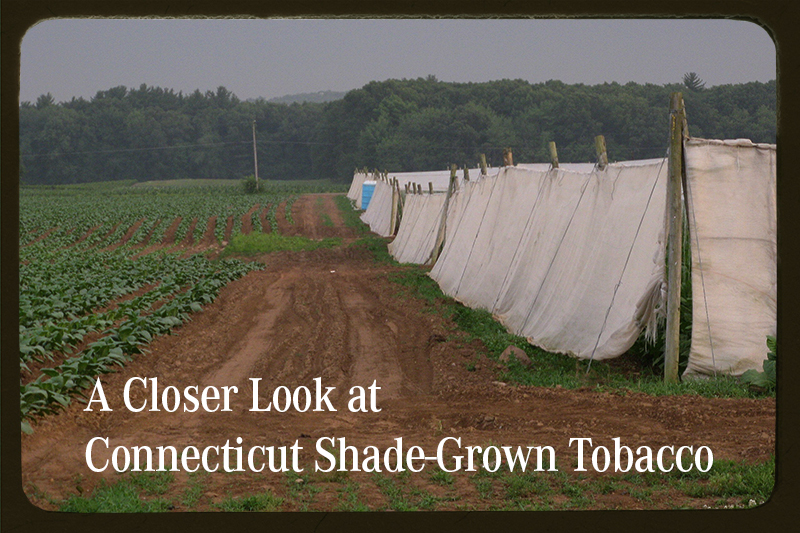
Tobacco field with shade tents in East Windsor, Connecticut
Connecticut shade-grown tobacco is one of the most sought-after leaves for cigar wrappers. It's beloved for the complex smoking experience it creates while remaining creamy and mild. The process utilized to grow this tobacco leaf is quite interesting, and it is still used today to realize wrappers for some of the world's most popular cigar brands.
What Is Connecticut Shade-Grown Tobacco?
Connecticut shade-grown leaf is named after the practice of erecting tents made of cheesecloth or a synthetic alternative, like nylon, which protects the tobacco from the sun and promotes a lighter complexion and a mellower body, once cured and fermented.
The "Tobacco Valley," or Connecticut River Valley, runs from Springfield, Massachusetts, to Hartford, Connecticut. Hundreds of years ago, farmers imported seeds from Virginia and began growing tobacco in the valley. By the mid-1800s, this area became a center for cash-crop production.
In the 1830s, Cuban tobacco seed came up the east coast with migrants, and after Connecticut tobacco growers cross pollinated the plant with local varieties, a more resilient and pleasing hybrid emerged, one that is more resistant to irritants, such as insects. As cigar smoking rose in popularity in the United States, commercial tobacco production grew immensely. Broadleaf and Havana leaf were the most popular varietals, making excellent binders.
Windsor, Connecticut, became renowned for its sandy loam — the ideal soil for tobacco growth. The silty soil is a result of glaciers that scraped the northeastern United States as they crept down from the Arctic centuries ago. Here, farmers began specializing in growing tobacco for binders and wrappers.
However, with the rise of Sumatran leaf from Indonesia in the 19th century, these farmers had to find a way to grow tobacco in similar conditions that would result in a similar smoking experience to combat their competition.
Farmers faced many trials while trying to replicate the character of Sumatran leaf. At first, they tried to grow Sumatran-seed tobacco crops like any other tobacco, yet failed as the leaves were burned by the sun. Since the typical growing conditions of Sumatra were shadier and cooler, and the weather was typically overcast, their tobacco was not subjected to the same harsh sun rays. Eventually, one experiment proved successful — utilizing tents to mimic the natural coverage of Indonesia's rainforests.
According to historian Dawn Byron Hutchins: "By 1899, W.C. Sturgis, a botanist in Connecticut, was successful in growing Sumatran tobacco from seed and reproducing the thinner leaf." Farmers began growing tobacco in the shade in 1900, on a plot of land on River Street in the village of Poquonock. By 1901, fifty acres were used for shade-grown tobacco production, and by 1910, this method of tobacco growth was well established in Connecticut.
"Marcus Floyd, the USDA's leading tobacco expert at the time and a Florida native, came to Connecticut to oversee the first crop of this experimental tobacco known as shade tobacco. The product proved equal to the imported leaf," states Hutchins. Shade-grown methods cut down sun exposure and raised humidity levels to re-create the humid and shaded environment where Sumatran leaf was grown in Indonesia.
The resulting wrapper leaf was thin and matched the quality of Sumatran leaves: milder and more delicate, delivering a smoother smoking experience. The success of this experiment was the catalyst for the shade-grown tobacco era in Windsor, leading to the town becoming the largest producer of tobacco in the state.
Jon Aguilar at Klaro Cigars expands on this topic, "This hybrid strain is the result of combining the original Connecticut Broadleaf tobacco with Sumatran and Cuban seed strains back in the early 1900s. Light in color, elastic, and silky to the touch, Connecticut shade-grown is often mild tasting, thus making it the 'gold standard' when it comes to claro natural cigar wrappers."
While true Connecticut shade-grown tobacco is grown only on Connecticut soil, this method of growing tobacco under the shade is now common all around the world, from the Dominican Republic and Nicaragua, to Cuba and Ecuador. In the mountainous growing regions of South America, such as in Ecuador and Nicaragua, continuous cloud coverage, mist, and fog from surrounding rainforests and airborne volcanic ash form an organic canopy for shade-grown varietals to flourish.
Connecticut Shade vs. Connecticut Broadleaf
There are several distinct differences between Connecticut shade and Broadleaf varietals. Cigar expert Juan Panesso explains a variety of characteristics that differ the two, starting with how the crops are grown. While Broadleaf is given ample space between each plant, growing up to three to four feet, shade-grown crops are grown closer together to provide more coverage from the sun, and shoot up to anywhere from eight to 12 feet, averaging a foot in width and 18 inches in length.
Broadleaf pulls nutrients from the stalk during the curing process, so the whole plant is "stalk-cut" and brought back to the curing barn intact when harvested. This process takes more preparation than that of its shade-grown counterpart. To make a Broadleaf a Maduro, it requires several additional weeks of fermentation, resulting in darker brown Maduro leaves. These plants are piled in pilones, which get hot and moist, allowing the leaves to develop further.
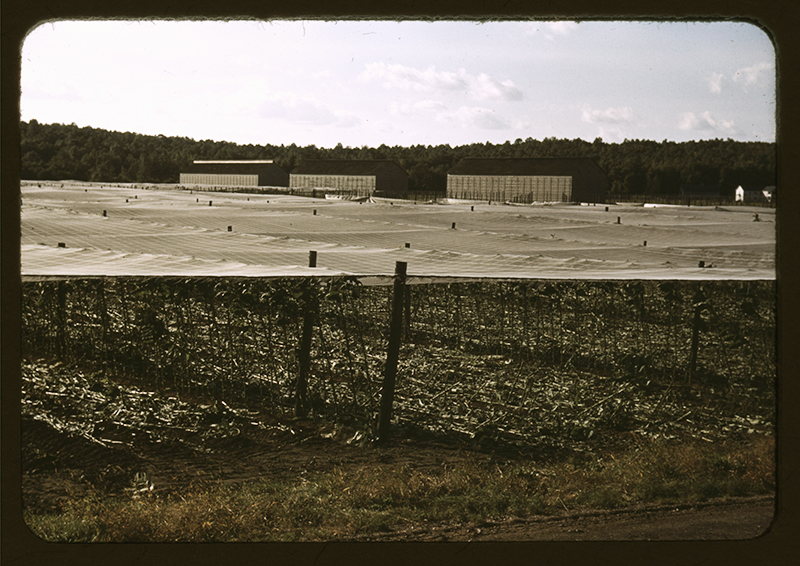
Cheesecloth covering used in growing shade-grown tobacco; The stalks lying on the ground are left after the tobacco is cut; Suffield, Connecticut
Shade-grown leaves are harvested in primings. "The growing season begins in May with weeding and transplanting seedlings in long rows," says Hutchins. "As the plants grow they are fastened to guide wires, and then cloth tents are spread over them to increase humidity, protect the tender plants from direct sunlight, and maximize the short New England growing season."
Another cigar expert, David Savona, describes the hot temperatures beneath the man-made coverings. "While the tents filter out direct sunlight, they raise the heat, and sweat blossoms on a visitor's forehead five steps under the tents. The air inside is heavy, hot and humid. Farmers say that when the temperature hits the upper 90s... their plants can grow two to four inches in a single day."
Once the crops have grown, leaves are cultivated by hand from the bottom of the plants, which is arduous work. In the height of shade-grown production, workers would spend weeks in humid conditions pulling off shoots and tobacco worms. Multiple harvests would then be brought to sheds or barns for stitching, where the workers sewed the leaves together to string onto a wooden lath, which were hung up in the rafters of the slat-sided tobacco barns to cure for up to six weeks.
According to Dave Altimari of CT Mirror, over 70 years ago, sewing machines and upside-down conveyor belts were created to assist in stringing the leaves together. Once the leaves are dried, they are moved to sorting sheds, where processing continues for shipping to cigar manufacturers.
Shade-grown leaves must be handled with great care. The smallest imperfection can degrade the value of the leaf. Since these leaves are intended for use in wrappers, they have to be free from any blemishes. Natural occurrences like rain can stain a leaf, and blossom rot can occur when parts of a flower fall on a leaf and decompose. Tobacco plants in Connecticut are not topped, or removed of their flowers, so this risk grows. Much like rain, hail, or a windstorm can impact the crops, human interference can also cause blemishes that damage crops, rendering them unsuitable for wrapper leaf.
Broadleaf and shade-grown tobacco offer two very unique experiences. While Broadleaf is thick, oily, and big in size, turning a dark brown color after fermentation, and is lightly sweet, with an earthy flavor profile, shade grown is a light green color while growing, and after the curing and aging process, it turns a molted yellow to a light-golden brown color, like sand. The resulting leaves are thin and provide notes of coffee, cedar, nuts, and cream.
Connecticut Shade-Grown Tobacco Today
Today, to conduct the Connecticut shade-grown process, nylon mesh is used more frequently than cheesecloth. "Tobacco plants can surge two to four inches in a single day as the nylon shade encapsulates the intense heat and humidity," according to Shane K. at Holt's Cigar Company. Aside from this alteration, the process hasn't changed much in the many years it's been utilized.
Tobacco production in Connecticut is not what it was at its peak in the 1930s, when about 30,000 acres grew tobacco. Now, roughly 2,000 acres are dedicated to tobacco production as a result of the decline of cigar smoking. Despite this reality, many of today's best-selling cigar brands rely on Connecticut shade-grown wrapper leaf to achieve a consistent taste that is celebrated. Wrapper leaves are the most expensive components in any handmade premium cigar, but Connecticut shade-grown wrappers have maintained popularity due to the leaf's refined flavor and elegantly subtle sweetness.
The Impact of Connecticut Shade-Grown Leaf
At shade grown's height in popularity during the first half of the 20th century, more than 16,000 acres were under cultivation in Connecticut, according to Hutchins. Due to this success, farmers needed support to complete their operations.
As World War I loomed large and workers dwindled, these farmers relied more on migratory labor. Since immigration restrictions accompanied the war, local farmers had to draw their seasonal labor from college campuses and high schools in surrounding areas. At first, Connecticut farmers sought students from schools in Virginia, North Carolina, Florida, and Georgia in the early 1900s through the 1930s before broadening to other southern states, the Caribbean, and small towns in Pennsylvania.
This seasonal work over summer breaks afforded students new opportunities away from home, as well as a reprieve of sorts from the segregation they experienced down south. In return for their labor, they were offered transportation and funds toward their education. An ongoing relationship between the farmers and students continued for more than 50 years. "Among the thousands of black Southern students who seasonally came north was a young Martin Luther King Jr," notes Hutchins.
She explains that many of the students who worked in the north over summers went on to achieve success in a variety of fields. Aside from the most noted example of Dr. Martin Luther King Jr., "The Luddy-Taylor Tobacco Museum in Windsor holds hundreds of Morehouse employment cards from the Cullman Brothers in the 1930s. A brief search yields a cross-section of future teachers, doctors, lawyers, religious leaders, and other professionals, some of whom returned to the North to establish their families."
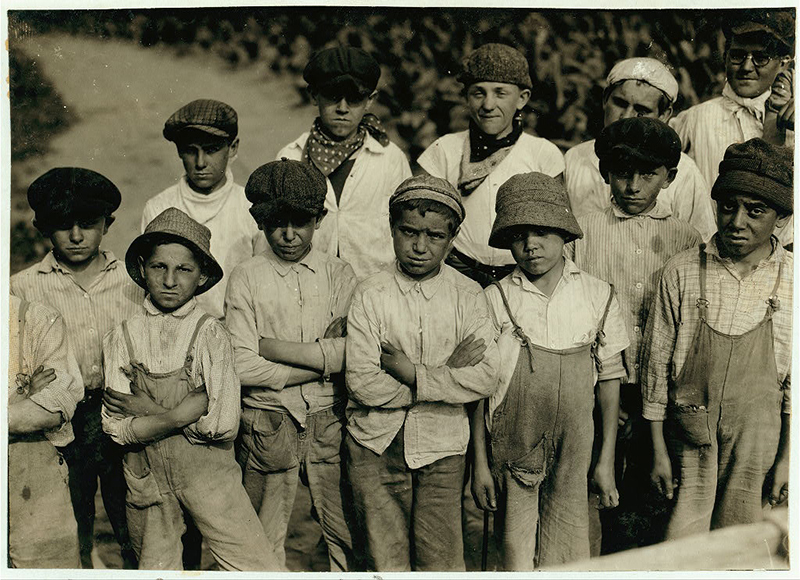
Field workers, at the Goodrich Tobacco Farm near Gildersleeve, Connecticut, 1917
Unfortunately, among these young workers were children, before the passing of Connecticut's Child Labor Bill in 1947. Farmers took advantage of child labor locally. These young people would be brought on trucks early in the morning to pick leaves and prepare them for curing in the sheds, and would be returned home at night. As to be expected, they were low cost for the farmers. Many of the workers assigned to the curing process were historically women.
This arrangement would change during the era of World War II and after the passing of the bill, leading to further labor shortages for the farmers. Thus, they looked to the West Indies for help. Starting in 1947, laborers from Puerto Rico and Jamaica came to Connecticut by the thousands to work in the tobacco fields, according to Hutchins. Many would settle in the area, making a significant impact on local demography.
Beyond the impact of shade-grown leaves on the cigar industry, this varietal also impacted the lives of farmers and those who came from far and wide to grow and cultivate the tobacco. The impact of this tobacco doesn't end there.
Today's top cigar brands, from Drew Estate to Lost & Found, Dunbarton to Foundation, Rocky Patel to Dapper, Arturo Fuente to Caldwell, and countless others on-site, continue to utilize Connecticut shade in their components, and it is still widely considered to be one of the most desirable wrapper leaves on the market.
Given the necessity for the plant to be free of any imperfections, it is quite a tricky tobacco crop for farmers to cultivate. However, the smooth yet complex smoking experience it elicits makes their efforts worthwhile for our favorite brands to procure and wrap over their iconic premium cigars.
Bibliography
- Aguilar, J. (2022, October). The Connecticut Disconnect: Misunderstanding America's favorite homegr.Klaro Cigars.
- Altimari, D. (2025, August 10). Laboring in the Shade - connecticut history: A cthumanities project. CT Mirror.
- K., S. (2025, January 6).All about Connecticut Shade Tobacco & Wrappers. Holt's Clubhouse.
- Hutchins, D. B. (2023, September 26).Laboring in the Shade. Connecticut History | a CTHumanities Project - Stories about the people, traditions, innovations, and events that make up Connecticut's rich history.
- Panesso, J. (2022, July 19).The difference between Connecticut Shade-grown and Connecticut Broadleaf Tobacco. Cigars Direct.
- Savona, D. (2017, July 28).Made in the Shade: Connecticut shade. Cigar Aficionado.
- N.D. (2024, May 14).Windsor Tobacco: Made in the Shade - connecticut history: A cthumanities project.Connecticut History | a CTHumanities Project - Stories about the people, traditions, innovations, and events that make up Connecticut's rich history.
You may also enjoy:






Comments
Nice read. I love to read about tobacco and its history. Well done.
please take my comments seriously.
I am trying very hard to follow instructions. I admit too having very limited computer abilities.
ok I giveup. but you did force me to type my favorite word flake