


 |
|
 |
|


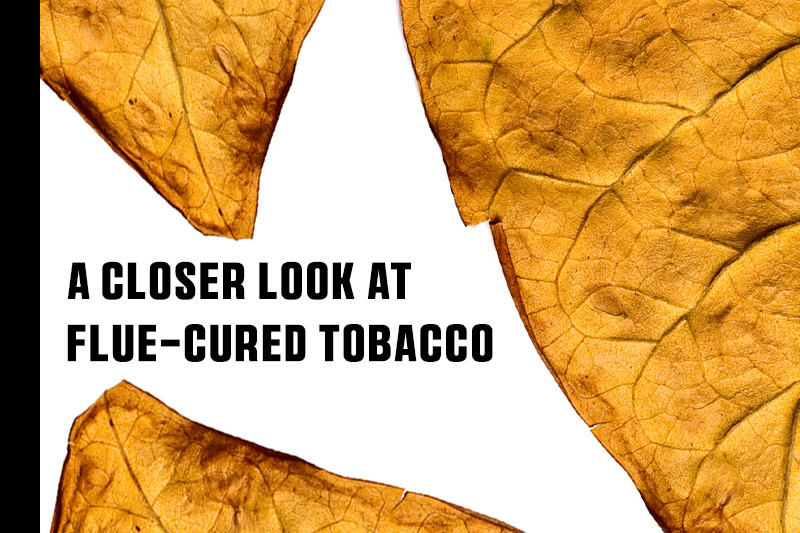
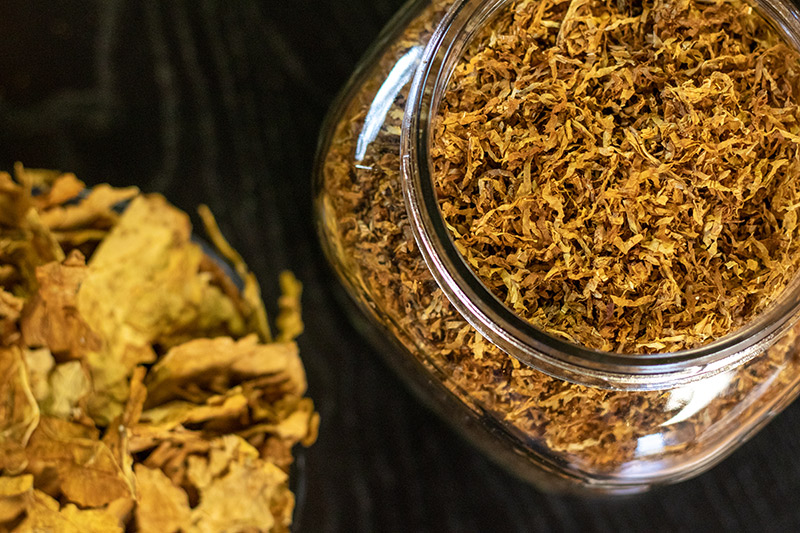
Flue-cured leaf, more commonly known as Virginia tobacco, is the most popular tobacco family in our industry. It is also the largest tobacco crop in the United States, making up about 90% of tobacco production. Flue-cured is mild, naturally sweet, and excellent on its own or combined with other varietals, like Burley, Perique, and Orientals. Today, we'll be diving into the world of flue-cured leaf, with the help of Cornell & Diehl's Director and Head Blender, Jeremy Reeves.
Origins of Flue-Cured Tobacco
Virginia leaf originated in the early 17th century in the North American colonies, though its characteristics have changed dramatically over the centuries. John Rolfe experimented with Caribbean tobacco, Nicotiana Tabacum, a sister plant to N.A.'s Nicotiana Rustica varietal in the 1600s, bringing seeds of N. Tabacum from Trinidadian to Virginian soil.
At that time, Europeans developed a taste for the sweetness of N. Tabacum, preferring it over the earthy, comparably more bitter character of N. Rustica. Rolfe sought to capitalize on this preference to see if N. Tabacum could thrive in Virginia as well. When planted in the rich land of the James River, it produced a milder leaf that became the standard, leading to more tobacco cultivation in the colonies to meet increasing demand from pipe smokers who delighted in it.
Production spread from this area to the Blue Ridge Mountains over the next 160 years, according to John and Emily Jones Salmon: "Rolfe's successful tobacco experiments inspired others to begin planting available land in Jamestown and in the settlements along the James River." The yield was staggering, amounting to approximately 60,000 pounds of the crop that year alone. This tobacco was closer to lighter, sweeter Burleys compared to the Virginias of today; It wasn't until the early 19th century that innovations in curing would result in the leaf we identify as Virginia in the modern context: flue-cured.
What Is Flue Cured & Its Characteristics?
Virginia is a blanket term for all tobacco that is flue cured, as noted by Jeremy: "We tend to talk about flue cured as being Virginia leaf but it doesn't all come from the state of Virginia in the United States. On the leaf side, you don't really hear the term Virginia used. We just talk about it being flue cured." For those who say they enjoy Virginias, what they really mean is that they like a flue-cured style of tobacco. "Flue cured is primarily prized for its naturally sweeter character," says Jeremy. "It can carry bready or hay notes but it can also bring some fruity elements into the mix. Citrus, in particular, is very common to pick up on with Bright and Orange leaf."
Because Virginias are primarily defined by their curing process, they can be sourced from numerous regions beyond their historical origins, including Canada, Zimbabwe, and Brazil, as well as other areas of the United States, like North Carolina. However, the name will always commemorate those first seeds planted by Rolfe in Virginian soil.
For those unfamiliar with curing, this process is crucial to preparing leaves for use in tobacco blends. Paul Sumner and J. Michael Moore refer to curing as an art in a piece for the Cooperative Extension Service at the University of Georgia College of Agricultural & Environmental Sciences. The leaves need to be cured, or dried out, because of excess moisture in the leaves when grown. "Curing develops and preserves the potential quality, flavor and aroma of tobacco," says Sumner and Moore. The natural tannins that are released while curing also increase the sugar content, leading to the sweet and mild taste that this varietal is so renowned for.
One of the most defining characteristics of flue-cured tobacco is that it has a naturally higher sugar content due to where it grows, primarily in sandy soil. Since the plant has to work harder to get its nutrients in these conditions — think of it like a plant trying to get nutrients through glass — it produces more sugar as a way to fuel the plant to be able to grow in that kind of environment. Once the tobacco leaves grow, harvesting begins.
Harvesting the Crop
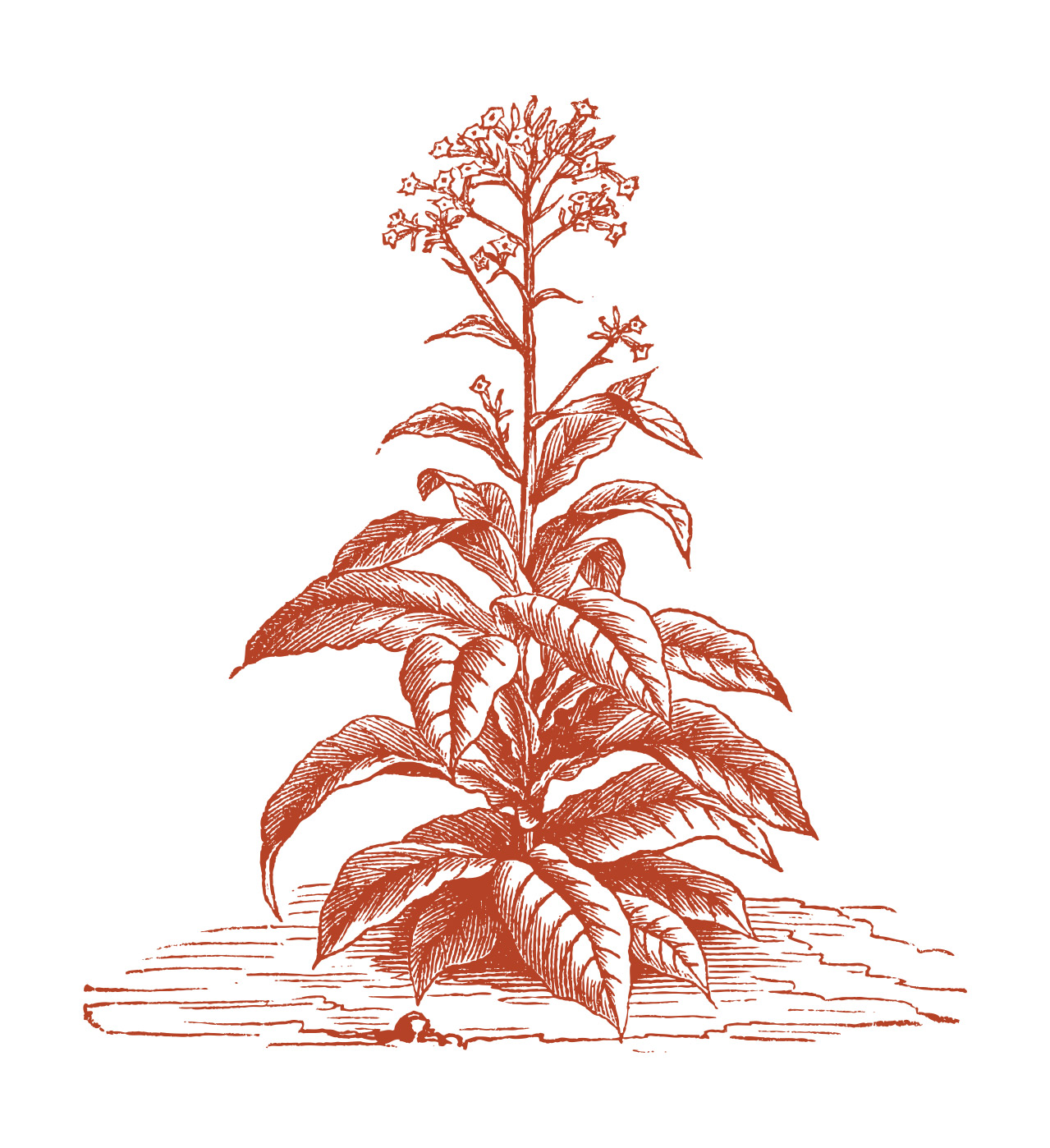
Before the curing process, tobacco must first be harvested. When it comes time to harvest, what farmers look for is optimum ripeness. "Under normal conditions," says Jeremy, "flue-cured tobacco ripens two-to-four leaves per week, so it requires a harvest rate of two-to-four leaves per plant per week for five-to-seven weeks."
When the leaves are harvested ultimately depends on the priming; Priming refers to the position on a tobacco plant that leaves grow and what purpose each section's leaves might serve. Tobacco leaves are primed, or removed from the plant, at varying times depending on its position on the crop. "The reason for priming," says Jeremy, "is to maximize ripeness at each section of the plant to be able to capitalize on the added sweetness that tobacco style can bring." Since leaves are left on the stalk for varying amounts of time and some are cured for longer, that is where the shades of leaf come from: Bright and Golden to Red, Orange, and Mahogany. There are three steps for flue curing: yellowing, leaf drying, and stalk drying, and the whole process takes about a week.
On a tobacco crop, there are various different primings for leaves — tips, leaf, cutters, and lugs — which are harvested at different stages. Let's take a closer look at each priming:
Tips are the top leaves of the plant, which get the most sun and where the plant pushes all of its energy. "Those leaves are quite strong in nicotine," says Jeremy, "and they can actually stay on the plant later into the growing season." Your tips are comparable to Ligero in cigars.
Leaf can be found underneath the tips. "I know that is confusing because they're all leaves but leaf refers to the upper third of the plant. That is where we primarily get our Red or Mahogany Virginias from. They're essentially allowed to become overripe." Leaf stays on the plant longer than lower down the crop, with harvesting occurring in September or October.
Cutters are below leaf, which is where you will get brighter shades of Virginia, like Orange or Lemon. Lemon is pretty uncommon, according to Jeremy. "In fact, unless you're here in the Low Country region of South Carolina, your cutter is going to be lighter but it won't yield that shade." Cutters are harvested in July or August, depending on weather conditions.
Lugs are the priming at the bottom of the plant. "As the plant matures," says Jeremy, "you start harvesting in sections, starting from the bottom, where the lugs are. These leaves hang in the dirt and get almost no sun, so they have the least amount of nutrition." The crop is trying to grow as tall as it can and produce as many leaves as possible. Since those leaves at the bottom suck up energy, they get cut off first. "Lugs are used as filler. For cigarette manufacturers, there's lots of use for them, whereas for a pipe-tobacco manufacturer, you don't really have use for them."
The discernment of a blender like Jeremy is to understand what leaves work best for blends, and flue-cured tobacco is used in a variety of C&D blends that call for "Virginias."
How Does Flue Curing Work?
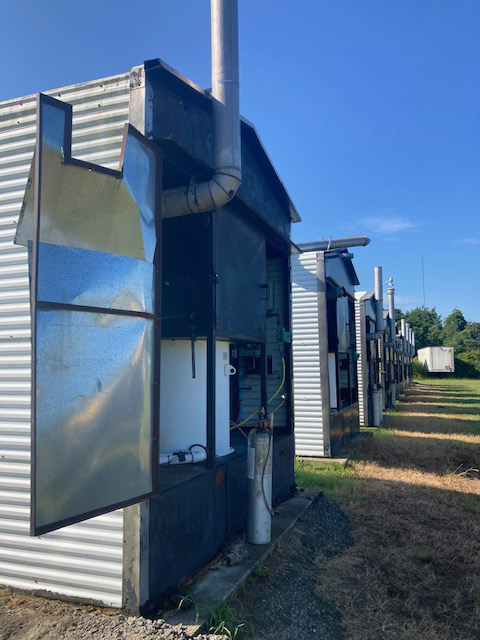
Flue Curing Barns
Now that we know what characterizes flue-cured leaf and have a better grasp on the different primings on the crop, how does the flue-curing process actually work? The flue-curing process comes after the leaves' harvesting from the field to minimize damage. The leaves experience a gradual increase in temperature, reaching anywhere from 100 to 175 degrees Fahrenheit. According to Sumner and Moore, the best quality cures occur when the tobacco is fully matured in the field, with good quality, color, and weight.
Unlike the longer-standing air-curing process, which involves drying tobacco leaves in open air, and fire-curing, which exposes tobacco directly to fire, flue curing uses indirect heat inside closed barns to dry the leaves to remove excess moisture. "Flue curing got its name," says Jeremy, "because the old barns that were used to cure this tobacco were basically heated by fireplaces that faced the outside of the barn and then chimneys that were in the walls of the barn. That flue, or chimney, is just radiating heat from the fire to cure the leaves." This process dries the tobacco at a quicker rate, thereby preserving much of the leaves' natural sugars and resulting in a yellow color. "That flue curing is what contributes to Virginia-style tobaccos really capitalizing on their naturally high sugar content."
Flue-curing was an accidental discovery in the 19th century by Abisha Slade, a tobacco farmer in Caswell County, North Carolina. As the story goes, when one of Slade's workers fell asleep while watching a barn of curing tobaccos, the fires died down. In an attempt to spark the flames back up, this worker used charred logs (some claim charcoal was used), and this sudden application of drying heat drove the moisture out of the tobacco, resulting in bright yellow leaves.
In the old days, it took a lot of effort to hang all the leaves in barns for the flue-curing process. Tobacco stalks were hung on long-tier poles that ran the length of a curing barn, known as oasts, according to Brad Christian at Total Leaf Supply. It was also difficult to maintain fire levels. The whole process of harvesting and curing required more than 200 hours per acre, according to Sumner and Moore. "You didn't want a steady one-size-fits-all fire level," says Jeremy. "The flue that is named flue cured comes from this style of curing the tobacco; using the radiant heat from a fire without putting the tobacco in the same area as the fire so there's no smoke contact."
Today, there are more mechanized and technological approaches to flue curing tobacco, reducing the amount of time per acre by 150 hours. "Most people do not use the old stick barns or manage their fires on the outside of the barn," says Jeremy. "We have little metal 'barns,' which are basically compartments that you can control the temperature, the humidity, and a cycle that you can run those things through to get the results that you want."
First, heat is spiked within the metal "barns," which essentially cooks the leaf enough so that the sugars are set. "You can think of that spike of heat having the effect of the crust on top of a crème brûlée," he says. "That's basically what you're doing; you're trying to harden that sugar and get it more baked into the leaf before you start the process of drying everything else down."
Within the leaf, sap and Chlorophyll, for example, are not desirable for tobacco use, so they are drawn out through the curing process. "Gradually, over a long period of time, we raise the temperature again," says Jeremy. "That gives you a very slow dry and cure time. Starting with a big shock of heat helps prevent the loss of too much sugar." This process occurs over a span of five-to-seven days without direct smoke exposure, resulting in a mild aromatic, high-sugar flue-cured tobacco with a bright yellow or orange color.
The source of the indirect heat in these curing barns is propane, which is used within a program on a set cycle. "Depending on what priming you're curing," says Jeremy, "you might run it through different cycles, taking the approach to get your Bright lemon color." This process is a bit like finding kindling for campfires; when you use green leaves, the colors change very quickly when burned. With flue curing, you're trying to achieve that first stage of yellowing. "You're bringing the leaf to that very first stage of being burned. It's never getting that hot but you're touching it very quickly to set the sugars."
It's also important to be able to control the humidity within the curing barns. "Too much or too little is bad," says Jeremy. "Being able to control the weather in the metal box gives farmers the results they want." These conditions are often computerized, with controlled systems to make the curing process more efficient. "The sap that is engorging all of the leaves as it ripens not only accounts for the nicotine that's in the tobacco but it also is carrying that sugar." As a result at the end of the flue-curing process, the leaves are ready to be blended with other components, or utilized on their own in bulk for personal blending purposes.
Flue-Cured Grading
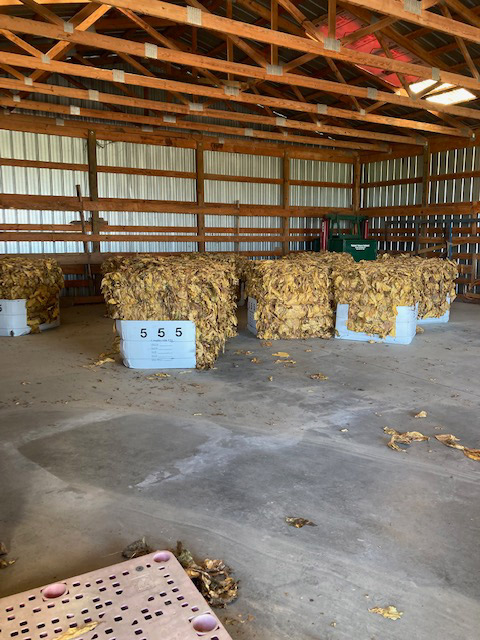
Flue Cured Leaf in 750lb. Farm Bales
For a long time in history, the United States was the largest producer of flue-cured tobacco. However, in recent years, Brazil has taken the top spot for flue-cured production. "You see tobacco of Virginia type grown in many different countries and climates," says Jeremy, "from Argentina to India, parts of Africa to Germany, Ukraine to Cyprus, Greece and many more." Due to this diversity of location and environment where the crop is grown, this results in a staggering 156 different flue-cured grades that can be described using USDA-grading tools.
Jeremy clarified that the grading system is nothing like a number or letter — for those who have flashbacks to getting back grades in school, you can exhale and relax, it's not that sort of grading. When we refer to grade in relation to tobacco, it refers to a particular lot. "It's not a pass or fail grade," says Jeremy, "it is a way of describing the conditions and there's a customer for any grade." Think of it like the difference between someone with blond or brown hair — it's not a judgement call, but rather, a simple description to differentiate.
Pipe-tobacco blenders like Jeremy have no interest in some of these grades, whereas a cigarette or chewing tobacco manufacturer relies on them for their products. "These larger consumers of tobacco are the reason that I'm able to get the prime cuts of leaf that we want without having to also take on all of the leaf that wouldn't make the cut to be used in a C&D blend." When Jeremy is working on C&D blends that call for Virginias, he generally considers them a useful component for adding sweetness. "If I'm looking for a sweetness that is a little more deep," he says, "and more pronounced, like something you'd find in molasses sweetness versus Karo corn syrup sweetness; the latter is driven by Bright leaf, and for something darker, I use a Red." Side note, the differences between Bright and Red Virginia are that, for Bright, it's the first priming, taken from the bottom of the plant, which results in thin, light-bodied, mild leaves. For Reds, they are harvested from the top of the plant and are cured at higher temperatures, resulting in darker, fuller-bodied, intense flavors in the leaves.
To maintain consistency in blends, Jeremy seeks out the same kind of tobacco grades over and over again. "They may not have these names or grades on them because manufacturers come up with their own internal grades. They like being able to use something that they've concocted to describe a grade that might be more difficult for another manufacturer to decipher. But it's something that they can tell the dealer." By the time it gets to the blender, like Jeremy, it already has a grade. "In a nutshell, our Red Virginia at C&D is a blend of a couple different grades of tobacco. One part is an overripe tip grade that is combined with a little bit of Orange upper stalk and Orange lower stalk. There's some depth of flavor but also brighter notes that are brought in."
All of those grades fall in the range of Red but the true USDA grade code that would be applied would be 4B3F: The two primary grades are B3 or B4F, B for leaf, T for tips. "Another grade of Virginia that we use a lot, though, is C1L and C1F coming out of Canada, C for cutters, L for lemon, and one or two, first or second quality." He clarified that first quality means that within a given lot of tobacco, 95% or greater of that lot is consistent, and consistent across 11 different quality conditions that would put it into that grade of first quality. Then, second quality means that you have about 85% of consistency across all 11 markers of quality, and the more varied those markers get, the lower the grade goes.
The flue-curing process is a fascinating example of innovation over the centuries to create the leaves that are utilized in many fan-favorite Virginia blends, including C&D's best-selling Briar Fox and the new Skyward Gate blend from their Summit Series, and plenty of others from manufacturers around the world. Virginias are more complex than expected when we break the varietal down by curing method. Dark Fired, sun-cured, and plenty of other methods are utilized for Virginia tobacco, which we will explore further in future posts. For now, I hope this was a helpful introduction into the most widely known tobacco varietal, Virginias, and the hard work and effort that goes into curing, grading, and sourcing flue-cured leaf for pipe-tobacco blends.
Bibliography
- Christian, B. (2021, December 16). What is flue cured tobacco? - Whole Leaf Tobacco Blog. Total Leaf Supply.
- Salmon, C. E. J., & Salmon, C. J. (2025, February 13). Tobacco in colonial Virginia. Encyclopedia Virginia.
- Sumner, P., & Moore, J. M. (1993, February). Harvesting and Curing Flue-Cured Tobacco. Athens; The Cooperative Extension Service, The University of Georgia College of Agricultural and Environmental Sciences.
You may also enjoy:




Comments
Great read!
阅读后对弗吉尼亚草又有了新的认识
阅读后对佛吉尼亚草有有了更新的认识
Very interesting read. Thank you.
Kayla, an excellent article! Well-written, and extremely informative. KUDOS!!
I grew up on a tobacco farm in North Carolina. The smell of a fully cured barn of tobacco is a sweet, heavenly scent. We always called the bottom leaves "sand lugs", then there was "prime", "second prime" and I believe "tops" - that was over 30 years ago, so I may have mixed it up a bit, but that's how I remember it.
Here from Canada, very interesting read.
From Canada, very good read, found very interesting as a long time pipe smoker.
Thank you for the deep dive behind the scene. It increases my appreciation even more Virginias/ flue-cured tobaccos. Looking forward to your future articles in this series
One of Slade's "workers"? SP has another arictle about flue cured tobacco, from 2020, that also refers to this "worker". His name was Stephen, and he was a slave. This is well known and published information.
Don't try to hide or otherwise sugarcoat our history, however ugly it may be.
Pretty darn interesting!
As a potato farmer in the PNW I really enjoy learning about growing and curing this equally historical crop. Thanks!
Excellent article and illumination of the disparity between how we, as consumers, think of tobaccos vs how the growers and manufacturers describe them. I would love to see more pieces expanding on this.
Excellent piece, Kayla!