


 |
|
 |
|


Collecting is a deeply personal objective that means something different depending on both the individual and the collection in question: two separate assortments of the same kind of items may reflect very different attitudes depending on the person accumulating them. For instance, two collections of classic toys may very well display part of the collector's personality, judging by whether they're boxed and mint, set behind glass, lining shelves, placed around one's house as decor, very obviously played with, or some combination of these. In some collections, the pristine-ness of the object collected is in direct correlation to the degree of attachment or joy associated with it, while others value the fact that the thing they're collecting has been used, or that it shows the history of itself through the marks, scuffs, or "imperfections" it bears.
Pipes are no different, though they have the added complication of being items that can be used regularly, carried with us to partake in as we please, and that has a direct physical connection with the smoker when in use, which only serves to deepen the personal relationship we have with our smoking devices. However, as with every collection, practices and the manner of appreciation differ between those doing the collecting, meaning that, for some, a pipe's value lies not in its ability to smoke, but in its qualities as an art piece, its historical connections, its rarity, or the personal events surrounding its acquisition.
There's seemingly no end to the variety of pipe collections out there, some being entirely made up of specific lines within specific brands, and each one holds a unique place inside the collector's mind. Personally, I've been focusing on pipes by Asian artisanal makers, pieces with silver bands and Cumberland-style finishes, and both Apple and Billiard family shapes in my major acquisitions, as they scratch a very particular itch for me that always makes me smile when I look at them. I have other pipes, certainly, but only a select few are truly members of my "collection;" the others are mainly used as daily smokers.
This has not been the first set of characteristics that have defined my collecting, however, as my tastes looked vastly different when I first started smoking a pipe compared to now. From shapes, to finishes, and styles, all of the things I consider before a purchase have shifted significantly. Five years ago, my focus was on larger, more Freehand-style pieces that were, ideally, deeply bent and smooth; now I prefer smaller, subtly bent and straight pipes with shapes that are more classic, both sandblasted and smooth, but highlight either ring grain or birdseye. As such, the pipes that make up "The Collection" have been in a state of constant, gradual flux, entering and exiting my rotation as my preferences evolve, my experiences shaping my perception of these pipes and guiding my growth in the hobby.
This change in perception wasn't solely engendered by the way the pipes smoked, however, but additionally through my exposure to the wider pipe making and pipe-smoking world, and through an ongoing process of learning the methods, traditions, and artistic styles of the medium. The more one inhabits the pipe community, the more one connects with others or interacts with those of differing opinions, the faster this learning becomes, granting a fuller appreciation and understanding of these smoking totems that unite us.
The learning is easy, the experiencing is a joy, and the excitement of discovery is wholly unique; the challenge lies in learning how to let go. This lesson can be tough to grapple with at first, especially if one discovers that their growth as a pipe smoker has outpaced a pipe that, at one point, may have been a favorite.
I learned this lesson for the first time with my first artisan piece, a lovely little sandblasted Blowfish with a slim, vulcanite saddle stem, and it took months of deliberation before I finally realized that I just wasn't very excited about it anymore. Not because it wasn't beautiful or it didn't smoke well or the fitment was off, no, but because I was inexperienced, unpracticed, and lacked grace in my smoking ability. I was perpetually terrified every time I smoked it because I couldn't stomach the idea of accidentally leaving a tooth mark in the stem or even darkening the rim, let alone carbonizing the chamber with my too-quick smoking cadence. I had already shifted my smoking habits to favor thicker-bowled, acrylic-stemmed pieces that were more forgiving if smoked too hot, and less prone to tooth marks. For that reason, my little Blowfish sat on the rack, disused and seldom smoked, and, while I still loved it for its looks, it was saddening to think how scarcely it would get to fulfill its duty as a smoking pipe. So I traded it in.
I was not without my concerns, afraid I would regret it once the deed was done, but after the process was finished, I felt hopeful. Not only was I excited to see what my newfound credit could replace it with, but I was happy that, in the near future, another smoker, another passionate member of this small and tightly knit community, would claim it as their own and enjoy it to their fullest ability. Not everyone will go through the same processes to identify those pipes of theirs that may warrant being sent to our estates program, and not everyone is as pipe-brained as to routinely examine their entire assortment of pipes on an almost daily basis to check and make sure they're being adequately used. Since every pipe person's individual collection is different, no one approach will fit everyone. That said, there are some frameworks that may assist collectors of various persuasions in gathering their own selection of smokers they would be comfortable trading in.

Collector/Smokers
For those of a similar mind to myself, pipe enthusiasts whose primary ambition is to smoke their briars, the aforementioned persistent analysis of the pipes will certainly help, but that's not necessarily possible for everybody. What may be more achievable is a system inspired by a now re-trending practice made popular for New Years' in recent memory. The idea is that, on New Years' Day, every article of clothing hanging in one's closet should be flipped, so that the hangers are facing opposite whichever direction they were initially in the year prior. As these clothes are used, washed, and put back away, their hangers are flipped to their original position, indicating their use. After a predetermined period of time, somewhere between six months and a year, this arrangement of hangers should show exactly which clothes are regularly worn, and which ones are most at home in storage. Then, the clothes that are primarily unworn are donated, freeing up space and decluttering one's closet with relatively little effort, all while avoiding the pitfall of ceaseless self-debate.
For fellow smokers/collectors, while we don't hang our pipes in the closet, it's very likely that we have our spread set out on racks, or something similar. Rather than inverting your pipes in their resting place, unless your rack can achieve that without the pipes toppling, you could start the year by putting something in each chamber, such as a small piece of paper or cotton ball. As the year progresses, you should be able to see exactly which of those pipes you're not using simply by glancing at the chamber, and if these continue to be neglected, it may be worth considering trading them in. As long as they aren't burned up or otherwise damaged, they can be cleaned up for someone else to enjoy. Cake can be reamed out, shanks scrubbed with alcohol, and stems can come back to life with a good clean and polish.
Collector/Curators
I have a great deal of respect for those in this category of enthusiast. Curator is in no way meant to be a pejorative, but rather the opposite: summoning visions of those with vast, ordered collections that highlight particular slices of pipe-making history or of a style they see great value in. In my mind, a Curator is one that must consider the whole of their collection if they are to move pieces out of it, as the individual members all contribute to the greater history or stylistic oeuvre reflected by the collection. In that sense, being cognizant of exactly what these individuals are contributing is necessary.
For instance, if the collection is primarily concerned with Italian pipes and their history, an older piece from a long-established workshop may be of more collectible and personal worth, regardless of condition, than a newer, less-smoked one. Or, if one's collection is of a particular shape, pieces that display evolution in that shape or that are dressed in little-known finishes are likely going to be of greater significance than those of a more standardized construction. It may prove useful to narrow one's focus, should a Curator wish to make a change, taking time to consider precisely what one hopes to reflect through one's pipes: whether grain or smokability matter to the collective, if historical significance is more desirable than stylistic continuity, or if there are any pipes that may detract from the impact of the others.
This last part will be entirely subjective, and essentially boils down to cohesion, as a collection of vintage English Billiards may look strange accompanied by a smattering of Danish Freehands. Since the tapestry of a Curator's collection is so intricately woven, it is a great feat for anyone in this position to pare down their assemblage, regardless of reason, but judicious individuals regularly considering the whole may very well have that tapestry improved or enhanced by careful subtractions and additions.
the pipes that make up "The Collection" have been in a state of constant, gradual flux, entering and exiting my rotation as my preferences evolve, my experiences shaping my perception of these pipes and guiding my growth in the hobby
Let us not forget that a great many objects we collect simply remind us of a person or place. Sometimes we purchase pipes at a show after meeting the carver and sharing a connection of time and place, or perhaps we have a pipe from a dear friend we just can't let go of. These are sometimes wonderful pipes to keep in our memory collections (and perhaps letting other pieces go can help us add to these micro-collections).
Collector/Gallerists
The Gallerist is one for whom the primary objective of pipe collecting is to surround themselves with as much beauty as possible, all in the medium we delight in celebrating. For the Gallerist, the pipe is art, pure and simple, art to be considered and appreciated, potentially without ever being smoked. As such, it's very likely that this kind of collector regularly ponders their pipes' aesthetics, and doubly so if they act as decorative art in frequently trafficked locations.
The Gallerist may well be one that takes considerable effort in selecting what pieces should join their gallery, in much the same way as the Curator, so gauging which of those pipes may best be traded in can be a challenge. Since these pipes are generally acquired for art's sake, and active appreciation is the best way to take in art, the best way to determine if your pipes are estate-worthy is to note the ones you don't look at. It sounds a bit silly at first blush, but, if there are art pieces in a gallery that go almost entirely unseen, let alone unappreciated, what is their purpose? Are they serving the beautifying utility for which they were acquired if they go unnoticed?
Likewise, as with all other pipe smokers on their individual journeys, tastes change, and in that way the impressions one piece may have offered years ago could have shifted, altered, or dampened, muting the lustrous charm it may have once held. If there are pipes that immediately come to mind after considering this, it could be beneficial to trade them in efforts to refresh the allure of your personal gallery.
The learning is easy, the experiencing is a joy, and the excitement of discovery is wholly unique; the challenge lies in learning how to let go
Pipes are powerfully collectable items once one truly delves into the wider world of styles, makers, sizes, tobaccos, chamber dimensions, finishes, and sees the potential of briar and vulcanite (or acrylic) to become something much greater than the sum of its parts: disparate pieces combining into functional, historically-connected works of art that can be carried and used readily. It's worth occasionally reminding us that pipes are indeed valuable and worth something, be that monetarily or emotionally, not only so that members of the community can share in the individual history of these pipes, but so that one's progression and evolution as a collector are improved.
We at Smokingpipes are happy to assist anyone in refreshing their collection, with fair rates for estate trade-ins on either cash or store credit options. Don't hesitate to reach out if you have any questions about the particulars, or if you'd like to let us know about an incoming batch you want us to evaluate.

You may also enjoy:




Comments
Great article and you covered a lot of collection ground. I believe I fall into a category of numbers. I have somewhere around 100 pipes and I have smoked them all. However, I’d have to say only about 30 of those are special to me and are in regular rotation. I have also noticed that over the years my taste has changed. I went from smoking large chambered bent pipes to small chambered straight billiards as my usual choice, with the occasional Dublin thrown in for good measure. It probably has everything to do with the change of taste in my tobacco type, yes I did the old aromatic, to English, to mostly Virginia blends, especially VaPers. I don’t even want to talk about the plethora of tobacco blends that I have cellared, maybe 200, I can’t really say (mainly because my wife is within hearing distance). Anyway, I have been thinking about letting a few of the pipes and tobacco go. It’s bittersweet, I’m sad to see them go, but glad they will be replaced with others that will bring me pleasure. After all, it’s a hobby, right?.?! Again, great article.
According to the way you qualify pipe collectors, I am considered a Collector/Gallerist. With that said, I am not sure you fully understand the Gallerist part. For a C/G, it is important to create a fantasy art scape in the way you display pipes. This is done through the acquisition of pipe rests and racks that reflect the Theme of your collection, as well as other tobacciana such as paintings, sculpture and art objects that solidify a collection into a visual adventure for anyone gazing upon it, even non pipe enthusiasts. My fabulous collection's theme is Natural History, Wild Birds and Hunting Dogs, with a minor in Native American. I show off all 150 of my pipes with rests and racks surrounded by aesthetically pleasing backdrops, making for a museum type display. I still show off my first Estate pipe, a WDC Gold Dot bent billiard I bought for $15 back in 2000. I can't imagine letting it or any of my collection go because all of it is the evolution of my collection for 25 years. I have learned as much from my cheap pipes as I have from my high-end ones and it has given me enormous personal satisfaction. Another thought, I think your readers would be interested if you started featuring "Collections of Note" from personal collections of your customers. We want to share in the excitement of this great hobby of ours.
The “Collections of Note” is a fine idea. Kudos!
很好的文章,很好的主意谢谢
I made the mistake back in the 1990's of letting all but one pipe go. All were Dunhills and all were purchased from none other than Mr Dunhill out of Murpheesboro Tenn. I don't recall all the dates now I had one 1972 silver band special edition that had never been loaded. I see the prices today not to mention i just miss many of my old Dunhills. I kept the 0arker around and can show you the spot that stopped it from getting the Dunhill stamp. And it still smokes except. It's a bulldog smooth. I will never be able to afford to replace those. There was a quarter bent #3 I really regret. Don't make this mistake.
A very fine essay. Excellent information. I think I line up in the Curator-Gallerist camp. I stopped smoking at one point and sold a number of my pipes. When I first started collecting many years later, I focused on replacing the kinds of pipes I had sold, primarily Castellos and Caminettoes. The pipe world had changed in the 35 year interlude. Balkan Sobranie was no longer available. Comoy’s and Barling had totally changed. There were new pipe makers and Rattray’s was no longer made in Perth. I expanded my goals for the collection. When in Vietnam in in 1967-68, I left my best pipes at home as I did when I entered Ranger School. I carried 4 or 5 decent pipes, a Saesini second, a couple of Colossal pipes, a Savinelli Corallo di mare, and a Longchamp. I decided to collect some of those and I built decent collections of those. I also evolved from straight pipes to Oom Paul’s. I still like chimneys. I have a fine collection of Oom Paul’s: Castello, Caminetto, Ascotti, and one Radic, not to mention 3 Ascorti/Radice stamped pipes, one of which I bought in 1970. I have briar, morta, olive wood, Arbutus briar, and meerschaum. I have other standard makes; Comoy’s , Dunhill, and others. One pipe is particularly historic for me. I was smoking my Barling fossil billiard on Nov 22, 1963, as I stood on the corner of 5th and Main with Jim Kelley owner of The Smoke Shop in Ft Worth watching the convoy and President Kennedy heading to the airport to fly to Dallas.
I will leave my collection to my son and wife to keep or sell as they wish.
Keep up the great work.
Very interesting !
I’ve come to realize that I don’t fully fit into any of the three categories described in the article, but instead borrow a little from each of the three.
There exists a fourth type of pipe collector, whom I would call the Collector/Epicurean: one who is guided solely by pure pleasure, without constraints or dogma, while drawing the best from the previous three categories—yet categorically refusing to ever resell or trade their pipes.
The Epicurean smokes their pipes with delight (like the Collector/Smoker), for nothing replaces the joy of a perfect draw in a bowl that matches the moment, the tobacco, and the mood. They appreciate the intrinsic beauty of each piece (like the Collector/Gallerist)—the way light plays on the grain, the curve of a stem, the balance in the hand—displaying, contemplating, and celebrating them as small works of art that enhance daily life. They are also attuned to history, style, and coherence (like the Collector/Curator), as a pipe crafted by a specific artisan in a particular era, or featuring a rare finish, adds layers of intellectual and emotional pleasure.
But what fundamentally sets the Epicurean apart is that they never part with a pipe, no matter how tastes evolve. Once a pipe has delivered pleasure—sensory, aesthetic, or evocative—it remains in the collection forever, as a cherished chapter in their personal journey. Even if it is no longer smoked regularly, even if new preferences push it to the background, it keeps its place: a reminder of a happy moment, a witness to a phase of life, an object that once stirred the soul. Selling or trading? Unthinkable. That would betray past joy and sever the emotional thread binding the collector to their intimate history.
Their collection is neither a frozen museum, nor a strictly utilitarian rotation, nor a mere display case: it is a living sanctuary, a garden that grows over time without ever being pruned. It may become eclectic, abundant, sometimes surprising to an outside eye—but it is perfectly coherent in the Epicurean’s heart, as every pipe is justified by authentic pleasure, past or present.
The Epicurean lives the hobby as a hedonistic art of living: they accumulate moments of pleasure and preserve them preciously. They acquire only what deeply moves them in the moment, without concern for trends or future resale value. No guilt, no regret—only the serenity of knowing that nothing that once mattered will ever disappear.
In the end, this may be the purest form of collecting: one that remains faithful to the very essence of the pastime—pleasure—while integrating the richness of the other approaches, without ever renouncing the past.
I am a smoker, not a collector, but I admire those of you who are. My pipes are companions, even tools, if you will, to add to my enjoyment of life. Not smoking a pipe would be like leaving a well trained bird dog in the kennel when I went hunting, a lost opportunity for both of us.
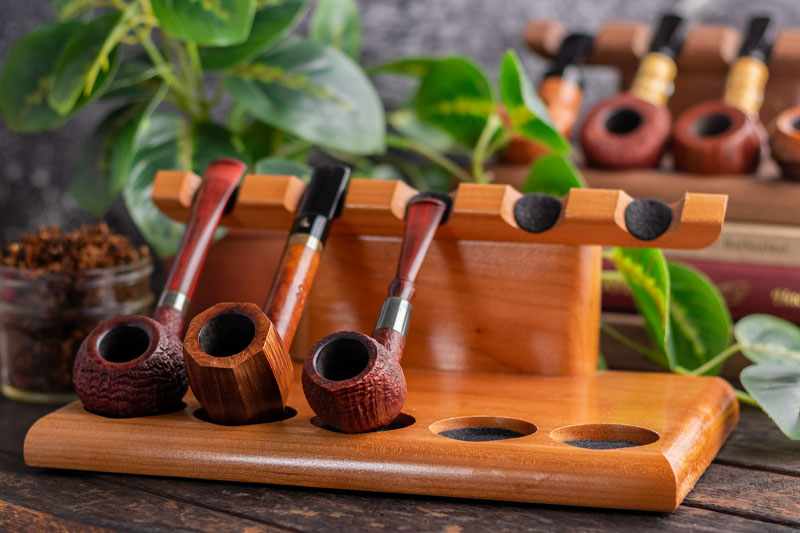
Great article! Thank you very much. Do you mind sharing what the model of the last pipe (the shortest one) in the thumbnail picture is?
Outstanding article. I have about 180 pipes in my collection. I would classify myself as a collector and epicurean. My collection holds memories that are very precious to me. When my children were very young, they would give me a pipe for my birthday, Father's Day, or Christmas. On special occasions, like their graduation from elementary school, middle school, high school, or any of their accomplishments, I wanted to etch these moments in time, so I bought a pipe. The same goes for me and my wife—anytime we wanted to make sure a memory was memorialized, whether it was my graduation, seminary, or my wife surviving cancer, I would buy a pipe to celebrate. My collection includes estate pipes, artisan pipes, and high-end pipes. I love the artistry of pipes; I will buy a crate pipe just as quickly as I will buy a high-end pipe. If I love the look, if I like the feel, if I love the color, if it touches my spirit and my heart, I buy it. Once, we were in New Orleans and walked into a pipe shop, and there was this one pipe still left on the stand. I turned to my wife and said, "I need to give this little fellow a home. He's all by himself." In my house, there's a dedicated area in a space we call the Great Room that holds my tobacco tins, cigars, and especially my pipes. I also have cigar art and pictures of famous celebrities who were tobacco and pipe smokers. I’ve called myself a collector, but now it's nice to know the official title of what I am, I am an epicurean!