


 |
|
 |
|


Fires on the Levee: A Christmas Eve Tradition in Louisiana


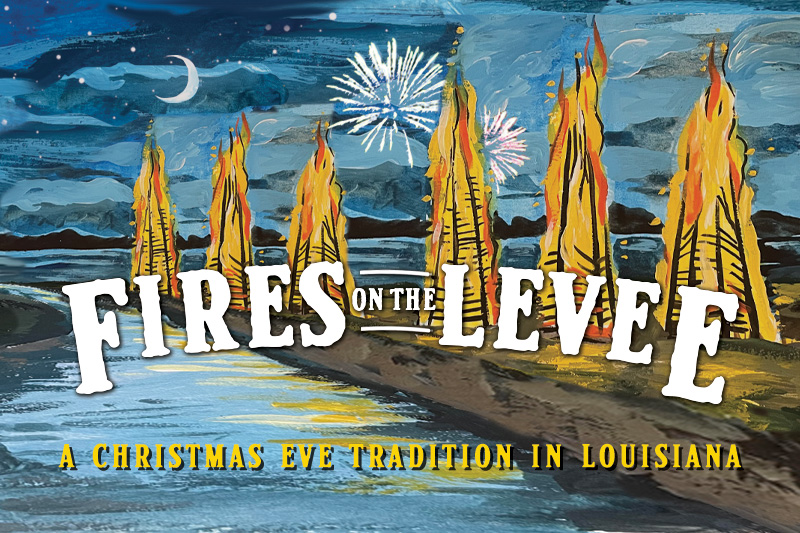
There's nothing quite like holiday traditions that warm the heart and fuel the spirit as one year ends and another one soon begins. In a world that is constantly evolving, whether it be technological advancements or everchanging social trends, traditions still carry importance in many ways that keep us connected as human beings. One such occasion can be found down south in Louisiana along the Mississippi River, particularly in St. James Parish: the annual Christmas Eve bonfires.
Note: Cornell & Diehl's Small Batch: Fires on the Levee was available as of December 16 at 6:00 p.m. ET.
Images courtesy of Ricky and Barbara Roussel.
The Origins of Bonfire Celebrations
This folk tradition is one of the most original public holiday-lighting displays around the world, drawing tens of thousands of visitors to the area each Christmas season. The Great River Road region between New Orleans and Baton Rouge is home to these festivities, with over a hundred fires built weeks ahead of Christmas Eve and then set ablaze in the night. The bonfire structures are built by families and friends all along the levee of the Mississippi River, but are mainly seen in prevalence in the St. James and St. John Parishes.
The significance of lighting bonfires throughout history around the world runs deep, as shared in a historical account from Emily Chenet Guidry in 1994 about the Festival of the Bonfires. Beyond the River Parishes, bonfires are still constructed in parts of Europe today as an outgrowth of an ancient Celtic custom, which was to honor the sun through ceremonial fires.
Before Christianity's influence, the British Isles and Gaul, a historical region in western Europe, was inhabited by the Celts from around the 4th century BCE to the 2nd century CE. Their leaders, the Druids, worshipped the sun, and large fires were built during the winter and summer solstice to honor it. "The Celts were dependent on farming for their tribal livelihood," says Guidry, "and believed that the fires would hasten the return of Spring and prolong the days of Summer. Following the birth of Christ, Druid beliefs were gradually supplanted by Christianity, and the fire ritual took on religious meanings."
According to Guidry, many festive fires would then be built for Christian saints, such as St. John the Baptist, who "represented a 'lantern of light' to the people." The summer fires celebrating St. John were a joyous occasion in good and bad times. "Wars, plagues and the passage of time did not stop the people from building their Fires of Joy. The custom endures until this day, especially in France... and in Germany."
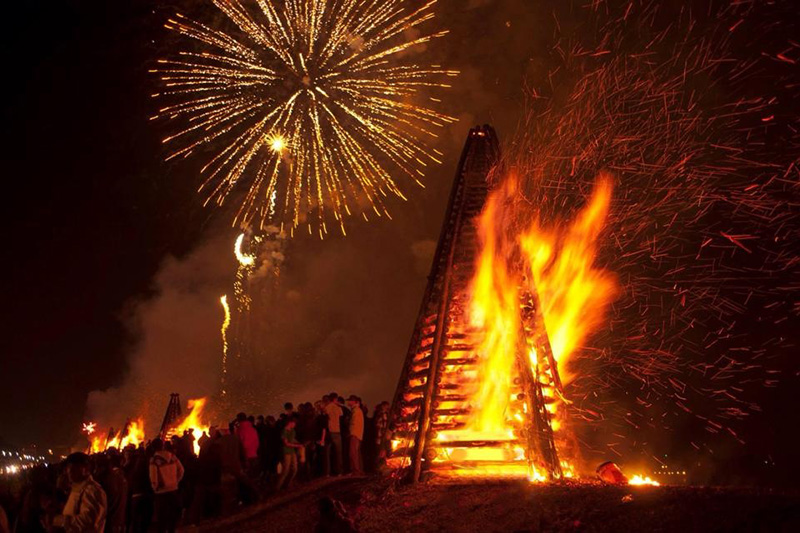
Of these seasonal celebrations, the winter solstice fires became the Christmas Eve bonfires, which are still burned in certain areas of France today. Similarly, the Christmas Yule log, known as "La bûche de Noël" in French, is also believed to be a remnant of the ancient fires.
Marcia Gaudet of Louisiana Folklife has memories from her own childhood in the 1940s and 1950s of the fires in Louisiana. In her piece from 1990, she notes a study of Russian festivals in relation to bonfire traditions in the past, stating, "prior to the nineteenth century at Christmas time 'big bonfires were made, and the dead were called to warm themselves.'"
She also noted the seasonal celebrations that Guidry mentioned in France, as well as bonfires lit in celebration of the Eve of the Epiphany, New Year's Eve, and the feast of the patron saint. After the Feast of St. John the Baptist, bonfires could be seen burning brightly throughout the countryside, much like the large bonfire constructions of St. James Parish's own tradition.
Bonfires in Louisiana's River Parishes
The area of Louisiana now referred to as the River Parishes, which includes St. James, St. John, and St. Charles, was settled in the early 1700s. "These early colonists brought with them the knowledge of both summer and winter bonfire customs and traditions," says Guidry, "which they had known in their native lands. By sharing this knowledge with their many descendants, they provided the inspiration for a practice which has evolved into one giant celebration — the present-day Christmas Eve levee bonfires!"
From Guidry's account, it seems that many of the European settlers celebrated New Year's Eve with presents and celebration instead of Christmas, which was seen as a more religious observance than anything at the time. However, that would change as Christmas transitioned into more of a secular celebration than it was historically.
Unfortunately, not much early history of the River Parishes exists on record. Guidry notes several possible origins for the fires aside from French derivation, including the whimsical story that it's a "Cajun tradition" that was used to light the way to guide Papa Noël, the Cajun's version of Santa Claus, along his merry way through the night skies to their homes on Christmas Eve.
The more practical theory is that the bonfires served as signals to navigate the way for boats along the river for churchgoers to attend Midnight Mass annually. Given that each parish had only one church, if you lived on the other side of the river, the journey was difficult. Without streetlights, a guiding light was essential for ships to safely transport churchgoers to the Christmas Eve service. Many of these people would only go to church on this one night due to the difficulties of traveling across the river. Due to this necessity, the tradition of lighting fires on the levee is said to have been born.
Gaudet shares that the custom has historically been practiced in Louisiana by people of Acadian French and German descent, though it was not a custom of the original settlers. However, the tradition was reintroduced by 1800s French immigrants, tracing back to around the 1880s. Gaudet states: "This could explain why the custom is not observed by the Cajuns on the bayous or the prairies of southwest Louisiana or, in general, by people on the First German Coast (St. Charles Parish)."
Father Louis Poche, a Jesuit priest and native of St. James, recalls hearing that the tradition began in Louisiana by the French Marist priests who came to the state after the Civil War to teach at Jefferson College, a Catholic college, in Convent, LA. "In a recent oral history project on bonfires," writes Gaudet, "the German-Acadian Coast Historical and Genealogical Society found oral documentation that a former Jefferson College student, George Bourgeois, began building bonfires in Mt. Airy (near Gramercy) in 1884 and that he had known the custom as a student of the Marist priests."
Back then, it seems that the bonfires were not yet built on the levee. The memories of old-timers in the River Parishes vary, as Gaudet notes. "In increasing numbers, people born in the decade of World War I, in the 1920's and 1930's recalled small yard Christmas Eve fires and told of the gradual resurgence of the larger levee bonfires." During World War II, bonfire building was paused, yet resumed with more celebration in the post-war years. In the 1950s, the bonfires moved to their current location on the levee and were lit on Christmas Eve, as they still are today.
The structures themselves became more standardized in the shape, size, and materials utilized, with willow becoming the wood of choice due to its growth along the river. Trees were cut down with axes and stripped of their branches before being hauled to the chosen levee site by foot. Rubber tires would also be assembled around the wood for added combustion.
A few days ahead of scheduled burning, cane reeds would be placed within and around the structure, which would then be set off when lit, creating a firecracker or fireworks sound. For those curious about how to assemble these massive bonfire structures, particularly the teepee pyramid versions commonly seen, the staff at Explore Louisiana explains in their article.
The Bonfires Today
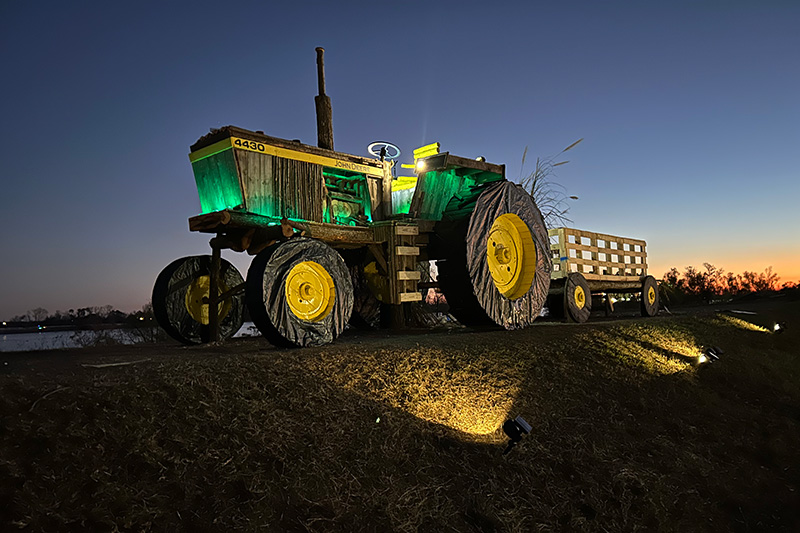
The festivities continue today with annual construction of the bonfire structures, and the lighting of the fires on Christmas Eve, serving as an opportunity for grand gatherings among families and neighbors alike, with cookouts and southern eating abundant. This tradition has lasted generations, and the children of today continue to learn and carry the torch into tomorrow.
The festivities go far beyond the reaches of St. James Parish, such as in the other Parish communities and nearby Ascension, in the area including about 30 miles of levee on each side of the river. The Algiers' Holiday Bonfire and Concert in New Orleans is an event where live music, an artisans market, and lots of food can be enjoyed. Similarly, the New Orleans Christmas Eve Bonfire Adventure packs a full day of holiday festivities with a Cajun Christmas Eve dinner, complete with music and eggnog.
In the heart of the celebrations in St. James Parish, many communities are involved, from Gramercy to Hester and Reserve to Paulina and Garyville, the last of which has an active group dedicated to creating ornate designs every year. News coverage about the tradition last year showcased the intricate displays created by members of a group in Garyville.
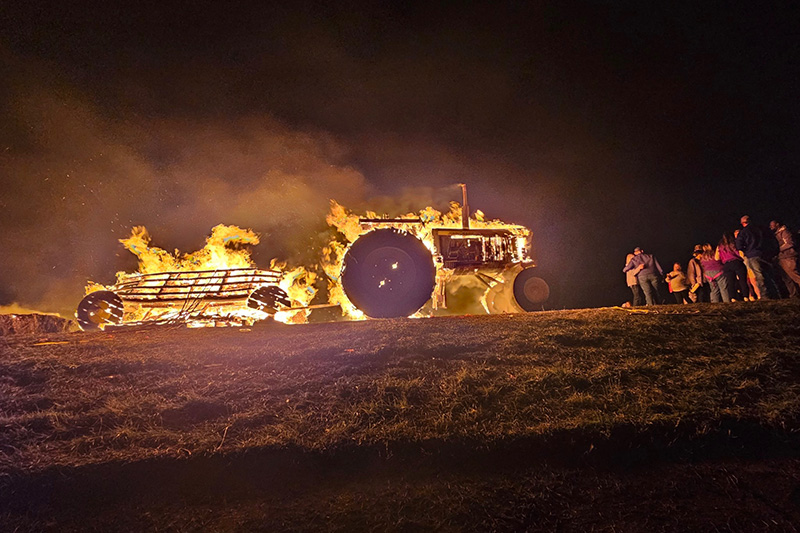
Roby Chavez covered the bonfire events in a PBS article centered in Garyville in 2023. In the article, he spoke with Josh Weidert, a member of Blood, Sweat, & Bonfires, a group made up of about 12 boyhood friends who have built extravagant bonfire shapes, sometimes with moving parts, for 15 years. Weidert's favorites include a breast cancer ribbon, a snapping turtle, a space shuttle, and a 30-foot-tall guitar.
In 2023, the group drew up a design for a 30-foot-tall alligator garfish. However, this project was allegedly scaled back due to shortness of time. It measured 6 feet tall, included 200 teeth, and 600 scales that were handcrafted. Just last year, the group erected a 20-foot-tall "Roux-dolph" reindeer bull, according to Ashlyn Brothers via Fox 8 News.
"It's just something we enjoy doing," says Weidert. "It gives us a sense of accomplishment. I'm building something that a little kid is gonna remember for the rest of their life. We're such a small town and there ain't much out here except for what we do with our bonfires; so, we are just trying to put our little town on the map the best we could."
Instead of the axes that were once utilized, chainsaws are more commonly used today for cutting down trees. Pick-up trucks haul the logs up to the top of the levee. The traditional teepee shape is still embraced among these artistic creations.
Until the late 1970s, there were no regulations on these bonfires. As the popularity has grown, drawing in visitors, more regulations about materials and construction became necessary, according to Guidry. "Environmental concerns about pollution resulted in a ban on the burning of rubber tires or toxic materials. The swamp replaced the river bank as the source of willow logs. Safety concerns created construction size and spacing limitations which were spelled out in building permits."
Nolan Oubre, Fire Chief of the Gramercy Volunteer Fire department, shared the permits from the Levee Board in Gaudet's piece as of 1990. In these regulations, fires needed to be at least 125 feet apart. As of 1987, they could not be taller than 25 feet. They also couldn't be larger than the crown of the levee, which is 12 feet in diameter. It could not include tires, creosote, or "foreign matter," due to environmental concerns, and each town was allowed only one "tourist attraction" with no regulations.
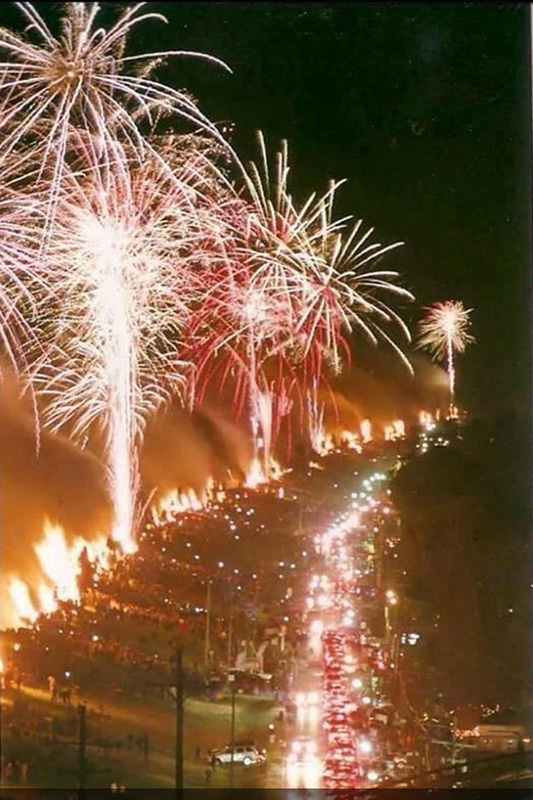
In 2025, written permits are needed to build a fire; each permit costs $50. Restrictions have tightened even more since 1990, minimizing the maximum height from 25 to 15 feet, as written in Chavez' article published in 2023. Though the regulations are ever changing, and various concerns have arisen, the Christmas Eve staple in the River Parishes persists.
Chavez also describes these modern-day restrictions placed on bonfires, with permits overseen by Jason Amato for 30 years and counting in St. James Parish. He is a parish council member and a former volunteer fire chief. "It's just a significant event," says Amato, "especially on Christmas Eve when thousands of guests, as we call them, come down to be a part of this spectacle. We have a really tremendous spirit of community here where there are open houses along the river road and people who may not know each other are just mingling. It is the true spirit of Christmas."
Amato goes on to describe the evolution of the tradition, from the unrestricted times to the more organized safety seen today. The firecrackers made from cane reeds, bottle rockets, and tires of yesteryear are no longer allowed. "Now, we've gone green," says Amato. "It has to be just wood, either trees or driftwood. We've also minimized the height of the bonfire from 40 feet to 15 feet. It's all in the effort to maintain safety."
On Christmas Eve every year, the fire chief in each town determines if the fires can be lit based on the wind, and clean up is conducted promptly the morning after. Weather permitting, fire chiefs give the green light to light the bonfires at 7:00 p.m. sharp.
Visitors on River Road usually view the bonfires from their vehicles while driving along the east and west banks of the Mississippi River, according to staff at Explore Louisiana. Aside from the broader event on Christmas Eve, The Festival of Bonfires is held annually in Lutcher in early to mid-December, with a full weekend of live music, a gumbo cookoff, pageants, and carnival rides. Attendees can enjoy Creole, Cajun, and soul-food vendors, and, of course, the bonfires burning brightly. This year's festival was celebrated on December 12-14.
A Folk Tradition or A Spectacle?
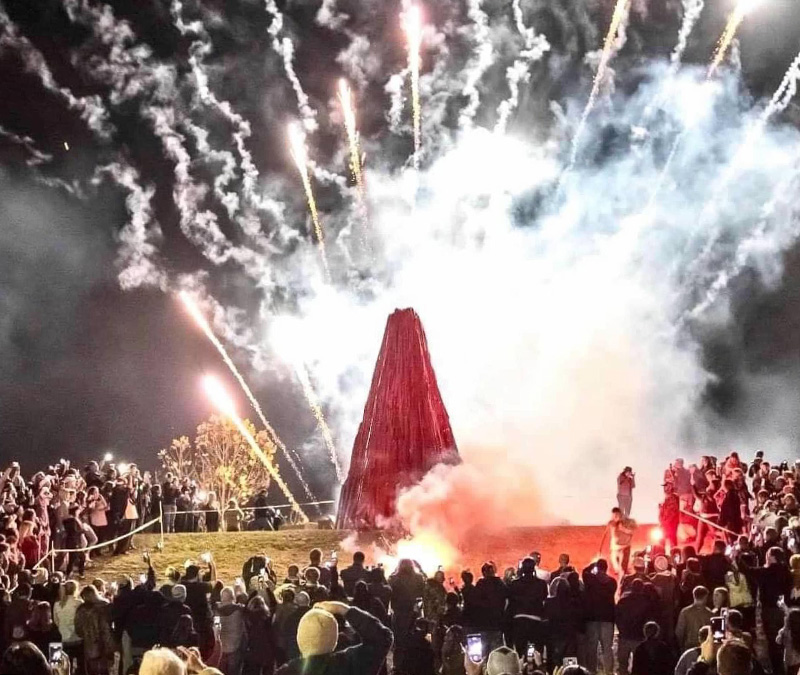
One interesting aspect about the bonfires on the levee tradition is how the custom has evolved over time. In the last 30-plus years, the fires have surged in popularity, thanks to media exposure and tourists that have now joined in on the once private celebrations. "Like many folk customs that come to the attention of the media and tourists," says Gaudet, "the bonfires seem to have changed considerably, becoming a spectacle with questionable tradition and shades of pyromania, along with ordinances to regulate them, complaints from ecologists, and commercialism."
In the last few years, over 40,000 visitors came to see the display. Each year, different fundraising events occur during the bonfire celebrations, such as the one hosted by The Gramercy Fire Department, which sells gumbo, beer, and souvenirs. "The atmosphere at these bonfires is somewhat like Carnival in New Orleans..." says Gaudet.
The local builders of these bonfires don't see it as a spectacle built for tourism, however; the bonfires have become a source of pride in their area and are a long-standing tradition over generations. Oubre noted that the novelty of tourist bonfires is not the driving factor for locals, but that it is a matter of community pride and upholding tradition. The building of these fires has become a "folk craft" for some, requiring learned skills to ensure an even burn and to avoid collapsing while alight.
As mentioned earlier, more impressive structures have been built beyond the traditional teepee design. "There have been spectacular pyres built in the shape of symbols of wealth and power," says Gaudet. "In 1985 one bonfire pyre was in the shape of a local antebellum mansion with two circular staircases and even an outhouse." Others include a replica of the Louisiana Superdome, an offshore oil rig platform, and a train with four cars.
"It is interesting," says Gaudet, "that changes in the bonfires and the building of pyres that symbolize wealth and power coincide with a time of severe economic depression in Louisiana, beginning in 1985. Perhaps the increased novelty of the pyres heightens the celebration and lifts the spirits, in addition to providing fundraising opportunities for community groups."
Friendly competition of who can build the largest and the best bonfire has also added general fuel to the fire, so to speak, that keeps this tradition alive and fun, as 31 Farms' Roussel family mentions in a recent video posted here on the Daily Reader.
The occasion has moved away from private holiday celebrations among family and friends in small groups to a more community-wide planning system with organized events and bonfire building plans, which Gaudet writes about. "The nature of the private celebration, of course, made it highly visible to the public since the bonfires were built on the top of the levees of the river and the spectacle of all these fires burning and reflecting in the river drew the attention of the media."
Also interesting to consider is how the tradition has changed based on the changing attitudes toward Christmas celebrations from family-centered festivities to a more secular festival. "The bonfires have been compared, in fact, to a 'one day Mardi Gras' or Carnival season," says Gaudet. "While the builders of the more spectacular bonfires make this comparison with pride, this aspect is disturbing to other more traditionally inclined people in the area who feel that this kind of Carnival atmosphere is inappropriate on Christmas Eve."
Locals clinging to the small, intimate gatherings of the bonfires each Christmas dislike the visitors and the congestion on River Road from outsiders. "According to Fire Chief Oubre," writes Gaudet, "though the levee is owned by the State of Louisiana and the landowners actually have no control over what goes on, there are some rights that have been traditionally observed. Some landowners do object and do not want a bonfire in front of their homes, and the town observes this courtesy."
Longtimers hold on to their customs and culture, building smaller, more traditional bonfires off the main path of spectators as a folk tradition, while those visiting enjoy the bonfires for the grand spectacle and the fun-filled festival atmosphere it creates. Some New Orleans natives who make a car trip up River Road seem to view it as a special tradition each year, though, much like the locals. Perhaps there is room for both as the festivities continue to grow in size and popularity year after year. Regardless of the changing views of the storied custom, it is quite impressive to see such a rich folk tradition stay alive in the modern era, and what a gift to consider this holiday season as we embrace our own family traditions.
Cornell & Diehl's Small Batch: Fires on the Levee
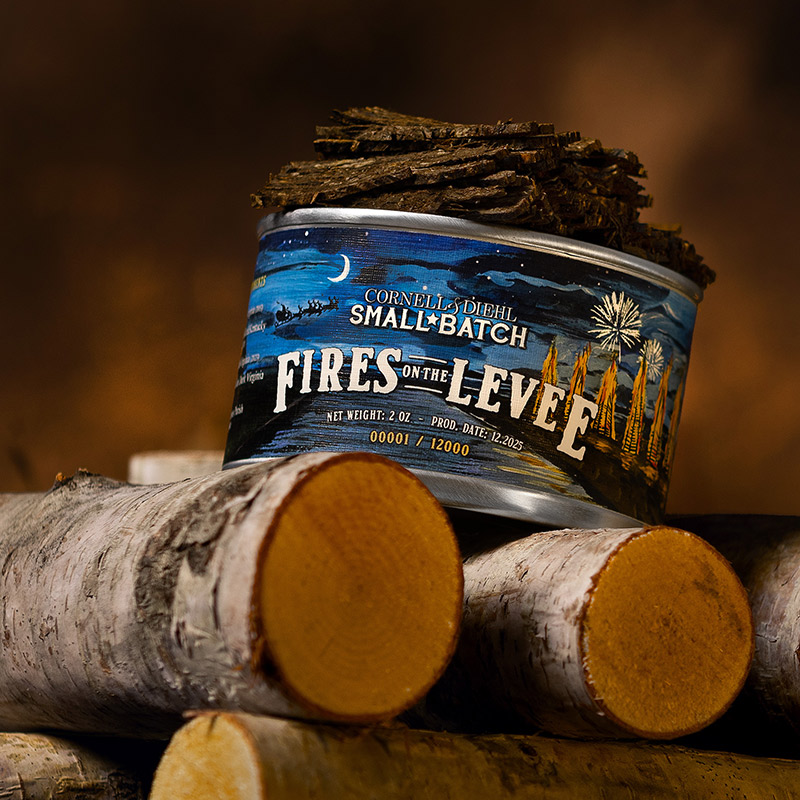
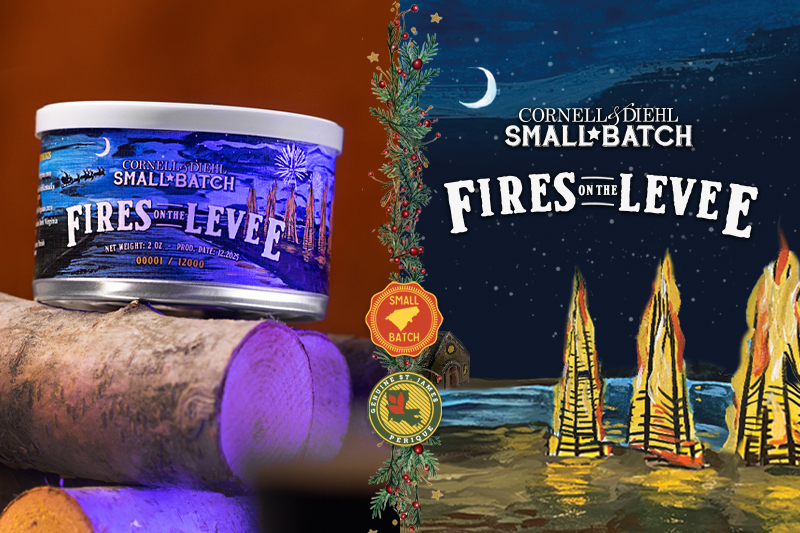
This deep dive into the Christmas Eve bonfires on the levee was inspired by the latest Small Batch blend from Cornell & Diehl, Fires on the Levee. St. James Parish is of particular importance to C&D, as it is the place where 31 Farms' Roussel family originates, the sole provider of all of C&D's Perique tobacco. The family's memories of the bonfires and the richness of tradition resulted in this special flake-cut blend, available on-site now in limited quantities. For more on the Roussels' connection to the area and to this tradition, check out our video here.
Happy holidays!
Bibliography
- Brothers, A. (2024, December 25). Bonfires light the levees on Christmas Eve in South Louisiana. https://www.fox8live.com.
- Chavez, R. (2023, December 8). The Christmas Eve Bonfire tradition that almost wasn't. PBS.
- Explore Louisiana Staff. (n.d.). Christmas Eve Bonfires on the levee: A Louisiana tradition. Explore Louisiana.
- Gaudet, M. (1990). Christmas Bonfires In South Louisiana: Tradition And Innovation. Folklife in Louisiana.
- Guidry, E. C. (1994). History of the Bonfires. Festival of the Bonfires.
You may also enjoy:



Comments
Great selection of pipes- never had a problem with any orders. You guys are the greatest.