


 |
|
 |
|


Portrait of Antoine Grenard by Artur Lopes
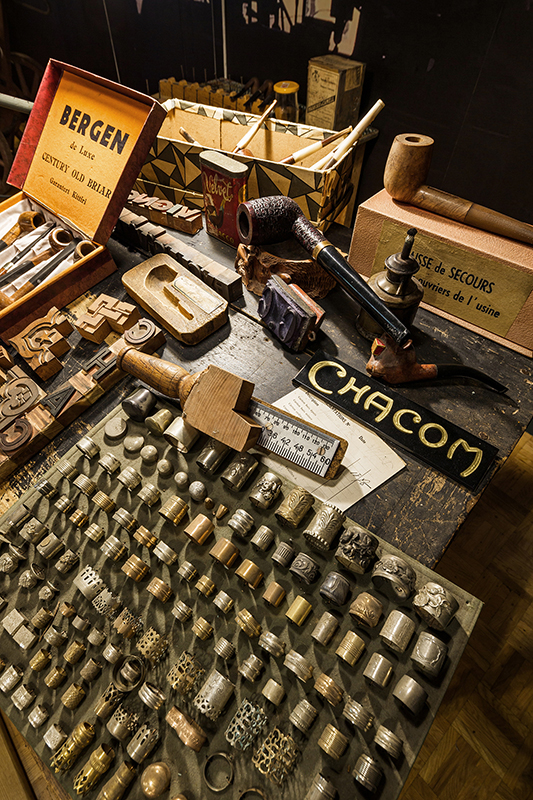
While many of us remember a childhood of green playgrounds with soccer fields and play equipment, Antoine Grenard remembers a giant, multi-floored, cavernous pipe factory filled with storage racks, ancient ebauchons, briar dust, ancient original French pipe-making machinery, and thousands upon thousands of vulcanite and horn mouthpieces. Chapuis-Comoy was a Treasure Island for a future pipe maker.
The importance of Chapuis-Comoy (better known by its portmanteau word, Chacom) to the history of pipes is profound. Antoine's family started what would become Comoy and then Chacom 200 years ago, with Francois Comoy in 1825. Pipes were a different breed of smoking instrument in that pre-briar age, but in 1856, Comoy was the first workshop to manufacture briar pipes. Briar recalibrated pipe making and pipe smoking. Everything had been fruitwood, meerschaum, and clay up until then. With the advent of briar, durable, long-lasting, supremely heat-resistant pipes changed the world, and Comoy was at the forefront of the charge.
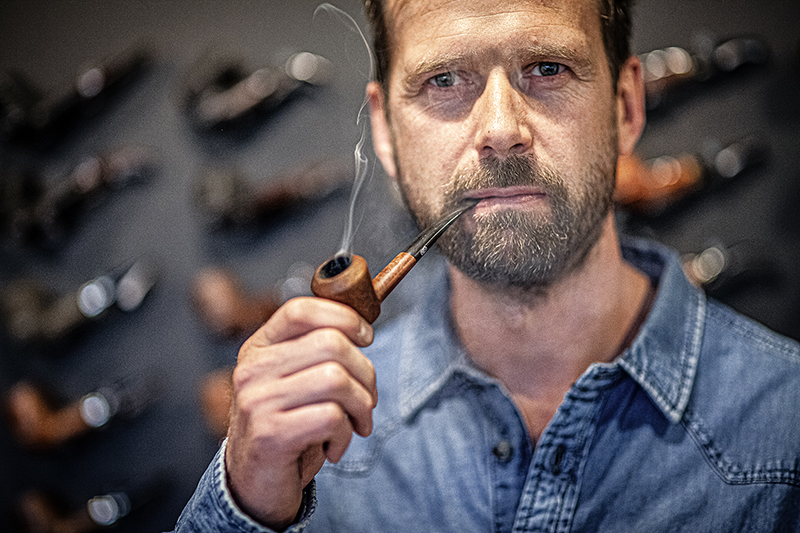
Today, Antoine owns and directs Chapuis-Comoy, maker of Chacom and Ropp pipes. He represents the sixth generation of this family-owned business, which traces back to Henri Comoy, who launched the brand name in 1850, 25 years after the company's genesis. Antoine's father, Yves Grenard, a second cousin, took over in 1971. The history of the company is complex, and not even Antoine knows all the pertinent details.
"I think everybody's confused about it," he says. "Not so many people remaining here in this world know about Chapuis-Comoy, because the story starts in 1825 with the Comoy family in a little village outside of Saint-Claude, when they were just turning some stems from horn, mostly from horn, and not even wooden pipes in that period." Antoine is modest; while most of us may be unfamiliar with the specific background, everyone who knows about pipes knows about Comoy's. Since the advent of briar carving, these pipes have sold worldwide, but he's right about the history being murky. For those who seek the details that are known, Kayla Ivan here at Smokingpipes has written an excellent history up through the Comoy's of London era, when these French pipes became for a time more associated with England than France in the public consciousness.
Pipes were a different breed of smoking instrument in that pre-briar age
"For some reason that no one understands," says Antoine, "Henri Comoy decided to go to London to create a pipe factory. Many people now believe the Comoy name is English rather than French. But it comes from Henri Comoy, from Saint-Claude."
It was 1971 when Antoine's father, Yves Grenard, second cousin to the Comoys, purchased the factory in France and separated from Comoy's of London to bring Chacom pipes to the originating family in France.
"The worst part of the story," says Antoine, "is that we don't know why the Comoys and the Chapuis sold the company to the big English company called Oppenheimer, or Cadogan Oppenheimer, which still owns very famous names like Comoy's of London, BBB, and GBD. The story doesn't say why the Comoys sold the company to the English. Really, no idea why. It's probably a question of money, I guess. And the odd thing is that the Comoys and the Chapuis were still working in the company even after they sold it."
After the company was relinquished, the family still missed it. "My father went to London many times. The first time, he was about 20 years old, and he worked at the Comoy's factory in London, though he told me that his main reason was to visit family. He learned to speak English." Yves returned to France afterward and attained his university degree, after which he tried a few different jobs, but he was unable to keep his mind from continuously returning to pipes.
"He finally went back to England and was a sales representative for Comoy's of London and then for GBD. It was quite interesting; he fell in love with pipe making and the pipe spirit, I believe." At that time, Comoy's owned not only the London factory but two in Saint-Claude. "My father had a good relationship with the accountant for the company, Simon Wells, who told him that the company was considering selling the factories in Saint-Claude."
Simon Wells asked Yves, "Why don't you buy it?"
we don't know why the Comoys and the Chapuis sold the company to the big English company
"And that's the start of the story," says Antoine. "My father had no money, nothing, but he decided to buy the Chapuis-Comoy factory in Saint-Claude. He bought it back from the English in 1971, and on the day of the sale, the London company didn't really know that it was my father who was the buyer. The English representatives who arrived in Saint-Claude to sign the transfer knew him from his times in London and asked, 'Why are you here?' He told them, 'I am the buyer,' and everyone was surprised."
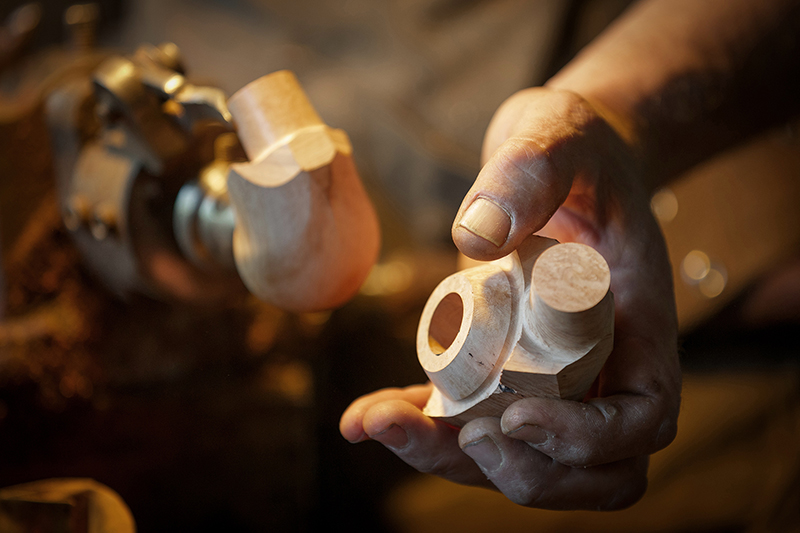
The return of Chapuis-Comoy to France was of monumental importance to the family, and must have been a triumphant event. "At the time of the sale, we had about 120 employees, so it wasn't a small business sale."
They did well, but pipes in the '70s started to become less popular worldwide and sales dropped. Other pipe companies in Saint-Claude began closing their doors and Chacom picked up their leftover inventory of briar blocks and stems, filling the factory with the lost treasures that Antoine explored as a boy. Chacom crafted many shapes but most were traditional in character while Freehand shapes from Denmark began influencing the public's tastes. Chacom needed to explore new design strategies, and Yves brought aboard Pierre Morel.
Morel is a celebrated and fantastically talented independent pipe maker who elevated particular series of pipes for Chapuis-Comoy. "He arrived a few years after we reacquired the company," says Antoine. "It was in 1978, I believe. He started making Freehand pipes, called Grand Cru, and all the pipes of the year. My father designed them and Pierre crafted them until he retired." These designs certainly helped keep Chacom current for pipe smokers looking for high-quality pipes in modernized shapes. "He's an amazing carver," says Antoine. "I would love to have more Freehand pipe makers in France able to do such work. I was with him yesterday morning. He still makes pipes today."
Other pipe companies in Saint-Claude began closing their doors and Chacom picked up their leftover inventory
A New Era
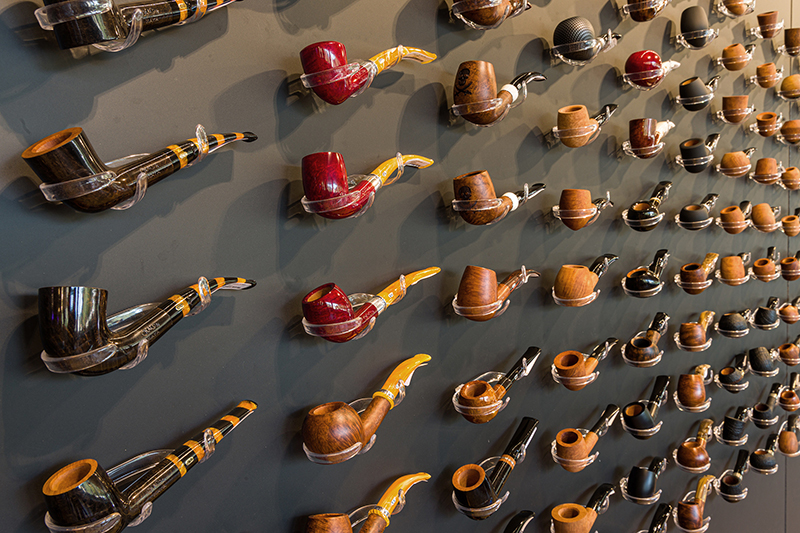
Antoine joined the company in 2005, fresh out of design school and eager to create new and exciting smoking instruments. "I was more in the production side; I spent most of my time in the workshop, working with the guys and creating new things. We developed some unusual shapes and colors. It was a good time to promote Chacom with a different style and to create excitement with pipes that were different. That's why we've done some modern art and very unique pipes."
An overall shift in design was achieved and Chacom survived the lean times when other pipe factories closed. "It was a very interesting period of time, but we came back with more traditional pipes a few years later, because Chapuis-Comoy is known for the classics, and we of course have to make the classics. When I arrived, I designed more of the very unique pipes to develop the name of Chacom with new concepts, because the name had waned in the public's mind. When I arrived in 2005, we were naturally making good pipes, but except for the Pipe of the Year and the Grand Cru, they were relatively boring pipes."
The new design language helped to revitalize Chacom. "They got a lot more attention because it was unusual to see these kinds of pipes. And even in the workshop, it was remarkable to see that the employees were more interested and more involved in the whole atmosphere. The work environment changed a bit. The company, I think, needed some new blood. And that's what I tried to provide."
When I arrived, I designed more of the very unique pipes to develop the name of Chacom with new concepts
Ropp Pipes
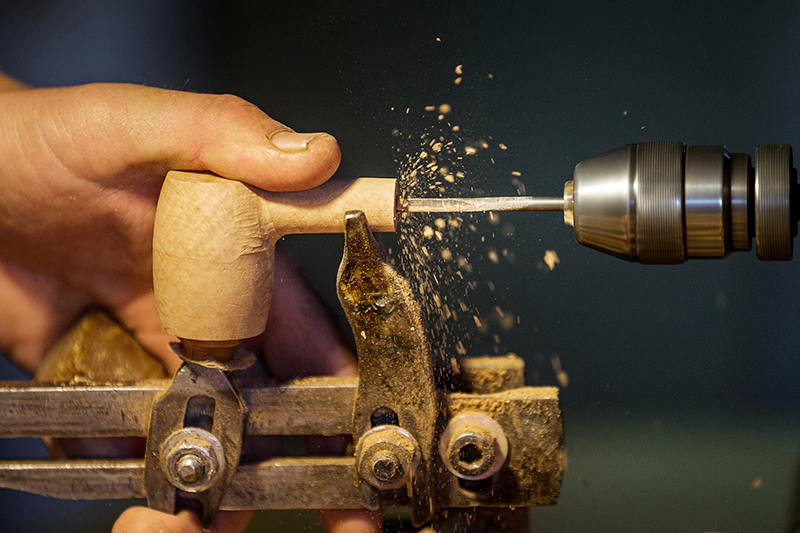
Chacom acquired the venerable pipe company, Ropp, in the 1990s, another trademark of French pipes to add to their growing list. Ropp closed in 1991 and was moved 150 kilometers from Baume-les-Dames to Saint-Claude. It went through a couple of incarnations and primarily served the French market and a few other European countries. "It was a big, important name in pipes, but was becoming less well known. That's why I later decided, with Sykes Wilford of Smokingpipes, to redevelop the Ropp name, concentrating on a really vintage style, very different from the other brands that Chacom carries."
The new Ropp pipes utilize vintage stummels turned in the 1970s, of which Chacom had tens of thousands in storage, perhaps hundreds of thousands. Saint-Claude pipe factories had in their better years been producing as many as 25 million pipes every year, and the leftover stummels from those factories ended up at Chacom. "Ropp pipes are now made from a very nice old inventory of bowls and sometimes stems, especially horn stems. It's something really interesting to work on Ropp pipes, they have such a distinct style." Of special interest is that the stummels employed for Ropp pipes are among the highest quality found in that inventory.
Most Ropp horn stems are straight, but Antoine unearthed a very old French stem-bending machine specifically designed for horn, which is more difficult to bend than vulcanite or acrylic, and he taught himself how to use it. "It's so complicated to bend the horn stems. 'We had a few lines with Chacom with horn stems, because we had a big inventory of horn stems from the Jeantet pipe factory, where they were turning them many, many years ago." While Chacom maintains an impressive number of briar stummels, horn stems are more rare, and that may make Ropp pipes with horn stems hard to find in the future.
"The complication is that some stem stock is running out, and to make these stems again is a nightmare. But I'm sure there are still some horn stem inventories somewhere in Saint-Claude, or around Saint-Claude, so I'm still searching."
Saint-Claude pipe factories had in their better years been producing as many as 25 million pipes every year, and the leftover stummels from those factories ended up at Chacom.
Antoine took over directorship of Chacom in 2007 when his father retired. It continues to thrive while other pipe companies in the area have folded. "We're still there. I think it's a shame that we are now nearly the last one remaining in Saint-Claude, or close to Saint-Claude, that is, because we are not exactly in Saint-Claude." That's because Antoine moved the factory in 2016. As may be imagined, moving a factory of that size and scope is an enormous undertaking, but it was necessary.
The Factory Move
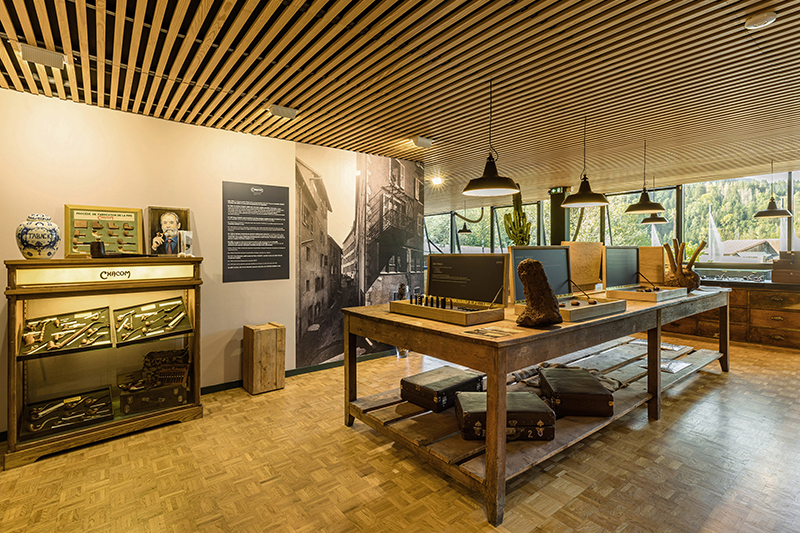
"When I first proposed that idea, some people in the company were nearly laughing, because they told me, 'Yeah, Antoine, you want to move the company. But, your father and all the guys before always said that they were going to move the company to a better building.' But we needed better facilities to improve everything. No one was particularly receptive. Then when I finally said, 'We're going to do it,' well, that was a unique experience. The old factory was huge, really big, built for 250 workers. You can imagine the building, and in that period, they were keeping everything, nothing was thrown away. The factory was full of everything: machines, bowls, stems, all filling many attics. We had six floors of that."
Organization was as difficult as the physical move. "We had to move and set up in a very short period of time, because we had to stop making pipes." Production ceased on December 20, 2015, and the first pipe in the new building was made on January 4, 2016.
"After that, in 2016, it took me a year to move all the stock of old stuff that we had in the attics. I was doing that with some friends, very good friends." Good friends will help you move; it takes extraordinary friends to move a pipe factory. "It's good to have good friends. Every weekend we moved box after box, big wooden boxes, from 8 a.m. to 8 p.m. It was quite interesting and a very big experience. I will do it just one time, no more."
Break-ins at the old factory were rampant once production moved out, and Antoine was harassed by robberies for the year he was moving old inventory. "We were robbed every month at least. It was so easy to get inside the building, to break a window, even though we had an alarm." He filled out police reports regularly. "It was a nightmare."
The old factory was huge, really big, built for 250 workers
The taxation on the old building was too high for Chacom to keep it; few companies enjoy the luxury of maintaining an empty, six-story building, so Antoine gave it to the city of Saint-Claude. "Right now, they are doing nothing with it. And there is no plan for it because Saint-Claude is not in a good mood, I would say, and the location is not that good in modern times. There is no project to do reconstruction. I think it'll probably be destroyed in a few years."
That will be a sad day, if and when it occurs. The history tied up in that building is impressive. But now Antoine Grenard and Chacom look to the future while maintaining the traditions of the past. Briar pipe making began in Saint-Claude, with Chacom. French pipes are the originals of the pipes we love today. It's remarkable that we can still find pipes that have been seasoning in the historical air of Saint-Claude for 50 years, and attain them at extraordinarily reasonable prices. Many pipe smokers are attracted to the history of pipes, and those made in Saint-Claude are the most genuine, historically relevant pipes that any enthusiast could hope for.
You may also enjoy:





Comments
Mr. Stanion, yet another wonderful bit of writing, thank you!Did the topic of sourcing briar arise? Did they try to get briar from anywhere in particular? Or, as I assume, with those production numbers, they got what they could from wherever.
I love my Chacom pipes!Thank you for the history!!!
There were 2 Pierre Morels, the father, Pierre Sr.(who passed away in 1979) was responsible for the Grand Cru line as well as his own independent brand, Pehem. His son, Pierre Jr., was the designer of Chacom's later high-grade lines like Gold and is still in business making pipes under his own name.
I own a Chacom and I think two Ropps. My Ropp MCM 1950 hawkbill is a fantastic smoker, it's my "everyday" pipe.
Chuck,Guess what I did after reading this? I grabbed one of my estate pipes from, sat down filled it and lit and enjoyed a very relaxed smoke this afternoon. I intend to buy more of the pipes from this group. Chuck please keep the good work!!!!!!!!!!!!!
Ik heb 3 chacoms en deze roken perfect.