


 |
|
 |
|


The Comoy family name is renowned for being the first to offer briar pipes and interpret classic shapes in a distinctive fashion. Although ownership may have changed, this tradition of shaping and briar as the best pipe-making material has persisted into modern-day pipe making. The Comoy's were not only a successful family business in England; they represented England's oldest and largest manufacturer of briar pipes. We will be walking through the Comoy family's beginnings, their discovery of briar wood in pipe making, their influence in France and England, and the initial merger with the Chapuis family, resulting in the Chapuis-Comoy factory, and eventually, the Chacom brand we know today.
Comoy's of London might evoke a variety of ideas of distinct pipe designs from English and French pipe making as a whole. There is, however, a lack of information about some of the history behind the Comoy family, though the Pipe Compendium (1964), and Neill Archer Roan's book, Comoy's Blue Riband Pipes (2014), provide intriguing information about Comoy's of London.
The Comoy Family and Their Beginnings
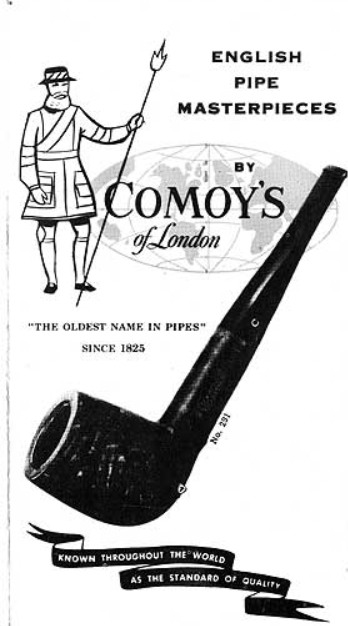
Comoy flier, Chris Keene Archive
Our story begins in Saint-Claude, France, where Francois Comoy established the Comoy pipe factory in 1825 in the small village of Avignon. The family-run company made a name for itself through the creation of pipes from materials that were common of that time, including clay, boxwood, and beech for the "Grumblers" of Napoleon's armies, formally known as the Grenadiers of the Old Guard, who were infamous for complaining in the presence of the Emperor, giving them their nickname "Grognards," or "Grumblers."
Comoy's factory became the first manufacturer of briar pipes in 1856. From then on, they produced pipes made solely from briar wood. And so began the long and storied history of Saint-Claude as the birthplace and mecca of briar pipe making, establishing what became a precedent for pipe making as a whole.
Briar As A Pipe Material
Briar wood is today's most popular and common material in pipe making. The Comoy family discovered that briar wood was an extraordinary pipe material in 1856, as noted within Comoy's Pipe Compendium: "Francois Comoy was undoubtedly one of the very first to realise the unrivalled qualities of extraordinary wood." Briar is a material built to last, with naturally beautiful, dense, and warmer-toned grain, with the ability to absorb moisture and insulate heat, all while imparting a pleasant flavor when smoked. "No other material has all these desirable characteristics in such a captivating form."
Designed in shapes that were functional and classic with radial symmetry, briar wood also became an archetype which formed aesthetic appeal in pipe making. Briar, otherwise known as Bruyere, or "Erica Arborea," grows primarily in the mountainous regions of countries bordering the Mediterranean. With brutal weather, dry soil, and little water, the plants that do survive are strong and resilient, with tough roots. The root burl of the heath tree grows naturally underground and is dug up in the dawn of winter to be harvested in peak condition for use in pipe making.
Briar must be cut into appropriate sizes and grades, and blocks are boiled for days to remove tannins and resins from the wood. Any burl less than 50 years old is usually too small to be useful. The Comoy family set out to master briar as a material for pipe making by "combining the finest raw material with superlative craftsmanship," according to the Pipe Compendium. It's safe to say they accomplished this goal.
The Comoys Move to London
Francois' son, Henri, was born in 1850 as the third generation of the Comoys. Henri was less than 30 when he went to London. Prior to this move, he had been making pipes in Belgium for three years after being interned in Switzerland as a prisoner of war during the Franco-Prussian War in 1870. It was then that he met his nephews, Louis and Charles Chapuis, and discussed the idea of an association. "He launched a business that would magnify and memorialize the briar pipe-making legacy of his father and grandfather, Claude Hermann Comoy and François Comoy," reports Roan.
When Henri Comoy emigrated to London in 1879, his nephews followed him. With a bag of tools and a few of his French pipe makers, Henri set out to sell Comoy briar pipes. It was then that their first English pipe factory was opened in Seven Dials, known today as Cambridge Circus: H. COMOY & C° LTD, with briar wood and pipe bowls supplied from the Saint-Claude factory. This move established briar pipes in Great Britain, making the Comoy name internationally acclaimed.
"London-Made" Pipes
Henri is credited with being the author of the phrase "London Made," which was valued highly by pipe buyers worldwide and was adopted by brands like BBB, Dunhill, GBD, and Loewe. Within Comoy's 1909/1911 catalog, they stated: "We are the manufacturers of the following well known brands: Comoy's Prima London Made, Comoy's London Made, H.C. London Made, Yomac London Made, Standard London Made ...To the trade this mark is a positive guarantee that each and every Comoy pipe is made in its entirety in our London factories by the most skilled workmen of the best obtainable materials and under the immediate supervision of Mr. Comoy and his personally trained associates."
With their international acclaim, the Comoys were in need of a new factory for production by 1895, so they opened their new building in Newcastle Place, Clerkenwall. Then, in 1905, the American trade market was thriving, resulting in Comoy's opening yet another factory at 72 Rosebery Avenue in London in 1913. There are accounts of Louis Chapuis, allegedly traveling to the U.S. around this time, first evidenced from a visit in 1906 where a passenger, possibly Chapuis, is recorded manifesting from RMS Umbria, which departed Liverpool for New York on June 30, 1906.
Through the 1910s, many changes happened for the company. In 1914, Henri and his nephews incorporated the business as H. Comoy & Co. Ltd. Before the war in the mid-to-late 1910s, Henri was also joined by his sons, Adrien and Paul, who were born after his nephews arrived in London. Sam Zinberg was appointed Director of Sales for the U.S. in 1921, and the House of Comoy was established. Henri Comoy died in 1924 at the age of 74, leaving the company in the hands of Louis and Charles, as well as his sons.
Comoy's Pipes: A Collector's Dream

From the Pipe Compendium of the Comoy's
Comoy's pipes were highly collectable and desired due to their exceptional stained finish, which highlighted the grain figuring of the briar, and for their distinctive, well-balanced style. The Blue Riband, for example, was among their most iconic pipe lines and revealed gorgeous grain. This name celebrated the record crossing of the Atlantic by the great ocean liners of the Cunard Line, Blue Riband being a symbolic award for the fastest ships. Each Comoy's pipe was made with a keen attention to detail with a close inspection at every stage, maintaining their devotion to upholding high-quality craftsmanship in the face of mass production as popularity grew.
Every mouthpiece was fitted with a slim bit that was hand cut from sheet vulcanite for longevity of use. These comfortable mouthpieces enhanced the sweet smoking properties of the briar pipes, which were easy to break-in with pre-charred properties. Comoy's took care to craft these thin contour mouthpieces, described in catalogs as a "slender-bite."
As an added distinction, a white "C" on the mouthpiece differentiated an English briar pipe from a Comoy's briar pipe. Comoy introduced this distinctive inlaid-stem nomenclature around 1919 with a 3-part "C" stem logo remaining in use until 1979. This design was dropped in favor of a more cost-efficient and simpler "C" engraved on a one-piece stem inlay. Each pipe was individually boxed and protected by a cloth bag as well.
Comoy's pipes' classic style, which denotes proportional balance, radial symmetry, and general shaping standards, represent the archetypal pipe form of English and French-style pipes. Lines were often simple and stoic, with proportions matching from bowl to stem, providing a uniform visual appearance and creating an aesthetic of crisp, clean lines and well-balanced designs. Additionally, according to The Pipe Compendium, "Comoy was the first to employ contrast-staining in their finishing."
The Pipe Compendium also details the Comoy family's' dedication to the best product possible: "At all stages of Comoy's progress there has been a fantastical devotion to the maintenance of impeccable standards of quality, backed up by the best possible service. In spite of all the pressures of a world dedicated to mass production we shall never depart from the ideals of craftsmanship which have always inspired us."
Identifying Comoy's Shapes/Years

A variety of signature stylings and accents indicate what shape and year a Comoy's pipe was made. For example, the top grade introduced in the early 1900s was Prima, the flagship brand, while Tradition was a grade introduced in 1925 to mark 100 years of pipe making, continuing in production until the 1970s. Grand Slam was introduced in 1933 with the patented metal filter system, which was produced until the 1970s as well. There were also several finishes no longer available by 1965, including Old Bruyere and Virgin Briar. The Royal was a high-grade Comoy's pipe. Before the Second World War, this was the highest-standard grade once the Prima was no longer in production.
As mentioned earlier, the Blue Riband is among the most notable of Comoy's pipes, named in 1936 to celebrate the crossing by the Queen Mary in four days and 27 minutes. Introduced as the second grade in the Blue Riband series to meet the demand from America for a lighter finish, the London Pride was made available. The Extraordinaire was a designation given to pipes outside of conventional size or grain introduced in the 1930s and then reintroduced in 1979 as Extraordinaire 1 and 11, which were dressed in a light two-tone walnut finish.
Roan catalogs the following pipes within his collection from Comoy's: Billiards and Pots, Dublins and Zulus, Bulldogs and Rhodesians, Globes (Apples) and Princes, Canadians, Liverpools, and Lovats, along with Miscellaneous shapes including Kruger Extraordinaire (Shape No. 236), Woodstock (Shape No. 202), Hexagonal Panel, Bullcap, Cutty (Tavern Pipe), and Danish, which was earlier designated as Woodstock.
Henri Comoy himself was extremely interested in involving himself in the manufacturing and design of machinery in the background of their pipe production, creating new pipe models and shapes, resulting in a diverse repertoire of shapes, all crafted with great care. The 1911 catalog stated, "Though this catalogue only illustrates 96 patterns, our collection comprises over 300 designs." Every pipe in this catalog was also silver-mounted.
Across catalogs, Comoy's classification systems seemed to be inconsistent, both in terms of shape numbers and names utilized, described as "mercurial" at times: "While Comoy seems generally disciplined in its use of shape numbers, there are instances where a given number was later used to identify a completely different shape."
Merging With Chapuis: Chapuis-Comoy Factory Established
After World War I ended in 1918, Comoy's brand was renamed Chapuis Comoy & Cie. to commemorate the partnership between the Comoy and Chapuis family, establishing Chapuis-Comoy factory in Saint-Claude in 1922. A number of other iconic makers, such as Ropp, Butz-Choquin, and Jeantet all originated in the same area of France. Their influence expanded to Britain with Dunhill, Barling, and other iconic marques.
Combining names, Chacom, as it is known today, officially became a brand in 1928. The Chacom name was influenced by the first three letters of the two family names: "CHA" from Chapuis and "COM" from Comoy. Over the next few decades, the company continued to grow, producing pipes that were distributed in France, Belgium, Scandinavia, Germany, the United States, Japan, and more.
Comoy's of London: Their Legacy Continues
Although no Comoy's pipes have been produced since the early 2000s, the impact the Comoy family had on pipe-making practices, particularly related to the use of briar wood as well as the French/English design style with standard shaping and balanced proportions, lives on in modern-day pipe production. The high-quality craftsmanship of Comoy's pipes has left a legacy of exquisite grain, slim mouthpieces, and an overall product that has remained and continues to float around estate sales and in the collections of pipe connoisseurs worldwide. As noted by Roan, "... the firm's importance to pipe-smoking, pipe history, and pipe-collecting cannot be denied." After the merge with the Chapuis family and the creation of the Chacom brand, production entered a new era which we will explore in more detail in a future article. For now, we can reflect upon the magnificent contributions the Comoys achieved in pipe-making practices that sent ripples through the industry, ripples which are still felt today.

Chacom 100th Anniversary Pipes
Bibliography
- (N.d.). A History of Comoy's and A Guide Toward Dating the Pipes. Pipedia.org.
- (N.d.). Blond, G. La Grande Armée, trans.
- Chapuis-Comoy & Cie. (2009-2024). History.
- Chapuis-Comoy & Cie. Shop. (N.d.). Our Story.
- Comoy's of London: A Brief History. (2020). ThePipeShop.co.uk.
- Comoy's Pipe Compendium (1964).
- Godbee, K. (2013). 4th Generation Pipes Debut, Comoys Come Back. Pipesmagazine.com
- Lopés, Manuel J. (2005). Pipes, Artisans, and Trademarks. Quimera Editores.
- Roan, Archer N. (2014). Comoy's Blue Riband Pipes. Briar Books Press.
- Smith, T. (2020). The History of Pipe Design: France and England. Daily Reader, Smokingpipes.com.
You may also enjoy:





Comments
I own 2 Comoy 625 volcano pipes. One in the Strawmatt series and one that is stamped Royal Comoy which dates to just before WW2. The Royal is an excellent smoker.
This is a well written article on the revered Comoy's brand, bravo!
If you can get Neil Archer Roan's book on the Blue Riband pipe do so. The photos of his collection are magnificent as well as the history of Comoy and this iconic pipe.
Well written article. I own a few Comoys, this puts those pipes in context.
Can anyone explain what happened to any of the Comoys pipe tobacco blends? Gone. Over. No more. Fini?
“After World War I ended in 1922…” Just want to point out that WWI ended in 1918. Apart from that factual error, I enjoyed this informative article. Thank you! I have several Comoy’s pipes. They are among my favorites. I am happy to learn more about the history of this venerable, important pipe manufacturer.
Mark, thank you for that correction! I'm glad the piece was informative and provided some new context to your Comoy's collection.
A good read.
Great article
Hi there, Just reaing through your fantastic website.I noticed mention in the text below, Seven Sisters. I think this should be Seven Dials, which is just by Cambridge Circus.The Seven Sisters area is in Tottenham, North London, several miles away.It was named after the Seven Trees planted there’s few hundred years ago. When Henri Comoy emigrated to London in 1879, his nephews followed him. With a bag of tools and a few of his French pipe makers, Henri set out to sell Comoy briar pipes. It was then that their first English pipe factory was opened in Seven Sisters, known today as Cambridge Circus: H. COMOY & C° LTD, with briar wood and pipe bowls supplied from the Saint-Claude factory. This move established briar pipes in Great Britain, making the Comoy name internationally acclaimed.