


 |
|
 |
|


Niels Bohr: The Pipe Smoker Who Fathered Quantum Mechanics


Portrait of Niels Bohr by Artur Lopes
Denmark has brought some remarkable advancements to the world, including moving-coil loudspeakers, insulin, dry-cell batteries, and, yes, LEGO. Danish pastries are great, too, though they originated with Austrian bakers working in Denmark who modified their previous recipes, and the new ones found their world-wide popularity accrediting Denmark. For us pipe smokers, however, the most important advancement from Denmark has been Danish pipe design, ushered into popularity through the innovative work of Sixten Ivarsson.
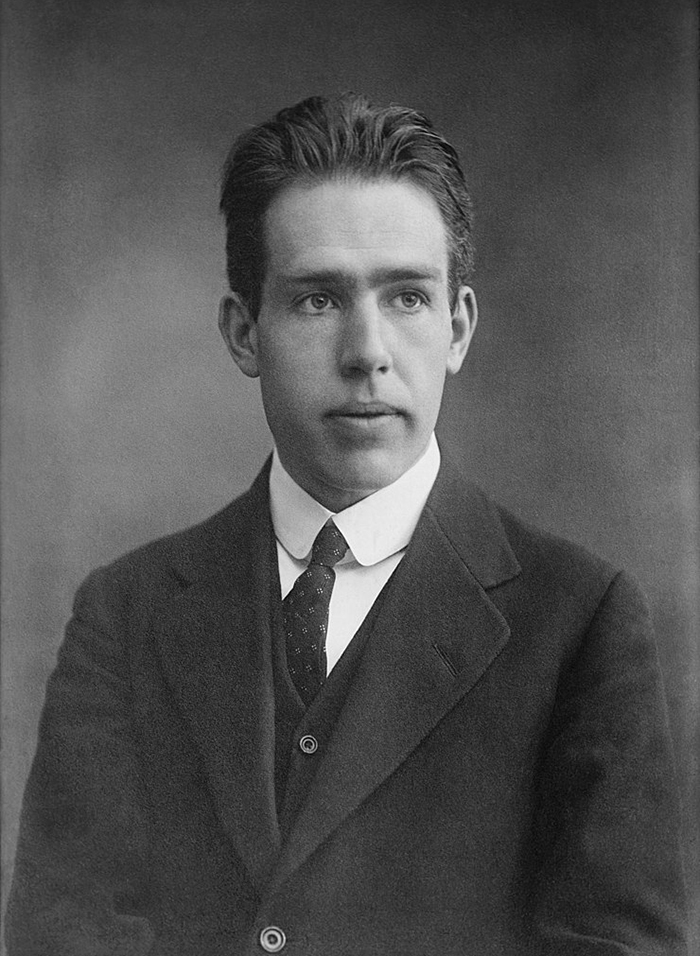
Niels Bohr
Sixten wasn't the only genius Danish pipe smoker. Physicist Niels Bohr smoked his pipes almost constantly, and while we don't know his preferred pipe makers or tobaccos, his pipe smoking is often mentioned in biographies and evidenced in photos. Where Sixten revolutionized pipe making by introducing a new way to maximize briar grain and therefore pipe design by shaping the pipe first and drilling afterward, Bohr revolutionized physics by building on the work of Max Planck and Albert Einstein, introducing a new model for the atom and providing the foundation for quantum mechanics.
One of the problems with the previous atomic model involving electrons circling a nucleus in a planetary fashion was that, according to the classical physics of electromagnetism, their negative charge would be attracted to the proton and lose energy as they almost instantaneously spiraled into the nucleus. The accepted physics of the time predicted that negatively charged electrons circling a positively charged nucleus would emit electromagnetic energy, continuing to lose energy until the atom quickly collapsed. It was an impossible model because it rendered atoms unstable, and atoms are obviously stable or we wouldn't be here to argue the point.
Niels Bohr devised new rules that would accommodate an orbiting atomic structure, rules that necessarily contradicted classical physics. He sidestepped the contradiction with a new way of thinking: Electrons maintained position within levels of concentric shells around the nucleus rather than moving gradually in distance from the nucleus. Atoms absorb or emit radiation only when they jump between the stationary shells. These movements would become known as quantum jumps.
In an article on NPR.org, Marcelo Gleiser describes the importance of quantum jumps:
Bohr suggested that when an electron jumps between orbits, it either emits or absorbs a chunk of light. These chunks of light are called photons, Albert Einstein's key contribution to quantum physics. (There were many others, but this was the one that gave him his Nobel and that he considered his most revolutionary, even more than relativity. It's the notion that light can be thought of as being either a wave or particles.)
The emission spectrum of an element consisted of the photons (or radiation) electrons gave off when they jumped from higher orbits to lower ones. The photons carried away the angular momentum the electron lost as it jumped down. Bohr suggested that the energy of the photons matched the energy difference between the two orbits.
The understanding of the radiation generated by these quantum jumps as described by Bohr would later make possible cell phones, microwave ovens, GPS navigation, lasers, atomic energy generation (and atomic warfare), quantum computing, and many more of the most astonishing technological advancements of the past 100 years.
However, what was especially confounding at the time was that Bohr's insights meant that classical physics didn't make sense at the atomic level, and a new category was needed to explain these micro-levels of existence: quantum mechanics. Electrons or photons, for example, exist in different states simultaneously and can act like particles or waves until observation (measurement) collapses the wave function of indeterminacy and they become one or the other.
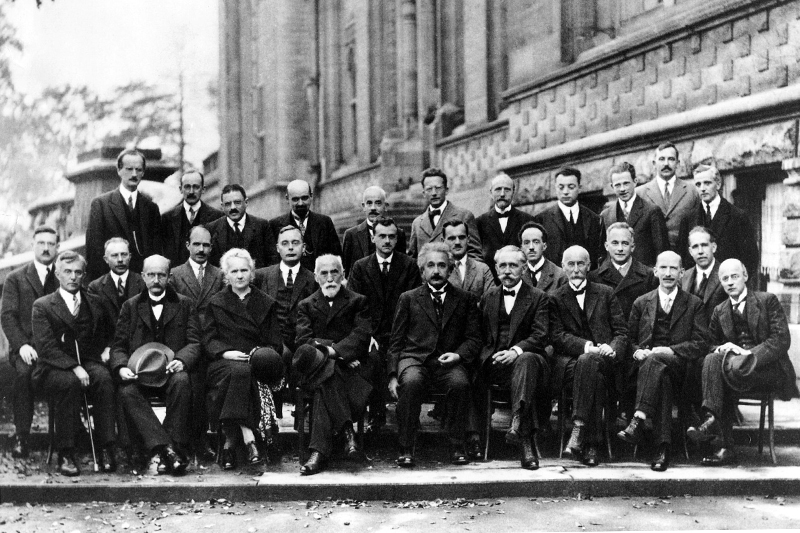
1927 Solvay Conference on Quantum Mechanics
The state of a physical system in quantum physics is estimated according to probability, also called a wave function, which predicts the likelihood of a particle's location. For example, there's a wave function for a particle moving to the left and for one moving right. There's also a wave function for a particle going both left and right, and is therefore neither left nor right until measured (observed), when the wave function collapses to fit the observed outcome.
One unsettling interpretation is that these tiny particles, upon observation, go back in time and reconcile their behavior with the later observation. Boom. Quantum physics is certainly entertaining.
The term for describing simultaneous, mutually exclusive states, is superposition. The most recognizable example is the Schrödinger's cat theoretical thought experiment. Introduced by Austrian Nobel-winning physicist Erwin Schrödinger to sarcastically illustrate the confounding aspect of quantum superposition, the thought experiment involves the example of a potentially poisoned cat in a box that is both alive and dead until the box is opened, at which time it is discovered to be alive or dead. It's a perplexing idea for everyone, even Stephen Hawking, who said, "When I hear about Schrödinger's cat, I reach for my gun."
This concept of superposition, though, wasn't universally accepted at its onset. Bohr and Einstein disagreed about the fundamental nature of the universe, each interpreting the superposition of objects differently. After Bohr published his work in 1913, Einstein said, "If all this is true, then it means the end of physics." He also famously quipped, "God does not play dice with the universe."
Electrons or photons, for example, exist in different states simultaneously and can act like particles or waves until observation (measurement) collapses the wave function
The two scientists later participated in a series of friendly public debates about the nature of quantum mechanics. The collapse of the wave function occurs faster than the speed of light, and Einstein's General Theory of Relativity does not allow for faster-than-light occurrences; Einstein called the theoretical quantum collapse a "spooky action at a distance." Bohr argued that the wave function isn't a physical reality but only a description of what happens. Knowledge is updated faster than light so no violation of the limit imposed by the speed of light occurs. Bohr's interpretation eventually became the established model, though it's now accepted that his work was incomplete.
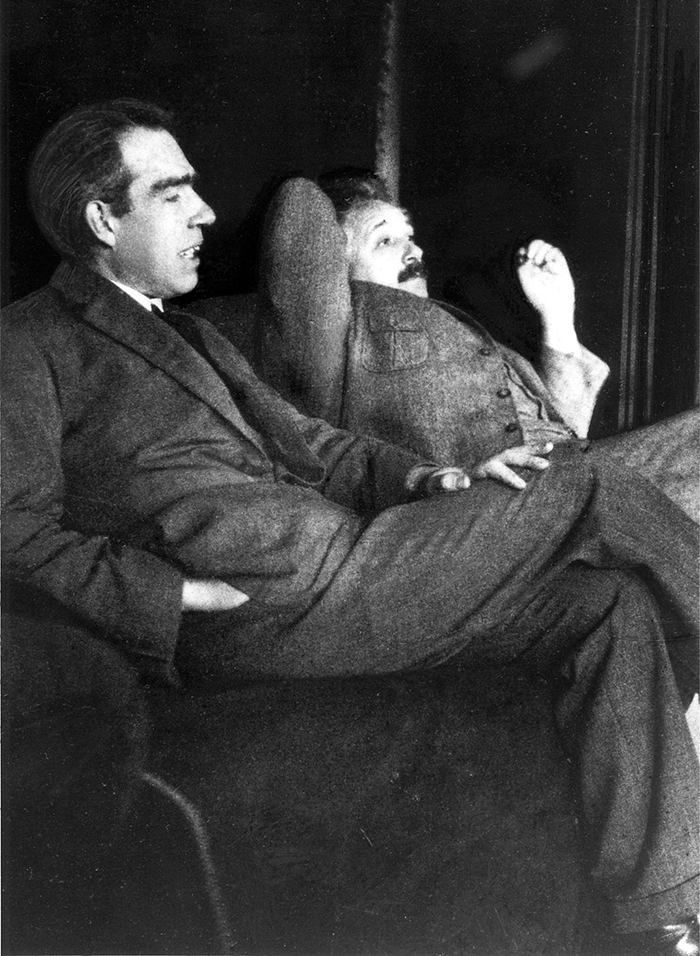
Bohr (left) and Einstein (right), December 11, 1925
Einstein believed that the universe and its infinite details exist whether observed or not. However, that particular reality reveals a prejudice toward object permanence, a concept that we humans grow accustomed to only after a year or more of life experience. (The game peek-a-boo is hilarious to infants because they don't register object permanence and every time a parent's face is revealed it's as if it has just popped into existence.) Bohr thought that, in the absence of observation, it is meaningless to assign reality-permanence to the universe because quantum systems exist in a "fuzzy" state mixing all potentialities.
Bohr's interpretation placed the observer of a quantum phenomenon in a central, active capacity (as opposed to a mere passive observer) because the measurement of any effect requires interaction with the phenomena being measured and thereby affects its behavior. Even today, such illustrious physicists as Roger Penrose conclude that consciousness itself is a feature of the physics necessary in characterizing quantum events.
Bohr did not take it to the extent of the following example, obviously, but a modern extrapolation may be found in video games. The world in which game characters exist is not rendered outside of the scene observed by the player — it would be a waste of computer processing power to constantly maintain the entire game world; hence only the observed portion is rendered at any one time and actions don't manifest until observed. That doesn't necessarily mean that the universe is a simulation (though the arbitrary speed of light has itself been compared to computer processing speed and a means of limiting character access to distant objects, which would require infinite computing power), or that only what we currently observe exists, but it's the kind of thought exercise generated by quantum mechanics that has led many physicists to become philosophers.
Bohr believed that an independent object could, without contradiction, hold more than one mutually exclusive and yet equally valid definition, with all definitions necessary to understanding that object. This concept he called "complementarity," at least in terms of examining both wave and particle properties, and he thus initiated a philosophical and metaphysical controversy in the field of physics that continues to be examined to the present day.
Bohr thought that, in the absence of observation, it is meaningless to assign reality-permanence to the universe
The study of quantum physics demands inquiry into the nature of existence, and Bohr became interested in the philosophy underlying his discoveries: electrons and photons that exist in several places simultaneously, that could be particles in one instant and act like waves the next, and objects that could exist in mutually exclusive states at the same time. These are all puzzles with implications best contemplated while smoking a pipe, and Bohr smoked his pipes a lot.
(It should be noted that the preceding attempt at describing quantum mechanics was written by an amateur who majored in English, not physics. I'm confident that I smoke at least as much and as often as Bohr did, and I even increased my daily tobacco combustion when writing this article (and since I smoke all the time, that required my own superposition), hoping that it might elevate my intellect, but it fell woefully short. Please forgive any inaccurate interpretations. As the physicist Richard Feynman said, "Anyone who claims to understand quantum theory is either lying or crazy.")
Bohr's Life
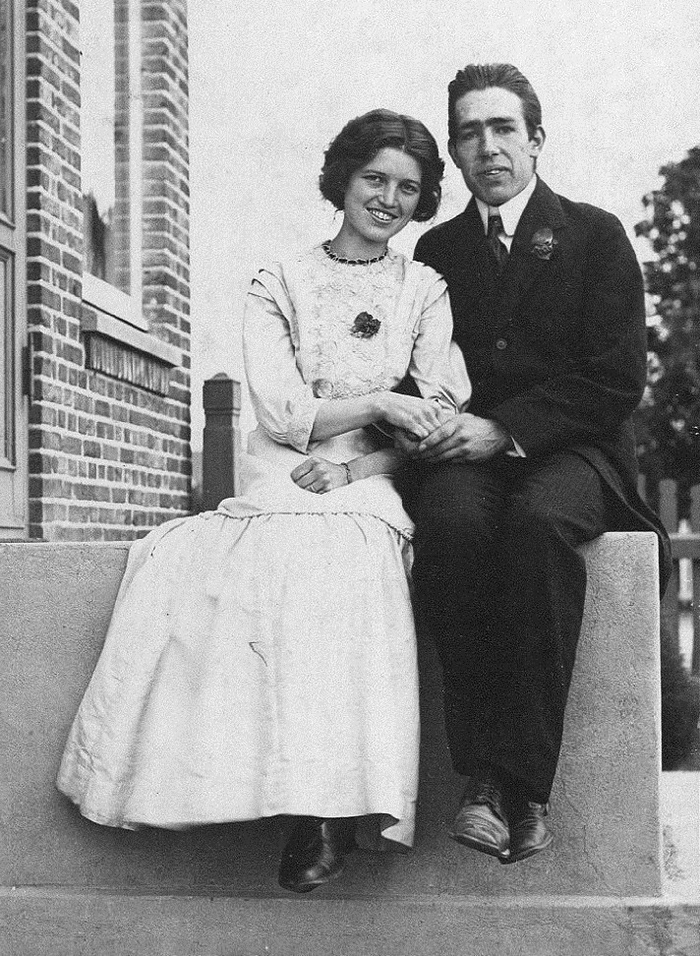
Neils Bohr and Margrethe Nørlund
Born in Copenhagen in 1885, Bohr was the son of Ellen Adler and Christian Bohr, a celebrated professor of physiology at Copenhagen University who was nominated three times for the Nobel Prize. The Bohr family had a lasting relationship with that award: While Christian did not win the prize, Niels was awarded the Nobel in 1922, and Niels' son, Aage, won the Nobel in 1975 for his work in the geometry of atomic nuclei. This family has demonstrated strong, scientifically inclined genes.
Bohr earned his doctorate in physics at the University of Copenhagen in 1911 and married Margrethe Nørlund the next year, with whom he had six children. In 1916, he accepted a professorship at his alma mater and in 1920 founded the Institute of Theoretical Physics at the school. His career and personal life were going very well — until Adolf Hitler started abusing the world.
German Jewish physicists started arriving in Copenhagen at Bohr's behest and were then able to safely move to the U.S. In 1940, Nazi forces invaded and occupied Denmark; Bohr learned of his imminent arrest in 1943 and escaped by boat to Sweden with his family. He was aware of the German project to develop an atom bomb and joined the Allies in their own research to counterbalance that threat, though he did not think at the time that it could be done before the war ended.
Bohr and his son, Aage, who was now a 21-year-old physicist, began working at Los Alamos and contributed to the Allies' bomb development. While Bohr contributed significantly to the technical aspects, Robert Oppenheimer acknowledged that of even more importance were Bohr's relationships with the other scientists and that he acted as a "scientific father confessor to the younger men."
In 1916, he accepted a professorship at his alma mater and in 1920 founded the Institute of Theoretical Physics
After the war, Bohr lobbied for responsible world-wide stewardship of atomic energy. He felt that to avoid a post-war nuclear arms race, the Soviet Union should be notified of the technology, and he wrote to Winston Churchill and Franklin Roosevelt to urge world-wide cooperation. His proposal was rejected, and Churchill suspected him afterward of being a Soviet spy.
He continued with his advocacy for openness and the rational application of nuclear energy to the end of his life, which came in 1962.
Bohr's Pipes
Records do not indicate Bohr's favorite pipe or tobacco brands. It's a shame because there could certainly have been an amusing pun to be made on "Bohr-kum Riff." Historians, however, have seldom recorded the pipe details of their subjects. Pipes were simple accessories and thought as unimportant as the types of socks a prominent figure might prefer. However, we know from many photos that Bohr primarily smoked straight Billiards. There is an archive of Bohr photos at arkiv.dk, and those pictures reveal that he was seldom without a pipe. Here's a list with links to some of the better images of Bohr with his pipes:
Straight Apple (1942) •
Bent Brandy (1945) •
Bent Billiard (1946)
Straight Billiard (1954) •
Straight Billiard (1954) •
Straight Billiard (1955)
Straight Billiard (1957) •
Straight Billiard (1958) •
Bent Billiard (Drawing by H.J. Bhabha, 1960)
Straight Billiard (1960) •
Straight Billiard (1960) •
Saddle Billiard or Dublin (1960)
Straight Billiard (1961) •
Straight Billiard (1960) •
Straight Billiard (between 1955-1962)
The images are not alone in recording Bohr's pipe smoking; biographies also indicate that Bohr was a dedicated smoker, such as Niels Bohr's Times by Abraham Pais:
Bohr was an indefatigable worker. When he was in need of a break in the discussions, he would go outside and apply himself to the pulling of weeds with what can only be called ferocity. At this point I can contribute a little item to the lore about Bohr the pipe smoker. It is well known that to him the operations of filling a pipe and lighting it were interchangeable but the following situation was even more extreme. One day Bohr was weeding again, his pipe between his teeth. At one point, unnoticed by Bohr, the bowl fell off the stem. Aage and I were lounging in the grass, expectantly awaiting further developments. It is hard to forget Bohr's look of stupefaction when he found himself holding a thoughtfully lit match against a pipe without bowl.
Jan Faye mentions on page 119 of Niels Bohr: His Heritage and Legacy (1991) that Bohr used matches to light his pipes — and lots of them. "He preferred to buy the biggest boxes of matches he could get."
Even his friends and staff recognized Bohr's need for multitudes of matches:
He used to relight [his pipe] repeatedly, and it was a recurrent good-humored prank on his birthday for the staff of the Institute to present him with a stack of huge boxes of matches. Without exception, everyone who has ever spent any time with him has experienced the incessant relighting of his pipe. On the tape containing the informal recollections recorded shortly before his death, his voice breaks off time and time again as a match is heard being struck, followed by repeated deep sucking to get the pipe to draw. (Blaedel, 85)
... we know from many photos that Bohr primarily smoked straight Billiards
Interestingly, Einstein, another avid pipe smoker, was friends with and often visited Bohr, and had the habit of raiding Bohr's tobacco jar. Einstein had been forbidden by his doctor from purchasing tobacco, but he could always find a way around troublesome problems. He rationalized that while he could not purchase tobacco, the doctor had said nothing about stealing it, and amused by his justification would jokingly wait until Bohr's attention was elsewhere to fill his pipe from the unguarded jar.
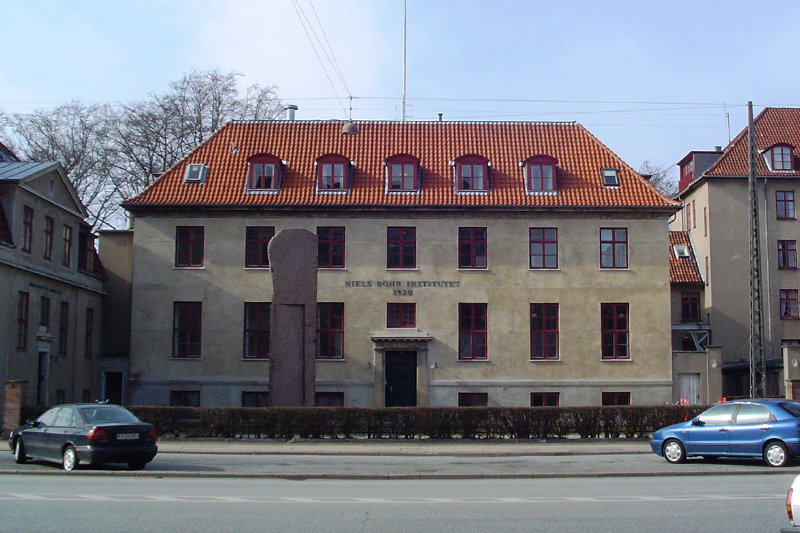
The Niels Bohr Institute, University of Copenhagen
Even as he aged, Bohr maintained excellent physical health and remained active while still dedicated to his pipe smoking: "He still zoomed down the ski slopes like a teen-ager and still took the institute steps two at a time. But his pipe was almost constantly in hand, and he seemed more reflective than before. The eyes were more deeply set under the thick beetling eyebrows. (Moore, 207)
Bohr was in many ways a walking ashtray. He would always place his pipe in his coat pocket, sometimes while still lit, but usually not, and spill ashes inside. In the many photos of Bohr seated at desks and tables, there is never a pipe in view, never resting on a table — it's in his pocket. He spilled ashes outside as well, and his office at Copenhagen University often became untidy, even to the point where the cleaning crew objected: "... the pipe ashes and chalk often were strewn around Room 208, Bohr's borrowed office. Wheeler came in late one afternoon to find the janitor haranguing Bohr about the mess that had been created in Fine Hall's finest office. (Moore, 250)
"He preferred to buy the biggest boxes of matches he could get."
When pipe tobacco failed him, Bohr often alternated to chocolate to stimulate his thought processes. It's hard to understand how a man of Bohr's mental acuity might think he needed the help, but it's clear that he enjoyed the mental benefits of both chocolate and tobacco.
It is known of course that nicotine increases the supply of blood sugar to the brain. And with Bohr's perpetual mental activity it is not so strange that he should always need to have his pipe lit — but it is not strange either that as the pipe was always going out because he forgot to smoke while he was thinking, he was often forced to make for the chocolate, whose sugar content has the same effect. "Potential energy," he called it. (Blaedel, 85)
Most of us would readily recognize the pipe smoker in Niels Bohr. He was animated in his lectures and excited by his subject matter, and he smoked in a contemplative manner, benefitting from the pastime as it helped him gather and organize his thoughts. A particular episode in his life demonstrates his thoughtfulness while pipe smoking. Jens Lindhard, another pipe smoker, who would later become President of the Danish Academy of Sciences, was working with Bohr sometime in the 1940s to write an article about the behavior of charged particles:
Every morning Lindhard presented himself at Bohr's house, where a blackboard was hung, and where they would often sit with few interruptions until twelve o'clock at night.... It had happened once that Bohr had inadvertently picked up Lindhard's pipe — something which other colleagues had also experienced — and for that reason the day used to begin with Bohr and Lindhard both laying all their pipes out on the table and sorting out which belonged to whom before lighting up and sitting in silence for a while as they smoked. There was a day when the silence continued. They carried on smoking. Bohr was concentrating with a distant look in his eyes. Still nothing was said. The pipes were refilled and lit up again, and after a while Bohr said, "Now I have it, we shall simply begin the sentence with 'notwithstanding.'" This was considered a little, and written down, whereupon they sat a while longer, smoking quietly, and then suddenly Bohr said, "I am so pleased at how well our work is progressing." (Blaedel, 88)
Smoking a pipe makes one realize how the small details matter, even the simple addition of a single word in a scientific paper. Niels Bohr spent his life examining the very small, things so small that they contradict classical physics. He found a way to reconcile science at the atomic level, and in so doing revealed a future filled with the modern inventions that we now depend upon. His thinking changed the world and made the impossible possible, all while Niels Bohr thoughtfully smoked his pipe and contemplated our existence.
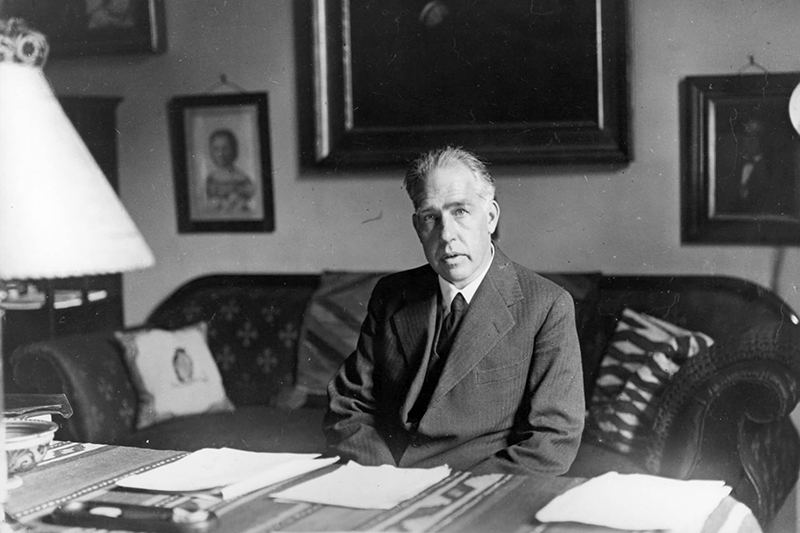
Niels Bohr
Bibliography
- "The Idea That Changed The World: 100 Years Of Quantum Jumps" (2013) by Marcelo Gleiser, NPR.com
- "Particle, wave, both or neither? The experiment that challenges all we know about reality" (2023) by Anil Ananthaswamy, Nature.com
- "Understanding the 'Schrodinger's Cat' Thought Experiment" (2019) by Andrew Zimmerman Jones, ThoughtCo.com.
- Niels Bohr's Times: In Physics, Philosophy, and Polity (1991) by Abraham Pais
- Niels Bohr: The Man, His Science, & the World They Changed (1966) by Ruth E. Moore
- Harmony and unity: The Life of Niels Bohr (1988) by Niels Blaedel
You may also enjoy:




Comments
Exquisite dissertation.A pleasure to read.
An excellent article. Thank you for your insights concerning quantum mechanics and the very essence of pipe smoking.
We haven't heard from you in a while, Chuck. You were missed. Thank you for writing an article about my personal hero. I studied Physics in HS, taught by Gerald Borer, S.J. (pronounced as Bohr), and went on to take eight semesters more in college. Bohr's intuitive leap of understanding in the behavior of electrons in valence shells is remarkable. I was also fortunate enough to visit Copenhagen a few years ago and visited the Institute. Thanks again for this article and all of the articles you have written so well.
Chuck, another excellent, well researched essay! Kudos!Sometime, take a look at E A Poe’s Eureka, only 500 copies in the first edition. Several turn-of-the century literary scholars suggested that Poe may have anticipated some of Einstein’s ideas. Interesting, at least.
Wonderful article, Chuck! I'll have to begin contemplating whether the pipe I'm smoking truly exists when it's unobserved in its rack, or only when it's observed and combusting pipe weed. Phew.
I was a physics major and have read a number of books in it, but nothing, nothing comes close to such an illuminating superposition of pipe smoking and thinking as you have done.
Thank you Chuck, for your excellent research and for bringing this man's life to us - as well as his pipes! It's perhaps a conundrum of philosophy that what is in our pipes results in smoke, whilst the pipe certainly does not!
Thank you. Such an interesting and informative article. I learned things from it, which is always useful and pleasing.
I received a Ph.D, in physics in 1974. If memory serves me correctly, I read somewhere that when the Germans invaded Denmark during the war, they dissolved Bohr's Nobel medal in acid and kept the solution in a container to prevent the Germans from confiscating it. After the war the solution was reconstituted and a new medal was formed from the gold, and Bohr got his medal back. Very clever guys, those Danes!
Chuck,You continue to amaze; the Bohr piece was excellent. Thanks for providing true added value to the customer base. Great comments everyone!