


 |
|
 |
|


Norman Rockwell: Illustrator of America and Pipe Smoker


Norman Rockwell is known for his work that captures a sentimental view of American life. While his work is often disregarded by "serious" art critics, there is no denying that it left an impact on many. A talented man, and a dedicated pipe smoker, today we're going to explore Norman Rockwell's life and his expansive career, in which he produced more than 4,000 original works.
Norman Rockwell Early Career
Norman Percevel Rockwell was born on February 3, 1894, in New York City to Jarvis Waring Rockwell and Anne Mary "Nancy" Rockwell. Rockwell's early childhood was largely uneventful until his blooming teenage years. At the age of 14, Rockwell would transfer from his high school to the Chase Art School, now known as Parsons School of Design. From the Chase Art School, he would go on to attend the National Academy of Design, and finally finish at the Art Students League of New York.
Rockwell would be taught by legendary figures like Thomas Fogarty, George Bridgman, and Frank Vincent DuMond. Rockwell's earliest works were produced for St. Nicholas Magazine, the Boy Scouts of America magazine, Boys' Life, and a few other lesser-known youth publications. While Rockwell was completing his studies, he'd work a few odd jobs, like serving as the supernumerary at the Metropolitan Opera. When he turned 18, he'd get his first major job, serving as the illustrator for Carl H. Claudy's book Tell Me Why: Stories about Mother Nature.
Shortly after, he was hired as a staff artist for Boys' Life. His pay was $50 each month for one completed cover and a set of story illustrations. One year later, at 19 years old, Rockwell rose to the role of Art Editor for the magazine, and he would maintain that role for three years. His most famous cover from this time period was Scout at Ship's Wheel, which appeared on the September 1913 edition.
When Rockwell turned 21, his family would relocate to New Rochelle, New York. Looking for a new studio, he'd meet and share a space with cartoonist Clyde Forsythe, who was working for The Saturday Evening Post at the time. Forsythe saw potential in a young Rockwell, and helped him submit Rockwell's first cover to the Post in the May 20, 1916, issue. The cover was entitled Mother's Day Off. Rockwell would follow this up with seven more covers for the Post in his first year. Around this time, Rockwell would marry his first wife, Irene O' Connor, on July 1, 1916.
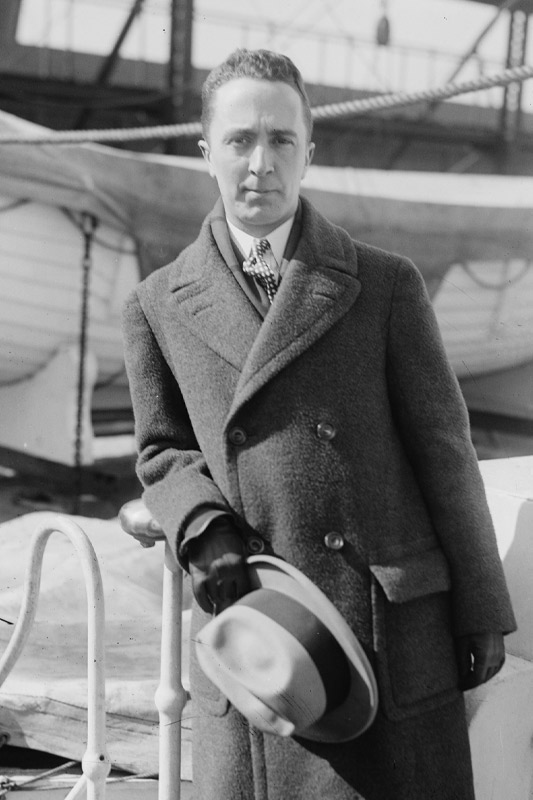
The Post and Rockwell would quickly become intertwined, with Rockwell publishing 323 original covers for them over a 47-year career. Rockwell's success with the Post led to him securing countless other illustration commissions for other publications, including Literary Digest, Life, The Country Gentleman, and many more.
When Rockwell's career with the Post started to pick up speed, he would leave his salaried position at Boys' Life. However, Rockwell would eventually return 10 years later to work with the Boy Scouts of America with his first of 51 original illustrations for their annual calendar.
During the Great War, Rockwell tried to enlist in the U.S. Navy but was refused entry because he was underweight for a 6-foot tall man. To compensate, he spent a night binge eating doughnuts, bananas, and liquids to weigh barely enough to enlist. He was assigned the role of military artist, and did not see any manner of action during his tour of duty.
Life settled into a steady rhythm for Rockwell until his divorce on January 13, 1930. In a deep depression, Rockwell would move to Alhambra, California, and stay as a guest of Clyde Forsythe. Rockwell would produce some of his best paintings here like The Doctor and the Doll. During his stay, he would meet and marry Mary Barstow. The couple would return to New York after marrying on April 17, 1930. Together, they would have three sons.
Rockwell's family would move to Arlington, Vermont, in 1939, shifting his inspiration to reflect small-town living. For the most part, his career wouldn't see any notable additions until 1943, during World War 2.
Inspired by a speech by Franklin D. Roosevelt, describing four freedoms for universal rights, Rockwell would paint the Four Freedoms series, a project he completed in an awe-inspiring seven months, which resulted in a 15-pound weight loss in the process. The four paintings were entitled Freedom from Want, Freedom of Speech, Freedom of Worship, and Freedom from Fear.
The paintings were first published in The Saturday Evening Post. The United States Department of Treasury later promoted war bonds by exhibiting the originals in 16 cities across the country. During this time, he also created Rosie the Riveter. While the Four Freedoms series was a success, Rockwell would face misfortune when a fire in his studio destroyed countless paintings and props for his work. Critics consider this fire to be the defining split in his career, forcing Rockwell to depict modern situations more prominently than his earlier, more nostalgic work.
Norman Rockwell Post-World War 2 Career
Toward the tail-end of the 1940s, Rockwell would spend his winter months as a resident artist at Otis College of Art and Design in Los Angeles. Rockwell's family would relocate once again in 1953, to Stockbridge, Massachusetts, for his wife to be treated at Austen Riggs Center, a psychiatric hospital close to Rockwell's studio. Rockwell also received treatment, seeing Erik Erikson. Erikson would later tell Rockwell Biographer, Laura Claridge, "Rockwell painted his happiness, but did not live it."
On August 25, 1959, tragedy would come to Rockwell's life when his wife Mary died suddenly of a heart attack, leading him to take a break to grieve. During this time, Rockwell and his son, Thomas, produced the autobiography, My Adventures as an Illustrator. Years after her death, Rockwell would marry his third and final wife, Mary Leete "Mollie" Punderson, on October 25, 1961.
During this period, Rockwell's studio was above the famous Back Room Rest, better known as the famous "Alice's Restaurant" from Arlo Guthrie's titular song. Starting in 1961, Rockwell was a member of the Monday Evening club, a men's literary group. He would be a member until his death.
Rockwell's time with the Post would come to an end in 1963, after 47 years of illustrating for the magazine. His career was far from over, and he would spend another 10 years painting for Look Magazine, where his work reflected his interests in civil rights, poverty, and space exploration.
His most famous work from the Look era was The Problem We All Live With, which depicted the issue of school racial integration. The painting depicted Ruby Bridges, flanked by the federal marshals walking to school past racist graffiti. The painting was displayed in the White House when Bridges met with President Barack Obama in 2011.
The latter half of the 1960s saw Rockwell participate in more pop culture. In 1966, he would paint the stars of Stagecoach, even serving as an extra in the film, and in 1968, he would paint the album cover for The Live Adventures of Mike Bloomfield and Al Kooper. On his 75th birthday, The Boy Scouts of America asked Rockwell to pose in Beyond the Easel for an illustration in the 1969 Boy Scout Calendar.
The U.S. Bureau of Reclamation commissioned Rockwell to paint the Glen Canyon Dam in 1969. Rockwell's career began to slow, and he would finish his last commission for the Boy Scouts of America in 1976 at the age of 82. Over the course of his career, he generated 471 images for the Boy Scouts of America, and spanned over 64 years of collaboration. President Gerald Ford bestowed Rockwell with the Presidential Medal of Freedom in 1977 for his career painting "vivid and affectionate portraits of our country." One year later, Rockwell would pass away quietly due to emphysema at the age of 84 in his Stockbridge, Massachusetts, home.
Norman Rockwell Pipe Smoker
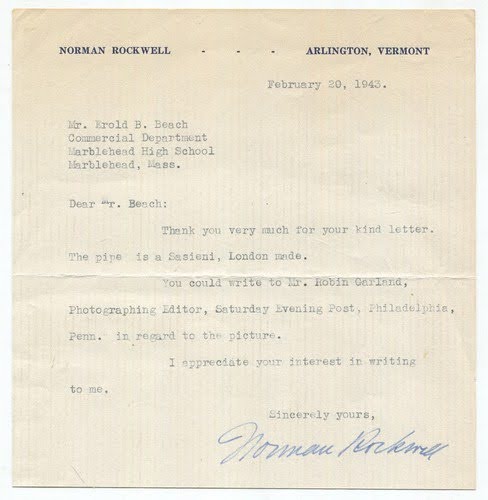
Rockwell was a life-long pipe smoker, which was reflected throughout his work and in countless photos of him. The Norman Rockwell Museum considers his Dunhill "an important element in his self-branded image." Rockwell was said to have kept a copper bucket by his easel which he would dump his smoldering ashes into. According to both an ad campaign, and the Norman Rockwell Museum, Edgeworth Executive Mixture was the illustrator's choice of tobacco. In a letter of correspondence with a fan, Rockwell also remarks that one of his pipes is "Sasieni, London made."
Rockwell's career was expansive, and while art critics have dismissed Rockwell, his work lives on to this day, though Rockwell would label himself as an "illustrator" instead of painter. Rockwell depicted a nostalgic view of America while capturing some of the real issues the country faced over his lifetime. He shared joy with the world even when he felt none. When you feel nostalgic, light a pipe in honor of Rockwell and remember the good times while kindling a hope for the future.
Bibliography
- Norman Rockwell wins medal of freedom. Native American Writer Born. (n.d.).
- Petschek, W. (2020, April 3). Norman Rockwell, the most American of all artists – archive, April 1972. The Guardian.
- Norman Rockwell - a brief biography - a career in illustration. (n.d.).
- Kamp, D. (2009b, October 7). Norman Rockwell's American Dream. Vanity Fair.
You may also enjoy:




Comments
Another great article showcasing another interesting pipe smoker. I am no art expert but I have to disagree with the art critics because Norman Rockwell’s illustrations speaks volumes.
Screw the critics, I love Rockwell's work. I can just get lost looking at the detail and the magic of the moment in time (especially the American holidays) that he captured. Those were the good ol' days when the world wasn't in such a damn hurry. I enjoyed this little biography, you're growin' on me Rose.
刚注册的网站,挺好的
I became an Eagle Scout in 1974 and Rockwell’s Court of Honor illustration hung in meeting hall.
Norman Rockwell’s BSA illustrations were part of my childhood. I remember my Grandfather looking at Rockwell illustrations in Look magazine while sitting on his lap and enjoying the aroma of his pipe. Thanks for the memories!
Norman Rockwell was a brilliant artist who loved his pipes. That was why I featured his "Triple Self-Portrait" on Page 1 of Still Searching for Pipe Dreams. I corresponded with his son, Thomas, to get permission to reprint the painting. Thomas wrote back that he would normally say no to a request of this kind, but his father was so passionate about his pipes that he would definitely approve.
Great article. My father was a painter and friend of another great painter: Thomas Beuchner: He was a well known Rockwell Historian...a character in his own right...known for his paintings and cigars. He lived in upstate NY.
There’s so much history about Norman where I live, right next to Arlington. Some of his paintings were of extended family members of mine. And today there’s even a few pipe makers within a handful of miles of where he lived in Vermont :)
Great article. I never knew much about the man beyond his paintings. This was very informative.