


 |
|
 |
|


Smoke Rings: Long Live the Queen by Caldwell Cigars


W
elcome to another episode of "Smoke Rings." Today I'm chatting with Robert Caldwell about Caldwell's new release complementary to Long Live the King, which is Long Live The Queen. Long Live The Queen is the first cigar in Caldwell's portfolio to utilize Cameroon wrappers and is available in five vitolas.
Note: The following transcription has been edited for clarity and brevity.
[Shane Ireland]: Hey everybody, I'm Shane Ireland. I have a special guest with me back again. This guy can't stay away it seems like. Robert, welcome back.
[Robert Caldwell]: Thank you.
[SI]: Today we are talking about maybe the most anticipated release in the Caldwell line in some time.
[RC]: I think that's fair.
[SI]: And maybe the most well received, highest rated, all that good stuff. Is that all true?
[RC]: All true, and also the most back-ordered cigar I think we've ever had.
[SI]: That's fantastic.
[RC]: Yeah.
[SI]: So, why? Why was this one basically such a smash? And tell me about how long it took to bring it to market and when you started basically conceiving of and working on the project.
[RC]: Sure, well, I think first of all, the artwork's very nice.
[SI]: It's gorgeous.
[RC]: So we do a good job with the artwork, and it's a very nice product.
[SI]: Absolutely beautiful.
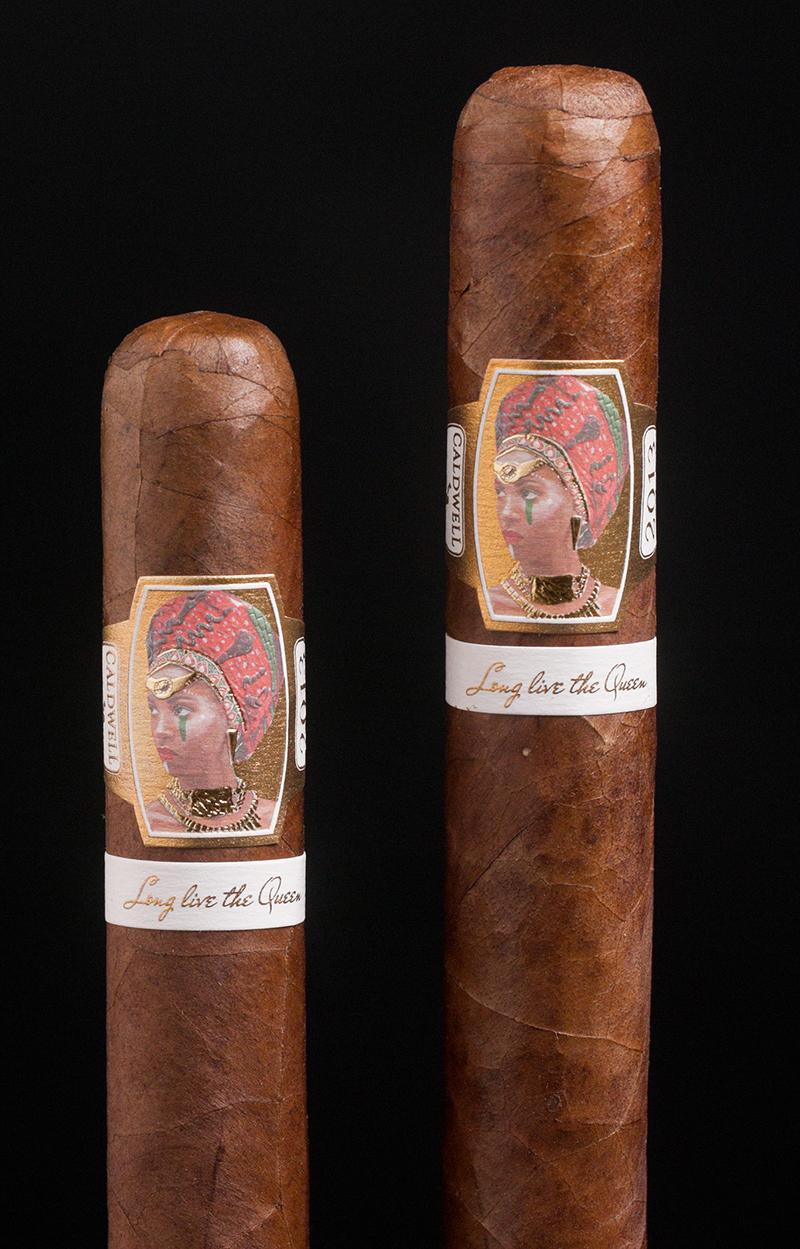
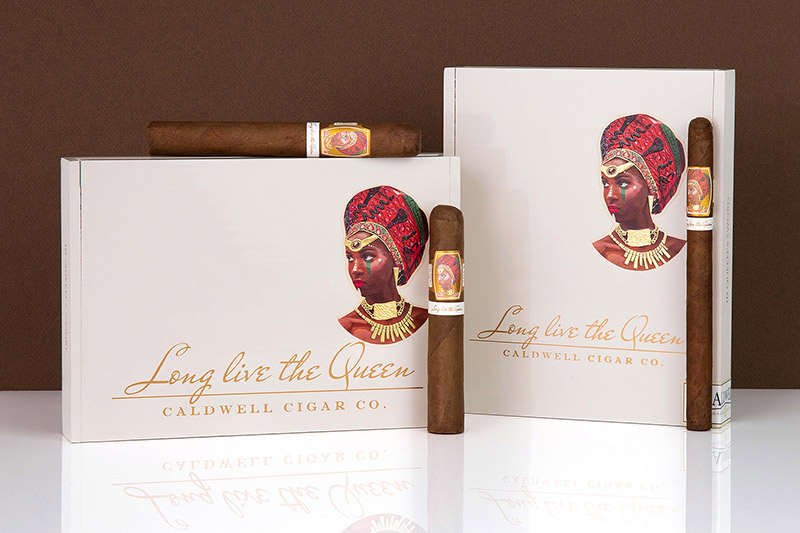
[RC]: So I think it's something that calls attention to the consumer, but Long Live The Queen's an extension of our Long Live The King portfolio, or sits beside it, obviously. But I think the reason it was so well received, obviously there was a lot of hype coming into the cigar. The branding was very cool. We announced it a long time before we started shipping the product, using a Cameroon wrapper, which is something that's very much sought after. And to tell you the truth, I was very concerned when we rolled out the cigar because there was so much hype in front of it arriving that I was thinking there's no way that this cigar is going to live up to the expectations of what people are thinking that it's going to be, because it doesn't matter what the cigar tastes like, it doesn't matter how good it is. When there was that much hype and anticipation prior to the rollout of a brand, there's no way that you're going to meet consumers' expectations. It doesn't happen.
So I was very concerned, and actually when we started shipping them, it was like a white knuckle, you know, like I'd have my sales guys call me, and I'd ask, do guys like it? I knew it was a great cigar, but it was just so hyped up and they're like, yeah, they're selling out of it left and right. So we had that kind of problem 'cause we produced a certain amount of the cigars expecting that they were going to give us six or seven or eight months worth of stock, and then not only that, but we were a bit delayed on stuff. So the cigars had been aged a bit longer than we'd expected.
[SI]: Not a bad thing.
[RC]: Not a bad thing. But on the subsequential productions, we wanted to age them the same way 'cause we wanted to have consistency. So it turned from a cigar that was going to be aged, I don't know, four or five months, to a cigar that now is aged like 6, 7, 8 months. So that caused some other complications. But the reception of the smokers to the cigar was actually better than I expected, which I didn't think was going to happen just 'cause there was so much hype I think built into the product. And then, yeah, when we started getting the ratings, we started getting weird ratings. So I mean we've gotten a lot of 92s and 93s from Cigar Aficionado. This one came in at a 94. I was like, oh, okay, that's the best one we've had. And then Half Wheel — which a great rating from Half Wheel is like an 87 — I think they gave us a 91 or 92, which is like a 96, 97 from Cigar Aficionado. And I wasn't expecting that either. And then they gave a lot of praise to the brand as well.
So we had kind of like the three-pronged punch of having a good product, good packaging, more uniqueness in terms of the wrapper offering to what's on the market a lot, with a lot of anticipation. And then we got the ratings on top of it. So it's done very well. I mean currently we have none in stock. And it's kind of been that way since we brought it in, we have 500-600 boxes sitting on the shelves — or 200-300 boxes, whatever the number is — and then they're gone, and then you have to wait. So it's been a very successful launch and it's been our most successful launch I think that we've had in several years of any core product, which in the last several years we've only added Blind Man's Bluff core products to the portfolio, but it's just done phenomenally well.
[SI]: Excellent. So this is the first Cameroon wrapper in the brand.
[RC]: Yes.
[SI]: Is it the first time you've worked with a Cameroon wrapper at all?
[RC]: No, I had some early on that I worked with, but we didn't do any big releases. I had some stuff under the Secret Stash Lost and Found line that was Cameroon.
[SI]: Very cool.
[RC]: So it's not my first experience playing with it or working with it, but it was the first core line that we've done, or any type of product for Caldwell.
[SI]: So are there challenges associated with using Cameroon? So that's a two-pronged question. Between sourcing the quality that you want and then also blending with it, is it different from blending with other grades of wrapper leaf or other origins?
[RC]: I wouldn't say it's more complicated to blend with, but it is in terms of leaf selection. So you get a lot of really small leaves, and then you get a lot of very ugly leaves. So cosmetically, there's a lot more imperfection that I find in Cameroon and there's more sensitivity.
[SI]: You see a lot more Cameroon binders on the market these days than wrappers.
[RC]: A lot of Cameroon binders. So a lot of stuff that could be a wrapper ends up as binder quality. So you have a bit of an issue.
[SI]: Just to pause there super quick: for those who might not know, when you're talking about binder-quality leaf, — this is my understanding, correct me if I'm wrong, — it's basically the same exact grade initially as the wrapper-quality leaf, and it's been sorted out for cosmetic imperfections or size reasons.
[RC]: Yes. You can't have stuff that is only binder, but a lot of wrapper that doesn't make the cut ends up being binder. So a lot of Cameroon does end up being binder.
[SI]: So flavor profile wise and how you utilize it in a blend, what was the approach like for this compared to maybe other tobaccos that you use more frequently?
[RC]: Well we wanted to have, in terms of the blending, something that stood up to the brand. So we knew, okay, we have Long Live The King. Long Live The King's going to be our fullest-bodied, spiciest blend that we have on the original Caldwell production. And so along with Long Live The Queen, we wanted something more refined, but that also packed a punch. So we didn't want to short people on nicotine or flavor. We also wanted to have the flavor, with a moderate plus amount of spice that was very complementary to the King, but more refined. And then, so our idea was, to me, our most refined cigar that we have is Anastasia. And then, since we're adding another female to the portfolio, we needed something that was similarly refined, but lives up to the Long Live The King expectation.
So when we were blending this cigar, the first thing we did was immediately knowing we were going to use Nicaraguan tobacco in the filler and then Dominican tobacco as well, but using stuff that was a little bit heavier on the kick to build out the blend. The blending for this cigar was different because I think a lot of the cigars that we blend, we don't necessarily start out with the idea of a strength profile.
And then, with the Queen, we did want to have something that was going to be a bit more gutsy and then getting that to play with a Cameroon wrapper, which isn't necessarily a hard thing, we wanted something that was going to have the refinement, the creaminess, the sweetness, and the beautiful aromatic opportunity supported by the filler tobacco that we used. And then it's always a challenge with Nicaraguan as well, 'cause a lot of times you'll get tobaccos that really overpower the blend and you'll end up with something that was large in body, large in profile, but lacking the refinement. I think that's a very easy thing to do when you're working with some of the stronger Nicaraguan and Dominican tobacco.
So the blending process was a little bit complex, but not complicated. And that was also a concern of mine, because when we were launching the brand, I'm like, I don't know if guys are expecting like the Anastasia-refined approach or if they're expecting the King, full-bodied kind of California, spicy thing. But I think we just threaded the nail and just hit the nail on the head as well in that regard in terms of giving the public, I guess, what they were hoping to find in the blend.
[SI]: Right. So not that this is any indication of the success as a blender, because sometimes you hit immediately, sometimes it takes a million iterations. But I'm just curious, how long did it take to lock in the blend for the Queen?
[RC]: It took about a year. And I'd say that we did 20-ish blend variations. And then once we got really close, we probably iterated another 10 or 15 times playing around. Until we got to the foundation of what the blend was going to be, I'd say it took about 20 tries. And then, from there, the refinement, probably another 10 swings, and then we were able to execute I think pretty well.
[SI]: Nice. Before we talk about vitolas a little bit, the only other thing I wanted to ask is what, in your opinion, are the unique qualities of Cameroon as a wrapper? Like what is the advantage of using it? What is the attraction of it? You mentioned that sourcing it, especially in the size and the grades for the wrapper, is difficult. So why go through the effort? What's special about the leaf?
[RC]: There's a uniqueness of flavor that is very hard to find and cannot be replicated. So I would say, I mean you can get a smoking experience from non-Cameroon tobaccos that is somewhat reminiscent of the experience of smoking Cameroon, but you cannot replicate the flavor. And so, with us, we have a lot of Habano, of course we have San Andrés, and Connecticuts. We rely really heavily on Habano for a lot of our blends.
And then, when we were going to create the Queen, we wanted to do something that would be as unique as the brand was going to be. And that's kind of what led us to Cameroon, because when we started looking at tobacco, the first one that we were actually going to do, or the tobacco that I referenced to you last night, was Brazilian Cubra, because that's a great tobacco. And so we started actually working originally with the Queen line thinking that we were going to do Cubra, but then we recognized that Cameroon's going to give you a caramelly, creamy, and beautiful bouquet of flavor.
We decided Cubra would be a great line edition, but to lead with Cubra I think was something that would've been a little bit more challenging with the brand. And actually it probably would've performed equally as well, but it would've been outside of what we wanted to do with the brand in terms of the refinement and the flavor experience. But Cameroon is, if you talk to cigar makers, the honest ones, they'll be like, "Ah, Cameroon." You know, there's a romance behind Cameroon.
[SI]: A little mystique, yeah.
[RC]: Mystique and romance. A lot of the other tobaccos aren't that way. So guys don't talk about it in the same way. So I mean, there was a time when Cameroon was all over the market, and now it's not. And I think that by losing the accessibility of Cameroon that we had 10 or 15 years ago as a market, people realized what they'd lost a little bit. And so a lot of guys on the tobacco side, they have that reminiscent nostalgia. It's one of those things that I think was under appreciated until it was not available.
[SI]: Yeah, interesting. If somebody was approaching Long Live The Queen for the first time, is there a particular vitola you would recommend them starting with? Where did the blend start? What did you start with? Is it the same approach you take with all your blends, or did you do something different this time?
[RC]: No, actually the blend size was a 6" x 46, which is what I use every time.
[SI]: That's what you use every time.
[RC]: We didn't release that size.
[SI]: Interesting, any chance that'll ever come out?
[RC]: It should.
[SI]: Okay, nice.
[RC]: It should, because I did like a thousand of them and then I sent a handful to one of my sales guys, and he calls me, and he's like, "What is this bundle?" And he freaked out when I told him it's the Queen Corona. We never released that size.
[SI]: Oh man.
[RC]: He said to me, you're an idiot. So I think we should.
[SI]: That sounds perfect.
[RC]: Yeah, but to me, the one that kind of stands out to me — which is very atypical, as you said right before this — I usually smoke the Robusto.
[SI]: Interesting.
[RC]: So I feel that the Lancero's my size.
[SI]: Which is what I normally smoke in this line. And I smoked the Robusto today 'cause you said it was what you tend to gravitate toward.
[RC]: Yeah, because I think that ... I think this is more my type of cigar, actually, but that's more what I was going for. It's got a bit more oomph.
[SI]: It does, it has a bit more oomph, a little bit more of the warming spices, especially in the retrohale. But it's really creamy. And honestly, you talk about cedar notes and woody notes a lot of times on the palate, like closely connected with cigars that are leathery, earthy, and the umami flavors, and an aromatic wood kind of aroma. It's a little unique. I don't know that I've experienced that.
[RC]: One hundred percent, and I think that the Lancero smokes much more typically Cameroon than you would expect from a Cameroon. And so, for me, the Robusto is a bit more interesting because it delivers what I imagined for the blend, which was to have something that was a bit more powerful and kind of that hybrid of Long Live The King mixed with an Anastasia experience. I think it's very, very prominent in that vitola, and the box press as well.
[SI]: That's what I was just going to ask. That's the most recent release addition, right?
[RC]: Yeah, so we originally did 1200 boxes: 400 for Europe and 800 in the U.S. on the box press as a limited edition called Ace of Hearts. And then we just had so much demand for it. And then I kept having guys ask, "Hey, when are you getting more box press?" And I hate to do it, 'cause I didn't want it to be a cheap thing. Like, hey, this is successful and it's limited, so we're making a regular production, but we ended up doing just that. But it was a more pure thing where there was so much demand and a lot of guys didn't get it. So we had a lot of retailers say I'll take 80 or 100 boxes. When we announced the brand of the limited edition and we sold through it, a lot of guys didn't get an opportunity to smoke that cigar. That's the one that got the 94.
[SI]: Ah, okay.
[RC]: So that particular size. So then we said, okay, we've got to put this out.
[SI]: So why do you think that particular size got that high score? As a consumer contrasting and comparing a similar length and ring gauge, but a box press versus not, what can you expect?
[RC]: It's got a bit more of a caramel thing going on.
[SI]: Interesting.
[RC]: Yeah, it's a little sweeter and a little more syrupy. But to me it's not the best one in the line either. So I'm not sure if that's the only one that they rated, or decided to smoke for the ratings. Or that's the one that stood out to them. Or more because it was limited. I'm not sure exactly why that one got rated, but I don't find it to be the best one in the line.
[SI]: Interesting. I guess there's only one way to find out: You've got to try 'em all. Which means I still need to smoke, I think, at least two of them. So we talked about the hype and the anticipation ahead of time. I think a lot of that is owed to the artwork, which again, I can objectively say is gorgeous. Like everybody that sees this wants that T-shirt and wants that poster that doesn't exist yet. Tell us about the concept for the art and maybe the execution. How did you work with the designer on that? Where did it come from? How many iterations were there? Like what you ended up with is striking, and I'm just curious how you got there.
[RC]: Perfect, so the artist is named Jade Rivera. So he is a good friend of mine, a Peruvian artist. As for iterations, I kind of just let him run with his ideas. So he did Anastasia also. And then another correlation to Anastasia. It's got the same-shaped ring.
[SI]: Yes.
[RC]: I don't know if you noticed that.
[SI]: Yes, absolutely.
[RC]: You know, the idea was building on the female collection and then, I worked with a good friend of mine, Nigel, to develop the artwork and he really helped to guide. So I got some insights from him. He's a very in-tune guy. And then he worked together with my buddy Jade to develop it.
[SI]: It's gorgeous.
[RC]: Makes you want to buy it, doesn't it? Really good. So yeah. But no, I couldn't have been more pleased with it. So from the jewelry, the gold finish on the packaging, everything just turned out exceptionally well.
[SI]: That's incredible. For Long Live The Queen, how many vitolas are available now?
[RC]: Five.
[SI]: Five vitolas. Smoke them all. Try them. It's an incredible Cameroon cigar. Very unique as far as Cameroon goes, in my opinion. Complex, easy to enjoy, and I haven't been able to put this one down since it came out. Robert, thank you so much dude.
[RC]: My pleasure.
You may also enjoy:



Comments