


 |
|
 |
|


Note: This is a continuation of a narrative about the Comoy family and their eventual merge with the Chapuis' family to become Chacom. For Comoy's early years and the initial merge information, check out Part 1 here.
The Comoys are known worldwide for their pioneering use of briar wood in pipe making. Their Anglo-French design and overall aesthetic with standard shapes and balanced proportions are still seen in pipe-making practices today. Although Comoy's pipes are no longer in production, Chacom is still prospering and producing pipes appreciated worldwide.
Comoy's and Chapuis Join Forces
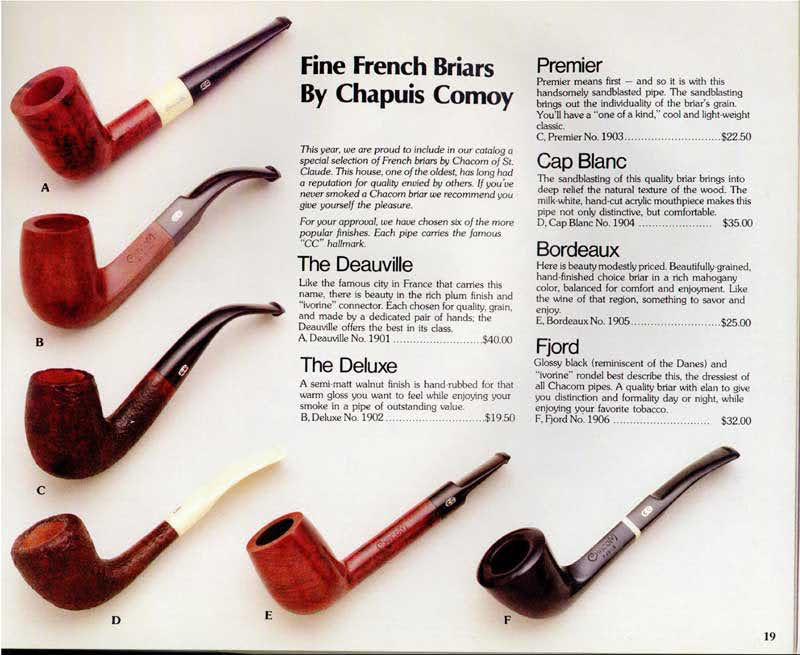
As discussed in the previous Comoy's history piece, the Comoy and Chapuis families partnered together after World War I. The Comoy's brand was succinctly renamed Chapuis Comoy & Cie., establishing the Chapuis-Comoy factory in Saint-Claude, France, in 1922. Thus, Chacom became a brand in 1928, combining the first three letters from the two family names. After this point, Chacom saw decades-long growth that spanned the globe.
Chacom After Henri's Passing
Prior to Chacom's establishment as an official pipe brand, Henri Comoy passed away in 1924 at 74 years old. He left the company in the hands of his sons Paul and Adrien as well as his nephews, Louis and Charles. The company was invited in 1929 to join Cadogan Investments Ltd., signifying the merger of the Civic Company and Oppenheimer Pipes with their associated companies, formed to create cooperation between them, according to Pipedia.
This historic occurrence for the Comoy's name was also documented in the Blue Riband book: "Henri Comoy's sons and nephews relinquished ownership of their company in exchange for a smaller interest in the new entity, Cadogan Investments." However, for several decades, the extended Comoy family ran their part of the business based on what they thought was best.
By the time World War II ravaged the world, pipe making had been greatly reduced as all industry was focused on producing items for the war effort. The demand for pipes was still high, but supply could not meet it.
Chacom and Comoy's Factories
Due to the economic crisis at Saint-Claude in 1932, the factory merged with La Bruyère, adopting that name and becoming one of the biggest pipe companies in the world, with 450 workers. A new factory was opened in 1937 on Pentonville Road to accommodate more employees. Louis Chapuis, Sr., joined in 1938 as did Pierre Comoy in 1947 after he served in the Royal Armored Corps, according to Pipedia.
When the war ended in 1945, all British companies had a difficult time re-establishing their dominance in the industry. However, a new factory was built in Aldershot to meet production demands. A statement from the 1965 catalog from Comoy's highlights this new factory: "And now, we the Comoys of the fourth generation, together with those of the fifth, Pierre Comoy and Louis Chapuis, continue to follow the course set by our forefathers, who would be gratified to see our latest ultra modern plant in Aldershot Hampshire."
That same year, Chacom split into two separate companies. The name Chapuis-Comoy returned in 1957 due to the success of the Chacom brand in France.
The Last of the Comoy's Family
The foreword in the Blue Riband book by Lucian Comoy — the son of Pierre Comoy, who was the last of the family to work for the Comoy's firm — provided some intriguing information about the '60s forward within the company and revealed the familial aspect of the brand: "We grew up feeling a part of a 'dynasty' and, indeed Julian and I bear the company 'stamp' in our second name: Henri."
Adrien Comoy, Lucien and Julian's grandfather, converted the factory in the 1960s for Mosquito fighter-bombers. During this time, Pierre was in Normandy in the Royal Tank Regiment, as explained in the Blue Riband book.
"During the 1960s and 1970s, my father travelled a lot to the States, to various countries in Europe and once to Japan, to meet distributors, go to trade fairs and so on. By then, it was already clear in his mind that to prosper, Comoy's had both to focus on quality, concentrating on the top end of the market, and to branch out into accessories, capitalizing on the company's reputation."
Comoy's indeed branched out into creating wallets, pouches, penholders, and a variety of pipe accessories. Cadogan, up until this point, allowed the family to make many of the key decisions about the brand themselves. This soon changed. "By the late 1960s changes in governance, however, reflected an increased direct influence of Cadogan on Comoy's operations."
Additionally, Britain was going through a rough patch during the '70s, which Julian noted: "These were the years of savage strikes, of power blackouts, of poor design and management. Underlying this was a crushing sense that quality was denigrated, that high taxation made entrepreneurship pointless, that the machine was taking over."
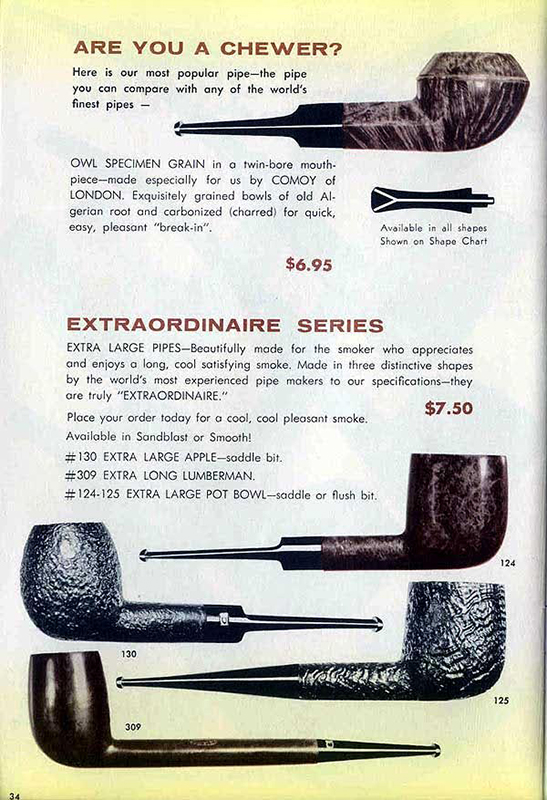
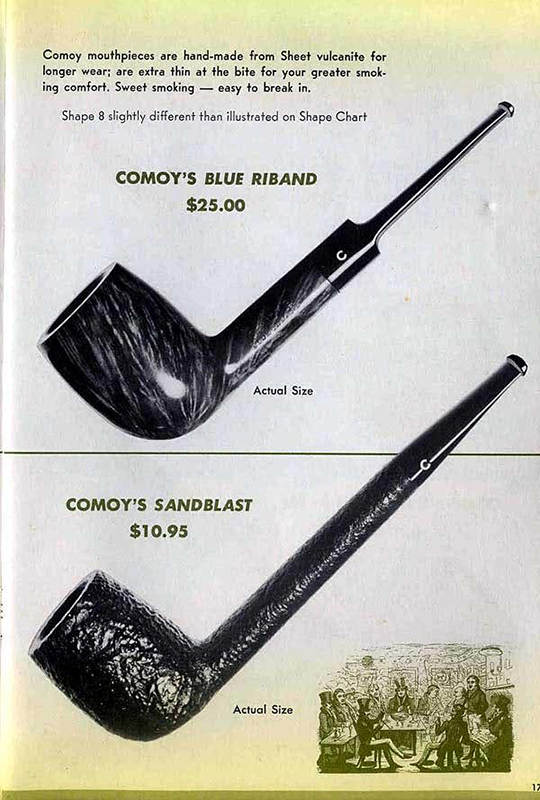
The Blue Riband line was no longer listed in catalogs as early as 1975 through the early 1980s after Cadogan began controlling manufacturing. "John Adler, who was Cadogan's CEO at the time, revealed that Blue Ribands were no longer promoted in Comoy's catalogs because precipitous declines in briar quality had made ongoing production no longer feasible."
Between 1987 and 2001, the factory joined the City-Fort Enterprises SA holding. Ropp was included in the catalog in 1994, according to José Manuel Lopes in Pipes, Artisans and Trademarks.
Comoy Catalogs
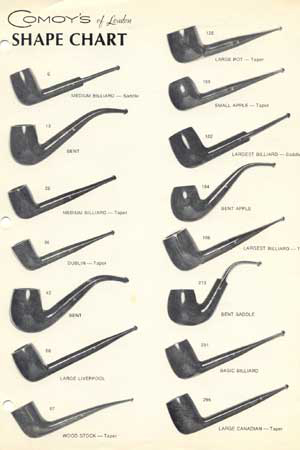
From 1911 to 1965, catalogs depicted both shape names and numbers together with each pipe. Within nearly every catalog, inserts were included to speak directly to retail customers. For example, in nearly every flier, the following statement would be included, highlighting the disciplined messaging early on within marketing efforts for Comoy pipes: "Of every thousand bowls made in Comoy's Workshops, three or four may possess the unique beauty of a Blue Riband." The United States' distributor of Comoy's was called House of Comoy Inc. through 1949, which was then renamed to Comoys of London Inc. as shown in a catalog from after 1950.
In the 1962 catalog, there were more names and numbers available, with the shape chart depicting more offerings than the catalog, which was a stark contrast to prior iterations. The shape chart also purposefully obscured grain quality, which was a deviation from previous image strategies employed. Within this same catalog, the company's messaging emphasized its London-made location, continuing to remind customers that it was "The Oldest Name in Pipes."
However, in the 1965 catalog, they adapted to American sensibilities by utilizing names over numbers, as American pipe buyers seemed to prefer. This catalog also emphasized the fact that Comoy's pipes were London made; there was a Big Ben illustration, as well as the Blue Riband line shown on a significant number of Comoy advertisements and other marketing materials. The Blue Riband in particular was depicted as a staple collector's piece within a catalog printed in the early-to-mid-1950s and was arguably the most well-known premium line, backed by clever naming and marketing initiatives.
An image from the 1964 Pipe Compendium provides one primary example of the incredible influence and prominence of the Blue Riband pipe: "The undisputed masterpiece at the pinnacle of Comoy's achievement and correspondingly rare. Perhaps one bowl in every thousand will match the exact standards set by the meticulous craftsmen who select and grade these bowls in the Comoy's factories."
Comoy pipes were described as sleek and lyrical, with an elegant design, wonderful smoking capabilities, superior manufacturing, and exemplary material components in every piece, as noted in Neill Archer Roan's Blue Riband book. "Comoy is the great-granddaddy of all briar pipe makers — artisan and factory alike. Along with being the oldest briar pipe manufacturer, they are emblematic of those attributes that make a great pipe..."
The Grenards Buy Chacom
Yves Grenard, Pierre Comoy's second cousin, bought the Chapuis-Comoy factory, which produces Chacom, in 1971 and brought the company back to France where it initially began in Saint-Claude. He went to London several times, working at the Comoy's factory there and visiting family, as well as gaining working experience speaking English prior to buying it. He also worked in the company in the Commonwealth of London and then came back to Saint-Claude to finish university and to work. Then, he went back to London and was the representative for the Commerce of London, and then GBD. "He totally fell in love with pipe making and the pipe spirit," said Antoine in a recent interview and profile piece about Antoine Grenard. "The return of Chapuis-Comoy to France was of monumental importance to the family, and must have been a triumphant event."
Antoine Grenard is the current head of Chapuis-Comoy, maker of Chacom and Ropp pipes, continuing its historic legacy. He represents the sixth generation of the family-owned business. A film called Father the Flame follows Lee Von Erck, an accomplished pipe maker, who traveled around the world learning about the nearly forgotten art of tobacco pipe making. Within the film's description on the accompanying website, it states, "As interest in pipes waned from 1970s through the late 1990s, Yves oversaw the company's growth as other factories closed down and sold their stocks of briar and their trademarks."
Before Yves passed away in 2012, the company was handed over to his son, Antoine, in 2007.
"Yves's son, Antoine, treated the factory more as a playground than a production facility. There was all the old machinery to marvel at, countless dusty racks to climb and an almost endless supply of briar bowls waiting to be finished. Antoine took over the company in 2007 and Yves enjoyed watching his son for five years before his death in 2012. Now Antoine can walk the facility almost as a museum, still bringing life to machines much older than himself, and attempting to retain the spirit of a world still echoing through the factory's mostly empty workrooms and attic spaces," as stated on the Father the Flame website.
Chacom Today
The brand today continues the rich history of Saint-Claude, France, fashioning pipes in the traditional way, utilizing vintage stock and machinery to create the Chacom pipes that have been loved for generations. Davin Hylton of Smokingpipes wrote an excellent history piece on Saint-Claude, which describes the impact of Chacom on the pipe-making world for decades:
"Chacom remains France's largest pipe brand, with their work distributed to more than 35 countries. In addition to their continued work, Chacom also established a museum to preserve the legacy of craftsmanship pioneered in Saint-Claude. The museum, like the brand, offers a glimpse into the methods and work of a bygone era, protecting the vestiges of unique history for future generations."
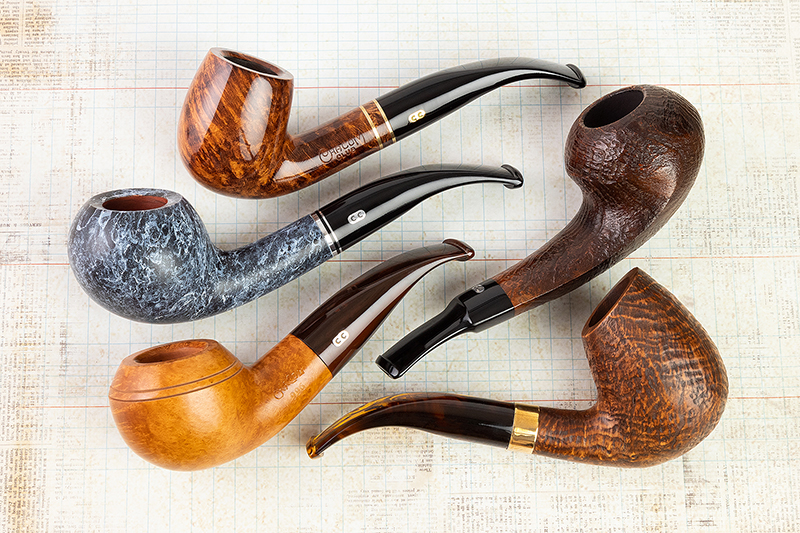
We offer an array of Chacom pipes, highlighting the traditional Anglo-French aesthetic with classic shapes and finishes, harkening back to the earliest days of Comoy's and the Chapuis-Comoy factory. Some of their stunning offerings include the Jurassic, Pistache, and Churchwarden pipes, among a plethora of others.
History is at the fingertips of those who smoke a pipe from Chacom. A tradition of family, craftsmanship, and legendary status rests within each piece; whether a Blue Riband or a Tradition, the passion of Francois Comoy can be felt with every smoke.
Bibliography
- Antoine. Father the Flame. (2018, June 28).
- Comoy's. Pipedia. (n.d.).
- Comoy's Pipe Compendium (1964).
- Hylton, D. (2023, April 12). The History of Saint-Claude, France | The birthplace of the Briar Pipe. Smokingpipes.
- Pipes - artisans and trademarks: Lopes, Jose Manuel.
- Roan, Archer N. (2014). Comoy's Blue Riband Pipes. Briar Books Press.
- Stanion, C. (2024, February 16). Chacom pipes | Antoine Grenard. Smokingpipes.
You may also enjoy:



Comments
I have enjoyed these writings every month. Thank you to the MANY staff members that have contributed to these well written passages. I look forward to the next one. DaveGOW
A better builder of pipes by a large margin was Butz-Choquin. I own two and am amazed at the build and fit quality. Truly, these guys knew how to make pipes. OTOH I have a Chacom that has a disgusting fit with the shank.