


 |
|
 |
|


Sykes Wilford has a pipe on display in his office that was made by Hiroyuki Tokutomi in 2004. It's what artisan pipe makers refer to as an "own" — a pipe that is complete and functional in every respect but doesn't quite meet the standards of being sellable. Perhaps the draft hole is drilled slightly askew, or the bottom of the chamber reaches too close to the heel. Sometimes, pipe makers will keep these misfit pipes for themselves, but on rare occasions they may gift them to close friends. Sykes prizes it because it represents a specific conversation he had with the Japanese master in which Tokutomi explained to Sykes how he could break the rules of pipe design.
In previous installments of The History of Pipe Design series, we've traced pipe making from its origins in the briar workshops of St. Claude and the mass-production era that standardized the classic shape chart across France and England; through Italy's creative reinterpretation of those classic forms into what we call the Italian neoclassic aesthetic; and through Denmark's elegant, functionalism-influenced refinement and the inception of artisan pipes. If you're unfamiliar with those earlier chapters, I'd encourage you to start there; this one builds on them. (Return of the Jedi isn't as enjoyable if you haven't seen A New Hope and The Empire Strikes Back.)
Unlike those other chapters, though, Japan doesn't have a "style" in the same tidy sense that France and England do, and even Italian and Danish pipes have more defined aesthetic conventions. There's no "Japanese version" of a Billiard — at least not in the same vein as when discussing French/English, Italian, and Danish Billiard variants. There's no governing aesthetic orthodoxy or Japanese shape chart. Instead, Japan has a set of makers whose visions were singular enough, and influential enough, to alter the course of pipe making worldwide.
The Danish Foundation
By the 1960s and into the '70s, the artisan pipe-making movement that Sixten Ivarsson had catalyzed in Denmark had gained disciples across the small country. Ivarsson's "shape first, drill second" technique — inverting the long-standing factory method of drilling the chamber and airway before shaping the block — had freed pipe makers from the radial symmetry that lathes and fraising machines demanded. Asymmetric shapes were possible now, and grain could be considered in tandem with the shape before a single hole was drilled. For the first time, pipes could be made by following the block and maximizing its grain.
Danish pipe design absorbed these freedoms through the lens of Danish functionalism — the minimalist, elegance-forward aesthetic that has shaped Scandinavian architecture and furniture for decades. As we've discussed, that style is often marked by soft lines, supple curves, and a refined sense of proportion that distinguishes Danish pipes from the stoic solidity of their English and French counterparts and the boldly contrasting proportions of their Italian brethren.
Among Ivarsson's most influential scions was Jørn Micke, a carver whose work would prove enormously significant not just in Denmark, but in Japan as well. In the West, American and European pipe makers drew much inspiration from such Scandinavians as Jess Chonowitsch, Lars Ivarsson, and Bo Nordh through the 1990s and early 2000s, but in Japan, Micke was paramount. "In Japan, Jørn Micke was much more important," says Sykes. "His work just loomed larger in the collector consciousness there than it did here [in the US]. And so, a lot of what we think of as Japanese designs now are very much derivative of Jørn Micke."
Similarly, Shane Ireland puts it plainly: "When you're looking at Jørn Micke pipes from the early- to mid-'60s, maybe some a little bit later, you end up with a bunch of shapes that are essentially what we think of as signature Tsuge shapes right now."
Tsuge and the Ikebana Workshop
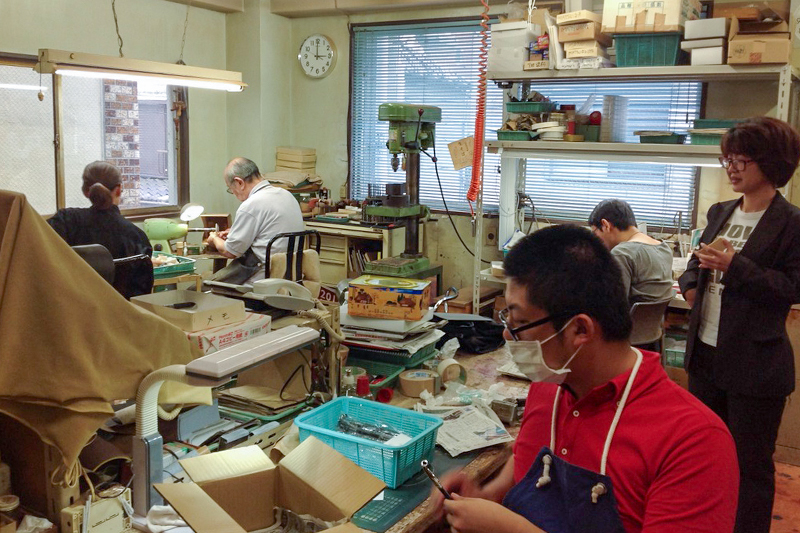
Ikebana Workshop, photo from Pipedia.
Even today, Tsuge is Japan's most significant pipe-manufacturing company, and its history provides the scaffolding upon which most of Japanese artisan pipe making is built. Like most of the world's pipe factories in the mid-20th century, Tsuge began by producing pipes that closely followed established French and English shapes. The mass-production focus that characterized the early decades of French and English pipe making found a parallel in Japan, and Tsuge was its primary expression.
But in the 1960s, that expression evolved when Tsuge sent one of its craftsmen, Kazuhiro Fukuda, to Denmark where he learned artisan pipe making from Sixten Ivarsson. When he returned, he brought that knowledge to Tsuge, and it became the foundation of what would eventually be known as the Ikebana workshop — Tsuge's artisan pipe-making arm, producing higher-end, handmade pipes alongside the factory's standard output. In that sense, the relationship between Tsuge and Ikebana mirrors the dynamic we saw in Denmark: major factories like Stanwell partnering with individual artisans to bring handmade design sensibility to a broader market. Even more so, Tsuge's artisan lineage parallels Denmark's Pipe-Dan and Jørgen Larson workshops where many artisan pipe makers first cut their teeth before transitioning into making their own handmade pipes. Kei-ichi Gotoh, one of Japan's most distinctive carvers, worked with Ikebana in the early 1980s. Smio Satou, another significant figure, worked for Tsuge as well, though on the production floor rather than the artisan side, and came to pipe making through a different route entirely.
The early Ikebana pipes, produced primarily by Fukuda through the latter decades of the 20th century, were heavily Danish in character, specifically Micke-derived. In Japan, the collector appetite for Danish artisan pipes had been cultivated by distributors who had encountered them while traveling in Copenhagen, where Danish-made pipes occupied prominent places in the city's tobacco shops. Of all the Danish artisans, Jørn Micke loomed largest in the Japanese market. Many of the shapes we now associate with Japanese pipe making are, at their root, Micke derivatives filtered through a Japanese artistic lens, refined over decades, and made distinctly their own.
Hiroyuki Tokutomi
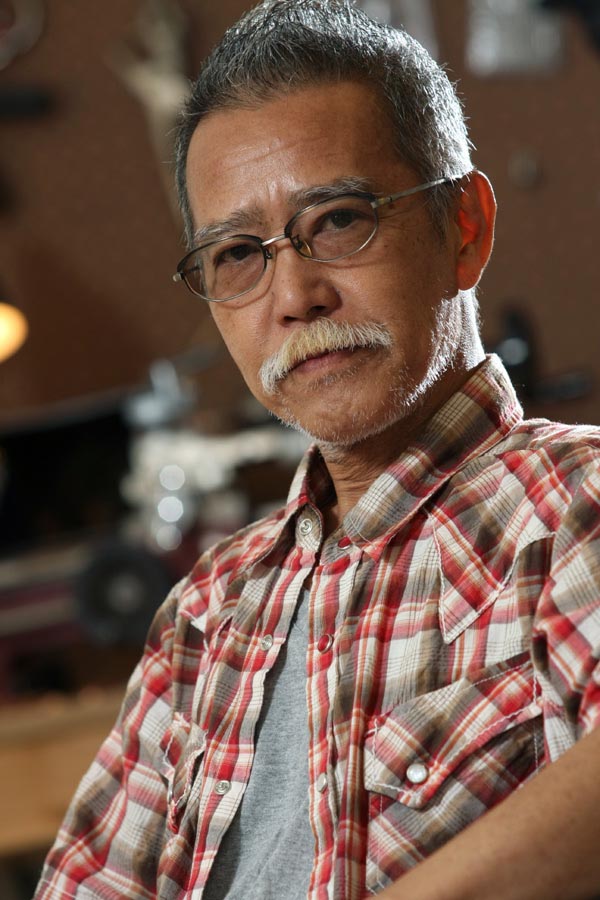
Hiroyuki Tokutomi
If Tsuge and the Ikebana workshop provided the institutional backbone of Japanese pipe making, Hiroyuki Tokutomi provided its creative soul. He holds not only a Mount Rushmore-like pedestal in the history of pipe making but also a very significant place in the history of Smokingpipes.
In 2002, Sykes was 21 and had founded Smokingpipes only two years prior from his college dorm room. He traveled to Japan during the World Cup at the encouragement of a customer — a diplomat stationed in Tokyo — who'd convinced him that there were pipe makers in Japan worth visiting. Through introductions arranged by Barnabas Suzuki, then president of the Pipe Club of Japan, Sykes found himself sitting across from Tokutomi, looking at his pipes. "I thought, 'Holy crap, these pipes are really bleeping good,'" says Sykes. "But I didn't really know what I was looking at yet at that point. Other than knowing that these pipes were really special, I really didn't have a clear sense at that time; I didn't have a framework for thinking about his pipes until later. These guys had basically no exposure outside of Japan." Sykes bought all of them — six or seven pipes — and brought them back to the United States, where almost no one had seen Tokutomi's work before.
Back at Smokingpipes, Sykes began trying to find language to describe what he was looking at regarding Tokutomi's aesthetic and approach to pipe design. In the early 2000s, the vocabulary for talking about pipes as art objects — the kind we now use almost reflexively, words like proportion, harmony, asymmetry, negative space — was largely undeveloped. Sykes's fascination with and commitment to describing Tokutomi's work burgeoned into the lexicon we use today to analyze pipes as pieces of art.
Sykes was joined in this lexical project by Thomas Looker, a lecturer in American studies at Amherst College, who became one of Smokingpipes' earliest significant customers after buying four Tokutomis off the website almost at random. The pair struck up an email correspondence between Sykes and Looker that sought to describe and define Tokutomi's work. "Tom was fascinated by these pipes too," says Sykes. "And we carried on a really sensitive correspondence for four or five years about what these pipes were, what they meant, and their aesthetic inspiration." Sykes describes the tone of these exchanges as intellectually curious, mixed with a little sales-pitch-iness and a lot of genuine mutual discovery. The duo were building an artistic vocabulary for pipes in real time.
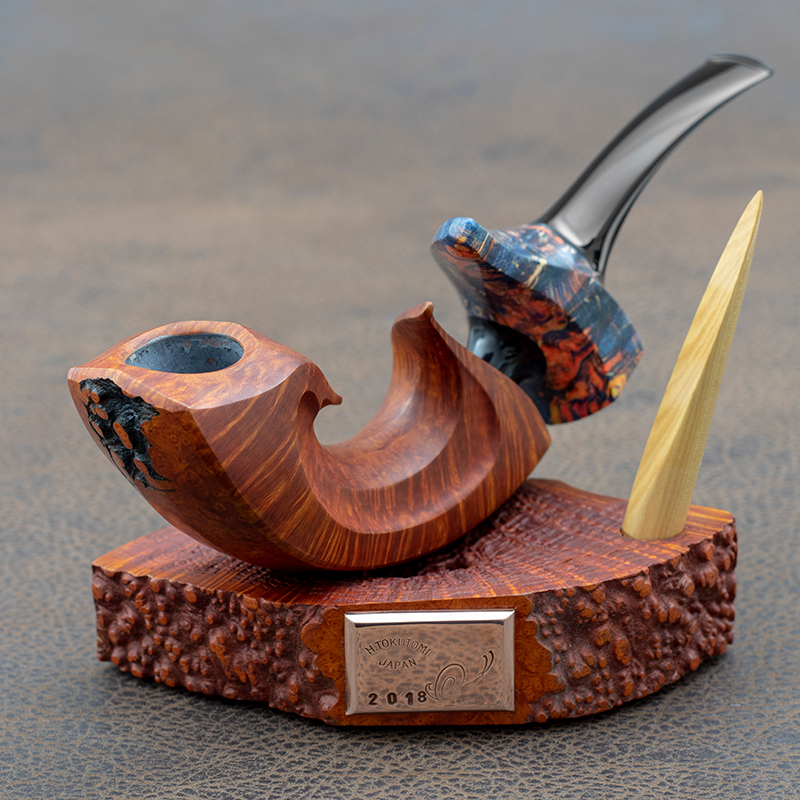
Hiroyuki Tokutomi Smooth Horn (Hiro)
Through that correspondence, a clearer picture of Tokutomi's aesthetic emerged. His early work was, like most of his contemporaries', rooted in what Sixten and Jørn Micke had pioneered. But something else was present, too. Something that wasn't simply Danish. Sykes traces its origins to a tradition of 19th-century Buddhist art — characterized by what he describes as "carefully controlled wildness," a sense of intentionally organic shaping rather than shaping governed by imposed geometry. George Nakashima, the Japanese-American furniture designer whose work similarly drew on Buddhist craft traditions, offers a useful parallel: someone working with a functionalist medium but filtering it through a distinctly Eastern aesthetic consciousness. Tokutomi, as Sykes came to understand it, was doing the same thing with pipe making.
The critical moment arrived around 2004, when Tokutomi sat down with Sykes and explained what he'd been thinking. "Sixten said this line had to be straight," he told Sykes. "Jess says this line has to be straight. Lars says this line has to be straight. I don't think so." The line in question was the bisecting axis of an asymmetric shape. Danish makers, working within the principles of Western art, held this line to be structurally essential for a shape to cohere visually. Sykes explains:
Even with intentionally asymmetrical Danish shapes, such as the Blowfish (originally called the Disk by Sixten and Former, the two carvers most commonly attributed with its creation), the asymmetry is held by the bisecting line of the pipe. A direct line can be drawn from the center of the button to the very front of the bowl. The sides may or may not be symmetrical, but the rigidity of this center line helps the pipe keep its visual balance and coherence.
Tokutomi's argument was that it didn't have to be straight. A shape could retain its balance through other means — through the relative weight of its various elements, the implied spaces surrounding them, the overall elegance of the composition. Western art requires the straight line; Japanese aesthetic principles don't. "Symmetry is highly valued in Western art, but [it's] generally eschewed as a guiding principle in most Japanese art forms," says Sykes. "If a Danish or Italian pipe maker were to create a round bowl that did not possess radial symmetry, the immediate assumption would be that the carver was either incompetent or careless. But natural forms are not symmetrical; therefore, the art that reflects those forms is not symmetrical." Once Tokutomi let go of that rule, he was able to craft utterly new pipes that were still governed by the aesthetic principles of harmony and balance but with more natural, organic sensibilities. "That was the moment that Tokutomi was liberated," Sykes says.
What followed was a period of extraordinary productivity. The Blowfish shape, long a staple of Danish pipe making in its symmetric form, became something else in Tokutomi's hands. The classic Danish Blowfish, or Disk, is structured, almost architectural, even if it's asymmetrical. Tokutomi's version, which eventually became known as the Fugu, twists and billows asymmetrically, the panels unequal, the grain determining the shape rather than the shape determining the grain. "The first true Fugu that Tokutomi made wasn't because he had a clear vision of what it should be," Shane says. "It was because the material inspired the vision and then the vision bounced back off of the material and it went back and forth several times." Like any great artist, Tokutomi was iterating and reiterating off of his own work to discover a specific design.
Other shapes followed: pedestal Sitters of awesome complexity, Volcano designs that traced back to Micke but became thoroughly Tokutomi's own, and formal innovations like an irregularly shaped accent on a stem mirroring the shape of the shank face — which Sykes attributes to Tokutomi specifically, though as with many things in pipe-making history, the precise origin involves some ambiguity. The influence spread outward from there. American pipe makers like Jeff Gracik and Todd Johnson, discovering Tokutomi's work through Smokingpipes, absorbed and built on his innovations. "There are an awful lot of pipe makers who don't even realize Tokutomi did these things first," Sykes notes. "They just see a cool pipe that Jeff Gracik made, but Jeff would be the first to point them back to the source."
The aesthetic language Tokutomi pioneered through his work — his embrace of asymmetry, his sensitivity to negative space, his willingness to let the material lead — didn't emerge from a vacuum. Shane frames it in terms of specific Japanese design principles that resonate with, and in some ways exceed, Danish functionalism's minimalism. "Kanso," he explains, "is basically really similar to minimalism. Simplicity, lack of clutter, leaving something out or taking something away actually adds to the design." This idea parallels the Danish inclination toward elegance and restraint, but the Japanese concept of wabi-sabi goes further: "It has to do with authenticity and connecting the earth and natural materials," says Shane. With wabi-sabi, there's an appreciation for imperfection, for natural materials as already whole and interesting, for the beauty in what's incomplete or asymmetric. "I feel like the Japanese are more inclined to take that issue and to incorporate it into the design rather than try to solve it," Shane says, comparing the Danish and Japanese approaches to working with difficult grain. "They're trying to carefully respect and work alongside the natural material to come up with something that really no one had ever envisioned or seen before."
Tokutomi's pipes are perhaps the clearest expression of this sensibility. Where a Danish Disk invites you to follow its lines to their natural conclusion, a Tokutomi Fugu challenges you to feel where the lines would have gone if the material had continued — to complete the shape in your imagination. "With Japanese pipes," Shane says, "often the negative space and where the lines continue beyond the shape actually complete the form, but literally the physical material's not there. There's a lot more implied movement, more implied form, more consideration of negative space." In other words, the focal point sometimes rests in what isn't there.
Kei-ichi Gotoh
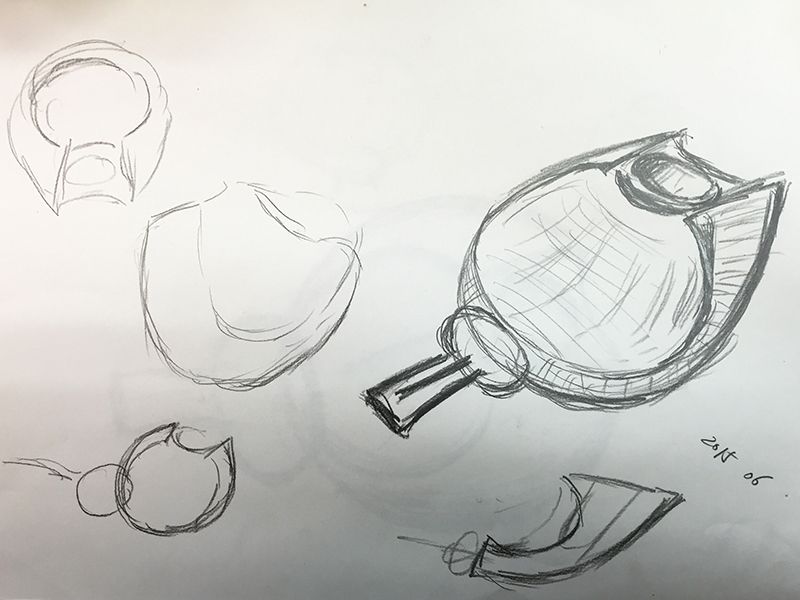
Gotoh Sketch
Gotoh occupies a somewhat different position in this story. His relationship with Tsuge's Ikebana workshop in the 1980s gave him a professional foundation, but his own natural restlessness as a designer pushed him beyond it. Like Tokutomi, his early work shows the Micke influence clearly, but Gotoh developed his own formal vocabulary, drawing on Buddhist art and on his keen attention to the Danish work he was watching unfold simultaneously. He is, as Sykes puts it, "very slow, very deliberate, very careful, and very thoughtful" — traits that make him harder to pin down stylistically, but that manifest in work of stunning refinement.
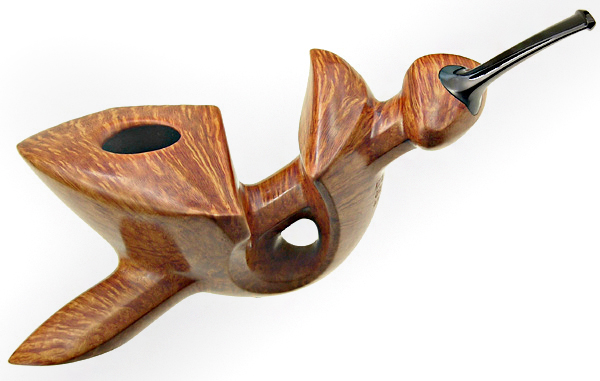
Kei-ichi Gotoh Sio-Yaki
His most iconic design, the Sio-Yaki, pioneered something no one had quite attempted before: a pipe that uses bamboo or another material to seemingly pierce and connect two sections of briar. "No one had ever done anything like the Sio-Yaki," Sykes says. "To put bamboo or another material between two pieces of briar like that — that was certainly novel." It has since become part of the artisan pipe-making vernacular worldwide. Many makers now work in this idiom without necessarily knowing where it originated. "At this point," Sykes observes, "it's all part of the lexicon and no one knows what the etymology is." But it started with Gotoh.
Smio Satou
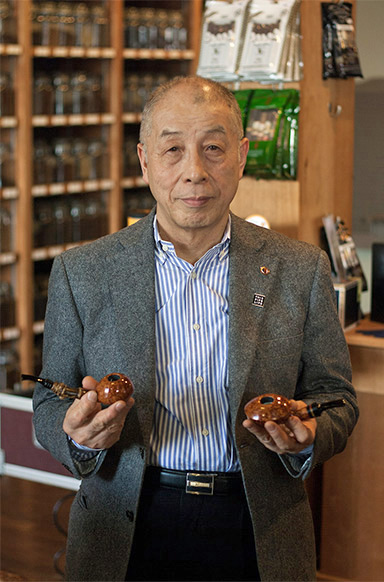
Smio Satou
Satou is the outlier in this story, which is perhaps why he's the most interesting to consider at the edges. His path to pipe making ran through his father, an early Japanese pipe maker who himself learned Danish pipe-making principles from Jørgen Larsen. The younger Satou later went to work for Tsuge, though his primary focus was always on process rather than shape. "Satou came to pipe making by way of pipe repair," says Sykes. "His dad repaired pipes. He repaired pipes. I don't want to say he was a semi-hobbyist pipe maker, but that wasn't his main gig. His main gig was pipe repair. And he wasn't making that many pipes. He was making them very slowly because the lacquer takes forever to dry properly."
Urushi lacquer and tsuishu — a form of Japanese lacquerwork that involves building up layer upon layer of material — were Satou's foci. The process is extraordinarily slow; the lacquer must cure properly between applications, which means Satou produced pipes in extremely small quantities. He built up a stock of tsuishu material his father had made decades ago, which he continued to use until his passing.
"It's hard to tell whether Satou thought of himself as a pipe maker or as a guy that works in urushi," Sykes says, "He definitely thought of himself as a pipe maker, but Satou was interested in materials more." Satou's contribution to Japanese pipe design is less about shape and more about finish, about the application of a traditional Japanese craft form to the pipe as an object. His shapes are harder to categorize than Tokutomi's or Gotoh's, suggesting influences from multiple directions without resolving clearly into any of them. The finish remains consistent though: meticulous, layered, deeply Japanese in a way that has little to do with Danish pipe making at all. "If there are two religious aesthetic strains in Japanese culture," Sykes says, "you've got Buddhism and Shintoism. Satou is very much drawing more on Shinto art, I think." Sykes holds that observation tentatively and acknowledges the limits of his expertise in Japanese art history, but there remains a different quality to Satou's work, one directed less toward form and more toward process, material, and the slow accumulation of craft.
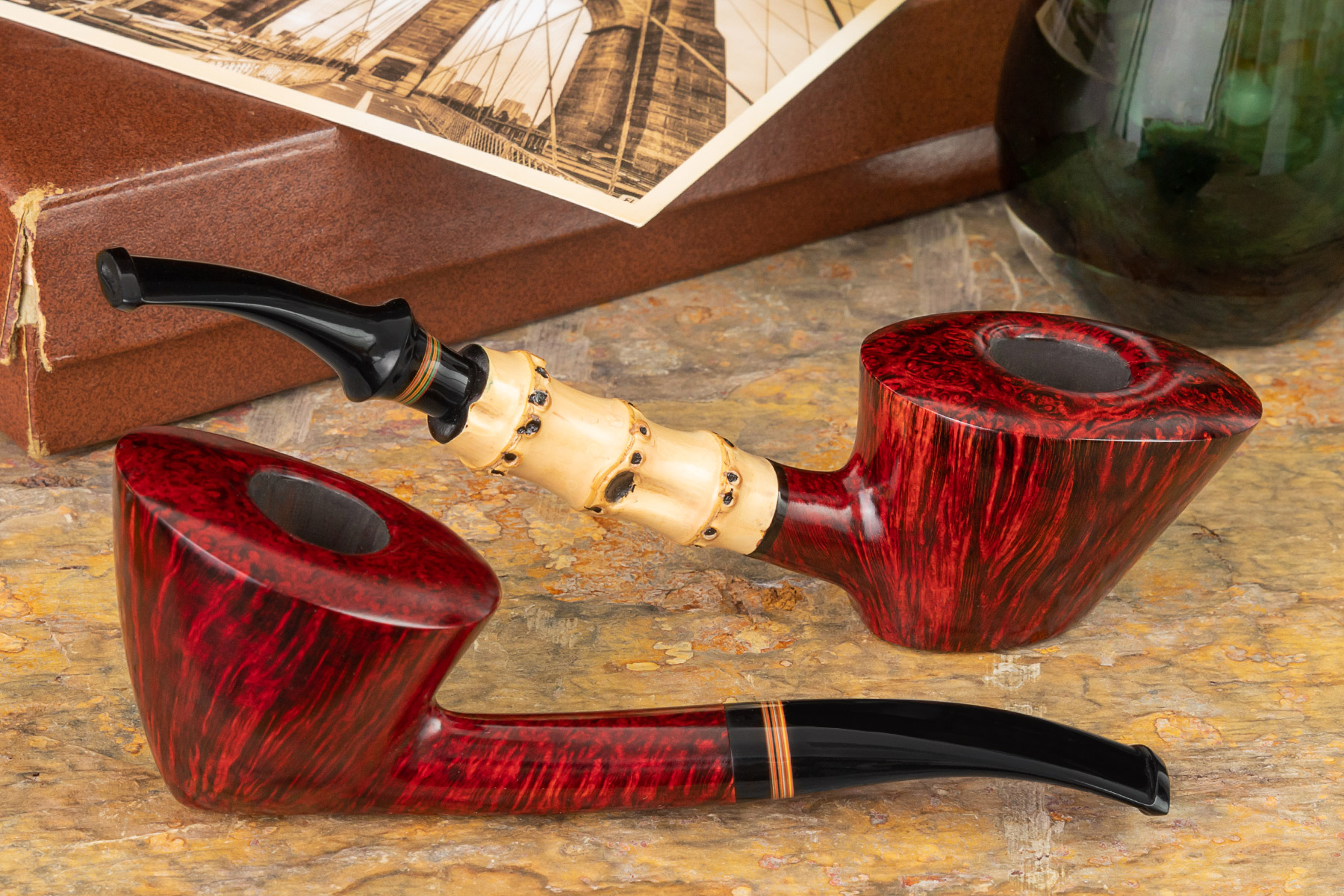
Smio Satou Smooth Bent Dublins
What Makes Japanese Pipes 'Japanese'
These Japanese artisans were the first non-Scandinavian carvers to craft pipes using Sixten's methodology, and their "lineage" isn't as tidy as Denmark's pipe-making tradition. In Japan it was a much more individual effort, like separate wheel spokes but with Tsuge acting as something of a connecting hub in the middle. So, what exactly distinguishes a Japanese pipe from the other regional design schools we've discussed?
"Most of the time when we're referencing the Japanese aesthetic," Shane says, "what we're actually referencing is a really specific niche in the early '60s to early '70s Danish aesthetic." The stylistic DNA and technical process are shared: The shaping technique is the same — Sixten's technique, passed through Fukuda and Tokutomi — and the shapes themselves often derive from the Danes, from Micke, Sixten, and others. But the vision differs; the cultural filter through which the process and the briar is viewed results in an aesthetic diversion.
"In a lot of ways," Shane continues, "the Japanese aesthetic is exaggerating the Danish in a similar fashion to how Italian neoclassicism is basically taking more stoic French and English shapes and making them more lively, making them more playful. Not so much in proportions [for Japanese pipes] — though sometimes in those too — but more in the lines, negative space, and finding beauty in the perfection of the natural materials." Where Danish functionalism seeks to refine a shape until it reaches its most elegant expression, the Japanese wabi-sabi influence affirms the material as already interesting; work with it, not against it. "I think that the Danish could run into an issue shaping a block, and then come up with a creative solution to solve that issue," says Shane. "But I feel like the Japanese are more inclined to take that 'issue' and to incorporate it into the design." Imperfection (i.e. asymmetry and organicism) is included as part of the composition and, even, made a focal point.
There's also a slightly different approach to grain. Historically, Danish artisans, alongside high-end Italian ateliers, sought to maximize grain and shape each block in a way that showcases the briar's most beautiful characteristics. But that doesn't always lead to the most interesting of designs: A bent Dublin can showcase some exquisite grain since the block can be oriented so that the grain flares in the same direction as the bowl. Japanese pipe makers share this sensibility but take it further. "I think in many cases," Shane says, "what they're actually doing is fully realizing and pushing the boundaries of the material itself instead of conforming to it." The grain is a collaborator, not necessarily the target.
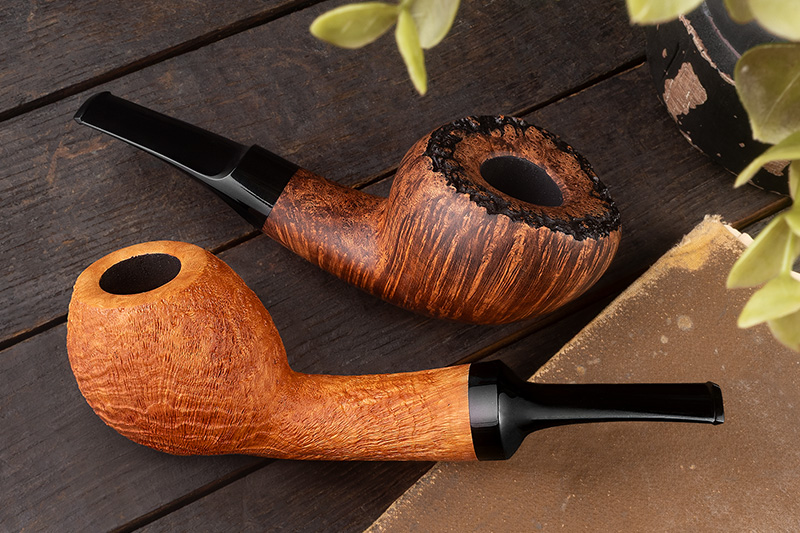
The Blowfish, or Fugu, is perhaps the most useful illustration — and perhaps the most iconically 'Japanese' shape. A classic Danish Blowfish, or Disk, has two roughly equal panels of birdseye along the flanks, the shape symmetrical around a central axis. The Fugu, though, is asymmetric because the grain dictates it: The side of the block that was oriented closer to the center of the original burl features a smaller panel where the grain is tighter; the panel from the outer burl, where the grain fans wide, is larger. Such shaping allows the form's central panel to slant inline with the cross grain, following its trajectory and, thus, maximizing its beauty. The shape follows each block wherever it leads, which might mean one panel vastly bigger than the other, or a silhouette that seems to be swimming or turning. "Somebody like Tokutomi is going to say, 'That just means I need to make the one panel really, really, really tiny and the other panel really, really, really large,'" Shane says. "And how am I going to get there? Well, it's kind of natural if you follow that grain pattern where now this fishy-looking shape kind of looks like it's turning to one side or swimming forward, etc." Following and chasing the grain wasn't a new concept to artisan pipe making, but Tokutomi certainly evolved it to another level.
A Look Forward
In previous installments of this series, we've been able to point to specific, defining aesthetic conventions for each country's design tradition: the balanced proportions of classic English and French shapes, the dramatized forms of Italian neoclassicism, the elegant restraint of classic Danish design. As mentioned, Japan resists that kind of clean classification. "There's Tokutomi," Sykes says plainly. "And going from Tokutomi to an inclusive Japanese aesthetic is really hard."
Japanese pipe design is largely that of Tokutomi and, to meaningful degrees, Gotoh, Satou, and the Tsuge, Fukuda, and Ikebana lineage — each working from similar Danish foundations but arriving at distinct places, yet still united by certain shared cultural and aesthetic principles. Tokutomi is not a school in the way Italian neoclassicism is a school. He's a singular figure more like Giancarlo Guidi of Mastro de Paja and Ser Jacopo, whose resulting Pesaro style is so defined by his own personal aesthetic that others can be influenced by it without quite replicating it.
What these pipe makers collectively represent is something broader and more historically significant: the first wave of artisan pipe makers outside of Scandinavia to take Sixten's technique and run it through a genuinely different cultural aesthetic and personal artistic lens. The Danes built on Western art principles; the Japanese built on Eastern ones. "Japanese artisans were among the first, if not the first, to take that same technique but carve things from a different design language," says Sykes. This era was the gateway to today's post-modern artisan pipe-making milieu: American pipe making, the explosion of artisan pipe making worldwide throughout the social-media age, they all owe something to what happened in Japan, even if it's not consciously recognized.
The story of Japanese pipes also directly relates to the history of Smokingpipes. "I think of the early days of Smokingpipes, that 2002, 2003, 2004 period," Sykes says, "as being this wonderful symbiotic relationship between Tokutomi, Tom Looker, and me." That relationship between Tokutomi's pipes, Sykes's and Tom's intellectual engagement with them, and Sykes's efforts to bring them to a broader market was essential in building the company's early identity. The language Sykes and Tom developed to describe Tokutomi's pipes became the foundation for how Smokingpipes continues to talk about all artisan pipes today. The connections forged in Tokyo in 2002 led to connections with Danish makers, which led to the artisan-pipe market becoming a defining part of the business.
In many ways, Japanese pipe design — if we can even create such a universal title after everything we've discussed — is among the last design schools defined by region. Since the domination of the internet and social media, pipe design has developed into something of a paradox: The aesthetic details of every pipe are both ultra-specific to each individual maker while also being a smorgasbord of virtually every historical pipe-design language. The explanation is no longer, "This pipe is more English, or more Italian, or more Danish, or more Japanese," but instead, "This pipe is so-and-so's personal interpretation of English, or Italian, or Danish, or Japanese design cues — or a combination of multiple."
The coherent stylistic schools — French and English, Italian, Danish, Japanese — have blurred as makers everywhere can see everyone else's work in real time. Today, a pipe's country of origin tells less about its aesthetic than it once did. The world has become one long conversation, and the idea of isolated national design schools belongs increasingly to history. This newfound dynamic makes classification increasingly difficult, but it's resulted in a much higher percentage of stunning, interesting, and beautiful pipes.
Bibliography
- Ireland, Shane. Personal Interview. September 2020.
- Wilford, Sykes. "An Analysis of the Artistry of Hiroyuki Tokutomi.". Pipedia.
- Wilford, Sykes. Personal Interview. September 2020.
You may also enjoy:





Comments
A critical difference between the Japanese and Danish Pipe Makers that should be stressed is that the Danes focused on making smoking instruments whereas the Japanese focused more on aesthetics and briar sculpture. For the Danes the focus remained the activity of smoking so each pipe should be balanced and hand friendly. As Nanna Ivarsson says: "Every pipe I make has its smoking qualities as my preeminent goal."Whatever you think of Tokutomi's work, you would have to agree that they are not always designed with the smoker in mind. Compare this with Tom Eltang who in many ways is Denmark's Tokutomi. Yet all his pipes are designed to be smoked with balance and smoker friendly designs.
One correction: the writer confuses the cross grain/disc with the Lars blowfish which is a totally different design.
The Ivarsson Blowfish, often just called a Fish nowadays, is a distinct shape from the Blowfish/Disk of Sixten and Former referenced in the article. I’ve described numerous Ivarsson Fish shapes for Smokingpipes, so I’m well aware of the differences. The comparison between the Japanese Fugu and the Danish Blowfish/Disk is completely separate from the Isvarrsonian Fish shapes. I think the article expresses that clearly, but I apologize that it wasn’t clear enough. Lastly, while not expressed as clearly as in your comment, the article does express that these Japanese artisans did focus more on form than the Danish makers they were inspired by, but the article was not meant to directly compare Japanese pipes vis-á-vis Danish pipes. Thanks for the feedback though!
Thank you for a very informative article.