


 |
|
 |
|


Portrait of Red Auerbach by Artur Lopes
The top professional athletes have a singular goal: ending the season with a championship win. It takes years of practice, long hours in the gym, and an unrelenting drive to defeat every opponent and call themselves the best. Once they reach that peak and can celebrate their accomplishments, there is something that unites every athlete from the football field to the boxing ring — a victory cigar.
After a championship game, like the Super Bowl or the World Series, winning-team locker rooms are thick with smoke from the world's finest cigars. In victory's sweetest moments, countless athletes have reached for cigars, and many more will in the future. Although many of us can see the appeal in smoking a cigar after a momentous occasion, how did this tradition become so ubiquitous across all of sports?
It all began with one man: Red Auerbach.
As coach of the Boston Celtics, Red Auerbach led the team on a championship winning streak unmatched in American sports history: eight straight championship victories. Then, as the General Manager of the Celtics, Auerbach continued to construct the Celtic's championship teams from behind the scenes. When it was all said and done, Auerbach led the Celtics to 16 championships.
Red Auerbach is synonymous with winning, so it's fitting he started one of sport's best known celebrations, the victory cigar. When his Celtics teams blew out their opponents, Auerbach would light up a cigar on the bench and relax during garbage time, knowing victory was secured. Since Auerbach's teams won so often, his punctuating cigar became known across the globe. However, even though everyone knows the victory cigar celebration, few know the full story of Red Auerbach.
A Basketball Player From Brooklyn
Born Arnold Auerbach on September 20th, 1917, to Marie and Hyman Auerbach, he spent his childhood in Brooklyn, New York. With a fiery temper and a matching head of red hair, he quickly gained the nickname "Red," which stuck with him for the rest of his life. His energetic persona lended well to sports, and Red became a star athlete in his childhood.
Red played varsity basketball for PS 122. Despite his asthma and five-foot-nine frame, Red was still a terrific player, making sure to work out after practices to enhance his conditioning. In his senior year, he was named to the Second Team All-Brooklyn, something he would brag about to five-time MVP Bill Russell during his coaching days.
When his Celtics teams blew out their opponents, Auerbach would light up a cigar on the bench and relax during garbage time, knowing victory was secured
Red's talent for basketball earned him a scholarship at George Washington University in the District of Columbia where he played under coach William J. Reinhart. Reinhart's tough-nosed coaching style and pioneering invention of the "fast break" would form the groundwork of Red's coaching dogma. Serving as team captain his senior year, Red was a solid player, but his basketball playing days ended after graduation. However, he also found a new beginning at college: his lifelong wife Dorothy. They were married in 1941, about the same time Red entered the profession of coaching.
Auerbach began coaching prep and high school teams, and even officiating games on the side. Just as he and Dorothy were settling into a stable life, the attack on Pearl Harbor intervened and Auerbach enlisted in the Navy. Auerbach's physical education degree earned him a place in the service's Physical Fitness Program, and he was sent to Norfolk military base, where his old coach William J. Reinhart was the full commander. At the base, Auerbach assembled a basketball team with sports stars who had enlisted in the service, and they performed admirably in exhibition games.
Additionally, Red picked up cigar smoking at the Norfolk Navy base. He had never liked cigarettes, but had smoked a pipe after he graduated from college. Auerbach then began to smoke the occasional cigar and started to see their appeal. One can only wonder if a young Red Auerbach smoked his first victory cigar during an exhibition game on a Navy base, a far cry from the bright lights of the NBA.
But as it turns out, those Navy games drew the attention of D.C. millionaire Mike Uline, who owned a professional basketball team called the Washington Capitols. The team was a part of an upstart basketball league called the Basketball Association of America, which would later become the NBA. Uline reached out to Auerbach and offered him the job, which he accepted, beginning his long career in the NBA.
Going Pro
At just 29 years-old, Red Auerbach was in total control of a professional basketball team, but first he had to find a team. Most of his team was assembled from the ragtag teams he coached on Navy bases during WWII, but they did have one star, Bones McKinney. An All-American from North Carolina University, McKinney was a superb talent that Auerbach was able to lure away from signing with a rival franchise. This would be the first of many iconic Red Auerbach basketball signings and trades.

Norm Drucker ejecting Red Auerbach, 1959
Red was completely unproven in professional sports, but his winning teams started to show he had a special talent for motivating players. Thanks to Red's tough practices, the Capitols were better conditioned than any other team in the league, something that would define all of Auerbach's teams. Also, his constant badgering of the referees got him a few extra calls at important moments in games. During his first year, the 1946-47 season, the Capitols went 49-11 and set the league record at the time for consecutive wins at 17. Two years later, they were in the Finals. However, they lost to the Minneapolis Lakers, led by the legendary George Mikan, in six games. This would be the peak of Auerbach's tenure with the Capitols, as he was replaced as coach the next year by Bones McKinney, the player he once recruited.
Red bounced around for the next few years, spending time as an assistant coach at Duke University and coaching the professional franchise the Tri-Cities Blackhawks. Red's independence played a large role in leaving both jobs, as he wanted to blaze a trail on his own terms. However, his stubborn attitude risked his entire coaching career, as he was now without a job. But people who watched professional basketball, especially news reporters, knew that Auerbach had the talent to lead a franchise. So when Walter Brown, the owner of the Boston Celtics, asked a group of sportswriters who he should hire as his next coach, they all replied, "Red Auerbach."
Auerbach started coaching and managing the Boston Celtics the only way he knew how: his way. In the 1950 NBA draft, everyone in Boston wanted the hot-shot player out of local college Holy Cross, Bob Cousy. However, Auerbach had other ideas. When asked in a press conference if he would draft Cousy, Auerbach said, "I'm not interested in drafting someone just because he's a local yokel" (Shaughnessy 70). The Celtics passed on Cousy during the draft, much to the chagrin of Boston sports fans. However, the team that drafted Cousy ended up folding, and Cousy signed with the Celtics. It was a stroke of good fortune for Auerbach, which would end up becoming a pattern throughout his career.
Thanks to Red's tough practices, the Capitols were better conditioned than any other team in the league, something that would define all of Auerbach's teams
The Celtics played well over the next few years, consistently going deep into the playoffs. It was during this time that Auerbach began smoking his famous victory cigars. The ritual had simple beginnings, "So I decided if we had a game comfortably in hand, I'd smoke ... I'd light up a cigar and just sit back. That ended up becoming the signal to people that we'd won the game, so guys started calling it my victory cigar" (Feinstein 73). Auerbach thought it was ridiculous when coaches would still shout out plays and call timeouts when in garbage time, so this was his little form of protest.
Although Auerbach enjoyed plenty of victory cigars in these years, he had not yet claimed the ultimate victory, the championship trophy. After 10 years in the league, Auerbach had not yet won a title and was earning a reputation for being a coach that couldn't take his team over the hump. To take his team to the next level, Auerbach needed a superstar player. He needed Bill Russell.
In another one of his famous managerial moves, Auerbach traded several of the Celtics key players to move up to the second pick in the 1956 NBA draft. However, the small town Rochester Royals also had interest in Russell, and they were picking number one. To ensure he got his player, Auerbach got the Celtics owner to promise to send his hit traveling show, the Ice Capades, to Rochester for several performances over the years. Rochester promised not to take Russell in return, and the Celtics took him at number two. This marked the beginning of the Boston Celtics legendary dynasty.
The First Dynasty

Red Auerbach and the 1962-1963 team
For the next decade, and then some, the Boston Celtics were synonymous with winning. From 1957 to 1969, the Boston Celtics won a remarkable 11 championships — that's 11 championships in 13 years. Russell immediately made them a winner in his rookie year, with his incredible defense and rebounding being the perfect addition to Cousy's flashy fast break and shooting. However, there were other stars on the Celtics.
As players like Cousy grew older, Auerbach drafted younger players, such as John Havliceck, to replace them. The young and old coalesced on the 1962-63 team, which had a total of nine Hall of Fame players: Bill Russell, Tom Heinsohn, Clyde Lovellette, John Havlicek, Frank Ramsey, Satch Sanders, Sam Jones, K.C. Jones, and Bob Cousy. Additionally, Red Auerbach and Celtics owner Walter Brown were also inducted into the Basketball Hall of Fame, meaning the Celtics organization had 11 Hall-of-Famers at this time. It makes sense that Auerbach enjoyed a lot of victory cigars during these years.
Red smoked many different types of cigars, but his favorite brand was Hoyo de Monterrey. He would carry several sticks on him at all times and, at one point, smoked 10 a day. His victory cigar served both as a relaxing moment after a stressful game and as a stubborn protest against the league. Auerbach said about the victory cigar, "One day I lighted up a cigar during a game. Afterward I got a little note saying, 'It doesn't look good for you to be smoking cigars on the bench.' I haven't been without one since" (Shaughnessey 2). If you have ever smoked a Hoyo de Monterrey cigar or been around someone who was enjoying one, you know that their smell is particularly pungent, particularly for those who don't smoke. It's no surprise that Auerbach picked the smelliest cigar to enjoy after a game — everyone in the stadium would know where the smell was coming from and why.
Auerbach certainly enjoyed his victory cigars, but as the Celtics players racked up wins they became less and less fond of his victory ritual, and rival players hated it even more. Bob Cousy said about Red's victory cigar, "...once he went for the cigar, the other team's intensity went up a hundred percent. I hated that thing. Paul Seymour told me that his ambition in life was not to win an NBA championship as much as it was to have Arnold [Red] light up prematurely, lose a game that they were involved in so he could go down and just stuff that cigar in his face." (Shaughnessey 133).
Auerbach acknowledged himself that his victory cigars were not the most polite gesture, "It probably would have made me mad if I'd been on the other end of it ... I didn't think of it that way when I did it, the game is over. It's garbage time ... So I lit up a cigar" (Shaughnessey 135). Despite teams gunning for the World Champion Celtics, and Auerbach's cigars lighting a fire in their bellies, the Celtics kept winning. However, as the years wore on, Auerbach's competitive edge began to wane. So in 1966 he decided it was time to retire from coaching, but not before he won one more championship.
His victory cigar served both as a relaxing moment after a stressful game and as a stubborn protest against the league
The NBA had one final opportunity to snuff out one of Auerbach's victory cigars, and they gave it their all. Teams tried to play mind games with Auerbach and the Celtics, but Red always seemed to come out on top. In one famous example, the Celtics played a regular season game against the Kansas City Royals who, "handed out five thousand cigars to fans who attended Boston's last regular-season game in 1966" (Shaughnessey 162). The plan was for the entire stadium to light up their cigars after the Royals bested the Celtics. When Auerbach got word of this stunt he stormed into the locker room and gave one of his signature fiery pre-game speeches. To little surprise, the Celtics clobbered the Royals. "The promotion blew up in their faces. Red had the last laugh and the only cigar" (Shaughnessey 162).
The Celtics faced plenty of challenges along the way, but they made it back to the Finals. There they found themselves face-to-face with the Los Angeles Lakers, their archrivals. The Lakers and Celtics played numerous times in the Finals over Auerbach's tenure, but the Celtics always came out on top. However, in 1966, the Lakers took them to the brink — a winner-take-all game seven.
Auerbach acknowledged himself that his victory cigars were not the most polite gesture
The last game of Auerbach's coaching career was a back and forth battle that looked like it was going down to the wire, but in typical Celtics fashion, they pulled ahead in the final minutes. When Russell threw down a dunk to bring the lead to 95-85 with 30 seconds left, Auerbach went for his final victory cigar. As he took his first puffs, bad things started to happen for the Celtics. They had four straight turnovers and the Lakers pulled to within two points. But right at the end, the Celtics were able to dribble out the clock. Auerbach and the Celtics had won their eighth straight championship. After the game, still smoking a cigar, Auerbach told reporters, "I never came closer to disaster. I feel drunk, and I haven't even had a drink" (Shaughnessey 164). Crisis averted. Red and his cigar went out on top. But that wasn't the end of Auerbach's story with the Celtics.
Transitioning
Auerbach's years on the bench were over, but he continued to control the Celtics roster in his role as the General Manager. Although Auerbach was a legendary coach, he was even better behind the scenes. Without his move in 1956 to draft Russell, there is no chance the Celtics would have won as many championships, no matter how well Auerbach coached. Now, it was time for Auerbach to return the favor. He named Russell the player-coach of the Celtics, and it was his responsibility to give him the players he needed to win.
In 1967, the first year after Auerbach retired from coaching, the Celtics lost to the 76ers in the playoffs, breaking their incredible eight-year run as champions. Now that Auerbach had left the bench, had the Celtics lost their magic? The Celtics started the 1967-68 NBA season with something to prove, and they stormed back to the NBA Finals. They captured the title in 1968 and again in 1969. The Celtics were back on top.
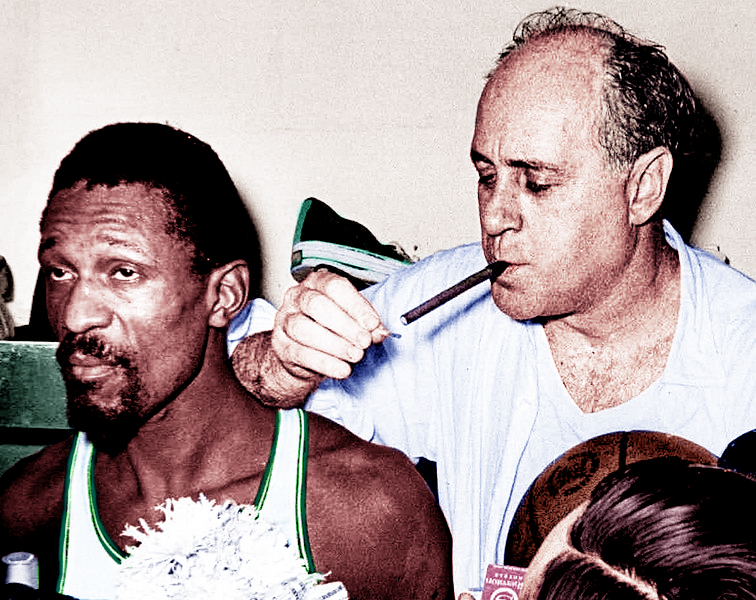
Bill Russell and Red Auerbach, 1966 Champions
Since Russell had arrived in 1956, the Celtics had won 11 out of 13 championships. In that same time frame, the Celtics had faced 12 win-or-go-home games — they won all 12. However, 1969 was the end of the Bill Russell era in Boston. At this point in time, Auerbach and Russell's winning legacies were so intertwined that many wondered if Auerbach could win without Russell. Despite shaping the Celtics into the greatest winner in NBA history, Auerbach entered the 1970s with a chip on his shoulder.
In 1970, Auerbach drafted Bill Russell's replacement, Dave Cowens. An undersized center at 6'8", Cowens couldn't defend like Russell, but he scored and rebounded with the best of them. Additionally, talented players like John Havlicek still remained from the Celtics championship core. The combination of youthful energy and seasoned veterans proved tough to beat, and soon the Celtics returned to the NBA Finals, winning championships again in 1974 and 1976. Auerbach showed the league that he could win on the bench or in the box and with or without Russell.
However, the Celtics struggled as the decade came to a close. Cowens took a sabbatical from basketball and the team struggled without him. Although the Celtics made the playoffs the next few years, they did not live up to the high standards set for the franchise. By 1978 the Celtics missed the playoffs altogether and got one of the top picks in the draft, something they hadn't had since they drafted Bill Russell over two decades previously. Auerbach had to draft another generational talent or the Celtics risked becoming a bottomfeeder in the NBA for years to come.
Despite shaping the Celtics into the greatest winner in NBA history, Auerbach entered the 1970s with a chip on his shoulder
In the 1978 draft, Auerbach liked several players but did not believe any of them could lead a franchise. However, there was one player he believed could become a superstar in the NBA: Larry Bird. Based on Bird's collegiate achievements, one would expect that every team was angling to draft him, but this was not the case. In 1978, Bird was still a junior at Indiana State, and NBA rules stated that players had to be in college for four years before they were drafted. Furthermore, Bird had made it clear that he would be returning to play collegiate basketball the next year. Therefore, Bird was an afterthought in the 1978 draft, for every team except the Celtics. Auerbach knew the rules better than anyone (he helped write many of them in the early years of the NBA) and he put a plan into action to draft Larry Bird.
It turned out that Bird enrolled at Indiana University in 1974, but dropped out only a few weeks into his first semester. Therefore, by the time Bird finished his junior year at Indiana State in 1978 he had technically spent four years in college and was draft eligible. Drafting Bird was a risky play because he could choose to re-enter the draft after his senior season, but Auerbach was willing to gamble. With the sixth pick in the 1978 draft, the Celtics picked Larry Bird to the shock of much of the league. Although Auerbach had to watch Bird play in college during the 1978-79 season instead of the NBA, he loved what he saw. Bird led Indiana State to a 33-0 record, took them to the national championship game, and won National college player of the year. Afterward, Bird thought about re-entering the draft, but Auerbach visited his home in French Lick, Indiana and convinced him to sign with the Celtics.

Larry Bird and Red Auerbach celebrating
Auerbach had done it again. His shrewd moves and knowledge of the rules showed he was always two steps ahead of the competition. However, Bird needed to live up to incredibly high expectations to justify Auerbach's decision to draft and sign him. Bird didn't just exceed these expectations, he demolished them.
The Second Dynasty
In 1980, a new era was beginning for the Celtics. All of the players from the legendary run in the '60s had retired, and Auerbach had to build a team that could support Bird. Auerbach made trades for defensive roleplayers like Gerald Henderson and clutch performers like Cedric Maxwell. Also, he continued to work his magic in the draft. In a famous example from the 1980 draft, Auerbach executed a maneuver that allowed him to draft future superstar Kevin McHale and trade for Robert Parish. The frontcourt of Bird, McHale, and Parish is widely considered to be the greatest frontcourt in NBA history.
Bird had already made the Celtics championship contenders in his rookie year, but they reached a new peak in the 1980-81 season. The team members Auerbach assembled complemented each other perfectly, being a top five offensive and defensive team. They stormed to the best record in the league and made easy work of their first opponents in the playoffs. However, they had to face their archrivals, the Philadelphia 76ers, in the Eastern Conference Finals.
Bird thought about re-entering the draft, but Auerbach visited his home in French Lick, Indiana and convinced him to sign with the Celtics
The Celtics struggled out of the gate, going down 3-1 to the 76ers. Bird willed them back in game five, six, and seven, winning three straight nail-biters by a combined five points. Much like Auerbach's teams in the '60s, the Celtics triumphed over the 76ers in dramatic fashion, and they would play many more hard-fought series throughout the '80s. However, it was the Celtics turn to shine, and they won the 1981 NBA Finals over the Houston Rockets in six games.
After the series-clinching game, Red lit up one of his victory cigars and went down to celebrate with the Celtics players. Amidst the celebrations, Bird embraced Auerbach's cigar tradition, "The Hoosier hotshot [Bird] put the cigar in his own mouth; puffed and formed his crooked fingers in a 'V for victory' sign as Auerbach grinned" (Shaughnessey 230).
Throughout the '80s, Auerbach and Bird enjoyed many more cigars. The Celtics had legendary rivalries with the 76ers and Lakers, meeting both teams in the playoffs almost every year. The team captured two more championships in 1984 and 1986. While Auerbach was enjoying his victory cigars, he was still making plans for the future. He made a trade during their championship run, obtaining the Seattle Supersonics first round pick in 1986. They had one of the worst records that year, and their pick ended up being the second in the draft. Coming off their third championship in six years, the Celtics had the opportunity to add another young superstar.
In 1986, Auerbach drafted the super-talented Len Bias second overall, another college player who was a surefire star. Adding Bias to a core of Bird, McHale, and Parish made the Celtics seem unbeatable. Was it possible that the Celtics could go on another championship run and dominate the NBA for years? Unfortunately, tragedy struck. Just two days after being drafted, Len Bias died from a drug overdose.
After the series-clinching game, Red lit up one of his victory cigars and went down to celebrate with the Celtics players
The loss of Len Bias shook Auerbach. Unlike other basketball issues like dealing with injuries and negotiating contracts, Auerbach was powerless. This moment led to Auerbach beginning to relinquish his power within the Celtics organization. Former Celtics owner Alan Cohen said of the situation after Bias' death, "I think it really affected his [Auerbach's] involvement with the club. Red knew the Bias family. To him, it was like a dream that we were going to get Len Bias" (Shaughnessey 259). Auerbach's years of outsmarting teams and building dynasties were over. The Celtics appeared in the Finals again in 1987, but they fell short for the rest of the decade. Bird and McHale suffered from serious injuries, and the Celtics struggled to play championship-caliber basketball. As quickly as it began, Auerbach's second Celtics dynasty had disintegrated.
Forever A Celtic
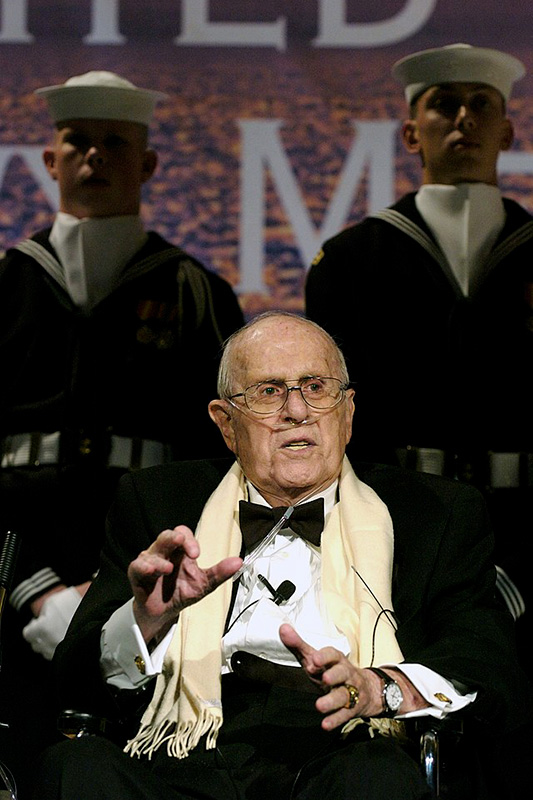
Red Auerbach, honored with the 2006 Lone Sailor Award
Auerbach had overseen the Celtics for 40 years, starting as a hotheaded coach in 1950 and later moving to the front office. Although Auerbach held many different roles in the Celtics organization, he always had the final say on all decisions. Hiring coaches, signing players, making trades, everything went through Auerbach. In 1990, Auerbach was over 70 years of age and he was ready to change his role within the Celtics. So, Auerbach hired Dave Gavitt to take over his main responsibilities, "He placed the microphone in front of Gavitt, then pulled a Hoyo de Monterrey cigar from the breast pocket of his blue blazer and lit up as Gavitt started to speak. The torch was passed. A plume of smoke rose over Gavitt's head. One last victory cigar." (Shaughnessey 267).
Despite no longer being the Celtics head honcho, Auerbach remained an essential part of the organization. He helped coaches, advised the front office, and served as a figurehead for the Celtics. Even in his later years, Auerbach still had a great eye for talent. However, the NBA had changed, and every organization was a well-oiled machine, much to Auerbach's chagrin.
Auerbach commented in the early 1990s, "Everybody's got so many scouts. Right now, I know of a real great player who's going to be great. A high school kid. And they know about him" (Shaughnessey 288). The player Auerbach is talking about? Kobe Bryant. Maybe if he was ten or twenty years younger, Auerbach would have swung for the fences and drafted Kobe, but the Celtics front office decided to pass on him. Imagine how many more victory cigars Auerbach would have smoked with Kobe in Celtic green.
As Auerbach aged, he began experiencing health problems, and could no longer smoke the 10 cigars a day he once enjoyed. However, he still smoked a healthy two or three daily cigars for the rest of his life and definitely enjoyed them after big Celtics wins. If any other coach smoked a cigar on the bench during garbage time, it might just be looked back on as a novelty. But it was Red Auerbach who smoked those cigars, leading the Celtics to championship after championship as he did it. At the end of games, fans didn't have to look at the scoreboard — looking at Auerbach told them everything they needed to know. One would be hard pressed to think of anyone who won more, or smoked more, than Auerbach, perhaps the greatest coach and general manager in NBA history.
Even in his later years, Auerbach still had a great eye for talent
Auerbach remained a part of the Celtics until his death in 2006. One of his final acts as President of the Boston Celtics was hiring Danny Ainge as Vice President, one of his former players from the Celtics '80s dynasty. Ainge made bold trades and caused conflict with head coach Jim O'Brien. When the Celtics had to make a decision between Ainge or O'Brien, Auerbach supported his former player. Ainge kept his job, and Red Auerbach passed away shortly after.
Perhaps emboldened by Auerbach's relentless spirit, Ainge made one of the greatest trades in NBA history and brought Kevin Garnett and Ray Allen to Boston. Paired with Boston Celtics legend Paul Pierce, the Celtics "Big Three" stormed out of the gate in 2007 and made it all the way to the NBA Finals. In the 2007 NBA Finals, the Celtics faced their old foe, the Los Angeles Lakers. In a series filled with climatic comebacks, the Celtics beat the Lakers in six games. It was the first time the Celtics had won since 1986, and the first Celtics championship without Red Auerbach. However, his memory lived on in the cigar smoke that wafted down the city streets of Boston that evening — the smell of victory.
Bibliography
- Seeing Red: The Red Auerbach Story (1994) by Dan Shaughnessy
- Let Me Tell You A Story (2007) by John Feinstein and Red Auerbach
- Red Auerbach: An Autobiography (1977) by Red Auerbach and Joe Fitzgerald
- "How Kobe Bryant almost became a Boston Celtic" (2021) by Baxter Holmes, ESPN
- "What Cigars Did Red Auerbach Smoke?" (2023) by Will Roby, Cigarzine
- "King of the Garden" (1994) by Kenneth Shouler, Cigar Aficionado
You may also enjoy:




Comments
Great article Zachery, Thank you!
Who came first in Victory Cigars? Red Auerbach or Alabama Football beating Tennessee?