EN
EN
 JA
JA ZH
ZH





 All New Pipes





















Ask a question about this product.
Measurements & Other Details
- Length: 7.00 in./177.80 mm.
- Weight: 1.34 oz./38.10 g.
- Bowl Height: 1.66 in./42.16 mm.
- Chamber Depth: 1.46 in./37.08 mm.
- Chamber Diameter: 0.71 in./18.03 mm.
- Outside Diameter: 1.91 in./48.51 mm.
- Stem Material: Vulcanite
- Filter: None
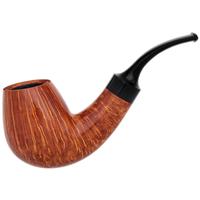
- Shape: Blowfish
- Finish: Smooth
- Material: Briar
- Country: China
About This Pipe
Formerly known as the American Pipe Making Exposition, our annual Global Pipe Making Exposition features contributions from some of the world's foremost artisans, all united around a central theme. One of the most exciting events of the year for carvers, smokers, and enthusiasts of briar alike, the Global Exposition acts not only as a showcase for the immense talent of these artisans, but a focus for the boundless creativity that these masters of the art possess. For 2025, the theme of our Expo is "In Memoriam," celebrating the life and works of artisans who have passed on, yet whose impact on the craft and those around them is utterly undeniable.
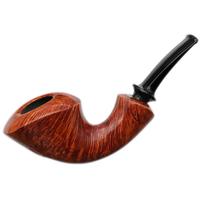
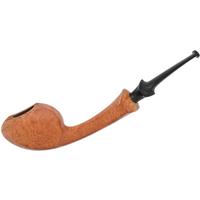
Hiroyuki Tokutomi is arguably one of, if not the most, influential Japanese artisans to have ever lived, and the impact of his work has been felt the world over, as the waves of his unique style rippled forth and into the schools of nearly every country's pipe making sphere. Of particular note, however, are the myriad iterations of Tokutomi's Fugu, or Blowfish, whose silhouettes have run the gamut from reserved and compact to highly stylized, elongated fusions of the form with the Cavalier. One of the most striking elements of many of his takes on the shape, however, was the particularly baroque geometry of his shanks, and the extension of that highly complex shaping through to the stem, even if said stem is separated from the shank by an extended tenon. What results, invariably, is a pipe that makes powerful use of implied lines, connecting the shank and stem through empty space while drawing the eye toward the pairing thanks to that very same vacuum. Here, Chinese artisan Ping Zhan has channeled the spirit of that remarkable shaping into his own Fugu, a shape that he's particularly talented at crafting.
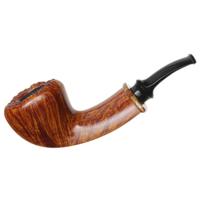
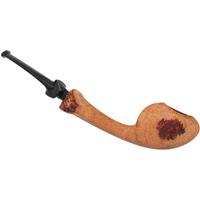
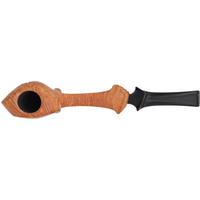
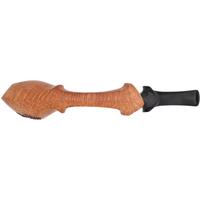
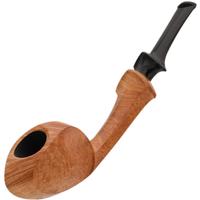
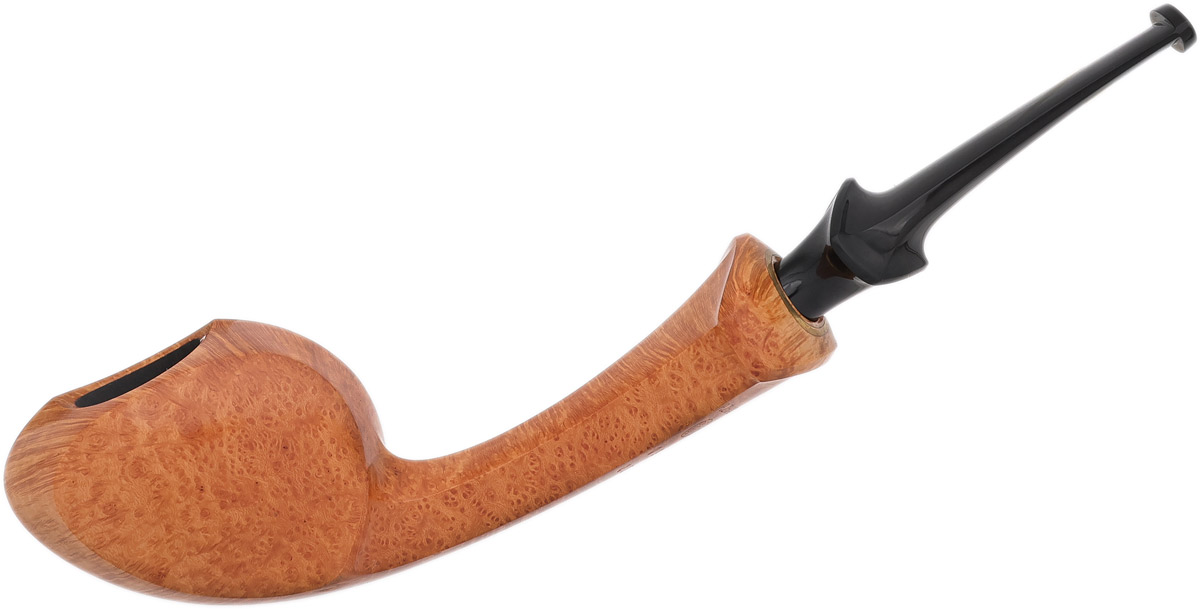
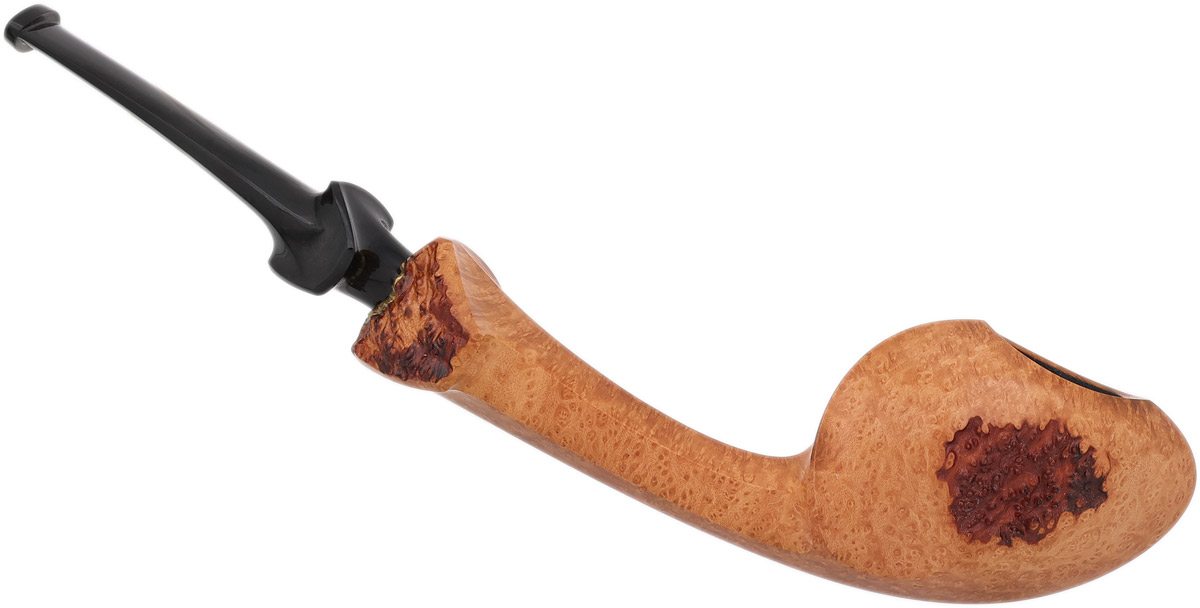
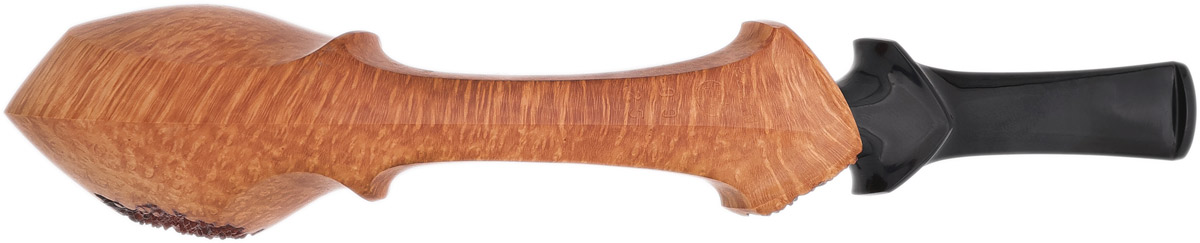
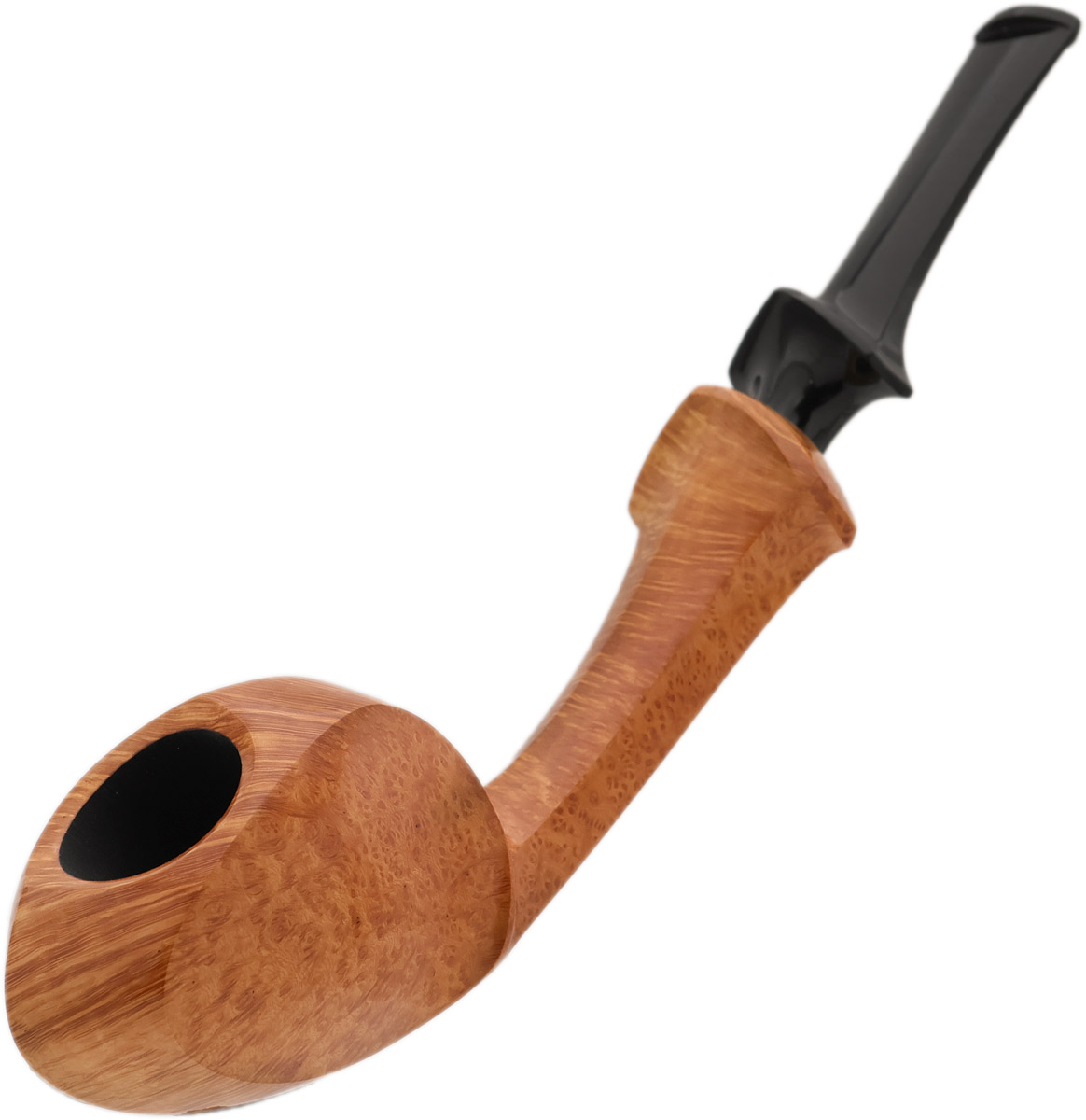
This truly is an exceptional example of the shape, one that looks perfectly poised in its fusion of organic and geometrical detail, as firm ridges and gentle curves commune across every part of this piece's outline. The bowl itself is supple and rounded through the flanks, with a slightly elongated appearance at the top fore, where a prominent ridgeline draws the eye. This ridge showcases one of my favorite aspects of many of these especially complex takes on the Fugu, as it's actually the extension of a ridge present on the shank, the lowermost ridge on the right side panel. From its origin at the face, this ridge flows in line with the shank and curls sharply rearward at the transition, leaning toward the center and rising through the aft wall before surrounding the rim. After draping over the fore wall, this ridge extends through the underside and becomes the lowermost line on the shank: creating a cyclical line that not only meets itself, but splits into a variety of smaller lines along the way. A similar, albeit more self-contained shaping detail is present on the left side of the bowl, creating the second of the shape's iconic rounded panels, with both sharing a collared, fin-like structure around the lower area of the transition.
From out of this transition, the shank lifts very subtly, taking on an expressive flare as it reaches toward its end, its sextet of panels terminating in a pointed, arrowhead-like hexagon. Nearing the face, the base expands rapidly into a trim ridge that's beveled toward the stem and rounded at the left side, while the right is peppered with a dense pocket of plateau. The base of the stem almost exactly matches the shape of the shank face, easily introducing the aforementioned implied lines and calling attention to Zhan's skill for shaping vulcanite, the rigid rubber here marked by sharp precision and striking proportionality: as if the implied lines were possessed of a taper from the shank to the stem. Dressing this piece is a stunning, natural stain that reveals phenomenal grain, with vast seas of birdseye across both flanks of the bowl and either side of the shank, while the top and underside are lined with dense cross grain.
-John McElheny