


 |
|
 |
|


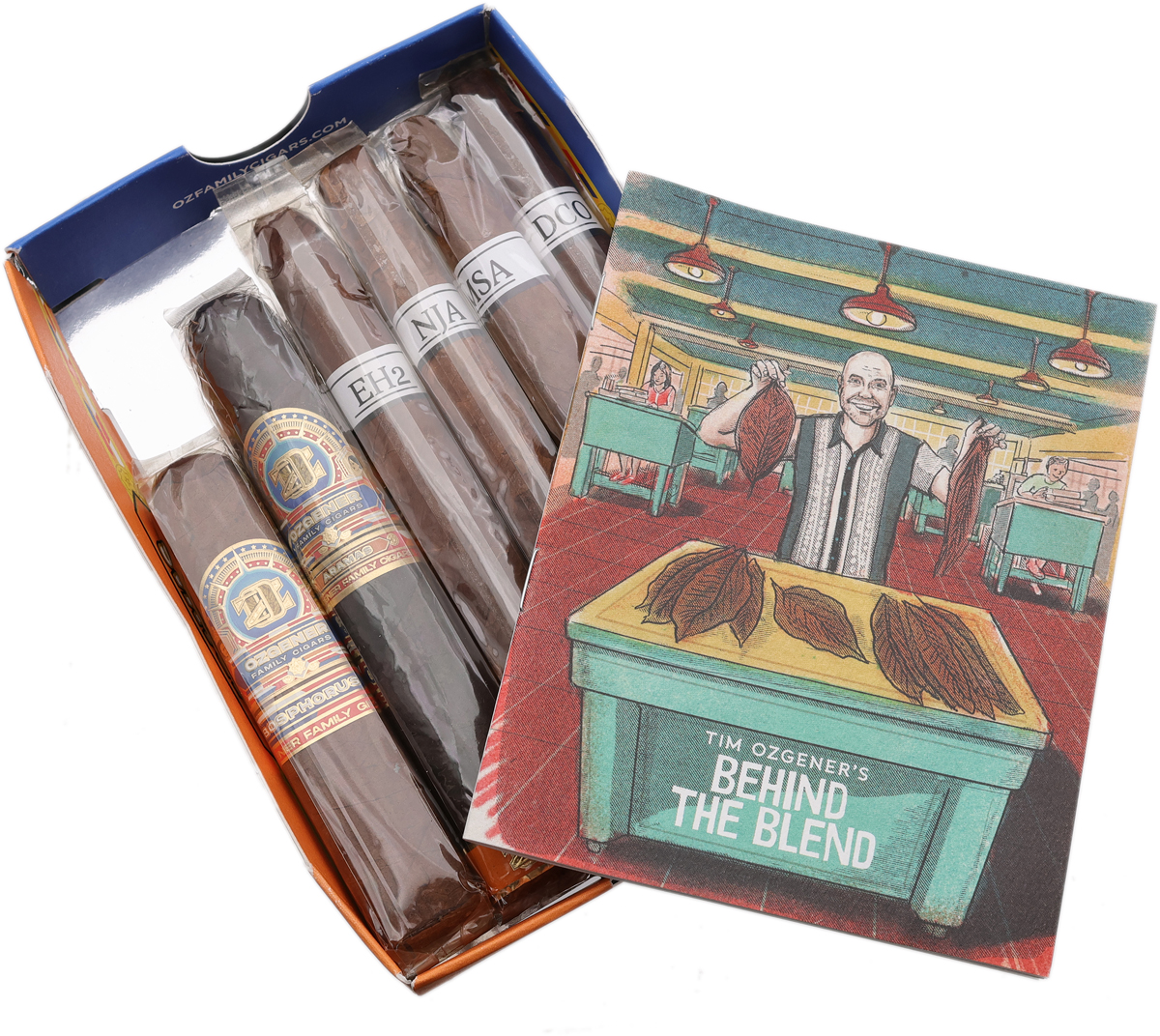
In this special video, I had the opportunity to chat with Mr. Tim Ozgener of Oz Family Cigars about the Behind the Blend Components Tasting Pack, available on-site in limited quantities with a special promotion, while supplies last. I hope you gain a deeper understanding of just a few of the components used in their cigars, and ultimately of the complex science and the intentional art of cigar making.
Note: The following transcription has been edited for clarity and brevity.
[Tyler Caldwell]: The Behind the Blend Tasting Pack features Puritos. Let's discuss the blend of two excellent cigars, made by this man right here.
[Tim Ozgener]: Oh, thank you very much. And Tyler, it's been really fun to spend a couple of days with you and your stores and clients.
Behind the Blend: The Origins
Behind the Blend started because of our previous brand, CAO. We had a lot of different blends and a lot of different tobaccos from 21 countries/regions. To keep up with all of them, my father would always say, "Write it down. Einstein wrote it down, and you are now Einstein." I'm like, "Thanks a lot, Dad." I would write down what all these blends were, and I also wanted to know what all these tobaccos tasted like on their own.
I almost think of it like spices in your spice cabinet. You have to know what cumin, cinnamon, black pepper, and white pepper taste like on their own so that you have a frame of reference of how to combine them, and then once you combine them, you let them marry, and then you let them age. I always equate that with slow cooking.
This is an exercise as to what I do for myself to keep track of all the different tobaccos, and then I try to imagine how they combine. In this case, we did write it down and put it in this booklet. The booklet has different tobaccos. You want to try them?
[TC]: Absolutely.
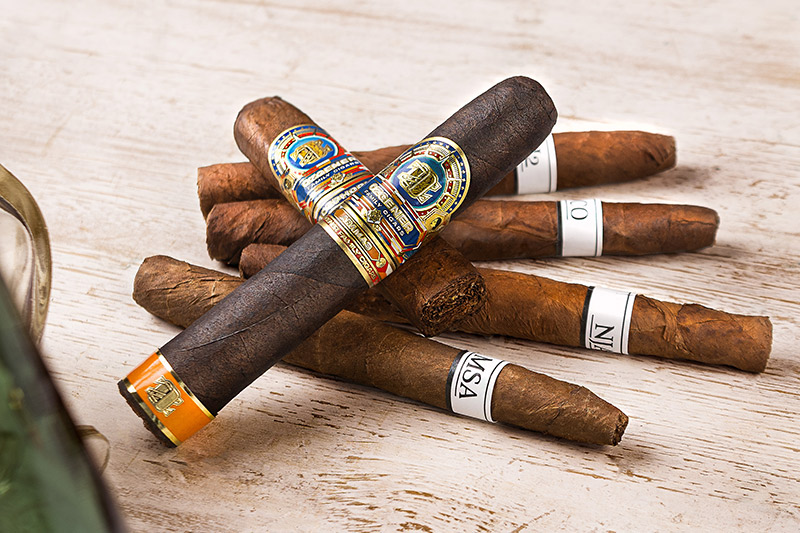
[TO]: We have them coded. We have four different Puritos. These are not cigars. These are 100% tobacco from one region, from one position on the plant, from one area. In this experience, we are simulating the way a customer and a farmer would interact. You will smell the tobacco, look at it, and you'll be like, okay, let me roll it up, and let's smoke it. That's what we're doing right now.
[TC]: Cool. Let's do it.
NJA: Jalapa Seco From Nicaragua
[TO]: This first one is coded NJA, and this is seco from the bottom third of the plant from Jalapa, Nicaragua. Some things to think about when you smoke are, first, the appearance. What does the tobacco look like, although that's really not primary to this tasting. It's more about the flavor. How does it feel on your palate? Do you taste more sweetness or spiciness? Does it make your palate salivate, or does it dry out your palate?
[TC]: I would say there's a nice, juicy, fruity, and sweet kind of profile. A little bit of a creamy, fruit gummy kind of flavor profile as well.
[TO]: For me, Jalapa is a region that I like a lot in Nicaragua. If you think of Estelí, it's more in the north, and Managua is more in the southwestern part of the country. You fly in there and drive about two hours northeast inland to get to Estelí, where all the factories are, and over there the soil is very volcanic and asphalt black. It forms to your hands in a very clay-like manner, producing more of a spicier, stronger tobacco, for the most part.
Then you drive another two hours, approximately northwest of that, toward the border of Honduras, and you get to Jalapa, and over there, at higher elevations, they're growing coffee, and the soil is finer, sandier, and browner. Then, at lower elevations, they're growing this tobacco.
Jalapa is well known for having a tobacco that has this really nice, earthy sweetness to it. A lot of times, when you're smoking this, you can pick it up toward the back end of your tongue.
[TC]: Yeah. You can definitely get that earthy tone with it as well. This might sound weird, but it has an earthy, almost metallic flavor. It's very interesting.
[TO]: A lot of times, I have talked to Ernesto Carrillo about this. He said that a lot of people use this as the relleno, almost like the base layer when creating a blend. I like to think of it like cooking or wine because tobacco for cigars is very similar to wine. It has to do with the soil. What are the nutrients of the soil? How's that traveling through the stalk?
I'm also amazed at the amount of effort that goes into working in the fields. There are people in these sun-drenched fields that are very hot. I remember in Jalapa, a man was breaking off suckers that they do not want taking away from the nutrients that are going into the principal leaf. That's all his job is in this huge field that's so hot all day. I think that's quite extraordinary, the amount of labor that goes into that.
[TC]: It's always eye-opening hearing things like that because you don't know what these guys are going through in the extreme conditions that they're dealing with for us to sit here and spend money and enjoy something. Even still, you find people who can sit here and argue and talk badly about this. This is an art form; There was an artist out there working his butt off to make sure that you can enjoy this. So appreciate it a little more.
[TO]: Right, and again, to use the cooking analogy, if you're making a stew, what's your base broth? Is it chicken, beef, or vegetable broth? What are you using that you're going to add more ingredients to, building upon that base level of flavor?
A lot of times, I find that Jalapa is great for that because of its soft, subtle sweetness. Like I said, this is also from the seco part of the plant, which is the bottom third, furthest from the sun. It's a thinner leaf with better combustibility. You notice the ease in which we're smoking this. We're not having to relight it. It's bringing wafts full of smoke, so it's nice.
[TC]: And bears very well being bunched up like that.
EH2: Ecuadorian Habano 2000 Seed
[TO]: Let's move to the next Purito now. In this tasting, we could have done all-Nicaraguan tobacco, just for fun. But I thought it would be interesting to explore four different countries/regions here. So the next one is Ecuadorian Habano 2000 seed.
Now we're moving up on the position of the plant to more of the viso, or the second from the bottom. This is actually the type of tobacco that could be used for wrapper or binder. This particular one we actually use for the wrapper on Bosphorus.
[TC]: It's very much different.
[TO]: Yeah. Very much different. And my father would always say tobacco is like a combination of art and science. There's a certain science with how the tobacco is prepared ultimately to when we can smoke it. What we're doing now is really more about the art. How does it taste, and how do you combine them, and how do you imagine combining them?
I'm certainly not an expert at the science of tobacco. I know enough to be dangerous, but I'm not a geneticist splicing seeds or anything like that. However, I know this is EH2 Habano 2000, so it's a Habano 2000 seed. It was a seed that was spliced so that it could be successfully resistant to blue mold or black-shank fungi that could devastate tobacco fields, and also that it would be easier to work with and ferment. It's not as bitter of a taste, but it has a unique flavor to it as well.
This is grown in Ecuador near the Macul River. There are basically two seasons: rainy or not. During the rainy season, this river tends to flood, and then the erosion from some of the hillsides nearby goes into these fields that provide a unique pH level to the soil over there, resulting in the flavor that we're tasting.
I'm curious, what are you getting from this?
[TC]: The best way I can describe it is that it's earthy like the first one, but in a completely different way. The earth tone here is more forward and pungent. I don't want to say it has like a dirty taste, but it's sharper.
[TO]: To me, it's sharper in the retrohale. You know what I mean? It's a lot more stingy.
[TC]: Thicker. There's a lot more heaviness to it.
[TO]: Yeah. Again, to go with the wine or bourbon analogy, sometimes when you're tasting, for example, bourbon, you can taste some of the barrel or some of the wood and oak notes. I get that here. I don't know if you get that, where you can taste some of the woodiness.
[TC]: Absolutely. It's like the smell of burning cedar.
[TO]: Yeah, that's right. Some people, when I've done this, they say oak, some people even say pine, but maybe that has to do with the kind of cedar aroma that you're picking up from it.
[TC]: Sure. It's very good.
[TO]: Also, this one to me is making my palate salivate a bit more than the first one that we smoked, which is an important quality because, in the format that this is in now, it's a bit rough looking, but when you're going to be preparing this for a cigar, and you buy it, you want to ferment it longer. As you ferment it, it turns a bit darker and the veins disappear and evaporate a bit more. This is actually the same wrapper, except this has more fermentation after this has been acquired from the tobacco grower.
Then the factory owner will say, I want to ferment it even longer. Whether they can ferment it longer depends on the texture and the thinness of the material.
Some people like to combine the two Puritos we have tried together and say, what do these taste like? This kind of goes to the whole concept of blending; you're not going to do this all the time. You want to be able to imagine what these taste like combined, but since we have them both and they're already rolled here, it's fun to, at the risk of looking goofy, taste how they work together.
[TC]: Oh, I'm a natural at that.
The Ecuadorian Habano has that dirty, earthy feel that I was describing mixed with that gummy fruitiness of the Jalapa. It's interesting knowing that I've smoked plenty of these cigars and now I'm able to smoke it in separation at the same time. It gives you a whole different understanding of what the blend turns out to be. It's very interesting.
[TO]: What's interesting also is the sharpness that you pick up in the nose of the Ecuador Habano 2000 and the powdered sugary sweetness that you get from the Nicaraguan Jalapa. When you combine them together, it softens the sharp tones. You have this combination of the woodiness and the sweetness, and then it is reminiscent in some regard, I think, to the same flavor profile that you might get from a bourbon. Bourbon has a little bit of that sweetness because of the corn, and then also the woodiness from the barrel. I find there are parallels between them.
[TC]: Sure, I can totally get that.
[TO]: These have been combined and have been box-pressed, and then it's been aging in an aging room at 70 percent humidity in Spanish cedar. It's allowed to age and rest in there. After the tobaccos have gone through that, you want to give them time to marry, almost like slow cooking. When you slow cook something at that kind of temperature and percentage of humidity, then it becomes two separate organisms.
Bosphorus Cigar
Both of these are found in the Bosphorus blend. It has the EH2 as the wrapper, except it has the benefit of more fermentation on it. This has a double binder. One of the binders is NJA. The other binder is Connecticut Ecuador, but binder quality. It's a bit rougher looking and a bit thinner, which helps with the burn and the combustibility of it. Then the filler uses NJA again. We also have Estelí tobacco in there, so it gives it a bit more of that peppery nature, and Ometepe tobacco, which is a volcanic island in Nicaragua.
So you have really in this one, gosh, six different kinds of tobaccos, or you could say NJA is the same tobacco, but they're placed in different areas. One for binder, one for filler.
Bosphorus is named after the strait in Istanbul, Turkey, where my father was raised. He was Armenian-born and raised in Istanbul. That's the strait that separates Europe from Asia Minor.
[TC]: Very cool. Let's go ahead and light up the Bosphorus.
Right off the bat, I can get that gummy sweetness and a little bit of a tangy profile.
[TO]: In the retrohale, right away there's a bit of that sharpness that you get from the EH2. I always want our cigars to start off with a bit of a bang, so that you get people's attention and the cigar is saying, okay, pay attention to me for a second.
[TC]: Man, really, when you put it all together, it's just a very unique flavor. Especially because it's been box-pressed, it's been aging, and it's had time to marinate with all the oils and the minerals of all the tobaccos. It's not something that I would say I taste in very many cigars. To me, that's always a compliment.
[TO]: This Bosphorus is in a Rothschild size. It's 4" x 50 and it was aimed at achieving a premium cigar experience but in 20 to 30 minutes. Also, because of the ring gauge, I view this one as almost like a double-espresso where you have a lot of concentration of the bean and less of the water, so it's very dense.
This flavor profile, I think, delivers that type of experience. If you go to a bigger ring gauge, like a Churchill-esque type of a size that is a 6.5" x 54, it takes longer for the smoke to go through, so it's actually less intense and accentuates the Jalapa sweetness.
Whereas with this one, you can taste the intensity of all of these tobaccos.
[TC]: Absolutely. Intense would be a word I would use for this, in a very good way.
[TO]: I agree with you.
[TC]: It's got this sweet, tangy, almost barbecue sauce kind of thing going on.
[TO]: Yeah, it's very good. I never thought about it that way, but that's good. You must be drinking a lot of barbecue sauce.
[TC]: I do what I can.
DCO: Dominican Republic Corojo '99 Seed
[TO]: Now next we're going to go to a different kind of flavor. Normally, I have people cleanse their palates, but you and I are experienced veteran guys. We don't need to do that.
[TC]: Don't give me any credit, please.
[TO]: We went from the seco portion of the tobacco in Nicaragua up the plant to smoke some viso leaves that are more like wrapper quality from Ecuador. Now we're going to go to the top third of the plant, the ligero portion, from the Dominican Republic. This is Corojo '99 seed. It's grown in an area of the Dominican that's called La Canela, which is toward the central northern part of the country, about an hour west of Santiago, where a lot of factories are.
How does it look? Mine is very rough looking.
[TC]: It's also very thick in texture compared to the other ones.
[TO]: Oh yeah, yours is very rough looking. There's no way that you would ever want to have this as the wrapper of a cigar because people would look at it and they'd be like, what happened here?
[TC]: This looks like how I feel most mornings when I wake up.
[TO]: Tyler is feeling rough.
In La Canela, there's a lot of intense sunshine and not much water, so the tobacco is seeking the water. Sometimes the stalk of the plant is a little bit thinner than average but it is a plant that has a lot of intense flavor that's going through the stalk and into the leaves.
[TC]: It's definitely a nice, zesty, floral flavor. I don't want to say lavender, but maybe like a touch of that sweet lavender zestiness.
[TO]: First off, when I blow it out of my nose, the retrohale is very intense. Ernesto is saying he picks up a lot of malted flavors and pepper, and I do pick up those from that. It's almost like a bit of a layering on the back of your palate.
[TC]: Yes, absolutely.
[TO]: Do you feel a film?
[TC]: I was gonna say, it's a flavor that just lingers right there, like in the middle of my tongue. It's like a carpet of zestiness right now.
[TO]: Even if you look at the smoke, the smoke has this bluish kind of color.
[TC]: As you were saying that I was thinking that you can even tell the difference of the color of smoke coming from each one of these as well.
[TO]: Look at how yours is burning. You're almost having to relight it again. When you're making a cigar, the ligeros are thicker, so you would not want to have this on the outside of the cigar. If you're looking at the cigar from a birdseye view, if you had this tobacco on the outer layer of the cigar and you had the NJA in the middle, then what would happen is that you'd have the middle of the cigar burning faster than the outside, and therefore you get this kind of tunneling that you hear of in cigars.
The engineering and airflow of a cigar is important. My father, being that he was an engineer, cared about this. So we were always interested in the science of the cigar.
MSA: Mexican San Andrés
Now, we'll do a quick pivot on that, so I'll put that down, and then the last one we're gonna smoke is Mexican San Andrés, coded MSA.
[TC]: That's a personal favorite of mine.
[TO]: Oh, yeah. It's a wrapper that has become very popular, especially over the last 10 years.
I remember 20 years ago, there was a bit of a stigma where people in New York, for example, loved Te Amo cigars that were Mexican, but people who might've been in other regions of the country didn't like it as much. Now this has become a universally respected and admired leaf. They've done a really great job of quality and reputation.
We're going from ligero now back down to the viso, but from the upper viso portion of the plant. This is like a wrapper quality coming from the Turrent family, an amazing family that's been doing this for three generations.
I spoke to a gentleman from the third generation of the Turrent family for over an hour on the phone about his tobacco. It's coming from a region in San Andrés that is more inland from that, but it's more along the southeastern coastline in Mexico. It's surrounded by dormant volcanoes and a valley. The soil there is asphalt black, volcanic, and it yields this flavor that we're about to try.
When Ernesto, in this particular case, is buying the tobacco from the Turrent family, they're prepared for six months before he buys them, which he appreciates. He ferments this even more for wrappers. What you see here is the same as what eventually is added to the Aramas blend. The veins are less pronounced and it's smoother and a little bit darker.
What is the flavor that you pick up from this, Tyler?
[TC]: For me, San Andrés tobacco normally has an espresso, creamy, chocolatey taste. This here is a little more peppery than I expect out of Mexican San Andrés but also has a very crisp tone to it, especially on the retro.
[TO]: What's interesting to me is that it begins very sharp on the retro, but then as you get into it, it settles a bit more. Then you can really explore the complexity of flavor. Some of the other ones we might have smoked might have been more singular in flavor. Of the ones that we've smoked, I find this one to be the most complex in flavor on its own.
[TC]: Yeah, I could see that.
[TO]: I do pick up what you're saying with the dark chocolate and espresso, but there's something a bit layered to this.
Now, when we combine the MSA with the Dominican Corojo, you'll probably have to relight the ligero again, just because it's so thick.
[TC]: They blend really well into each other with that thick, spicy tone from the ligero. Now the spiciness that I had in the San Andrés isn't there. Now I'm getting more of that chocolatey, creamy tone that I'm used to.
[TO]: Yeah. I view it as the Reese's Peanut Butter Cups experiment when you dip the chocolate in the peanut butter. It's like, wait a minute, that combination works. Any of the sharpness or harshness that you were talking about is a bit tempered now and it works. You can see how they complement one another.
[TC]: And the combination of the two, for me, has brought out this tart, strawberry-esque flavor into the ligero.
[TO]: Yeah, I get that. And again, these are just two, so you write these down and you have notes that you can refer to. We did this experimentation during my CAO days and I wanted to do it again. I went down with some of our sales team to the Dominican Republic two years ago and I had asked Ernesto Carrillo to do the same experimentation.
We did this, but we might've honestly done this with maybe 16 different tobaccos, if you can imagine. So we had to do that over two days. But he had us rate it from one to five, like one meaning I liked it least, and five meaning most. I had another column where I would write down what I'm tasting and also what it was causing my palate to do. Was it drying my palate? Was it salivating? Was it pungent? And then also, what kind of flavors I was picking up from it. Was it more vegetal, sweet, peppery, etc.?
[TC]: Very interesting, man.
Aramas Cigar
[TO]: The Aramas cigar has the MSA, but it has been further fermented. The binder on it is Sumatran-seed from Ecuador. Then the fillers are the DCO we just smoked, but that's in the middle of the blend because of the combustibility. Also, we have NJA, the very first one we smoked, but instead of it being from the seco position, it's more from the viso position of the plant, the lower viso. And then we have a half leaf of Connecticut Broadleaf Maduro in the filler, just to give it a little bit of a more Maduro accentuation to complement it all.
After this has been made, we let this rest in the aging room for an additional 30 days. It basically has 60 days of age. The darker tobaccos that you use, the longer that you can age it. Also, it will mellow.
We wanted to call it Ararat, but we couldn't because the name was already trademarked. Then people in Armenia call it Masis. That name was trademarked. And so we just took the prefix of Ararat and Masis, and thus the name Aramas was born to use on this one.
[TC]: Very cool.
[TO]: So, the question is, can you taste elements of the last two Puritos that we smoked?
[TC]: Yes. Definitely the ligero. Again, like I said, I got a little bit more of that like tart fruitiness. Yeah. And now I can pick some of that up in the final form as well.
The Art of Blending Cigars
Let me ask you, you've got all this selection of fine tobacco. Once you've got like the final product made, do you ever go to the final product and wonder what this would be like with just a little bit more ligero. Do you play with that as well?
[TO]: That's a great question. I haven't done that. It's funny because the other day, when we did this with some of your customers, they were wanting to smoke all four of these at one time, which I haven't done yet. But you could experiment.
[TC]: That could be another blend down the road right there for you.
[TO]: It's also interesting to think about these elements when you look at your notes. Again, this is using more of the art component. I always like to say that cigar making is an art, just like you can view wine making as an art.
As you get accustomed and familiar with these, you can understand what characteristics they present on their own and then try to use your imagination, in this case, with your palate, and think of what the experience would be like if you combine them. Then, how do you wanna balance these proportions? How does the 60 ring gauge experience differ from a 50 ring gauge experience?
There are so many different little tiny variables that could change everything from size to size, blend to blend.
[TC]: For consumers out there, if there's anything that I would want someone to get from this, it's learning that you might buy a cigar from anywhere from $8 to $15, on an average cigar in today's time. It's a work of art, like you said, and it needs to be appreciated. I always tell people, you're not just smoking a product, you're smoking an experience.
[TO]: Also, to me, the whole point of cigars is to deliver the optimum flavor that you're getting from all of these regions and all of these fields. Once the tobacco is picked, it's hung in the barn and the chlorophyll drains from the tobacco and then it's fermented multiple times so that you have a thin-carbon ring. That's where the ash meets the wrapper. That black ring is the carbon ring that tells you that it's been fermented as long as it possibly could have. You're getting the maximum potential out of every single one of those leaves that are combined to make the cigar.
It's not about the nicotine. There are other tobacco-based products where the nicotine delivery is what it's made for. This one is made for the flavor. Very similar to wines or like single-malt scotches or finer bourbons, it's about the delivery of that flavor. That's why it's really interesting. It's science meeting art.
[TC]: Awesome. I gotta say, this has been a really eye-opening experience being able to do something like this. I appreciate you taking the time out and educating me as well as the masses watching.
[TO]: Yeah, thank you very much. Hopefully, people experience it on their own when you pick up one of the packs. If somebody learns even one thing from this, then that's great. Then we did our job here.
[TC]: There you go. Hopefully, everyone watching learns that Oz Family is a brand that you should check out. Don't miss the boat on them.
You may also enjoy:



Comments