


 |
|
 |
|


On December 3, 1792, Charles Carroll of Carrollton wrote to his Senate colleague John Henry to report the passage of a Maryland statute forbidding the simultaneous holding of federal and state offices. Carroll, who served in both the Maryland and US Senate, had voted against it — one of two dissenting votes — and resigned his US Senate seat the same day, recalling to Henry some lines from Horace:
Solve senescentem mature sanus equum,
Ne peccet ad extremum ridendus, et
Ilia ducat.
It was a curious reflection for a man of 55 who would live another 40 years. But when forced to choose between the Senate and Annapolis, Carroll — educated and cosmopolitan though he was — chose home.
II.
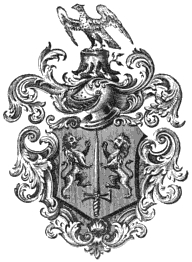
The Carroll family's coat of arms
Maryland had been home to the Carroll family since 1685, when Charles Carroll the Settler (grandfather of our Charles) migrated from Ireland. From its inception, the colony had been something of an experiment in religious pluralism. The colony's proprietor, the 1st Lord Baltimore, had envisioned a North American colony that would be a refuge for English Catholics. Prudentially, that necessitated religious toleration for all Christians. Although they were soon outnumbered in the colony, it remained an attractive destination for politically ambitious Catholics. Charles Carroll the Settler was appointed attorney general by Lord Baltimore. The experiment in toleration was not to be. By 1689, the colony was firmly in Protestant hands, and Catholics like the Carrolls were barred from holding office or participating in the political life of the colony.
These legal realities remained in force when Charles Carroll of Carrollton was born in 1737. Despite the limitations, including a prohibition against practicing law, the Carroll family was serious about young Charles's education. He was educated by Maryland's Jesuit community for the first decade of his life, when he was sent to France to study at the Jesuit College of St. Omer. When he returned to Annapolis in 1765, he was among the best educated of the colonial elite.
He was also one of the wealthiest. It was natural, therefore, that as the relationship with Great Britain became ever more acrimonious in the 1770s, that Marylanders and Americans more broadly would lay prejudice aside and look to Carroll for leadership. He embraced the Patriot cause and was elected to serve in the Continental Congress. On July 4, 1776, he signed the Declaration of Independence. He was the only Irish Catholic signatory.
Carroll's education took him to Europe. His patriotism took him to Philadelphia. But his love for Maryland — for home — brought him back to Annapolis.

III.
Outside of Maryland, Carroll has faded from the popular memory that keeps Washington, Jefferson, and Adams in view. And so it was with some trepidation that I reached for his name in late 2020. Glen Whelan, Sykes Wilford, and I were in Dublin together at the Peterson factory working on a project that I've long since forgotten. In the course of this discussion, Sykes began lamenting the loss of the Peterson Independence Day pipe. The three of us began discussing the idea of a pipe that might commemorate the special relationship that existed between Ireland and the United States, as well as between Peterson and Laudisi.
Someone proposed a series that could celebrate a famous Irish American. We turned to familiar names: John F. Kennedy, F. Scott Fitzgerald, even Grace Kelly. Into this august mix, I proposed Charles Carroll of Carrollton. I expected to be greeted by skepticism, but I made the best case I could for this rather obscure founding father. To my delight and surprise, Glen and Sykes liked it.
Carroll embodied the Irish-American connection. He hailed, moreover, from an era that saw the emergence of pipe smoking as a social and cultural ritual. The pipe would bear his name, but it would likewise harken back to the clay tavern pipes of the colonial and early Republican era. It would be on the smaller side; tobacco was vastly more expensive in that period — relative to wages — than today. It would have a long stem — a demi-churchwarden — that served a practical purpose in early American taverns. The pipe was a table fixture, with each new patron breaking off the used bit of the stem to give himself a fresh start. This vision has characterized every version of the annual Carroll pipe.
IV.
The Carroll pipe was always, at its core, a celebration of a relationship. Some of the most devoted Peterson collectors in the world are Americans — people who have followed this series from the beginning, who own multiple iterations, who understand and love what Peterson is. That relationship predates Laudisi's involvement with Peterson; it is older than any of us involved in making these pipes. Carroll of Carrollton was our way of honoring that relationship.
Carroll himself understood something about this kind of attachment. He was educated in France, fluent in the intellectual currents of the European Enlightenment, at home in a wider world than most of his contemporaries would ever see. None of that diminished his loyalty to his home; it only deepened it.
Peterson pipes are sold around the world, made with the help of craftsmen whose roots are in Italy, Poland, Spain, and Brazil. And yet a Peterson pipe is unmistakably Irish. That is not in spite of its wider context. It is, in some sense, because of it.
When we were designing the initial Carroll of Carrollton pipe, Sykes had the idea that we should make the same number of pipes as years elapsed since the signing of the Declaration. This year marks the 250th anniversary. Some numbers are worth pausing at. We began this series at 245 and always knew that 250 would be something special. It seemed right to end here, and to end as we began — with the Belge, the shape that launched the series. The 2026 Carroll of Carrollton pipe is the last addition to the line.
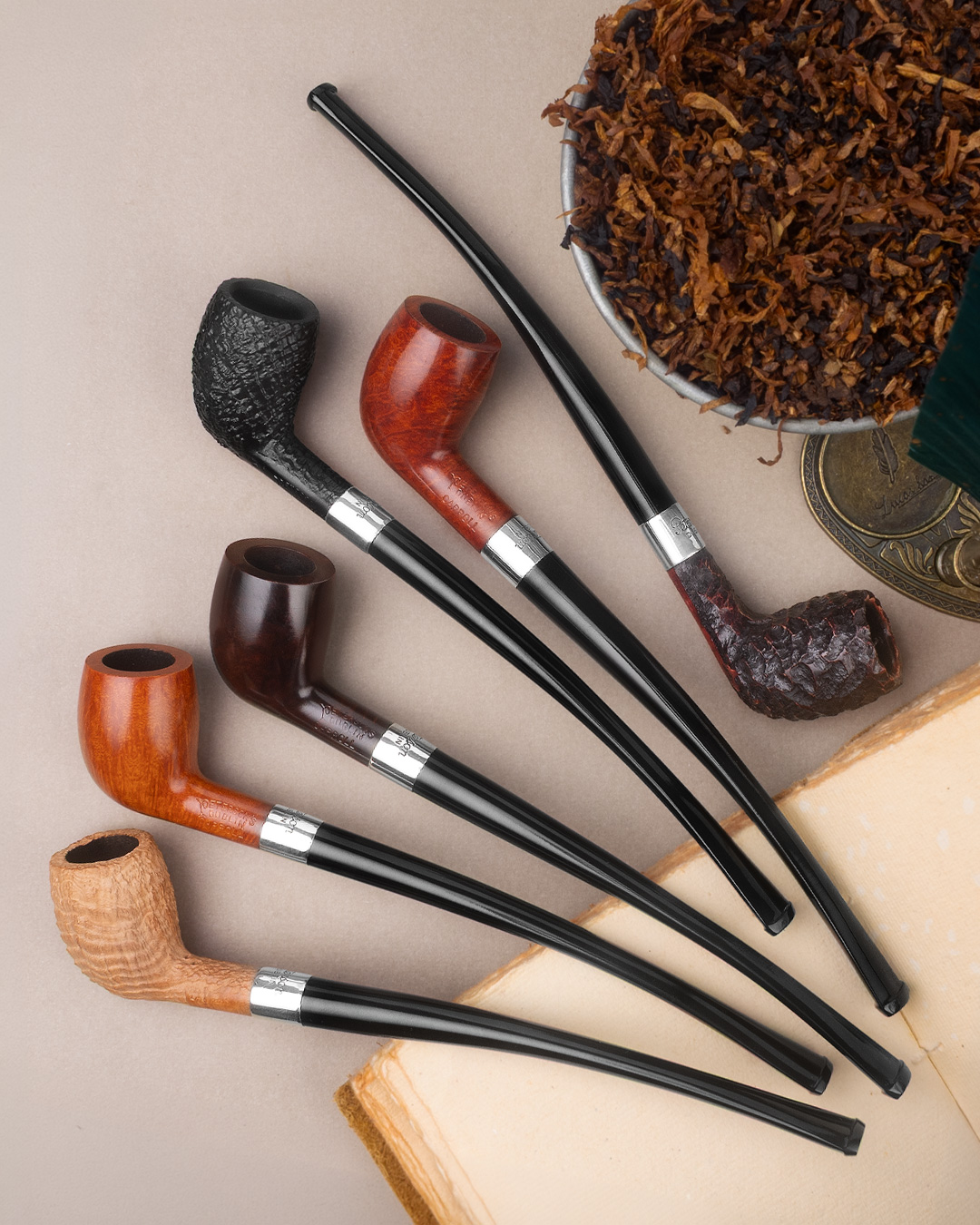
2026 Carroll of Carrollton Pipes
V.
John Adams and Thomas Jefferson both died on July 4, 1826, the 50th anniversary of the signing of the Declaration of Independence. Upon their deaths, Charles Carroll of Carrollton remained the last of those men who pledged "our lives, our fortunes, our sacred honor." He would live seven more years.
In a letter to the poet Lydia Huntley Sigourney, Carroll reflected on what was — in his estimation — a modest contribution to the life of the nation. "To be esteemed and loved by a whole people is most flattering and acceptable," he wrote, "especially to those really meriting that esteem and love. I am not so vain as to consider myself as one of them; I conscientiously voted for the Independence of my country; its cause was righteous, and I lent my feeble aid in its support during the struggle."
You may also enjoy:




Comments